
PDJA Series Balancer for Industrial Lifting
Product Introduction
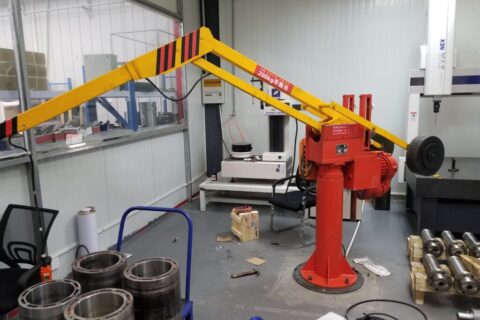
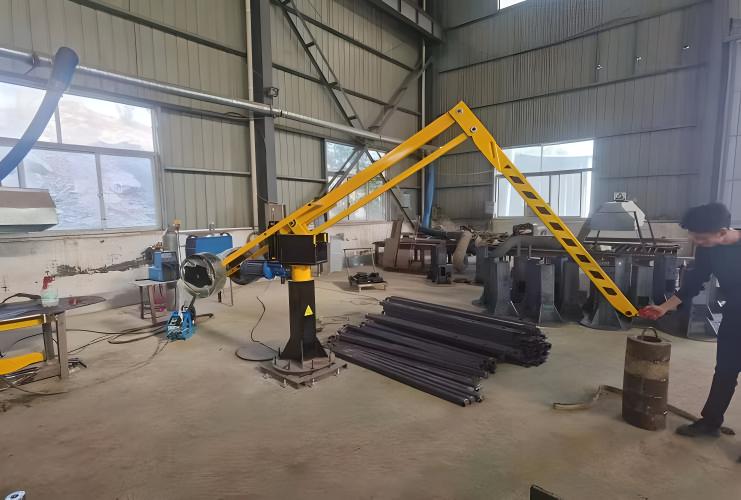
The PDJ-A low-profile balancer is a new type of material handling equipment that utilizes the parallelogram scaling principle for precise, effortless positioning. It features a unique screw lifting mechanism, complemented by a reliable overload protection and limit protection device. Compared to the PDJ tall series, the PDJ-A low-profile series achieves the same working range while occupying significantly less space. The series includes five models, ranging from PDJ125A (100kg) to PDJ625A (630kg).
The PDJ-A low-profile balancer features a compact structure, easy operation, reliable performance, and simple maintenance. It is widely used for loading and unloading parts in machine shops, component assembly between processes, and short-distance, high-frequency, intensive lifting operations in stations, docks, warehouses, and similar settings. Our company manufactures both the PDJ tall series and the PDJ-A low-profile series to accommodate various space and height requirements for material handling.
Product Images
Product Features
Compact Low-Profile Design: The PDJ-A low-profile balancer is specifically designed for spaces with height restrictions. With an Hmax of only 2850mm, it delivers the same working range (R2=2500mm) while occupying considerably less space.
Parallelogram Scaling for Precise Positioning: Utilizing the parallelogram scaling principle, the load remains suspended in a three-dimensional floating state within the rated travel range. It can be freely moved up, down, left, right, and rotated manually, and remains stably positioned at any point upon release.
Screw Lifting Mechanism with Safety Self-Locking: Featuring a unique screw lifting transmission mechanism, equipped with overload protection and limit protection devices for dual safety assurance. The screw is self-locking, preventing the load from slipping in the event of a power failure.
Easy Operation and Simple Maintenance: The handle button provides inching control for lifting and lowering, while manual push-pull enables horizontal movement and slewing, allowing for effortless single-operator use. The simple structural design ensures quick and convenient routine maintenance.
Working Principle
The PDJ-A low-profile balancer operates on the parallelogram scaling principle combined with a screw lifting mechanism. The main structure consists of a low-profile column, a parallelogram arm, a screw lifter, and a hook block. The parallelogram arm forms a deformable four-bar linkage through pivoted connections. As the load moves horizontally, the parallelogram scales, keeping the hook block moving along a vertical line while the load remains suspended in a balanced state within the three-dimensional space. The screw lifter is driven by a motor that rotates the lead screw, causing the nut to move up or down, ensuring smooth transmission and excellent self-locking capability.
During operation, the operator gently pushes or pulls the handle to move the load horizontally or slew it. Pressing the buttons controls the screw lifter's forward and reverse rotation for lifting and lowering. All controls are conveniently located on the handle for intuitive operation. The overload protector automatically cuts off the power supply when the load exceeds the limit, and the limit protection device automatically stops the mechanism when it reaches the travel limits.
Structural Composition
Comprising the following core components:
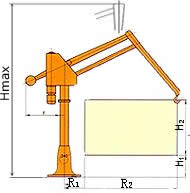
Low-Profile Column: A low-profile steel column (Hmax=2850mm) designed for installation in low-ceiling factory buildings, providing a wide coverage area of R2=2500mm.
Parallelogram Arm: A four-bar deformable quadrilateral structure with R1=650mm and R2=2500mm, offering flexible horizontal travel and effortless operation.
Screw Lifter: Motor-driven lead screw and nut transmission with a lifting speed of 6.3~7m/min and excellent self-locking performance.
Handle Controller: Control buttons are integrated into the handle for intuitive operation, with inching control for the lifting and lowering buttons.
Safety Protection Devices: Equipped with an overload protector and limit switches for dual protection.
Technical Parameters
| Parameter | PDJ125A | PDJ225A | PDJ325A | PDJ425A | PDJ625A |
|---|---|---|---|---|---|
| Rated Lifting Capacity (kg) | 100 | 200 | 300 | 400 | 630 |
| R1 (mm) | 650 | 650 | 650 | 650 | 650 |
| R2 (mm) | 2500 | 2500 | 2500 | 2500 | 2500 |
| r (mm) | 900 | 900 | 900 | 920 | 920 |
| Hmax (mm) | 2850 | 2850 | 2850 | 2850 | 2850 |
| h1 (mm) | 500 | 500 | 500 | 500 | 500 |
| h2 (mm) | 1500 | 1500 | 1500 | 1500 | 1500 |
| lifting speed (m/min) | 7 | 7 | 7 | 6.3 | 6.3 |
Note: The original page contained two duplicate parameter tables, which have been merged into one (covering five models: PDJ125A to PDJ625A). The PDJ625A rated capacity of 630kg is taken from the second table.
Product Structure Diagram
Applications
Machine Tool Loading/Unloading: For loading and unloading workpieces at machine tools, the PDJ-A low-profile design with Hmax of only 2850mm is ideal for low-ceiling workshops and areas with limited overhead clearance above machine tools.
Inter-Process Component Assembly: For transferring and assembling components between machining processes, the balancer offers flexible operation and precise positioning, with R2=2500mm covering a large working area.
High-Density Warehouse Lifting: For short-distance, high-frequency lifting operations in stations, ports, warehouses, and similar venues, featuring effortless operation and responsive control to keep pace with intensive lifting cycles.
Confined Low-Headroom Spaces: For locations with insufficient vertical clearance where a standard-height balancer cannot be installed, the PDJ-A low-profile model delivers the same working range in a compact footprint.
Selection Guide
By Lifting Capacity: Choose PDJ125A for 100kg, PDJ225A for 200kg, PDJ325A for 300kg, PDJ425A for 400kg, and PDJ625A for 630kg. All models provide a wide coverage of R2=2500mm with Hmax=2850mm, making them suitable for low-headroom spaces.
PDJ-A Low-Profile vs. PDJ Standard: For installation heights ≥3650mm, choose the PDJ standard model; for installation heights between 2850mm and 3650mm, choose the PDJ-A low-profile model. The low-profile version maintains the same large working range of R2=2500mm while reducing column height, making it ideal for low-ceiling workshops.
By Usage Frequency: For high-frequency, short-distance lifting, the PDJ-A low-profile balancer with single-handle operation delivers efficiency and ease of use. For longer transfer distances, an extended cantilever or mobile base can be customized.
Manufacturer Services
Henan Kelude Heavy Industry Co., Ltd. provides end-to-end services for the PDJ-A series low-profile balancers, covering sales, installation, and after-sales support.
Quality Inspection: Each unit undergoes a static test with 1.25 times rated load before shipment. The parallelogram arm assembly is subjected to repeated extension/retraction testing, and the screw lifting mechanism is endurance-tested.
After-Sales Warranty: Full machine warranty for 12 months, with an extended 24-month warranty on the screw lift and motor. After-sales requests are responded to within 48 hours.
Request a Quotation
Need a quotation for the PDJ-A low-profile balancer?
Share your lifting capacity requirements, installation height, and application details, and we will provide a customized solution within 2 hours.
Consultation Hotline: 13903802779
FAQ
Q: What is the specific difference between the PDJ-A low-profile model and the PDJ high-profile model?
A: The PDJ-A low-profile model (Hmax=2850mm) is designed for confined spaces with limited headroom, while the PDJ high-profile model (Hmax=3650mm) is intended for standard factory buildings. Both offer the same working radius of R2=2500mm, but the column height of the low-profile model is 800mm shorter. The low-profile version provides slightly less lifting travel but features a more compact structure.
Q: In the PDJ-A series, why is the rated lifting capacity of the PDJ625A 630kg instead of 600kg?
A: The PDJ625A has a rated lifting capacity of 630kg (approximately 0.63t), making it the highest-capacity model in the PDJ-A series, positioned above the PDJ425A (400kg). When selecting this model, note that the 630kg capacity requires a compatible lifting spreader and workpiece matching.
Q: Does the screw lifting mechanism of the balancer require routine grease maintenance?
A: Yes. The screw and nut of the screw lifting mechanism are the core transmission components. We recommend applying grease once every quarter. The screw surface should be kept clean to prevent metal chips and sand particles from entering the thread clearance and accelerating wear. Inspect the screw for wear once a year.
Q: What are the installation requirements for the PDJ-A balancer?
A: A level, hardened floor is required (levelness of ≤3mm/m recommended), with the base secured using anchor bolts. The low-profile model requires a minimum clearance height of ≥2850mm, and we recommend reserving an additional 100~200mm safety margin. Power supply options: 220V or 380V.
Q: Both the PDJ-A and PAJ balancers are low-profile models — what's the difference?
A: The PDJ-A series (PDJ125A~PDJ625A) offers lifting capacities from 100~630kg across 5 models, while the PAJ series (PAJ225B~PAJ625B) covers 200~600kg across 4 models. Both are low-profile balancers, but the PDJ-A series provides more model options, whereas the PAJ-B series focuses specifically on the medium-capacity range. The final selection should be determined by comparing your load requirements against the site-specific installation parameters.