
KPDZ Low-Voltage Rail Electric Flat Car for Industrial Transport
Product Introduction
The KPDZ low-voltage rail electric flat car, also known as the low-voltage rail electric platform truck or KPD-type low-voltage powered rail cart, is available in a range of models and capacities including KPDZ-2t, KPDZ-5t, KPDZ-10t, KPDZ-16t, KPDZ-20t, KPDZ-25t, KPDZ-30t, KPDZ-40t, KPDZ-50t, KPDZ-63t, and more. The KPDZ series employs an "AC step-down transmission, rectified DC drive" scheme, where AC 380V is stepped down to two-phase AC 36V via a step-down transformer, transmitted to the flat car through the rails, and then converted to DC 36V by a rectifier module to drive the DC motor.
Compared to the KPDS AC low-voltage rail flat car, the KPDZ model uses a DC motor drive, offering significant advantages such as smooth starting, minimal impact, and reduced stress on the gearbox. The DC motor produces no commutation sparks (operating within a sealed enclosure), making it suitable for locations with stringent explosion-proof requirements. The power supply uses a 36V safety voltage, which poses no harm even upon direct human contact with the rails—a safety level superior to KPC conductor rails (which use exposed 380V supply).
The KPDZ series is designed for applications with a load capacity not exceeding 63t, high usage frequency, and medium-to-long distance transport. The flat car can operate on S-shaped tracks, curved tracks, and in high-temperature environments, with no limits on travel distance (additional transformers are required to compensate for voltage drop on the rail when exceeding 70m). Optional features include a hydraulic lifting platform, tipping device, V-type support, remote control system, and variable-frequency speed control system (supporting both stepped and stepless speed regulation).
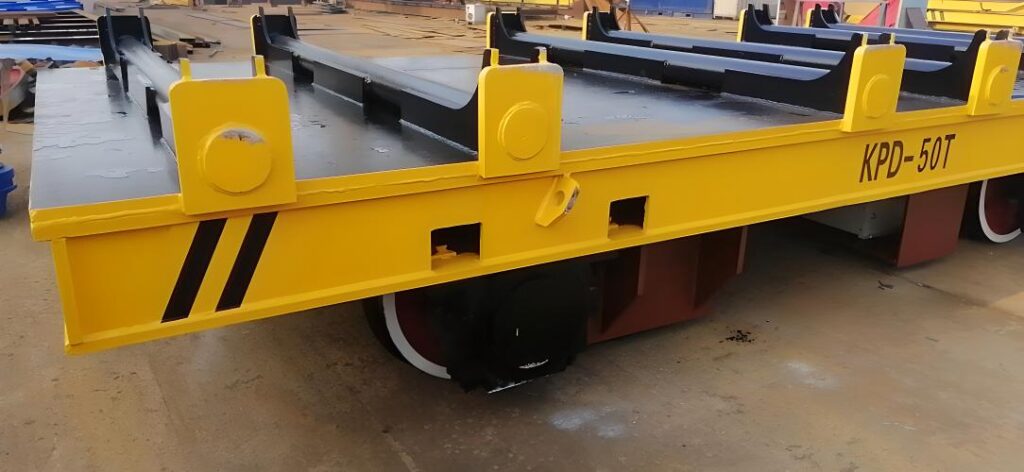
Product Gallery
Model & Specifications
- Product Name: KPDZ Low-Voltage Rail Electric Flat Car
- Also Known As: Electric platform truck, low-voltage rail cart, KPD-type rail cart
- Model & Specification: KPDZ series (KPDZ-2t to KPDZ-63t)
- Category: Ground conveying machinery and equipment
- Power Supply: AC 36V two-phase low-voltage rail supply + rectified DC 36V
- Motor Type: DC motor (ZYT/ZSZ series)
- Control Voltage: Low-voltage DC 36V
- Operation Mode: Wired control / Remote control
- Place of Origin: Changyuan, Xinxiang, Henan
- Customization: Available for non-standard manufacturing
- Stock Status: Made to order
- Production Lead Time: 10~18 days
- Supply Scope: Nationwide
- Delivery Method: Customer pickup or arranged freight
- After-Sales Service: One-year warranty
Product Features
- 36V Safety Voltage: The rail voltage is only two-phase AC 36V, posing no risk of injury upon human contact. This offers the highest safety level compared to KPC conductor rails (exposed 380V), making it ideal for workplaces with high personnel density or stringent safety requirements.
- DC Drive with Smooth Starting: Driven by a DC 36V motor, it delivers high starting torque (2 to 2.5 times the rated torque), low starting current surge, and smooth operation. The DC motor imparts significantly less impact on gearbox gears than an AC motor, extending gearbox service life by over 30%.
- S-Curve and Curved Track Capability: The 36V low-voltage transmission along the rails has no directional restrictions, allowing the flat car to travel on S-shaped and curved tracks, adapting to complex factory layouts.
- Unlimited Continuous Operation: Powered continuously through the rails, it can operate 24 hours a day without recharging, achieving equipment utilization rates above 95%. Compared to KPX battery-powered flat cars (which require 3 to 8 hours of downtime for charging), this significantly boosts production capacity.
- Strong Explosion-Proof Suitability: The DC motor, combined with a sealed electrical enclosure design, produces no open flames or exposed commutation arcs, making it suitable for explosion-prone areas such as paint shops, chemical warehouses, and dusty environments.
- Low Maintenance Costs: The DC motor has a simple structure, no slip rings, and a long carbon brush replacement interval (>5000 hours). Routine maintenance only involves checking carbon brush wear and commutator cleanliness.
- Rich Expandable Features: Optional add-ons include a hydraulic lifting platform, tipping device, V-type support, rotating table, remote control system, explosion-proof electrical controls, and variable-frequency speed control.
Working Principle
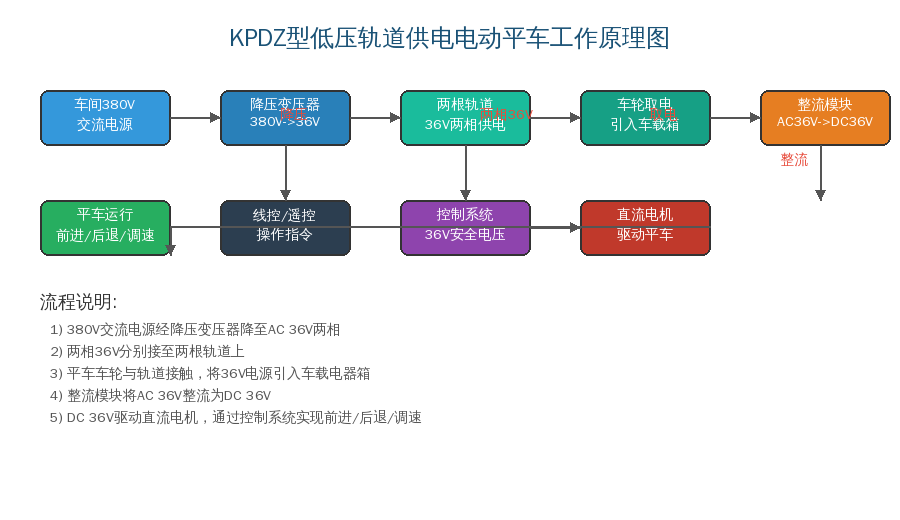
The working principle of the KPDZ low-voltage rail-powered electric flat car is based on a safe power supply scheme of "step-down transmission, rectified DC drive":
Step 1: Step-Down Transmission. The workshop's 380V AC power supply is stepped down to two-phase AC 36V by a step-down transformer, which is then connected to two parallel running rails. The two rails are electrically insulated from each other—insulating base plates (epoxy resin) are laid under the rails, insulating sleeves are installed at the tie-down points, and insulating fishplates are used at rail joints.
Step 2: Power Pickup. The flat car's wheels (which also serve as conductors) make contact with the running rails, bringing the two-phase 36V power from the rails into the onboard electrical enclosure. Insulators isolate the wheel bearings from the frame, ensuring the 36V supply is effectively routed without grounding through the frame.
Step 3: Rectified DC Output. The incoming two-phase AC 36V in the onboard electrical enclosure is converted to stable DC 36V by a rectifier module (bridge rectifier + filter capacitor). The rated current of the rectifier module is selected based on motor power (standard 10A to 63A) and includes built-in overcurrent protection.
Step 4: DC Drive. The DC 36V powers the DC motor, with a DC drive controlling motor direction and speed for starting, stopping, forward/reverse travel, and stepless speed control. The control system operates on DC 36V safety voltage (via an isolation transformer) and is operated through a wired pendant or wireless remote control.
When the travel distance exceeds 70m, voltage drop along the rail increases, requiring additional booster transformers to be installed at the midpoint or end of the track to ensure the flat car at the far end still receives adequate AC 36V input voltage.
Product Structure
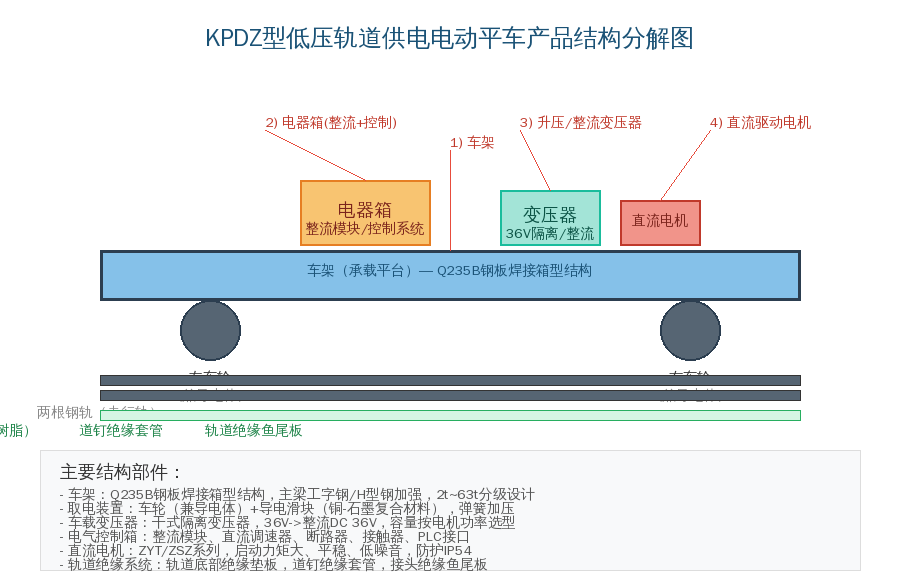
The KPDZ low-voltage rail-powered electric flat car consists of the following main structural components:
- Frame (Load Platform): Box-type structure welded from Q235B steel plates, reinforced with I-beam or H-beam main girders, with graded designs from 2t to 63t. Models above 25t feature a double H-beam main girder structure, and the entire assembly is annealed after welding to relieve stress.
- Power Pickup Device: Comprises the wheels (which also act as conductors), conductive contact shoes (copper-graphite composite material), and a spring-loaded pressure mechanism. The wheels contact the running rails to pick up the two-phase power supply. Insulators isolate the wheel bearings from the frame, with insulation resistance ≥1MΩ (tested with a 500V megohmmeter).
- Step-Down Transformer (Ground Side): A dry-type isolation transformer, 380V/36V, with capacity selected based on the flat car's power (standard 5 to 50kVA). Installed at the start of the powered rail section, with IP54 protection.
- Rectifier Module (Onboard): Three-phase bridge rectifier + filter capacitor, converting AC 36V to DC 36V. Rated current from 10A to 63A, with built-in fast-acting fuse protection. An optional filter is available to suppress EMI interference.
- Electrical Control Cabinet: Houses the circuit breaker, DC drive, contactor, thermal overload relay, and isolation transformer. The control circuit operates on DC 36V safety voltage, configured with emergency stop, overload, short-circuit, and phase loss protection. An optional PLC (Siemens S7-200 SMART) and variable-frequency speed control are available.
- DC MotorDrive Motor: ZYT/ZSZ series DC motor, rated voltage DC 36V~48V, high starting torque (2~2.5 times rated torque), power 1kW~6.3kW. IP54 Protection, Insulation Class F. Features soft start, low noise (<65dB).
- Rail Insulation System: Insulating base plates (epoxy resin or rubber) are laid under the rail, insulating sleeves are fitted on the track spikes, and insulating fishplates are used at rail joints. The insulation resistance between each rail section is ≥10kΩ (36V system), requiring regular inspection during long-term operation.
Technical Parameters
The table below lists the standard technical specifications for KPDZ low-voltage rail electric flat cars, covering the main dimensions, power parameters, and rail matching data for 10 models ranging from 2t to 63t. Parameters such as Table Dimensions, wheelbase, and Travel Speed can be customized to meet specific customer requirements.
KPDZ Low-Voltage Rail Electric Flat Car Technical Specification Table
| Flat Car Model | KPDZ-2t | KPDZ-5t | KPDZ-10t | KPDZ-16t | KPDZ-20t | KPDZ-25t | KPDZ-30t | KPDZ-40t | KPDZ-50t | KPDZ-63t | |
| Rated Load Capacity(t) | 2 | 5 | 10 | 16 | 20 | 25 | 30 | 40 | 50 | 63 | |
| Table Dimensions | Long | 2000 | 3500 | 3600 | 4000 | 4000 | 4500 | 4500 | 5000 | 5500 | 5600 |
| Width | 1500 | 2000 | 2000 | 2000 | 2200 | 2200 | 2200 | 2500 | 2500 | 2500 | |
| High | 450 | 450 | 500 | 500 | 550 | 600 | 600 | 650 | 650 | 750 | |
| Wheel Base | 1200 | 2500 | 2600 | 2800 | 2800 | 3200 | 3200 | 3800 | 4200 | 4300 | |
| Gauge (Inside Rail Distance) | 1200 | 1435 | 1435 | 1435 | 1435 | 1435 | 1435 | 1435 | 1435 | 1435 | |
| Wheel Diameter | Φ270 | Φ300 | Φ300 | Φ350 | Φ350 | Φ400 | Φ400 | Φ500 | Φ500 | Φ600 | |
| Number of Wheels | 4 | 4 | 4 | 4 | 4 | 4 | 4 | 4 | 4 | 4 | |
| Ground Clearance | 50 | 50 | 50 | 50 | 50 | 50 | 50 | 50 | 50 | 50 | |
| Travel Speed | 0-25 | 0-25 | 0-25 | 0-20 | 0-20 | 0-20 | 0-20 | 0-20 | 0-20 | 0-20 | |
| motor power | 1 | 1.2 | 1.6 | 2 | 2.2 | 3 | 3.5 | 4 | 5 | 6.3 | |
| Transformer Power | 3 | 5 | 5 | 6.8 | 6.8 | 6.8 | 10 | 10 | 10 | 20 | |
| Transformer Quantity | 1 | 1 | 1 | 1 | 1 | 1 | 1 | 1 | 1 | 1 | |
| Travel Length(m) | 80 | 80 | 80 | 80 | 80 | 80 | 80 | 60 | 50 | 50 | |
| Maximum Wheel Load(KN) | 14.4 | 25.8 | 42.6 | 64.5 | 77.7 | 94.5 | 110.4 | 142.8 | 174 | 221.4 | |
| Reference Weight(t) | 2.8 | 3.6 | 4.2 | 5.5 | 5.9 | 6.5 | 6.8 | 7.6 | 8 | 10.8 | |
| Recommended Crane Rail Model | P15 | P18 | P18 | P24 | P24 | P38 | P38 | P43 | P43 | P50 | |
Typical Applications
The KPDZ low-voltage rail electric flat car, with its DC drive, safe voltage, and S-curve rail adaptability, is well suited for the following typical scenarios:
- Chemical / Paint Workshops: The DC motor produces no commutation sparks, and with the sealed electrical enclosure, it meets material transfer requirements in hazardous areas. A typical application is transferring 2–10 t loads from the raw material area to the mixing station on a paint production line.
- Precision Manufacturing Workshops: The DC motor delivers smooth starts with minimal impact, making it ideal for transporting precision parts and molds while reducing vibration damage to workpieces during transit.
- Electronics Assembly Lines: The 36 V safe voltage ensures zero risk to operators who may touch the rail, making it suitable for material delivery on labor-intensive manual assembly lines.
- Facilities with Curved Rail Layouts: For S-shaped or curved workshop layouts (e.g., aircraft maintenance hangars, ring-type assembly lines), the KPDZ travels seamlessly on curved rails with no need for segmented power switching.
- Steel & Metallurgy Workshops: The DC motor offers high-temperature resistance and strong overload capacity, making it suitable for cross-workshop transfer of steel coils and billets (in conjunction with hydraulic lifting platforms). The 63 t model handles heavy molds and large castings.
- Warehousing & Logistics Centers: Multiple flat cars operate in groups on the same rail system, centrally controlled by a dispatching system for automatic batch-based material delivery.
Selection Guide
Selecting the right KPDZ low-voltage rail electric flat car requires a comprehensive review of load capacity, table dimensions, travel distance, environmental conditions, and functional requirements:
- Load Capacity: Choose the model based on the heaviest single workpiece plus a recommended 20% allowance for the platform dead weight. For example, a KPDZ-10t (rated 10 t) is recommended for transferring 8 t molds.
- Table Dimensions: Standard table dimensions range from 2000×1500 mm to 5600×2500 mm. For long workpieces (steel pipes, billets), extended tables (up to 12 m) can be custom-built.
- Travel Distance & Transformer Configuration: A single transformer supports a standard supply distance of up to 70 m. Beyond 70 m, additional booster transformers must be installed along the rail — one transformer of the same specification for every additional 50 m.
- Rail Insulation Class: Epoxy resin insulating base plates suffice for normal workshops. For humid environments (e.g., foundries, car wash lines), a reinforced insulation scheme is required (rubber base plate + insulator + insulating coating, a triple composite), with insulation resistance ≥ 10 kΩ.
- Optional Functions: For lifting, choose a hydraulic lifting platform (stroke 500–1800 mm); for tipping, choose a V-type support or tipping device; for remote dispatching, choose a PLC + remote control system (effective range 100–500 m).
- Environmental Adaptability: For high-temperature environments (>60°C), select Class H insulated motors with high-temperature-resistant electrical enclosures; for dusty environments, opt for sealed electrical enclosures with IP65 protection rating; for corrosive environments (acid/alkali), choose stainless steel electrical enclosures with galvanized rails.
Operating Instructions
- Rail Preparation: Before laying the rail, verify the foundation flatness is ≤ 3 mm/m². Lay the insulating base plates, install the rails, install the insulated tie rod sleeves, connect the rail joints with insulated fishplates, install the step-down transformer, and measure the insulation resistance (normal ≥ 10 kΩ).
- Pre-Operation Checks: Check the rail surface for foreign objects, verify the insulating base plates are intact, confirm the wheel contact surfaces are clean, and ensure the electrical enclosure door is securely closed.
- Power-On Operation: Close the ground-side power switch. The onboard electrical enclosure emits a "beep" self-test tone. Operate the car via the tethered control handle or remote control. Forward: push the green button forward; Reverse: pull the red button backward; Stop: release the button to stop (models with a brake require pressing the stop button).
- Speed Control: Standard configuration provides stepped control (fast/slow two speeds). With optional variable-frequency speed control, stepless control from 0 to 20 m/min is supported; the speed adjustment potentiometer is located on the remote control or the side of the tethered control box.
- Safety Precautions: No personnel are allowed to board, climb onto, or stand on the platform while the car is in motion. Overloading is strictly prohibited. If abnormal noise, odor, or smoke is detected, immediately press the emergency stop button and disconnect the ground-side power supply. Inspect carbon brush wear weekly; replace brushes when worn to 1/3 of their original length.
- Insulation Testing Interval: Every 30 days, measure the rail-to-ground insulation resistance using a 500 V megohmmeter (insulation tester). If the reading falls below 10 kΩ, identify and repair the insulation damage point.
Why Choose Kelude Heavy Industry
Compared with other KPDZ/KPD low-voltage rail electric flat car suppliers on the market, Kelude Heavy Industry differentiates itself in the following areas:
| Comparison Parameter | Kelude Heavy Industry KPDZFlat Car | Market Comparable Products |
| Transformer | Dry-Type HClass Insulation, Temperature Resistance 180℃, Efficiency≥95%.All-Copper Windings, Capacity Margin 30% | Standard BClass Insulation, Temperature Resistance 130℃, Efficiency≤88%.Common with Aluminum Windings, overload Prone to Burnout |
| Rectification Module | High Fluctuation Power Bridge-Typerectifier+Filtering Capacitance+Fast-Acting Fuse Protection, Overcurrent 3 Times Without Damage | Simple Rectifier Diode, No Filtering, No Protection, Current High Fluctuation, Prone to Breakdown |
| DC motor | ZYT/ZSZSeries-Specific DC motor, IP54/FClass Insulation, Carbon brush Service Life>5000h | Standard DC motoror Retrofit Motor, IP44Common with Aluminum Windings, Carbon brush Service Life<2000h |
| Frame Structure | Q345B (≈S355J2)High-Strength Steel(≥25tClass), FEA Optimization, Weld Seam Ultrasonic Testing (UT) | Standard Q235B (≈S235JR), No Optimization, No Flaw detection, Prone to Under Long-Term Heavy Load Weld Seam Cracking |
| Insulation Design | Crane Rail+Bearing Double Insulation, Standard Insulation Detection Port, Factory Dielectric Test on Each Unit Testing | Only Crane Rail Insulation, None Detection Port, No Factory Dielectric Test Record |
| After-Sales Warranty | 1 Year Whole-Machine Warranty,48On-Site Response within Hours, Lifetime Technical Support | 6~12Months,72Response within Hours, Post-Warranty Service Fee Maintenance |
| Customization Capability | Table Surface/Load Capacity/Curved Rail/Lifting/Explosion-proof Fully Customized,12~18Days Delivery | Only Standard Model, Non-Standarddelivery time Long(≥25Days) |
Service & Support
Kelude Heavy Industry provides full life-cycle service support for KPDZ low-voltage rail electric flat car users: pre-sales site survey and solution design (free of charge), with customized proposals developed based on workshop layout, material flow, and power supply conditions; mid-sales supervision of the entire manufacturing process with progress updates, and each flat car undergoes a 72-hour continuous load test and insulation withstand voltage test before leaving the factory; after-sales support includes a 1-year full machine warranty, on-site response within 48 hours, and permanent technical consultation. For spare parts, we maintain a regular inventory of wear parts such as rectifier modules, carbon brushes, contactors, and bearings, ensuring delivery and replacement within 3 days. The rail insulation system supports Remote Diagnostics — users can test insulation with the included Megohmmeter (Insulation Tester) and send photos to us, and we will issue an insulation assessment report within 24 hours.
Need a KPDZ low-voltage rail electric flat car selection solution?
Get a free Technical Solution, drawings, and Quotation — provide load capacity + Table Dimensions + travel distance, and receive a solution within 30 minutes
Consultation hotline: 13903802779 | Factory address: Crane Industrial Park, Changyuan, Xinxiang, Henan
FAQ
Q: What is the difference between the KPDZ low-voltage rail electric flat car and the KPDS model?
A: The KPDZ uses a DC 36V DC motor, offering smooth starting, low impact, and suitability for explosion-proof environments; the KPDS uses an AC 380V AC metallurgical motor, providing higher starting torque and better suited for heavy loads (above 50t). The KPDZ has a maximum load capacity of 63t, while the KPDS can reach 150t. In short: choose KPDZ for light loads/explosion-proof/smooth operation, and KPDS for heavy loads/high-frequency use.
Q: What are the key requirements for rail installation?
A: Insulating Base plates (epoxy resin, thickness ≥5mm) must be laid beneath the rails; insulating sleeves are required for track spikes; Rail Joints must use insulating Fishplates, not conductive ones. The Insulation Resistance between the two rails must be ≥10kΩ (measured with a 500V Megohmmeter). We recommend marking insulation test points along the rail for routine maintenance. Rail flatness requirement: ≤5mm per 10m of full length.
Q: What is the maximum travel distance for a KPDZ flat car?
A: The standard power supply distance for a single Transformer is 70m. Beyond 70m, a booster transformer must be added at the midpoint of the track (one unit for every additional 50m). Theoretically, distance is not limited, but we recommend keeping the total length under 500m, as insulation maintenance costs rise significantly beyond that. When multiple transformers are connected in parallel, phase consistency must be maintained.
Q: What is the maintenance interval for the DC motor?
A: Carbon brushes should be inspected every 500 operating hours and replaced when worn to 1/3 of their original length (standard brush life is approximately 5,000 hours). The commutator should be cleaned every 1,000 hours (wipe with an alcohol cotton swab). Bearings should be relubricated with Grease (Lithium grease) every 6 months. We recommend keeping a maintenance log.
Q: What national standards does the KPDZ electric flat car comply with?
A: The Design & Manufacturing of the KPDZ low-voltage rail electric flat car strictly follows the JB/T 6127-2010 "Electric Flat Car" industry standard and the GB 5226.1-2019 "Safety of Machinery — Electrical Equipment" general standard. The electrical system complies with the GB/T 14048 series standards, insulation performance meets GB/T 10068-2008 requirements, and each unit undergoes Insulation Resistance Testing and withstand voltage testing before leaving the factory.
Q: Can the KPDZ travel on S-shaped tracks?
A: Yes. The KPDZ flat car is powered by a 36V low-voltage rail system, with power transmitted continuously along the rail with no directional restrictions, allowing normal operation on S-shaped Curved Rail and arc tracks. However, the minimum curve radius must be ≥2m (equivalent to the vehicle's minimum turning radius). A smaller radius can cause wheel derailment and poor power pickup. We recommend installing Guide Rollers on curved track sections.