JMM Large-Capacity Friction Winch
1. Product Overview
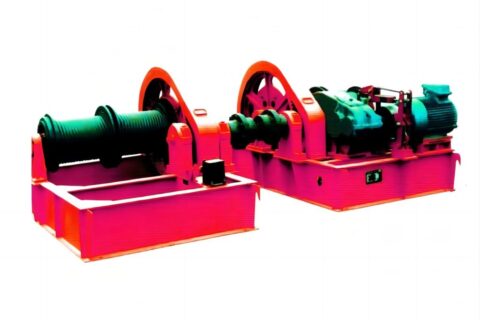
The JMM series large-capacity friction winch differs from conventional gear-driven winches — it transmits power through a friction drum, with the wire rope wrapped around the drum and driven by friction. This design delivers constant speed, stable lifting, and suitability for ultra-long-distance pulling. Models range from JMM10 to JMM55, with rated pull from 100~550KN (approx. 10~55 tons) and a maximum single-rope capacity of 4800m.
The friction winch excels in two dimensions: "long" and "heavy" — the wire rope can extend thousands of meters while maintaining constant tension, unlike gear winches where speed fluctuates during spooling. This makes it ideal for lifting large precast beams in bridge construction, towing 10,000-ton vessels ashore for maintenance at port terminals, and installing heavy equipment in large industrial plants. The JMM55 weighs 22 tons as a complete unit, with a 75KW motor alone — this is no "small hoist"; it's infrastructure-grade traction equipment.
This article covers the JMM friction winch from specifications and technical parameters to application scenarios.
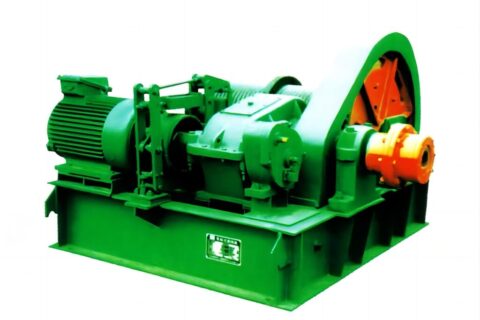
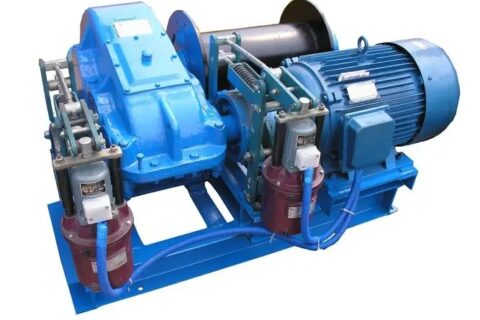
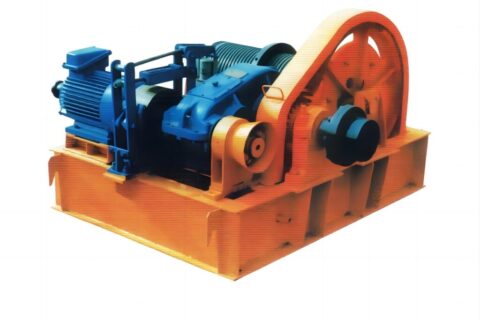
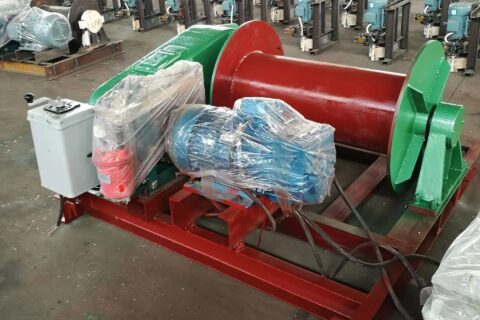
Product Images
2. Specifications
The JMM friction winch is available in 5 models based on rated pull. Basic specifications are as follows:
- Product Name: JMM Series Friction Winch
- Also Known As: Friction hoist, large-capacity winch
- Model Series: JMM10 / JMM16 / JMM20 / JMM32 / JMM55
- Rated Pull: 100KN (JMM10) ~ 550KN (JMM55)
- Drive Method: Friction drum drive (non-gear transmission)
- Rope Speed: 5~11 m/min (constant)
- Rope Capacity: Max 4800m (JMM10)
- Power Supply: Three-phase AC 380V-50Hz
- Place of Origin: Xinxiang, Henan
- Production Lead Time: 10~15 days (some models in stock)
- After-Sales: One-year warranty
3. Technical Parameters
The JMM series technical parameters are listed below, designed and manufactured to the JB/T 9008 standard. Note that the JMM10 has a rope capacity of 4800m — a single wire rope long enough to span the Yangtze River, a scale that conventional winches simply cannot achieve.
JMM Friction Winch Technical Specifications
| Foundation Parameter Model |
Rated Pulling Force (KN) |
Rated Speed (m/min) | Rope capacity (m) |
wire rope diameter (mm) |
Motor Model | motor power (KN) |
Overall dimensions (mm) |
Total machine weight (kg) |
|---|---|---|---|---|---|---|---|---|
| JMM10 | 100 | 10 | 4800 | Φ30 | YZR225M-6 | 30 | 1980x2650x850 | 6000 |
| JMM16 | 160 | 11 | 1000 | Φ34.5 | YZR225M2-6 | 45 | 3350x1920x1320 | 9500 |
| JMM20 | 200 | 11 | 3600 | Φ39 | YZR280S-6 | 55 | 3500x1960x1320 | 10000 |
| JMM32 | 320 | 10 | 3200 | Φ52 | YZR280M-6 | 75 | 4300x2350x1760 | 16000 |
| JMM55 | 550 | 5 | 2000 | Φ60 | YZR280M-6 | 75 | 5000x2800x1900 | 22000 |
4. Application Scenarios — Heavy Infrastructure Pulling
JMM friction winches are not for ordinary construction sites. Our customers are bridge contractors, port terminals, and heavy equipment installation companies. Three typical scenarios:
▎Bridge Construction — Precast Girder Lifting and Pulling
Precast girder segments for large bridges routinely weigh tens to hundreds of tons. Transporting, lifting, and positioning them from the precast yard to the pier requires large-capacity winches. The JMM series delivers a rated pull of 100–550 kN with a rope speed of 5–11 m/min — slow and steady, which is critical when lifting and landing girders. At higher speeds, inertia becomes a problem; a tens-ton girder simply won't stop where you want it. In one bridge project, we supplied a JMM20 as the main pulling winch with a single 400 m wire rope and two guide sheaves to pull precast girders from the riverbank onto the pier — two girders placed per day, with no transfer costs compared to using a large mobile crane.
▎Port Terminals — Ship Hauling onto Slipways
At ship repair yards, vessels of up to 10,000 tons must be hauled ashore on slipways for maintenance. The JMM55, with a rated pull of 550 kN (approx. 55 tons), can move thousand-ton vessels up the slipway using a multi-rope system. The advantage of friction drive is constant tension in the wire rope — resistance changes as the vessel moves along the slipway, and a gear-driven winch will suffer unstable rope speed under fluctuating load. A friction winch relies on friction and slips to protect the system, so there is no sudden jerk that could damage the hull.
▎Large Industrial Plants — Heavy Equipment Installation and Long-Distance Pulling
At coal preparation plants, steel mills, and power plants, large equipment often needs to move from the unloading point to its installation position — distances of several hundred meters or even over a kilometer. Using a crane to lift and carry the load the entire way is simply not practical. A JMM winch with a pulley block handles long-distance horizontal pulling in one pass. A JMM32 with a 52 mm wire rope delivers 320 kN of pull — enough to move a transformer or generator from the dock to the plant site. Per the TSG Q7014 standard, large-capacity winches require periodic inspection every two years.
5. Why Choose Kelude Heavy Industry
Large-capacity friction winches are not off-the-shelf items — every project has different operating conditions, and the friction drum diameter, wire rope matching, and brake selection must all be recalculated. We have been supplying lifting equipment for over a decade, and these three reasons keep customers coming back:
- Solutions engineered to your operating conditions, not templates: Bridge applications and port applications have different rope speed requirements — bridges need slow, precise placement (5–7 m/min), while ports need steady pulling (8–11 m/min). We re-match the friction drum diameter, motor speed, and reduction ratio to keep wire rope tension fluctuation within ±5%. We don't just ship a standard unit.
- Redundant braking system: When tens of tons of equipment are suspended in the air or stalled on a slope, brake failure is a major accident. The JMM series comes standard with dual brakes (electromagnetic + manual), and a hydraulic brake can be added for critical applications. Every brake is individually tested before shipment, with test records on file.
- Wire rope fitted before delivery: Large winches use wire rope of 30–60 mm diameter, and counterfeit rope is common on the market. We don't fit random rope — we supply factory-matched rope that matches the drum grooves, pre-spooled before shipment. It's ready to run on site — no crane needed to wind the rope onto the drum.
JMM10: approx. 50,000–80,000 RMB; JMM20: approx. 100,000–150,000 RMB; JMM55: approx. 150,000–220,000 RMB (excluding wire rope and installation). Common JMM10–JMM20 specifications are kept in stock — delivery in 15–30 days after parameters are confirmed. Larger models (JMM32 and above) have a 45–60 day customization lead time. Send us your operating conditions (pull weight / rope length / application), and we'll provide a solution and quotation — no charge until you confirm.
6. FAQ
Q: What is the difference between a friction winch and a gear winch (JK/JM type)?
A: The core difference is in the drive mechanism. A friction winch uses a friction drum where the friction generated by the number of rope wraps transmits power — rope speed is constant, and the drum slips to protect the system under overload. A gear winch uses a gearbox for power transmission — higher efficiency, but speed varies with the number of rope layers on the drum, and there is no slip protection under overload. For selection: long-distance pulling (hundreds to thousands of meters) and applications requiring constant speed and tension call for a friction winch; short-distance, fast lifting calls for a gear winch (JK type). Per the JB/T 9008.2 standard, friction winches have specific requirements for friction lining material and friction coefficient.
Q: How does the JMM winch achieve a rope capacity of 4,800 meters? Why can a friction winch spool such a long rope?
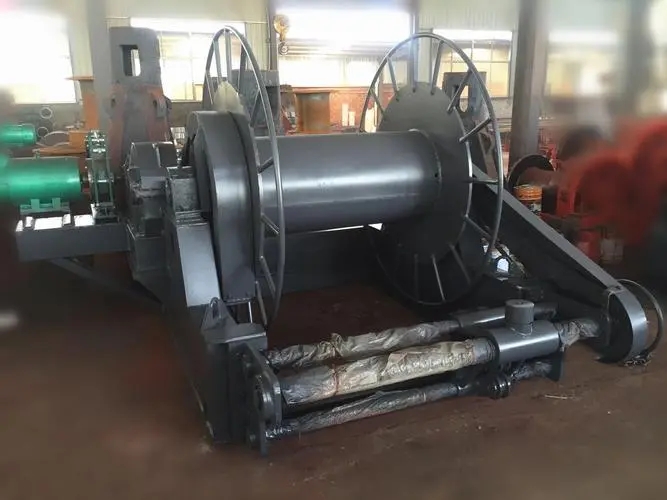
A: The wire rope on a friction winch is not all wound on the drum — it wraps around the friction drum only a few turns for friction drive, and the excess rope is spooled onto a separate storage drum via a level wind. So rope capacity depends on the storage drum size, not the friction drum size. The JMM10 storage drum holds 4,800 m of Φ30 wire rope — very practical in bridge construction: a 2,000 m river crossing can be done with a single rope from one bank to the other, with no joints in between.
Reference standard: JB/T 9008.2-2014—2018, Wire Rope Hoists — Part 2: Technical Conditions
Q: Can the JMM winch be installed without a professional crew? What foundation is required?
A: The JMM series weighs 6–22 tons as a complete unit, so a concrete foundation is mandatory. The foundation is designed with a 1.5 safety factor over the equipment weight — the JMM55 base requires approximately 8 m³ of C30 concrete. Installation requires a crane of 25 tons or more (the JMM55 needs a 50-ton crane). Anchor bolt positioning accuracy for the foundation embedment is critical — our drawings provide hole layout dimensions, and a verification check is required before installation. Additionally, large-capacity winches are classified as special equipment — after installation, a TSG Q7014 inspection must be passed and a usage registration certificate obtained before the unit can be put into service. We can provide installation guidance or dispatch an installation crew to your site.
A: