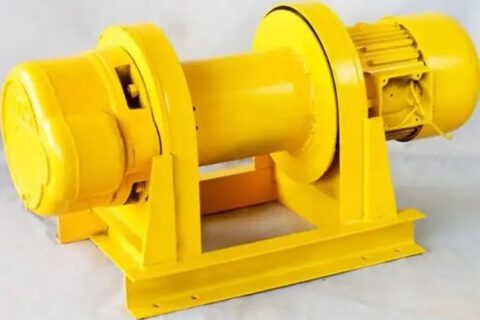
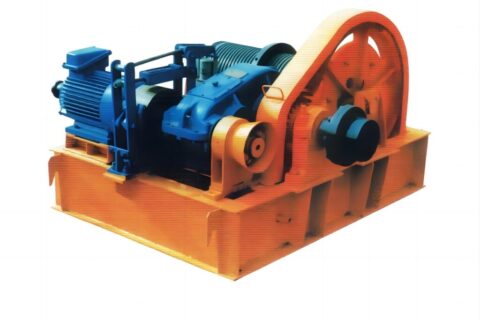
JM Series Electric Control Slow-Speed Winch for Heavy-Duty Lifting
1. Product Overview
The JM-type electric controlled slow-speed winch differs from the JK fast-speed winch in one key aspect—the "slow" in its name. With a rope speed of 9.5~16m/min, it runs at nearly half the speed of the JK series. But slow is not a drawback; it's a design goal. When precise installation and positioning are required, excessive speed only makes control more difficult.
The JM series is divided into two sub-series: JM1~JM8 (rated pulling force 10~60KN) and JM10~JM65 (100~650KN). Driven by a gear reducer, the wire rope is neatly spooled for smooth, stable lifting. Typical applications include precision hoisting by equipment installation contractors, structural component installation in road and bridge projects, and equipment disassembly and reassembly during plant overhauls. The JM65, with a rated pulling force of 650KN (approximately 65 tons), is powered by a YZR355L1-10 motor rated at 132KW and has a dead weight of 25 tons—a true heavyweight in the winch category.
This article covers the JM slow-speed winch in detail, from specifications and technical parameters to selection guidance.
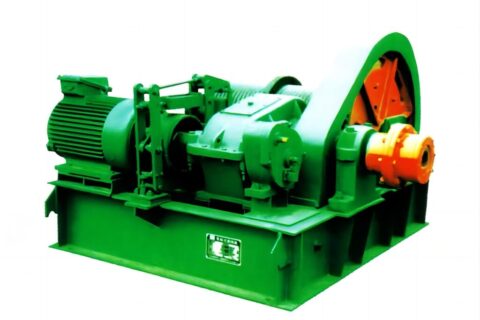
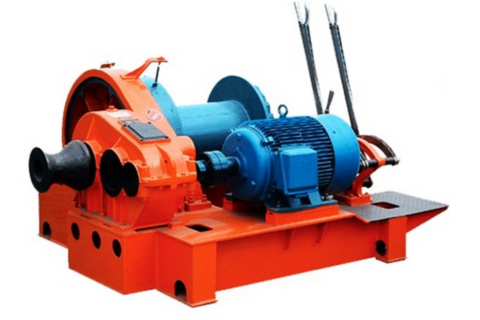
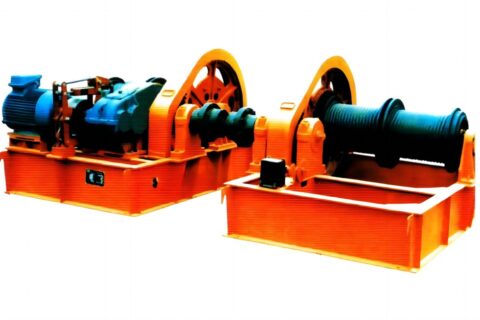
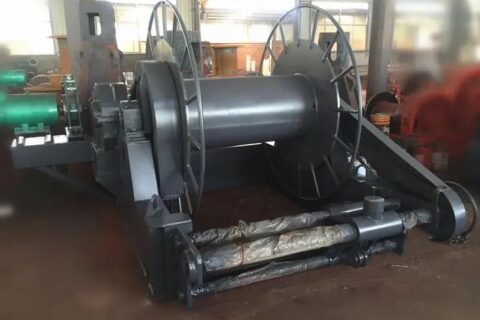
Product Image
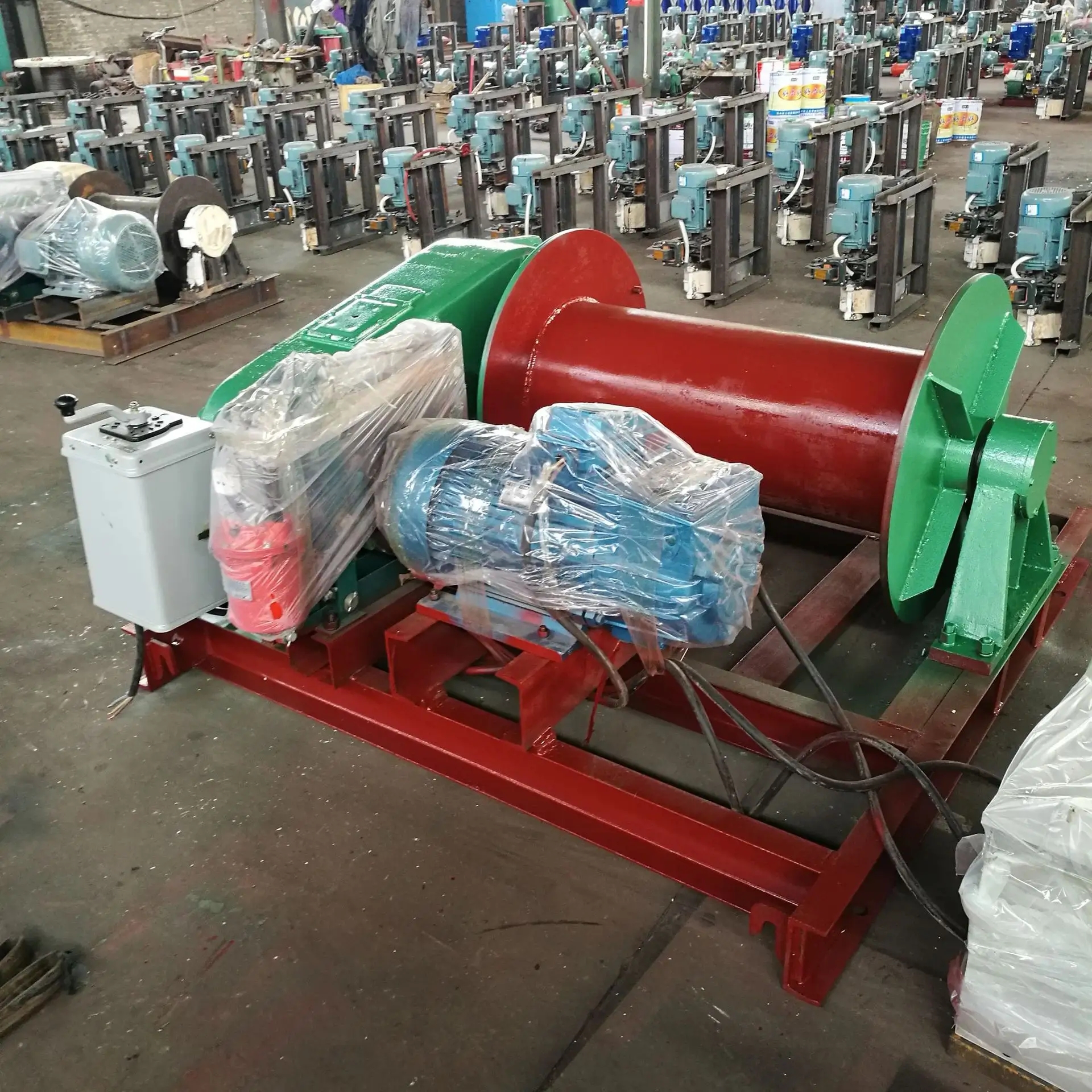
2. Specifications
The JM-type slow-speed winch is available in two sub-series based on rated pulling force. Basic specifications are as follows:
- Product Name: JM-type electric controlled slow-speed winch
- Also Known As: Slow-speed hoist, heavy-duty winch
- Small Series: JM1 / JM1.6 / JM2 / JM3.2 / JM3.2B / JM5 / JM5B / JM5C / JM5D / JM5E / JM6 / JM8 / JM8B (10~60KN)
- Large Series: JM10 / JM10B / JM12.5 / JM13.5 / JM16 / JM20 / JM25 / JM32 / JM50 / JM65 (100~650KN)
- Rated Pulling Force: 10KN (JM1) ~ 650KN (JM65)
- Rope Speed: 9.5~16 m/min (slow-speed precision)
- Drive System: Gear reducer transmission
- Power Supply: Three-phase AC 380V-50Hz
- Place of Origin: Xinxiang, Henan
- Production Lead Time: 15~30 days (custom-built)
- After-Sales Service: One-year warranty
3. Technical Parameters
The two tables below list the technical parameters for the JM1~JM8 small series and the JM10~JM65 large series, designed and manufactured to the JB/T 9008 standard. Note the "Type" column at the end of each table—two drive configurations are available: open gear and four-axis. The four-axis configuration offers a more compact design and lower noise:
JM-Type Electric Controlled Slow-Speed Winch Technical Specifications (JM1~JM8)
| Foundation Parameter Model | Rated Pulling Force (KN) | Rated Speed (m/min) | Rope Capacity (w) | wire rope diameter (mm) | Motor Model | motor power (KW) | Overall Dimensions (mm) | Total Machine Weight (kg) | Type |
| JM1 | 10 | 15 | 100 | Φ9.3 | Y112M-6 | 3 | 620x701x417 | 270 | |
| JM1.6 | 16 | 16 | 150 | Φ12.5 | Y132M2-6 | 5.5 | 945x996x570 | 500 | |
| JM2 | 20 | 16 | 150 | Φ13 | Y160M-6 | 7.5 | 945x996x570 | 550 | |
| JM3.2 | 32 | 9.5 | 150 | Φ15.5 | YZR160M2-6 | 7.5 | 1430x1160x910 | 1100 | Open Gear |
| JM3.2B | 32 | 12 | 195 | Φ15.5 | YZR160M2-6 | 7.5 | 1082x1014x0 | 536 | Four-Axis |
| JM5 | 50 | 10 | 270 | Φ21.5 | YZR160L-6 | 11 | 1235x1230x805 | 1560 | Four-Axis |
| JM5B | 50 | 9.5 | 200 | Φ21.5 | YZR160L-6 | 11 | 1620x1260x945 | 1800 | Open Gear |
| JM5C | 50 | 9.5 | 250 | Φ21.5 | YZR160L-6 | 11 | 1235x1230x805 | 1800 | Four-Axis |
| JM5D | 50 | 15 | 250 | Φ21.5 | YZR180L-6 | 15 | 1235x1230x805 | 1850 | Four-Axis |
| JM5E | 50 | 20 | 250 | Φ21.5 | YZR200L-6 | 22 | 1235x1230x805 | 2000 | Four-Axis |
| JM6 | 60 | 9.5 | 270 | Φ24 | YZR180L-6 | 15 | 1235x1509x805 | 1800 | Four-Axis |
| JM8 | 80 | 8 | 250 | Φ26 | YZR180L-6 | 15 | 2090x1475x956 | 2900 | Open Gear |
| JM8B | 80 | 9.5 | 350 | Φ26 | YZR180L-6 | 15 | 1075x1598x985 | 2650 | Four-Axis |
Technical Specifications for JM Series Electric Control Slow-Speed Heavy-Duty Winches (Models JM10–JM65)
| Foundation Parameter Model | Rated Pulling Force (KN) | Rated Start Button (m/min) | Rope Capacity (m) | wire rope diameter (mm) | Motor Model | motor power (KW) | Overall Dimensions (mm) | Total Machine Weight (kg) |
| JM10 | 100 | 8 | 170 | Φ30 | YZR200L-6 | 22 | 2090x1475x956 | 3000 |
| JM10B | 100 | 9.5 | 250 | Φ30 | YZR200L-6 | 22 | 1705x1598x985 | 3500 |
| JM12.5 | 125 | 8 | 300 | Φ34 | YZR225M-6 | 30 | 2880x2200x1550 | 5000 |
| JM13.5 | 135 | 0-5 | 290 | Φ28 | YZP225S-8 | 22 | 2990x2363x1650 | 6500 |
| JM16 | 160 | 10 | 500 | Φ37 | YZR250M2-8 | 37 | 3750x2400x1850 | 8800 |
| JM20 | 200 | 10 | 600 | Φ43 | YZR280S-8 | 45 | 3950x2560x1950 | 9900 |
| JM25 | 250 | 9 | 700 | Φ48 | YZR280M-8 | 55 | 4350x2800x2030 | 13500 |
| JM32 | 320 | 9 | 700 | Φ56 | YZR315S-8 | 75 | 4500x2850x2100 | 14800 |
| JM50 | 500 | 9 | 800 | Φ65 | YZR315M-8 | 90 | 4930x3050x2250 | 19500 |
| JM65 | 650 | 10.5 | 3600 | Φ64 | LA8315-8AB | 160 | 5900x4680x3200 | 46000 |
4. Precision Installation & Positioning — Application Scenarios
The core selling point of the JM series is its "slow" operation — at 9.5~16 m/min, it runs at half the speed of the JK series, but delivers precise control in return. The following three scenarios best showcase the advantage of slow speed:
▎Precision Hoisting for Equipment Installation Companies
Installation companies handle a wide variety of jobs — positioning reactor vessels in chemical plants, installing rolling mill housings in steel mills, and replacing steam turbine rotors in power plants. These equipment pieces range from a few tons to dozens of tons, and installation accuracy is required down to the millimeter. At higher speeds, inertia makes it difficult to stop precisely. The JM series operates at 9.5~16 m/min, and in inching control mode, each move advances only a few centimeters, allowing the operator to slowly lower the load into position while watching the clearance. We've seen this firsthand — working with several equipment installation companies in Henan, where the JM5 and JM8 are the most commonly used models. For heavy loads they use cranes; for medium-sized equipment, they use JM slow-speed winches with pulley blocks — just as efficient as a crane, at half the cost.
▎Component Installation in Bridge & Road Construction
Installing steel structure components on bridge piers and positioning precast bridge deck panels — these tasks differ from long-distance traction in bridge construction (which is what the JMM series handles). These are short-distance, precision placement jobs. The JM10~JM32 models deliver pulling forces of 100~320 KN, and when paired with jacks and sliding systems, they can precisely adjust steel box girders weighing dozens of tons into their designed positions on bridge piers. Neat wire rope spooling and stable lifting are design hallmarks of the JM series — and for bridge component installation, these matter far more than speed.
▎Factory Overhauls — Equipment Disassembly & Reassembly
Factory overhauls are another classic winch application: changing dies in stamping presses, replacing screws in extruders, swapping motors on overhead cranes. These jobs may only happen once or twice a year, but each time you need to lift out components weighing from a few hundred kilograms to several tons, then put them back. The small JM1~JM3.2 models have a dead weight of just 500~1100 kg, so two people can set them up on site. Pair one with a tripod or a small gantry frame and you're ready to work. The slow speed means less risk of bumping into surrounding equipment and piping — which is exactly why plant maintenance supervisors prefer them.
5. Why Choose Kelude Heavy Industry
A slow-speed winch may look like just a motor driving a gearbox that turns a drum, but in real-world use, a few key details make all the difference:
- Reliable rope spooling system: The most common problem with slow-speed winches is uneven wire rope spooling on the drum — tangled ropes can ruin the wire rope at best, or stall the motor at worst. Every unit undergoes a no-load spooling test before leaving our factory, with the rope guide gap precisely matched to the wire rope diameter, so you won't see tangled ropes in the field.
- Dual-brake safety: When equipment is suspended mid-air at an installation site, brake failure is no joke. The JM series comes standard with an electromagnetic brake plus a manual brake, and larger-tonnage models also feature a hydraulic thrust brake. Every single unit — not just a sample — is tested for braking torque and comes with its own test record.
- Custom solutions on demand: Equipment installation inside a container and open-pit mining operations have very different requirements for wire rope length and speed. We can adjust rope capacity, speed, and control method (push-button / remote control / PLC interlocking) to suit your actual needs — without significantly increasing the price, as long as the structure remains unchanged.
Pricing: JM1 manual models range from approximately ¥5,000 to ¥8,000; JM5 from ¥15,000 to ¥30,000; JM10~JM20 from ¥50,000 to ¥120,000; and JM32 and above from ¥150,000 to ¥250,000 (including motor and control cabinet, excluding wire rope and freight). Common models JM3.2~JM8 are kept in stock — delivery takes 15~25 days after parameter confirmation. Custom large-tonnage units require a 30~45 day lead time. Send us your working conditions (load weight / rope length / application scenario), and we'll provide a solution for quotation.
6. FAQ
Q: What's the difference between the JM slow-speed winch and the JK fast-speed winch? Which one should I choose?
A: The core difference is speed: the JM slow-speed winch runs at 9.5~16 m/min, while the JK fast-speed winch runs at 22~30 m/min. In short: if you need precise positioning and speed isn't a priority, choose the JM (slow-speed); if you need rapid material lifting and a fast work pace, choose the JK (fast-speed). Specifically, equipment installation, component positioning, and factory overhauls — these jobs don't demand high speed but do demand precise control, so go with JM. For lifting mortar and bricks in building construction, or pulling material carts in mines — these jobs are all about efficiency, so go with JK. Per the GB/T 1955 standard, both use gear reducer transmission; the key difference lies in the gear ratio design.
Q: There are too many models from JM1 to JM65 — how do I decide which one to buy?
A: It comes down to how much weight you need to lift. Calculation formula: Rated pulling force (KN) = load weight (tons) × 10 × safety factor of 1.25. For example, to lift 1 ton of equipment, you'd need at least 12.5 KN, which corresponds to the JM1.6. Next, consider wire rope speed — pick one within the 9.5~16 m/min range that matches your operating habits. Rope capacity needs to cover your lifting height. Per the JB/T 9008.1 standard, you also need to confirm the work duty (M3~M6) after selection — the higher the duty classification, the lower the allowable load for the same model. Per the JB/T 9008.1 standard, you also need to confirm the work duty (M3~M6) after selection — the higher the duty classification, the lower the allowable load for the same model. If you're still unsure, send us the equipment weight, maximum lifting height, and frequency of use, and we'll help you confirm the right model.
Q: Can open-gear and four-axis JM winches be mixed on the same job site?
A: They can be mixed, but it's not recommended. The last column of the JM series parameter table indicates the "Type." Open-gear means the gears are exposed and covered by a protective cover — simple structure, easy maintenance, and well-suited for dusty job sites. The four-axis design encloses the gears inside a gearbox, offering quieter operation and better lubrication — ideal for factory workshops and other noise-sensitive environments. Selection advice: choose open-gear for outdoor job sites (easier to repair and replace), and four-axis for indoor workshops (quiet and leak-free).