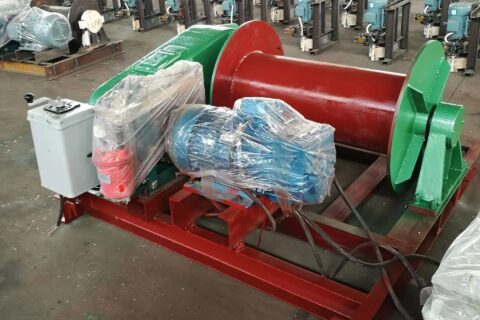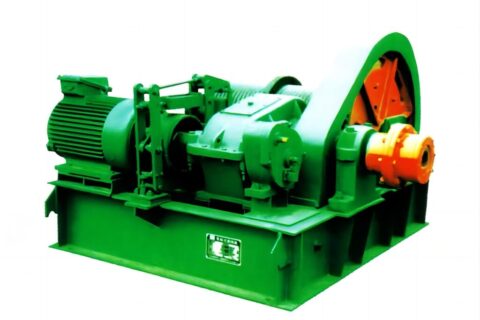

JK Electric Fast Winch for Material Cart Hoisting
1. Product Overview
The JK series electric quick-speed winch is designed for vertical lifting and horizontal pulling of materials. Available in models from JK0.5 to JK10, it delivers rated pulling forces from 5KN (approx. 500kg) up to 100KN (approx. 10 tons), with lifting speeds of 22~30m/min. Typical applications include material hoisting on construction sites, gantry frame integration, mine car pulling, and as the main hoist mechanism on bridge cranes.
Unlike standard slow-speed winches, the JK series prioritizes speed—the wire rope reaches line speeds up to 30m/min. Paired with an electromagnetic brake motor, it delivers crisp start/stop response, making it well-suited for fast-paced construction environments. The compact design keeps the JK0.5 at just 200kg, so two workers can reposition it easily—a real advantage when moving between job sites.
This guide covers specifications, technical parameters, selection advice, and FAQs to give you a complete picture of the JK series quick-start winch.
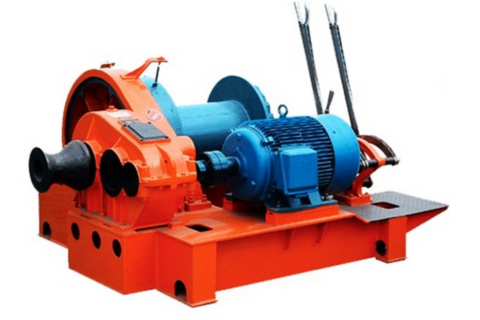
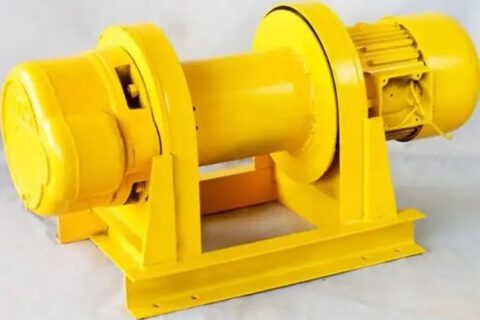
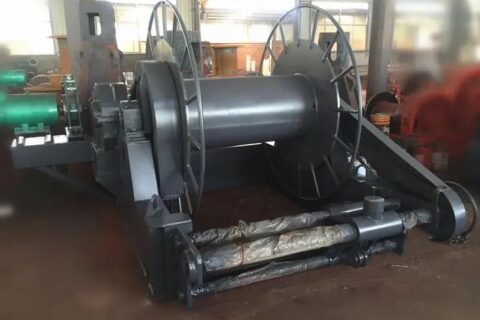
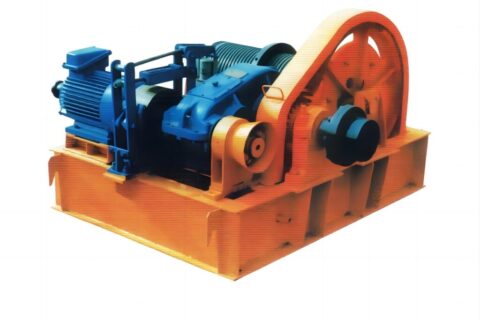
Product Photos
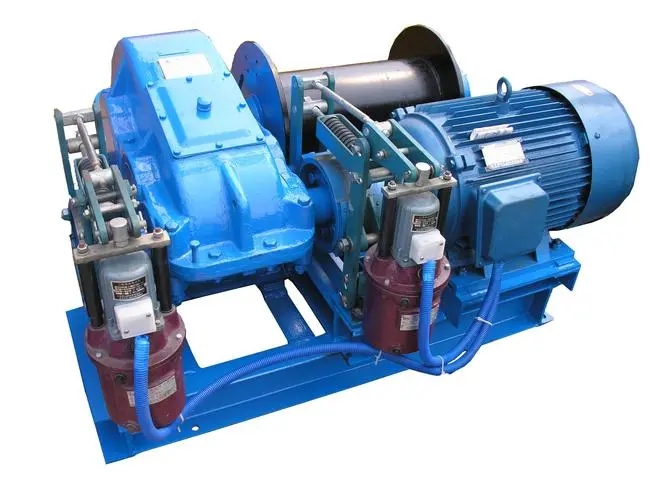
2. Specifications
The JK series quick-start winch is available in 10 models based on rated pulling force. Key specifications are listed below:
- Product Name: JK Series Electric Quick-Start Winch
- Also Known As: Hoist winch, electric quick-start winch
- Model Range: JK0.5 / JK1 / JK1.6 / JK2 / JK3.2 / JK3.2B / JK5 / JK5B / JK8 / JK10
- Rated Pulling Force: 5KN (JK0.5) ~ 100KN (JK10)
- Power Supply: Three-phase AC 380V-50Hz
- Place of Origin: Xinxiang, Henan
- Custom Manufacturing: Non-standard options available (drum capacity, speed, and control method can be customized)
- Availability: Selected models in stock; production lead time 10~20 days
- Warranty: One year
3. Technical Parameters
The tables below list detailed parameters for the JK series quick-start winch and the mine car winch, designed and manufactured to the JB/T 9008.1 standard:
JK Series Electric Quick-Start Winch — Technical Parameters
| Foundation Parameter Model |
Rated Pulling Force (KN) |
Rated Speed (m/min) |
Rope Capacity (m) |
wire rope diameter (mm) |
Motor Model | motor power (KN) |
Overall Dimensions (mm) |
Total Machine Mass weight (kg) |
| JK0.5 | 5 | 22 | 190 | Φ7.7 | Y100L-4 | 3 | 620x701x417 | 200 |
| JK1 | 10 | 22 | 100 | Φ9.3 | Y112M-4 | 4 | 620x701x417 | 300 |
| JK1.6 | 16 | 24 | 150 | Φ12.5 | Y132S-4 | 5.5 | 945x996x570 | 500 |
| JK2 | 20 | 24 | 150 | Φ13 | Y132M-4 | 7.5 | 945x996x570 | 550 |
| JK3.2 | 32 | 25 | 290 | Φ15.5 | YZR180L-6 | 15 | 1325x1335x840 | 1011 |
| JK3.2B | 32 | 30 | 250 | Φ15.5 | YZR200L-6 | 22 | 1900x1738x985 | 1500 |
| JK5 | 50 | 30 | 300 | Φ21.5 | YZR225M-6 | 30 | 1900x1620x985 | 2050 |
| JK5B | 50 | 25 | 210 | Φ21.5 | YZR225M-8 | 22 | 2250x2500x1300 | 2264 |
| JK8 | 80 | 25 | 160 | Φ26 | YZR280S-8 | 45 | 1533x1985x1045 | 3000 |
| JK10 | 100 | 30 | 300 | Φ30 | YZR315S-8 | 55 | 2250x2500x1300 | 5100 |
Technical Parameters of JK Electric Quick-Speed Skip Winch
| Specification(t) | 1.5(Double) | 2(Double) | 3 | 3.5(Single) | 3.5(Double) | 4(Single) | 5(Double) | 6(Double) | 6(Double) | 8.5(Double) | 9(Double) |
| Drawing Number | LYSCJ2-15 | LYSCJ2-20 | CJ2-002Modification | General 70-006Metallurgical 2 | DT99-2G1 | B1 Metallurgical 37.0 | Db271Modification | Iron 1122 | Db271Modification(Economical 02) | LYKJ-85 | 60-02001J4 Modification |
| Effective Volume (m³) |
0.6 | 0.6 | 1 | 1 | 1 | 1.3 | 1.4 | 3.2 | 2 | 3.2 | 3.8 |
| Normal Winch Capacity (kg) |
1471 | 1961 | 4000 | 4200 | 6000 | 5500 | 8500 6000 | ||||
| ZHigh Winch Capacity (kg) |
3000 | 3400 | 3400 | 5000 | 5000 | 6000 | 9000 | 12000 | |||
| Winch Speed (m/a) |
0.87 | 1.08 | 1.2 | 1.33 | 1.37 | 1.37 | 1.96 | 2.0 | 1.54 | 0-2.05 | 2.26 |
| Effective Lift Height (mm) |
25 | 25 | 36 | 36.6 | 43 | 43 | 50 | 54 | 64 | ||
| drum diameter (mm) |
400 | 450 | 502.5 | 680 | 700 | 700 | 800 | 1200 | 800 | 1200 | 1850 |
| Wire Rope Diameter (mm) |
14 | 14 | 18.5 | 20 | 19.5 | 20 | 22 | 28 | 24 | 30 | 32.5 |
| Electric Motor | YZR180L-6 N=15KW |
YZR200L-6 N=22KW |
YZR280M-8 N=45KW |
YZR280M-10 N=45KW |
YZR315S-8 N=56KW |
YZR315M-10 N=55KW |
YZR315M-8 N=72KW |
Z4-315-31 N=132KW |
YZR355L2-10 N=110KW |
YTSP355L-8 N=200KW |
YP400L-10 N=220KW |
| Controller | LK4-168/4 | LK4-168/4 | LK4-188/4 | LK4-168/4 | LK4-188/3 | LK4-168/4 | LK4-168/3 | LK4-168/3 | ZNLK-8 | LK23-24/13 | ZNLK4-024 |
| Limit switch | LX29-400/90 | LX-12-Piece | LX4-12Two | ||||||||
| Brake | YWZ-300/25 | YWZ-300/25 | DT=400j | YWZ-400/90 | YWZ25-500/121 | YWZ-400/90 | YWZ25-500/201 | YWZ2-600/201 | YWZ5-500/201 | YWZ5-630/301 | YWZ5-710/310 |
| Reducer / Gearbox | ZQ50-25-Ⅲc i=25 |
ZP50-50-Ⅲc 1=25 |
ZQ65-16-Ⅳ-z =16 |
ZQ65-16-Ⅰca i=16 |
ZQH85-20-Ⅲi=20 | ZQ75-16LX-z i=13.02 |
QJR-D450 -16LXPW |
ZL115-6-IV | QJR-D500 -16LXPW i=16 |
ZSY500-22.4 | TRC750-25.7- 220 |
| ZMaximum Overall Dimensions | 1382×1053 | 1487×1053 | 2027×1675 | 3058×1810 | 2788×2150 | 3850×1780 | 4257×2080 | 7161×2886 | 4685×2215 | 6700×2710 | 6504×3670 |
| Mass (kg) |
2800 | 4000 | 5310 | 4730 | 7510 | 18600 | 10000 | 1700 | 36009 | ||
| Matched with Blast Furnace (㎡3) |
50 | 50 | <100 | 100 | 100 | 120 | 179 | 380 | 450 |
4. Selection Guide — Which Model for Which Application
The JK series covers ten models from 0.5 to 10, with pulling forces ranging from 5KN to 100KN — a 20-fold difference. Choosing the wrong model means either insufficient power to lift the load or an oversized unit that wastes money. Here's a breakdown by application into three tiers:
▎JK0.5 ~ JK1 (5~10KN) — Light renovation, loose materials, single-story construction
These two models weigh 200~300kg and can be moved around by one or two workers. They suit light renovation sites, mortar and cement lifting in single-story buildings, and lifting motor bearings during equipment maintenance. Pair one with a tripod or a small headframe and you're ready to work — an investment of just three to four thousand yuan.
▎JK1.6 ~ JK3.2 (16~32KN) — Mid-size building construction, gantry frame integration, batching plants
This is the most commonly used range in the JK series. JK1.6~JK2 paired with a gantry frame or headframe handles standard material lifting in multi-story construction; JK3.2 offers 290 meters of rope capacity, enough for six-story buildings. Aggregate lifting at batching plants and formwork handling at precast component plants also fall in this range. We've done it — supplied JK2 units with matching headframes to several construction companies in Henan. One unit handled brick, mortar, and rebar transport for an entire floor, running forty to fifty lifts a day — several times more efficient than manual hauling.
▎JK5 ~ JK10 (50~100KN) — Large-scale sites, mines, heavy equipment installation
JK5 and above enter the heavy-duty range, with total machine weight of 2~5 tons requiring a concrete foundation for fixing. These are used for heavy material lifting on large construction sites, mine car pulling at coal preparation plants, skip hoist winching at steel mills (the second parameter table is specifically for skip hoist applications), and as the main hoist for loads under 10 tons on bridge cranes. The JK10 features a 30mm wire rope diameter, 100KN pulling force, and a 55KW motor — the largest in the JK series, designed for heavy-load, long-distance pulling.
5. Why Choose Kelude Heavy Industry
A winch looks simple in structure — just a motor driving a drum. But in real-world use, the details are where the difference shows: motor matching, braking reliability, and wire rope spooling.
- Motor and brake matching: Unlike a hoist, a winch suspends its load in mid-air — brake failure means an accident. Our electromagnetic brake motors are tested individually at the factory to JB/T 9008.1 standards, with factory records for brake clearance and braking torque. We don't just weld a motor onto a frame and ship it out.
- No-nonsense custom options: Need more rope capacity? Different control methods (push-button / remote / PLC interlocking)? Variable frequency speed control? As long as it's structurally feasible, we'll provide a solution based on your needs without excessive upcharges.
- Stock availability for common models: JK0.5~JK3.2 standard specifications are available in stock or as semi-finished units, shipping within 7~15 days after parameter confirmation. Larger models JK5 and above have a 20~30 day custom lead time.
JK0.5 manual models run approximately 3,000~5,000 yuan; JK1.6~JK2 with motor approximately 8,000~15,000 yuan; JK5 and above heavy-duty models approximately 20,000~50,000 yuan (depending on motor power and control method). Send us your operating conditions (lifting weight, speed requirements, duty cycle, installation location) and we'll help confirm the model and quotation — no charge before the solution is confirmed.
6. FAQ
Q: What's the difference between JK and JM (slow-speed) winches?
A: JK is a fast winch with wire rope line speed of 22~30m/min, suited for fast-paced lifting operations. JM is a slow-speed winch running at 7~15m/min, designed for installation work requiring precise positioning. Quick rule: choose JK for pure material lifting, JM for equipment installation and positioning. Per GB/T 1955 standards, the two types also differ in drum diameter and wire rope matching requirements.
Q: What parameters should I look at when selecting a JK winch? How do I determine which model to buy?
A: Focus on three numbers: how heavy the load is (rated pulling force), how fast you need it (speed requirement), and how much rope you need (rope capacity). For pulling force, take the weight you're lifting plus a 1.5 safety factor — for example, lifting 1 ton of cargo requires at least 16KN (JK1.6). For rope capacity, consider the lifting height — a 10-story building is roughly 30 meters, and with 3~5 safety wraps on the drum, you need at least 40~50 meters of rope capacity. If you're still unsure, send us the weight, building height, and duty cycle — we'll help you confirm.
Reference standard: JB/T 9008.1-2014—2018 "Wire rope hoists — Part 1: Types and basic parameters"
Q: Can JK winches be used outdoors? Can they work in the rain?
A: JK winches typically have an IP44 protection rating (splash-proof), so brief work in light rain is fine. For long-term outdoor exposure, we recommend adding a rain cover or opting for an IP54-rated motor. For outdoor installation, the base should be secured with a concrete foundation to prevent loosening from rainwater erosion. Wire rope and brakes should be inspected monthly — corrosion in open-air environments progresses much faster than indoors. Per TSG Q7014 standards, winches require periodic inspection every two years.
A: