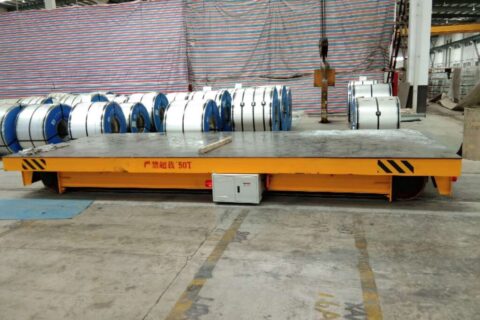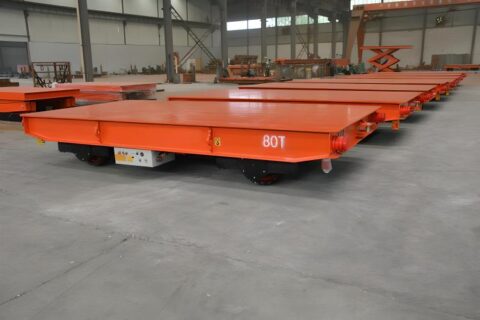

KPDS Low-Voltage Rail Electric Flat Car for Industrial Transport
Product Introduction
The KPDS series low-voltage rail-powered electric flat cars are available in the following main models and load capacities: KPDS-2t, KPDS-5t, KPDS-10t, KPDS-16t, KPDS-20t, KPDS-25t, KPDS-30t, KPDS-40t, KPDS-50t, KPDS-63t, KPDS-80t, KPDS-100t, KPDS-150t, etc. The KPDS series operates by stepping down a 380V AC power supply to 36V AC three-phase via a transformer, which is then connected to three rails (including one additional conductor rail). The wheels and contact shoes on the flat car pick up the 36V supply and feed it into the onboard electrical box, where a step-up transformer raises it back to 380V to drive the AC metallurgical motor.
In terms of power supply, the safe 36V low voltage is transmitted along the rails, so even direct human contact with the rails poses no risk of injury. The flat car can travel on S-shaped and curved tracks, which requires a high standard of rail insulation. The operating system is controlled by the low-voltage 36V supply, and the flat car can be optionally equipped with hydraulic lifting and hoisting systems.
This series is designed for applications involving heavy loads (>50t), high duty cycles, and medium-to-long-distance transport. Compared to KPX battery-powered flat cars, it offers continuous operation without the need for recharging; compared to KPC conductor rail cars, it provides greater electrical safety (36V vs. 380V). Travel distance is not limited, although additional transformers are required for runs exceeding 70 meters to compensate for voltage drop along the rails. This series is suitable for use on S-shaped tracks, curved tracks, and in high-temperature environments.
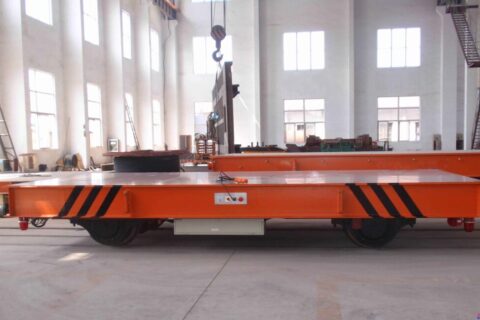
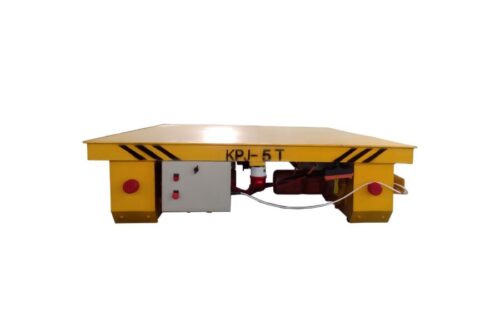
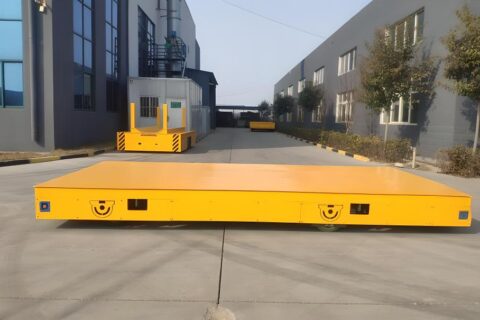
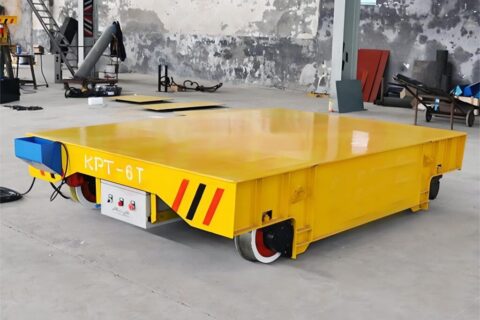
Product Gallery
Models & Specifications
- Product Name: KPDS Low-Voltage Rail-Powered Electric Flat Car
- Also Known As: Electric flat car, low-voltage rail car
- Model & Specification: KPDS series (KPDS-2t ~ KPDS-150t)
- Category: Ground conveying machinery
- Power Supply: AC 36V low-voltage rail power supply
- Motor Type: AC metallurgical motor
- Control Voltage: 36V low voltage
- Operation Mode: Pendant control / remote control
- Place of Origin: Changyuan, Xinxiang, Henan
- Customization: Available upon request
- Stock Status: Built to order
- Production Lead Time: 10–15 days
- Delivery Coverage: Nationwide
- Delivery Method: Customer pickup or freight arranged
- Installation: Quoted separately
- After-Sales Service: 1-year warranty
Product Features
- 36V Safe Voltage: The rail voltage is only AC 36V, posing no risk of injury upon contact. Compared to KPC conductor rails (exposed 380V) and KPJ cable reels (380V cable), this offers the highest level of safety, making it ideal for workplaces with high personnel density or stringent safety requirements.
- Capable of S-Shaped / Curved Track Travel: The 36V low-voltage supply along the rails has no directional restrictions, allowing the flat car to navigate S-shaped and curved tracks to suit complex factory layouts.
- Unrestricted Continuous Operation: Unlike KPX battery-powered cars that require downtime for charging, the KPDS receives continuous power from the rails, enabling 24-hour operation with equipment utilization rates exceeding 95%.
- Heavy-Duty Capability: AC metallurgical motors provide high starting torque, making them particularly suitable for heavy-load transport above 50t. These motors are resistant to high temperatures and dust, with strong overload capacity for demanding conditions.
- Curved Track Capability: The low-voltage power supply ensures uninterrupted electrical connections on curved track sections, offering greater flexibility compared to KPC conductor rails (which require straight sections).
- Rich Expandable Functions: Optional add-ons include hydraulic lift platforms, tipping devices, V-shaped supports, rotating tables, remote control systems, explosion-proof electrical controls, and variable-frequency speed control.
Working Principle
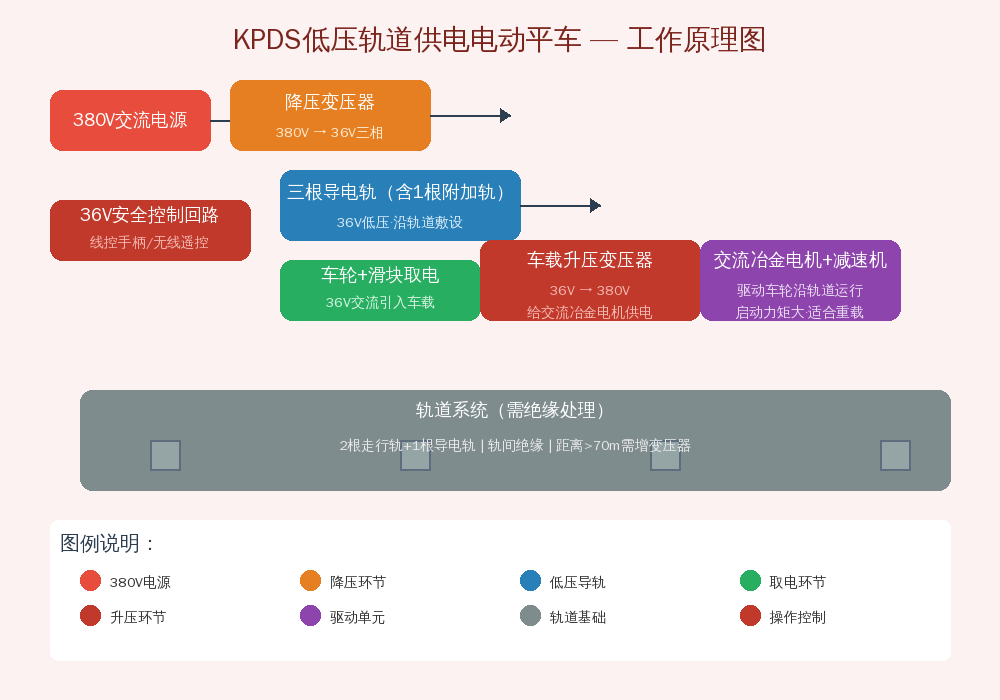
The working principle of the KPDS low-voltage rail-powered electric flat car is based on a safe power supply scheme of "stepping down for transmission, stepping up for use":
First, the workshop's 380V AC power supply is stepped down to AC 36V three-phase by a step-down transformer and connected to three parallel rails — two running rails and one additional conductor rail. The three rails are electrically insulated from each other (insulating base plates are placed under the rails, and insulating sleeves are fitted at the rail clips).
The flat car picks up the three-phase 36V supply through its wheels (in contact with the running rails) and a dedicated contact shoe (in contact with the additional conductor rail), feeding it into the onboard electrical box. Since the 36V low voltage is transmitted along the rails, even exposed rails do not pose a safety hazard to personnel.
Inside the onboard electrical box, the 36V supply is stepped up to three-phase 380V by a step-up transformer to power the AC contactors and the AC metallurgical motor. The control system operates on the safe 36V supply (via an isolation transformer), using a pendant control or wireless remote control to switch the contactors, thereby controlling the flat car's start, stop, forward, reverse, and speed adjustment.
When the travel distance exceeds 70m, voltage drop along the rails increases, requiring booster transformers to be installed at intermediate points or at the end of the track to ensure the flat car at the far end still receives adequate 36V power. The number of booster transformers is determined based on distance and current-carrying capacity.
Product Structure
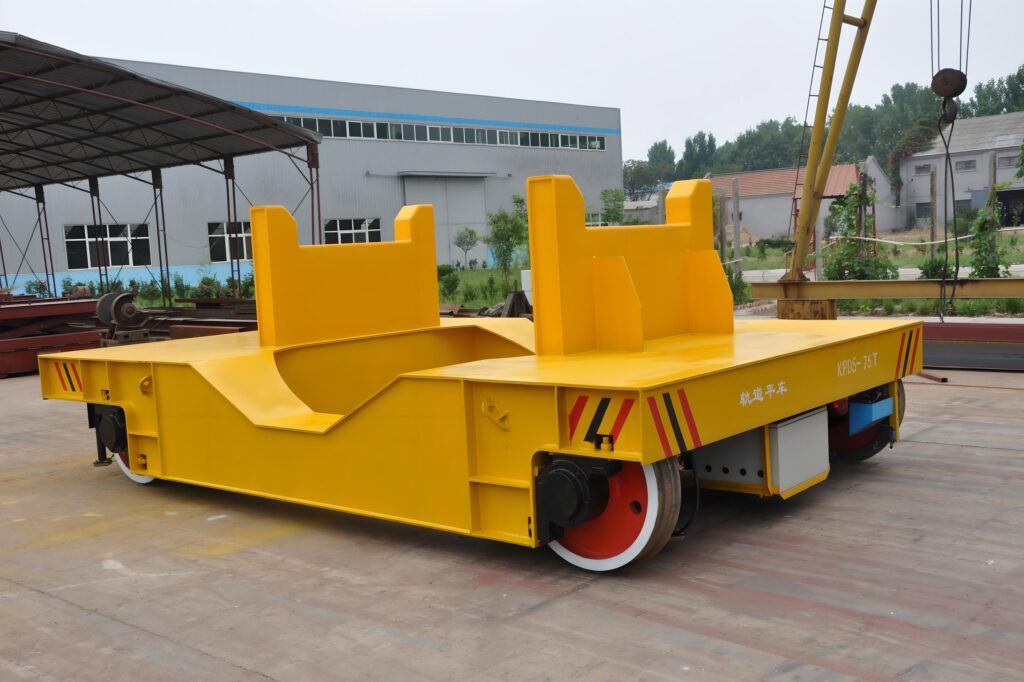
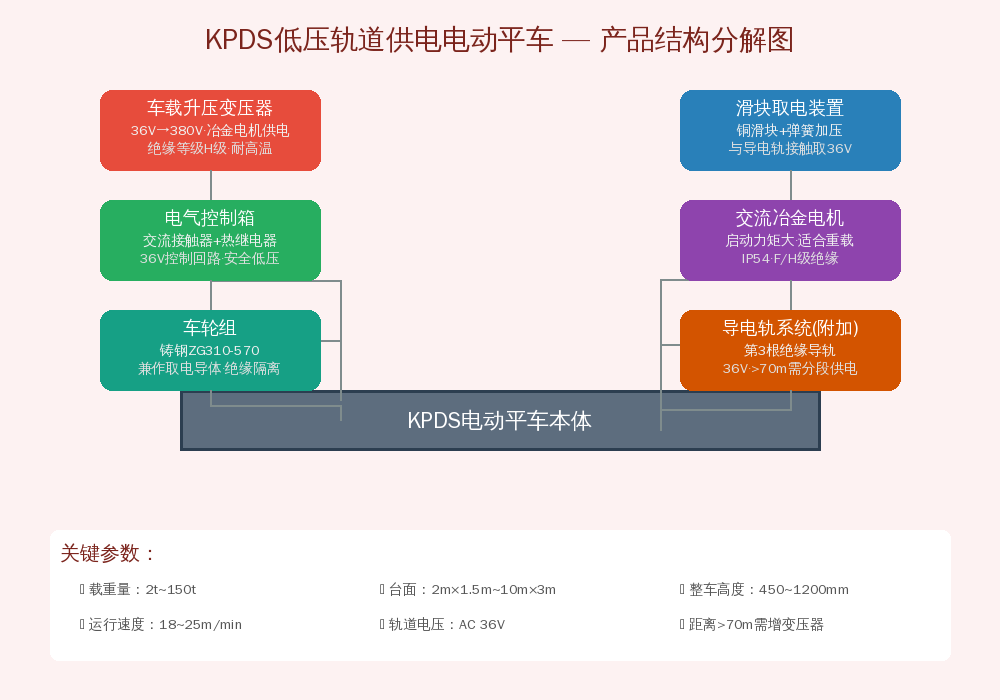
The KPDS low-voltage rail-powered electric flat car consists of the following main structural components:
- Frame (Load Platform): Box-section welded structure made of Q235B steel plate, reinforced with I-Beam or H-Beam main girders, with graduated designs for 2t to 150t capacities. The 150t model uses Q345B low-alloy High-Strength Steel.
- Power Pickup System: Comprises the wheels (which also serve as conductors) + contact shoes (copper-graphite composite material) + spring-loaded pressure mechanism. The wheels contact the running rails to pick up two phases, while the contact shoe contacts the additional conductor rail for the third phase. The wheel bearings are insulated from the frame using insulators, with Insulation Resistance ≥1MΩ (tested with a 500V Megohmmeter).
- Onboard Step-Up Transformer: Dry-type isolation transformer that steps up 36V to 380V. Capacity is selected based on motor power (standard configuration: 1.5~20kVA). Insulation Class H (temperature resistance 180°C), suitable for High-Temperature Environments.
- Electrical Control Cabinet: Built-in circuit breaker, AC contactor, thermal overload relay, isolation transformer (380V/36V), and switching power supply. The control circuit operates at a safe 36V, with emergency stop, overload, short-circuit, and phase loss protection. Optional PLC (Siemens S7-200 SMART) and frequency inverter available.
- AC Metallurgical Motor: YZR/YZ series metallurgical motor with high starting torque (2.5–3 times rated torque), strong overload capacity, IP54 protection, and insulation class F/H. Designed for heavy-duty, frequent start-stop applications.
- Rail Insulation System: Insulating base plates (epoxy resin or rubber) are laid under the rail, insulating sleeves are fitted on track spikes, and insulated fishplates are used at rail joints. Insulation resistance between each rail section is ≥10kΩ (36V system). Periodic insulation testing is required during long-term operation.
Technical Parameters
KPDS Series Low-Voltage Rail Electric Flat Car Technical Specification Table
| Flat Car Model | KPDS-2t | KPDS-5t | KPDS-10t | KPDS-16t | KPDS-20t | KPDS-25t | KPDS-30t | KPDS-40t | KPDS-50t | KPDS-63t | KPDS-80t | KPDS-100t | KPDS-150t | |
| Rated Load Capacity | 2 | 5 | 10 | 16 | 20 | 25 | 30 | 40 | 50 | 63 | 80 | 100 | 150 | |
| Table Dimensions | Length | 2000 | 3500 | 3600 | 4000 | 4000 | 4500 | 4500 | 5000 | 5500 | 5600 | 6000 | 6500 | 10000 |
| Width | 1500 | 2000 | 2000 | 2000 | 2200 | 2200 | 2200 | 2500 | 2500 | 2500 | 2600 | 2800 | 3000 | |
| High | 450 | 450 | 500 | 500 | 550 | 600 | 600 | 650 | 650 | 750 | 800 | 850 | 1200 | |
| Wheel Base | 1200 | 2500 | 2600 | 2800 | 2800 | 3200 | 3200 | 3800 | 4200 | 4300 | 4700 | 4900 | 7000 | |
| Gauge (Inside Rail Distance) 1200 1435 1435 1435 1435 1435 1435 1435 1435 1435 1800 2000 2000 | ||||||||||||||
| Wheel Diameter | Φ270 | Φ300 | Φ300 | Φ350 | Φ350 | Φ400 | Φ400 | Φ500 | Φ500 | Φ600 | Φ600 | Φ600 | Φ600 | |
| Number of Wheels | 4 | 4 | 4 | 4 | 4 | 4 | 4 | 4 | 4 | 4 | 4 | 4 | 8 | |
| Ground Clearance | 50 | 50 | 50 | 50 | 50 | 50 | 50 | 50 | 50 | 75 | 75 | 75 | 75 | |
| Travel Speed | 25 | 25 | 25 | 20 | 20 | 20 | 20 | 20 | 20 | 20 | 20 | 20 | 18 | |
| motor power | 0.8 | 1.5 | 1.5 | 2.2 | 2.5 | 3 | 4 | 5.5 | 5.5 | 7.5 | 7.5 | 11 | 15 | |
| Maximum Wheel Load | 14.4 | 25.8 | 42.6 | 64.5 | 77.7 | 94.5 | 110.4 | 142.8 | 174 | 221.4 | 278.4 | 343.8 | 265.2 | |
| Reference Weight | 2.3 | 3.5 | 4 | 5 | 5.5 | 6.2 | 6.3 | 7.2 | 7.6 | 10.3 | 12.1 | 13.9 | 26 | |
| Recommended Crane Rail Model | P15 | P18 | P18 | P24 | P24 | P38 | P38 | P43 | P43 | P50 | P50 | QU100 | QU100 | |
Application Scenarios
- Heavy-Duty Cross-Bay Transport in Steel Mills: A steel mill installed a KPDS-80t low-voltage rail flat car between its continuous casting bay and refining bay, covering a distance of approximately 60m and operating continuously in three shifts. The 36V safe low voltage eliminates the risk of electric shock to operators, while the AC metallurgical motor delivers high starting torque to meet the demanding requirements of frequent heavy-load starts during ladle transport.
- S-Curve Rail in Foundry Workshops: A foundry's sand processing line is laid out in an S-shape, so a KPDS-25t flat car was selected to transport molding boxes along the curved rail. Low-voltage rail power supply solves the problem of conductor rail installation being impractical on curved sections — the 36V supply transmits along the curved rail with no directional restrictions, and the rail insulation is handled in a single pass.
- High-Temperature Heat Treatment Workshops: A KPDS-40t flat car shuttles workpieces back and forth in front of heat treatment furnaces, where ambient temperatures range from 55 to 70°C. The onboard step-up transformer features Class H insulation (rated for 180°C), and the metallurgical motor offers superior heat resistance compared to standard motors. The 36V low-voltage rail provides a distinct safety advantage in high-temperature environments.
- Heavy-Duty Assembly Lines: A KPDS-50t flat car transports large structural components (approx. 35–45t each) along the assembly line over a distance of 40m. Low-voltage rail power eliminates the downtime associated with battery charging, enabling uninterrupted, round-the-clock material delivery.
- Material Flow on Curved Tracks: In one workshop, two parallel main factory buildings are connected by a curved track, along which a KPDS-16t flat car shuttles workpieces. The 36V low-voltage power supply imposes no special requirements on electrical connections for curved track sections, making installation quick and straightforward.
Selection Guide
- Load Capacity: Select based on the maximum weight per single transport. The KPDS series is particularly well-suited for heavy loads (50t and above).
- Travel Distance: ≤70m — standard configuration; 70–150m — a booster transformer must be added at the midpoint of the track; ≥150m — segmented power supply is required, with each segment equipped with its own transformer.
- Rail Insulation: Insulating base plates are laid beneath the rail, insulating sleeves are fitted over the spikes, and insulating fishplates are used at rail joints. It is recommended that insulation resistance be ≥10kΩ at initial installation.
- Environmental Conditions: For high-temperature environments, select Class H insulated transformers and metallurgical motors; for outdoor use, add a rain cover; in humid conditions, increase the frequency of insulation testing.
- Curved Track Requirements: If the car must travel on curved track, provide the curvature radius and angle. Opt for double-flanged wheels, and reinforce insulation treatment on curved sections.
- Feature Expansion: Hydraulic lifting (150–300mm), variable-frequency speed control, wireless remote control, PLC automation, and other options are available on demand.
Operating Instructions & Safety Guidelines
Operating Steps
- Pre-power inspection: Verify that the rail insulation is intact (no standing water, no metal bridging), the conductive slider makes proper contact, and the rail surface is free of obstructions.
- Start-up: Close the power switch on the ground-mounted step-down transformer, then close the main circuit breaker in the flat car's control box. Once the controller is energized, press the start button.
- Operation: Use the tethered pendant or remote control to move the car forward/backward.
- Emergency stop: Press the Emergency Stop Button to cut off the main circuit.
- Loading/unloading: Only load or unload after the car has come to a complete stop.
Safety Precautions
- Never exceed the rated load capacity. Buffer stops must be installed at both ends of the track.
- Test the insulation resistance of the rail insulation system once a month. If it drops below 1kΩ, maintenance must be performed immediately.
- Keep the rail surface dry and clean. Standing water or metal debris can cause short circuits or leakage.
- Replace the carbon brush on the conductive slider when it wears down to 40% of its original height.
- Periodically inspect the temperature rise and insulation condition of both the step-down and step-up transformers.
- No one is allowed to board, ride, or climb on the flat car while it is in motion.
Why Choose Kelude Heavy Industry
Compared to other KPDS low-voltage rail electric flat car suppliers on the market, Kelude Heavy Industry differentiates itself in the following areas:
| Comparison Parameter | Kelude Heavy Industry KPDSFlat Car | Market Comparable Products |
|---|---|---|
| Transformer | Dry-Type HClass Insulation, Temperature Resistance 180℃, Efficiency≥95% | Standard BClass Insulation, Temperature Resistance 130℃, Efficiency≤88% |
| Current Collector | Copper Slider+Independent Spring Pressurization, Adjustable Pressure 20~50N | Cast Iron Slider+Shared Spring, Uneven Contact Pressure |
| Frame Structure | Q345B (≈S355J2)High-Strength Steel(≥30tClass), FEA Optimization | Standard Q235B (≈S235JR), Prone to Under Long-Term Heavy Load Weld Seam Cracking |
| Insulation Design | Crane Rail+Bearing Double Insulation, Standard Insulation Detection Port | Only Crane Rail Insulation, None Detection Port |
| After-Sales Warranty | 1 Year Whole Machine Warranty,48On-Site Response within Hours, Lifetime Technical Support | 6~12Months,72Response within Hours |
| Customization Capability | Table Surface/Load Capacity/Curved Rail/Lifting/Explosion-proof Fully Customized,12Years of Experience | Only Standard Model, Non-Standarddelivery time Length(≥25Days) |
Kelude Heavy Industry brings 12 years of experience in the design & manufacturing of electric flat cars, having delivered over 1,800 units across various models. Our client base includes major equipment manufacturers such as Zoomlion, XCMG, CITIC Heavy Industries, and China First Heavy Industries.
Service & Support
- Pre-Sales Consultation: Free technical solutions, model selection advice, and rail insulation design.
- In-Process Service: Foundation condition drawings, factory test run and acceptance.
- Installation & Commissioning: On-site technical guidance available (additional cost applies).
- Training Support: Operator training for 1–2 days.
- After-Sales Maintenance: 1-year warranty on the complete machine, on-site response within 48 hours domestically.
- Spare Parts Supply: Transformers, conductor shoes, carbon brushes, metallurgical motors, and other components.
Need a KPDS low-voltage rail electric flat car selection plan or quotation?
Feel free to contact the Kelude Heavy Industry sales & technical team for free solution design and technical consultation.
FAQ
Q: Is the KPDS low-voltage rail power supply safe?
A: Very safe. The rail voltage is only AC 36V, which falls under the Safety Extra-Low Voltage (SELV) category and poses no harm upon human contact. Even under special conditions such as poor insulation of work shoes or wet floors, 36V will not generate a dangerous current. This is the biggest safety advantage of KPDS compared to KPC (exposed 380V conductor rail).
Q: How is KPDS rail insulation done? How often does it need maintenance?
A: Insulation base plates (epoxy resin or rubber plates, thickness ≥5mm) are laid under the rail, insulating sleeves are fitted at spike locations, and insulating fishplates are used at rail joints. The recommended initial insulation resistance is ≥10kΩ. Routine testing of insulation resistance is recommended quarterly; if it drops below 1kΩ, repair or replacement of insulation components is required. With normal maintenance, the rail insulation system lasts approximately 3–5 years.
Q: What if the travel distance is long?
A: The standard effective distance for KPDS is approximately 70m (beyond which rail voltage drop increases). Solutions: for 70–150m, add one voltage-boosting transformer in the middle of the rail; for over 150m, use segmented power supply with each segment equipped with its own step-down transformer. The number and placement of boost transformers are determined by our technical team based on distance and current capacity calculations.
Q: Can KPDS be used outdoors?
A: Yes, it can be used on hard outdoor surfaces, but the following must be noted: the rail insulation system requires waterproof design (add insulating waterproof covers), the rail foundation should avoid water accumulation; the electrical cabinet needs a rain cover with IP54 protection or higher. Use in outdoor environments with prolonged water accumulation or high humidity is not recommended.
Q: Can the KPDS flat car be automated?
A: Yes. The KPDS flat car can be optionally equipped with PLC, frequency inverter, and positioning sensors, working with a central dispatching system for automatic travel. Low-voltage rail power supply is naturally suited for automation (no charging required, no cable dragging), achieving positioning accuracy of ±10mm.
Q: What national standards does the KPDS low-voltage rail electric flat car comply with?
A: The design & manufacturing of the KPDS series low-voltage rail electric flat car strictly follows the JB/T 6127-2010 industry standard for electric flat cars. The low-voltage power supply section complies with GB/T 14048 (low-voltage switchgear) and GB 5226.1-2019 (Electrical safety of machinery). The rail insulation design references GB 50150 (Standard for acceptance test of electric equipment installation engineering). Each machine undergoes three-stage acceptance before shipment: full-load test run, dynamic load test, and static load test.
Other Types of Electric Flat Cars
As a manufacturer of KPDS low-voltage rail electric flat cars, we also offer a full range of products including BWP trackless flat cars, KPDZ low-voltage rail flat cars, KPX battery-powered flat cars, KPC conductor rail flat cars, KPT cable reel flat cars, KPJ cable drum flat cars, as well as explosion-proof electric flat cars, ladle cars, lifting flat cars, jib crane flat cars, and non-powered tow flat cars. For more model selections and pricing, please contact our customer service.