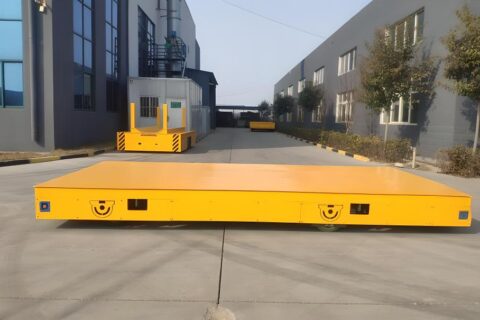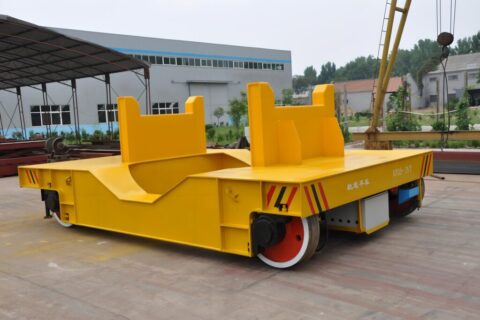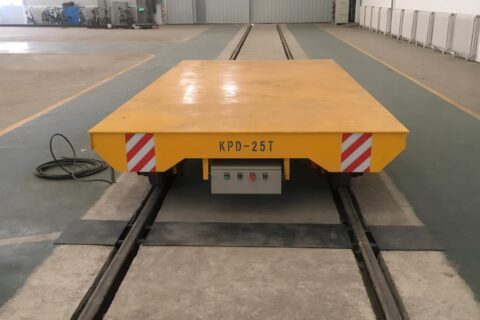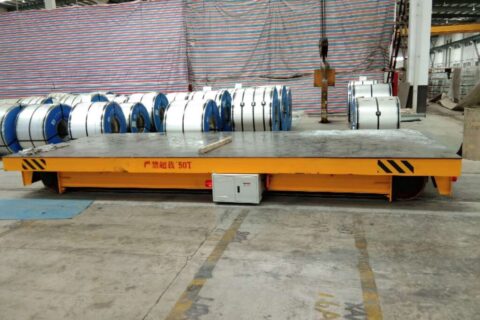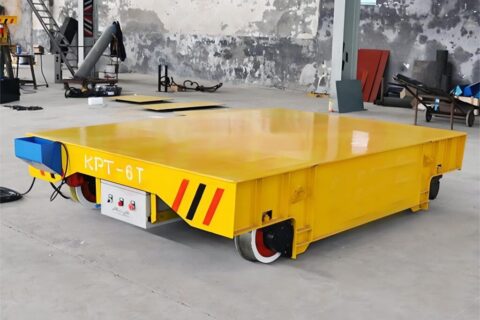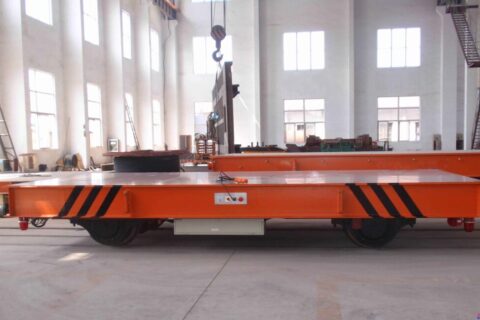

KPC Electric Flat Car with Conductor Rail Power Supply
Product Introduction
The KPC conductor rail-powered track-type electric flat car is available in the following main models and load capacities: KPC-2t, KPC-5t, KPC-10t, KPC-16t, KPC-20t, KPC-25t, KPC-30t, KPC-40t, KPC-50t, KPC-63t, KPC-80t, KPC-100t, KPC-150t, etc. The KPC series conductor rail-powered track flat car directly feeds 380V AC power from an enclosed conductor rail into the car's AC control system to control starting, stopping, forward, and reverse movements.
For power supply, the flat car draws power via sliding current collectors on the enclosed conductor rail. The rail can be installed either between the tracks or in a trench outside the tracks, with a cover plate and automatic flip-up mechanism on top of the trench for both safety and aesthetics. The operating system uses low-voltage 36V control, and the flat car can be optionally equipped with a hydraulic lifting system.
This series is suitable for harsh and high-temperature environments. Thanks to its simple structure, low track installation requirements, and cost-effectiveness, it is an ideal material transport solution for workshop assembly lines. It is particularly well-suited for assembly line operations with short travel distances, extremely high duty cycles, and low overall height requirements.
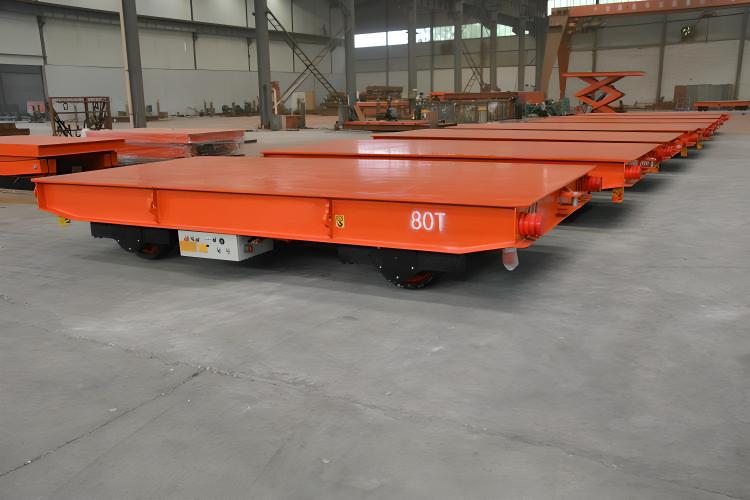
Product Gallery
Models & Specifications
- Product Name: KPC Conductor Rail-Powered Track-Type Electric Flat Car
- Also Known As: Conductor rail track-type ground flat car, conductor rail-type track car
- Model & Specification: KPC series (KPC-2t ~ KPC-150t)
- Category: Ground material handling machinery
- Power Supply: 380V AC enclosed conductor rail
- Control Voltage: Low-voltage 36V
- Operation Mode: Cable pendant control / Remote control
- Place of Origin: Changyuan, Xinxiang, Henan
- Customization: Non-standard manufacturing available (table dimensions and load capacity customizable)
- Stock Status: Made to order
- Production Lead Time: 10–15 days
- Delivery Coverage: Nationwide
- Delivery Method: Customer pickup or freight arranged by us
- Installation: Available at additional cost
- After-Sales Service: One-year warranty
Product Features
- Reliable Power Supply: Direct 380V AC power from an enclosed conductor rail eliminates battery charging downtime associated with battery-powered units and removes the risk of cable wear and breakage found in cable reel systems, making it ideal for high-frequency continuous operation. The rail can be installed between the tracks or in a trench outside the tracks, with a cover plate and automatic flip-up mechanism on top of the trench for both safety and aesthetics.
- Simple Structure, Low Maintenance Costs: The mechanical structure consists of only four main components — the frame, wheel blocks, motor gearbox, and electrical control cabinet — with no complex hydraulic or pneumatic systems. The only critical wear parts are the conductor rail carbon brushes and wheel bearings, keeping annual maintenance costs at approximately one-third of those for battery-powered flat cars.
- Built for Harsh Environments: The electrical control cabinet is sealed to IP54 Protection, and the current collector carbon brushes maintain reliable contact unaffected by dust or moisture. Suitable for high-temperature, dusty environments such as foundries, steel mills, forging shops, and heat treatment workshops, with normal operation in ambient temperatures from -20°C to +60°C.
- Flexible Travel Distance: Conductor rail power supply imposes no battery range limitations — travel distance is constrained only by the length of rail installed. Standard configuration supports transport up to 100m per run, extendable to over 500m with intermediate power feed sections.
- Low Overall Height: The motor gearbox is mounted horizontally inside the frame, keeping the overall height to just 450–1200mm (depending on load capacity), making it suitable for confined spaces and low-ceiling workshop environments.
- Extensive Optional Features: Optional hydraulic lifting platform, tipping device, V-type cradle, rotating table, remote control system, explosion-proof electrical system, and variable-frequency speed control are available, allowing one car to serve multiple process requirements.
Working Principle
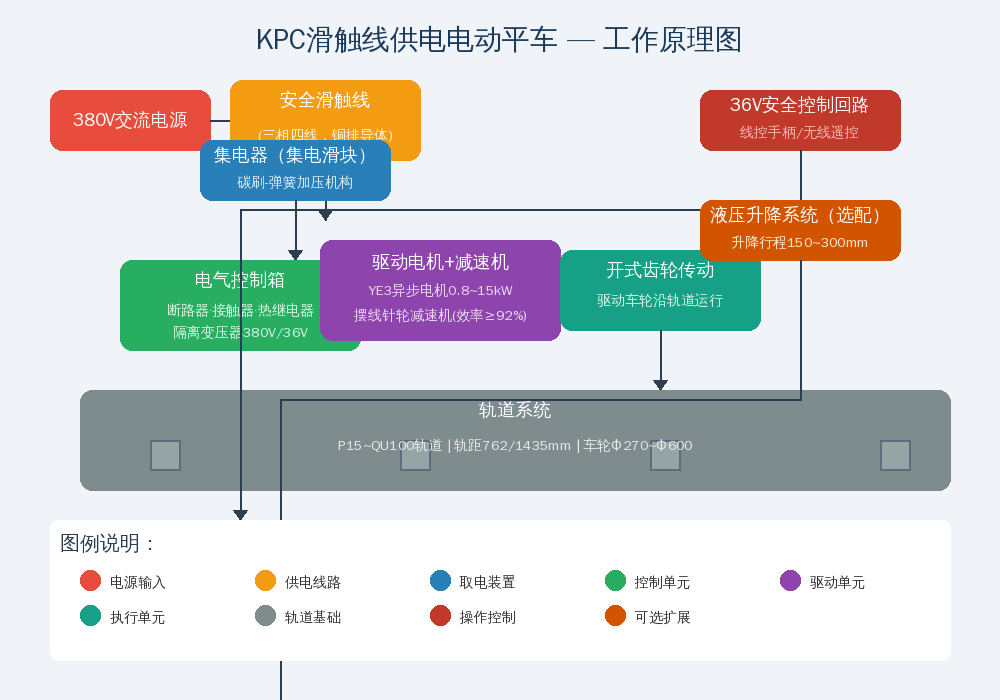
The working principle of the KPC conductor rail-powered track-type electric flat car is based on sliding contact power supply between the enclosed conductor rail and the current collector:
First, an enclosed conductor rail (three-phase four-wire or three-phase three-wire configuration) is laid either between the tracks or in a trench alongside them. The rail housing is made of engineering plastic or aluminum alloy profiles, with copper busbar conductors embedded inside. The rail is installed in sections connected to a 380V AC power source, with each section joined by dedicated connectors to ensure electrical continuity and mechanical strength.
A current collector (collector shoe) is mounted on the underside of the flat car, with carbon brushes held in reliable contact against the copper busbar under spring pressure. As the car travels along the track, the current collector slides within the rail, continuously delivering 380V AC power to the car's electrical control system.
The 380V AC power entering the car passes through control components in the control cabinet — circuit breakers, contactors, thermal overload relays, etc. — to drive a three-phase asynchronous motor (0.8–15kW depending on model). The motor output is reduced through a gearbox and transmitted via open gearing to drive the wheels along the track. The control system operates on safe 36V low voltage (stepped down via a 380V/36V isolation transformer), with a cable pendant or wireless remote control switching the contactors to achieve start, stop, forward, and reverse operation.
After the car passes over a section of the trench, the automatic flip-up cover mechanism resets to prevent personnel or foreign objects from falling into the trench. When the optional hydraulic lifting system is fitted, the hydraulic pump station is powered directly from the conductor rail supply, and solenoid directional valves control the lift cylinders to raise and lower the table within a 150–300mm range.
Product Structure
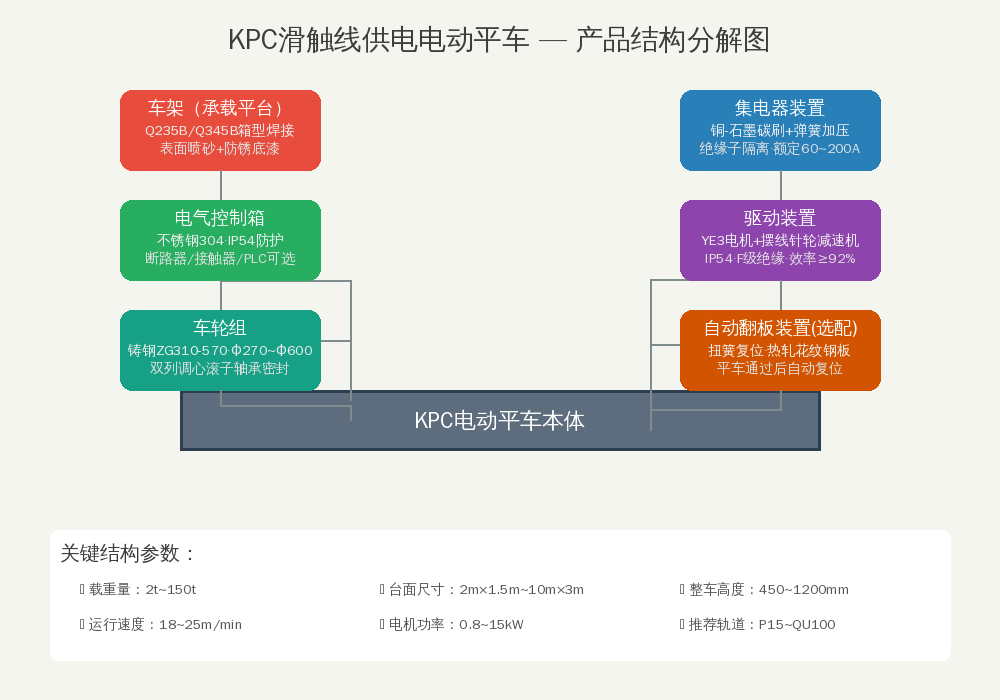
The KPC conductor rail-powered track-type electric flat car consists of the following main structural components:
- Frame (Load Platform): Fabricated from Q235B steel plate welded into a box-section structure, with the main girder reinforced using I-Beam or H-Beam sections. Load capacity is designed in grades from 2t to 150t. The surface is sandblasted and coated with anti-rust primer plus topcoat. The 150t-class frame uses Q345B low-alloy high-strength steel, with the main girder section height increased by 30% over the standard design.
- Wheel Block: Cast steel wheels (ZG310-570) with induction-hardened treads at HB320-380. Wheel diameters range from Φ270 to Φ600, with 4 or 8 wheels (8 for the 150t model). Wheel bearings are double-row spherical roller bearings, sealed with a combination of labyrinth seals and skeleton oil seals. Wheel flanges are available in both double-flange and single-flange configurations, compatible with P15 to QU100 crane rails.
- Drive Unit: Motor (YE3 series high-efficiency motor) coupled with a cycloidal gearbox (or hardened tooth flank gear reducer for the 150t model). The motor is flange-mounted to the gearbox input, and the gearbox output shaft transmits power to the driving wheels via a coupling or open gear. Motor protection rating is IP54, with Insulation Class F.
- Current Collector Assembly: Consists of a collector bracket, carbon brushes (copper-graphite composite), spring-loaded pressure mechanism, and collector leads. Carbon brush contact pressure is adjustable from 20 to 50N. Each collector is rated at 60–200A, with multiple units mounted in parallel to ensure reliable high-current transfer. Insulators isolate the collector bracket from the cart frame. Carbon brushes must be replaced when the remaining height falls below 40% of the original dimension.
- Electrical Control Cabinet: Stainless steel (304) enclosure with IP54 protection. Equipped with a circuit breaker, AC contactors, thermal overload relays, an isolation transformer (380V/36V), and a switching power supply. The control circuit operates at 36V safety voltage and includes an emergency stop button, overload protection, short-circuit protection, and phase loss protection. Optional PLC control (Siemens S7-200 SMART) and frequency inverter (Siemens V20/G120) are available for multi-speed and stepless control.
- Automatic Tipping Device (optional): Installed beneath the pit cover plate, consisting of a tipping shaft, torsion spring, and limit stops. As the cart passes, the wheels depress the plate; the torsion spring returns it to position afterward. The plate is made of hot-rolled checkered steel plate (δ=6–10mm) with a slip-resistant surface.
Technical Parameters
KPC Conductor Rail Powered Electric Flat Car — Technical Specification Table
| Flat Car Model | KPC-2t | KPC-5t | KPC-10t | KPC-16t | KPC-20t | KPC-25t | KPC-30t | KPC-40t | KPC-50t | KPC-63t | KPC-80t | KPC-100t | KPC-150t | |
| Rated Load Capacity | 2 | 5 | 10 | 16 | 20 | 25 | 30 | 40 | 50 | 63 | 80 | 100 | 150 | |
| Table Dimensions | Length | 2000 | 3500 | 3600 | 4000 | 4000 | 4500 | 4500 | 5000 | 5500 | 5600 | 6000 | 6500 | 10000 |
| Width | 1500 | 2000 | 2000 | 2000 | 2200 | 2200 | 2200 | 2500 | 2500 | 2500 | 2600 | 2800 | 3000 | |
| High | 450 | 550 | 500 | 500 | 550 | 600 | 600 | 650 | 650 | 750 | 800 | 850 | 1200 | |
| Wheel Base | 1200 | 2500 | 2600 | 2800 | 2800 | 3200 | 3200 | 3800 | 4200 | 4300 | 4700 | 4900 | 7000 | |
| Gauge (Inside Rail Distance) | 1200 | 1435 | 1435 | 1435 | 1435 | 1435 | 1435 | 1435 | 1435 | 1435 | 1800 | 2000 | 2000 | |
| Wheel Diameter | Φ270 | Φ300 | Φ300 | Φ350 | Φ350 | Φ400 | Φ400 | Φ500 | Φ500 | Φ600 | Φ600 | Φ600 | Φ600 | |
| Number of Wheels | 4 | 4 | 4 | 4 | 4 | 4 | 4 | 4 | 4 | 4 | 4 | 4 | 8 | |
| Ground Clearance | 50 | 50 | 50 | 50 | 50 | 50 | 50 | 50 | 50 | 75 | 75 | 75 | 75 | |
| Travel Speed | 25 | 25 | 25 | 20 | 20 | 20 | 20 | 20 | 20 | 20 | 20 | 20 | 18 | |
| motor power | 0.8 | 1.5 | 1.5 | 2.2 | 2.5 | 3 | 4 | 5.5 | 5.5 | 7.5 | 7.5 | 11 | 15 | |
| Maximum Wheel Load | 14.4 | 25.8 | 42.6 | 64.5 | 77.7 | 94.5 | 110.4 | 142.8 | 174 | 221.4 | 278.4 | 343.8 | 265.2 | |
| Reference Weight | 2.3 | 3.3 | 3.8 | 5 | 5.5 | 6 | 6.3 | 7.2 | 7.6 | 10.3 | 12.1 | 13.9 | 26 | |
| Recommended Rail Model | P15 | P18 | P18 | P24 | P24 | P38 | P38 | P43 | P43 | P50 | P50 | QU100 | QU100 | |
Typical Applications
- Sand mold / sand core transfer in foundry workshops: An automotive parts foundry adopted the KPC-20t conductor rail electric flat car for round-trip transport between the core drying oven and the pouring station, achieving a transfer rate of 15–18 trips per hour. Compared with the previous forklift-based solution, manpower on the line was reduced from 4 operators to 1, and the sand mold damage rate dropped by 60%.
- Steel coil / billet cross-line transport in steel mills: A medium and heavy steel plate mill installed a KPC-50t conductor rail flat car between the rolling line and the heat treatment line. Equipped with a hydraulic lifting table for automatic steel coil transfer, the daily throughput increased from 420t to 680t after the retrofit. Conductor rail power supply eliminated the downtime caused by frequent battery charging on battery-powered flat cars, raising equipment utilization to 92%.
- Workpiece transfer in forging / heat treatment workshops: The KPC-30t flat car is fitted with a high-temperature resistant protective cover and can transport forged blanks between forging stations with an ambient temperature of 55°C and workpiece temperatures up to 800°C. The table surface is lined with heat-resistant cast iron plates (temperature resistance ≥600°C), and the current collector uses high-temperature resistant carbon brushes (working temperature ≤120°C), providing over one year of continuous operation without replacement.
- Material distribution on assembly lines: A construction machinery assembly workshop adopted the KPC-10t flat car with a hydraulic lifting table to deliver large components such as engines and gearboxes from the parts staging area to individual assembly stations along the line. With an overall height of only 500mm, the car can travel beneath the production line, delivering 40% higher distribution efficiency than an AGV solution at one-third of the investment cost.
- Heavy workpiece flow on welding production lines: The excavator structural component welding line is equipped with a KPC-25t conductor rail flat car. The 4m × 2.2m table carries excavator boom weldments (approx. 18–22t), and locating stops at both ends of the table enable precise positioning of workpieces between welding positioners.
Selection Guide
- Load capacity (rated load): Select based on the maximum weight of the workpiece or material transported in a single trip. A 20%–30% safety margin is recommended — for example, if the actual maximum transport weight is 15t, choose the KPC-20t rather than the KPC-16t. For long-distance transport (one-way >50m), it is advisable to select one size up.
- Table dimensions: Determine the table length × width based on the workpiece footprint. Long workpieces (steel billets / pipes) require a long table; wide workpieces (structural components / equipment) require a wide table. If standard table sizes do not meet your requirements, custom dimensions are available. Table height must match the loading/unloading station height.
- Travel distance and duty cycle: For one-way travel distances ≤100m, a standard conductor rail configuration is sufficient; for 100–300m, an intermediate power feed section is required; for >300m, segmented power supply or alternative power supply methods are recommended. For heavy-load, high-frequency applications with ≥30 trips per hour, use a heavy-duty current collector (dual carbon brushes in parallel) with the motor power selected one grade higher.
- Environmental conditions: High-temperature environments (>50°C) require high-temperature resistant motors (Class F/H insulation) and high-temperature resistant carbon brushes; dusty/humid environments require a control box with IP54 or higher protection rating; outdoor use requires a rain cover and anti-corrosion treatment; explosive atmospheres require explosion-proof electrical control (Ex db eb IIB T4 Gb).
- Track installation: The wheel base and gauge (inside rail distance) must match the existing or newly laid track. Common gauge: 1435mm (standard gauge); light-duty models (≤16t) can use 762mm narrow gauge. Rail type (P15–QU100) is determined by wheel diameter and wheel load — see the Technical Specifications for details.
- Functional expansion requirements: If hydraulic lifting (150–300mm stroke) or tilting is required, this must be specified at the time of selection. Variable Frequency Speed Control is recommended for precision material transport requiring smooth acceleration and deceleration. Wireless remote control range of ≥100m (open area) is recommended to cover most workshop applications.
Operating Instructions & Safety Precautions
Operating Steps
- Pre-power inspection: Verify that the conductor rail power supply is normal (power indicator light on), the current collector carbon brushes are in good contact with the conductor rail, and the track surface is clear of obstructions.
- Start-up: Close the main circuit breaker in the flat car control box to energize the control circuit, then press the start button to latch the control circuit.
- Operation: Use the wired pendant or wireless remote control — press the "Forward" button to move the car forward; press the "Reverse" button to move the car backward. (Releasing the button stops the car; inching control enables precise positioning within 5m.)
- Emergency stop: In a crash back situation, immediately press the Emergency Stop Button to cut off the main circuit power. To reset, turn the emergency stop button clockwise and pull it out, then press the start button again.
- Loading/unloading: Only after the car has come to a complete stop and the brake is confirmed to be engaged (wheels locked by the motor's built-in electromagnetic brake or mechanical braking device after power-off) may loading or unloading proceed.
Safety Precautions
- Overloading and eccentric loading are strictly prohibited. The load per trip must not exceed the Rated Load Capacity. Under eccentric loading, the center of gravity of the load must remain within ±15% of the table center.
- Buffer stops (track end stops) must be installed at both ends of the track to prevent the flat car from derailing.
- The cover plates over the conductor rail trench must be kept in good condition. Travel over sections with missing cover plates is strictly prohibited. The automatic flip-plate mechanism must be periodically inspected for the return spring.
- No personnel are allowed to board, climb, or dismount the car while it is in motion, and no part of the body may be extended between the car and the track.
- Carbon brushes on the current collector must be replaced when worn to the specified limit (remaining height less than 40% of the original size). Disconnect the main power supply before replacement.
- Clean accumulated dust/metal filings from the conductor rail channel once a week, and check the spring pressure of the current collector.
Why Choose Kelude Heavy Industry
Compared with other conductor rail electric flat car suppliers on the market, Kelude Heavy Industry differentiates itself in the following areas:
| Comparison Parameter | Kelude Heavy Industry KPCFlat Car | Market Comparable Products |
|---|---|---|
| Frame Structure | Q345B (≈S355J2)High-Strength Steel(≥30tClass), FEA Optimization, Main Girderfatigue life≥10⁶Times | Standard Q235B (≈S235JR), Not Optimized, Prone to Occur Under Long-Term Heavy Load Weld Seam Cracking |
| drive system | YE3 High Efficiency Motor+Cycloidal Gearbox(Efficiency≥92%) | Standard YSeries Motor+Worm Gearbox(Efficiency≤75%) |
| Electrical Protection | Stainless Steelcontrol box+IP54Protection+Phase Loss/overload/Triple Short-Circuit Protection | Standard Cold-Rolled Steel Sheet Plastic-Sprayed Enclosure+IP43+Single Short-Circuit Protection |
| Current Collector System | Copper-Graphite Composite Material Carbon brush+Independent Spring Pressurization(Adjustable Pressure 20~50N) | Standard Carbon brush+Shared Spring, Uneven Contact Pressure |
| After-Sales Warranty | 1 Year Whole-Machine Warranty(Wear Parts Excluding),48On-Site Response Within Hours(Domestic), Lifetime Technical Support | 6~12Months,72Response Within Hours, High Parts Markup After Warranty |
| Customization Capability | Table Dimensions/Load Capacity/Lifting Function/Explosion-proof/Frequency conversion Fully Customizable,12Years of Industry Experience | Provided Only Standard Model, Non-Standarddelivery time Length(≥25Days), Unstable Process |
Kelude Heavy Industry has 12 years of experience in the Design & Manufacturing of electric flat cars, having delivered over 1,800 units across various models. Our client base includes major equipment manufacturers such as Zoomlion, XCMG, CITIC Heavy Industries, and China First Heavy Industries. We provide a full-chain service covering requirement analysis, Technical Solution design, equipment manufacturing, Installation & Commissioning, and after-sales maintenance.
Service & Support
- Pre-Sales Consultation: Free Technical consultation, product selection advice, and layout drawings. Customized solutions are available based on your factory building conditions and process requirements.
- Order Processing: Basic foundation drawings provided within 3 days of contract signing. Regular progress updates during production. Full machine test run and acceptance before shipment, including Factory Certificate and inspection reports.
- Installation & Commissioning: Technical personnel can be dispatched for On-Site Guidance on installation and commissioning (additional cost applies), ensuring track laying accuracy and electrical system parameters meet design specifications.
- Operator Training: Training provided covering operating procedures, daily inspections, and common fault troubleshooting. Sessions last 1-2 days and can be conducted on-site or remotely. Complete Operation Manual and Maintenance Manual are provided.
- After-Sales Service: 1-year Warranty Period on the complete machine (excluding Wear Parts). Free repair or replacement for non-human-induced failures during the warranty period. Lifetime paid service after warranty expiration, with full spare parts availability. Response within 48 hours domestically, 72 hours for remote areas.
- Spare Parts Supply: Long-term supply of Conductor Rail Current Collector carbon brushes, Gearbox / Reducer, Wheel Blocks, Bearings, electrical components, and other parts. Original manufacturer quality with transparent pricing.
Need a KPC Conductor Rail Electric Flat Car selection plan or Quotation?
Contact the Kelude Heavy Industry sales & technical team anytime for free solution design and Technical consultation.
FAQ
Q: What is the difference between the KPC Conductor Rail Electric Flat Car and the KPD low-voltage rail flat car?
A: The KPC uses 380V power supplied via an Enclosed Conductor Rail (a dedicated conductor rail laid along the track, with a Current Collector sliding for power pickup), while the KPD uses 36V low-voltage rail power (the track itself acts as the conductor). The KPC advantage is higher supply Voltage, lower resistance drop, making it suitable for longer travel distances; the KPD advantage is no exposed live parts, offering greater safety, but it requires high track insulation, suffers from larger voltage drops, and is not suitable for long distances.
Q: What is the service life of the Conductor Rail on a KPC Electric Flat Car?
A: The lifespan of the Copper busbar in the Conductor Rail depends on usage frequency and maintenance. Under normal conditions (up to 50 cycles per day, no corrosive gases in the environment), the rail itself can last 5-8 years. The Current Collector Carbon brush is a Wear Part, typically requiring replacement every 3-6 months depending on usage. We recommend quarterly inspections of carbon brush Wear; replacement is required when Wear reaches 40% of the original height.
Q: Can the KPC Electric Flat Car be used outdoors?
A: Yes, but waterproofing and corrosion protection are essential. Standard KPC cars are recommended for indoor or sheltered use. For outdoor applications, customization is required: a Rain Cover (insulated waterproof top on the control box), full-machine anti-corrosion treatment (Hot-Dip Galvanizing or Dacromet), and weather-resistant engineering plastic housings for the Conductor Rail. Outdoor tracks should also include drainage channels to prevent foundation settlement.
Q: Is Conductor Rail power supply safe? Is there a risk of electric shock?
A: The Enclosed Conductor Rail uses an insulated housing to encase the Copper busbar, providing a Protection Rating (IP) of IP23 (standard version), preventing direct contact with live parts. When installed in a floor trench, a flip-type Cover plate adds further isolation. The control circuit operates at 36V safe Voltage (via an isolation Transformer), so even an insulation fault poses no harm to operators. The Current Collector is isolated from the car frame using insulators, providing double insulation protection. The entire machine passes a dielectric withstand Test (1500V/1min).
Q: Can the KPC Conductor Rail Electric Flat Car be automated (driverless)?
A: Yes. KPC cars can be upgraded for automated operation by adding a PLC (Siemens S7-200 SMART or S7-1200), a Frequency Inverter / VFD (Siemens V20/G120), and Positioning Sensors (Laser Distance Measurement / Encoder / magnetic markers), integrated with a central dispatching system for automatic calling, travel, and load/unload station alignment. Conductor Rail power is inherently suited for automation (no charging concerns), with no limits on continuous operation. We have provided automation Retrofit solutions for numerous clients, achieving Positioning Accuracy of ±10mm.
Q: What national standards does the electric flat car comply with?
A: The Design & Manufacturing of the KPC series rail-mounted Electric Flat Car strictly follows the JB/T 6127-2010 industry standard for electric flat cars. The electrical system complies with GB 5226.1-2019 safety requirements for machinery. The control system passes a dielectric withstand Test (1500V/1min). Before shipment, the complete machine undergoes three-stage acceptance: full-load test run, Dynamic Load Test, and Static load test, ensuring safety and reliability. Factory inspection reports and Type Test reports are available upon request.
Q: What is the Production Lead Time and shipping cost?
A: Standard models have a Production Lead Time of 10-15 days (excluding logistics). Non-standard customizations typically take 20-30 days, depending on the complexity and scope of customization. Shipping costs are calculated based on actual distance and vehicle tonnage. Both customer pickup and arranged freight are supported. If Installation & Commissioning is required, the customer covers the travel expenses of our technical personnel (actual costs reimbursed).
Other Electric Flat Car Types
As a Manufacturer of KPC Conductor Rail-powered rail-mounted Electric Flat Cars, we also offer a full range of products including BWP trackless flat cars, KPDS/KPDZ low-voltage rail flat cars, KPX Cable Reel flat cars, KPT cable-towed flat cars, KPJ Cable Reel flat cars, as well as Explosion-proof Electric Flat Cars, ladle cars, lifting flat cars, jib crane flat cars, and non-powered tow flat cars. For more model selection and pricing, please contact our sales team.