
PAJ Fixed Balancer with Adjustable Column Height
Product Introduction
The PAJ Column-Mounted Balancer (PAJ Fixed Balancer, Standard and Tall Column Models) is a lightweight material handling device that uses a screw lifting mechanism to raise and lower loads, replacing manual labor and reducing operator fatigue. PAJ balancers are ideal for short-distance, high-frequency lifting tasks such as machine loading/unloading, inter-process workpiece transfer, and component assembly on production lines. They feature a compact design, minimal floor space requirement, and flexible operation.
Product Specifications
- Product Name: PAJ Fixed Balancer (Standard/Tall Column) / PAJ Column-Mounted Balancer
- Model: PAJ225B~PAJ625B (4 specifications available)
- Rated Lifting Capacity: 200~600kg
- Lifting Mechanism: Screw drive (lead screw transmission)
- Hoisting Speed: 6.1~7 m/min (single speed)
- Slewing Angle: 340°
- Category: Screw-drive balancer / Column-mounted balancer
- Place of Origin: Changyuan, Xinxiang, Henan
- Power Type: Electric lifting + manual push/pull for horizontal travel and slewing
- Supply Coverage: Nationwide
- Delivery Method: Customer pickup or freight arrangement
- After-Sales Service: 1-year warranty
Product Features
Screw Lifting Mechanism: Replaces the four-bar linkage with a lead screw drive for a more compact and reliable structure that is easy to maintain — ideal for space-constrained workstations.
Gravity-Balanced, Effortless Operation: Based on the gravity-balance principle, the load is suspended in a weightless state within three-dimensional space, allowing the operator to move 200~600kg loads with minimal push or pull force.
Compact Footprint: Compared to four-bar linkage balancers, the screw mechanism reduces the number of moving parts, making the unit more compact and lowering installation requirements.
Air-Loss Self-Locking Protection: In the event of main air supply failure, the self-locking device engages instantly, preventing the balancer from sudden load drop — safe and reliable.
Integrated Control Handle: All control buttons are centralized on the handle, which is integrated with the lifting spreader — the load follows the handle movement intuitively.
Multiple Configuration Options: Available in standard-column, tall-column, and mobile versions to suit different workstation layouts.
Working Principle
Unlike the PJ/PJSZ series, the PAJ balancer features a screw lifting mechanism (lead screw drive) instead of a four-bar linkage. The working principle is as follows: the motor drives the gearbox (reducer), which rotates the lead screw; the screw nut converts rotary motion into vertical lifting/lowering of the spreader. Meanwhile, the operator can manually push or pull the load to achieve horizontal movement (forward/backward) and 340° slewing around the column. The balancing system keeps the load suspended in a weightless state throughout the rated travel range, so the operator only needs to guide the handle and the load follows into position.
Three Structural Configurations
PAJ Standard Column (Low-Profile): The primary model featured on this page, with a moderate column height suitable for standard workshop heights. Models PAJ225B~PAJ625B (200~600kg).
PDJ Tall Column (Extended Height): Built on the PAJ base with an extended column for workshops with higher clearance, expanding the vertical working range.
Mobile Electric Balancer: Fitted with casters or rail wheels at the base, allowing the unit to be moved between workstations — one machine serves multiple positions for higher equipment utilization.
Product Structure
The PAJ balancer consists of the following core components:
Column: Fixed to the floor, supporting the entire balancer system.
Screw Lifting Mechanism: Motor + gearbox + lead screw/nut transmission for smooth lifting and lowering.
Jib Arm: Horizontal cantilever structure that carries the load and enables horizontal push/pull movement.
Lifting Spreader: Hook or custom fixture, controlled via the integrated handle.
Electrical Control System: PB push button controls motor lifting/lowering, with air-loss self-locking protection.
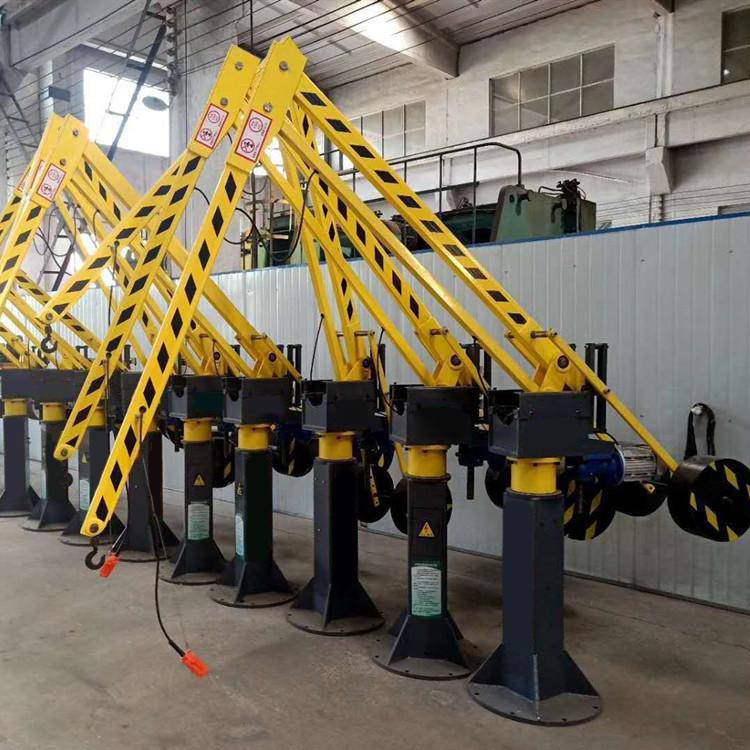
Product Images
Technical Parameters
| Technical Parameters | PAJ225B | PAJ325B | PAJ525B | PAJ625B |
|---|---|---|---|---|
| Rated Lifting Capacity(kg) | 200 | 300 | 500 | 600 |
| Max.lifting height(mm) | 1900 | 1900 | 2000 | 2000 |
| Horizontal Travel(mm) | 1850 | 1850 | 1840 | 1840 |
| Slewing Angle(°) | 340 | |||
| hoisting speed(m/min) | 7 | 7 | 6.1 | 6.1 |
| R2—Max.Working Radius(mm) | 2500 | |||
| R1—minimum Working Radius(mm) | 650 | 660 | ||
| h1—Boom Bottom Height(mm) | 400 | 500 | ||
| h2—Boom Top Height(mm) | 1500 | |||
| Hmax—Maximum Height(mm) | 2850 | |||
| r—Column Center Distance(mm) | 880 | 900 | ||
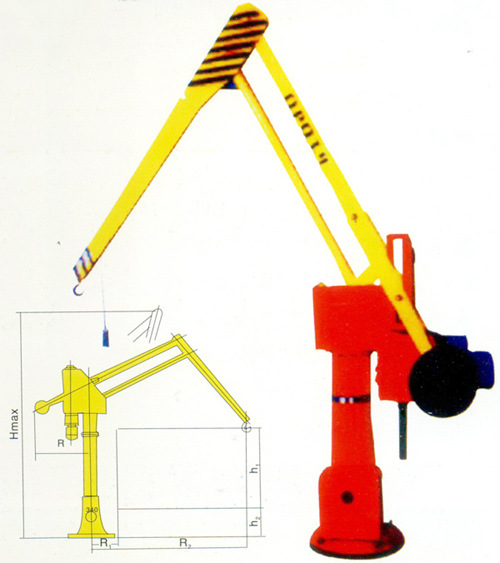
The table above lists the full technical parameters (including overall dimensions) for the PAJ series column-mounted balancers, models PAJ225B through PAJ625B. R2 is the maximum working radius, R1 is the minimum working radius, and Hmax is the maximum overall height. For high-resolution drawings, please contact our customer service team.
Typical Applications
The PAJ balancer is highly versatile and well-suited for a wide range of applications:
Machine Tool Loading/Unloading: Workpiece positioning and removal on lathes, milling machines, drill presses, and similar equipment.
Assembly Line Operations: Component assembly and transport between workstations, ideal for short-distance, high-frequency lifting tasks.
Warehouse & Logistics: Dense lifting operations at stations, docks, warehouses, and similar facilities.
Casting & Heat Treatment: Handling and cutting of parts and components.
Multi-Product Manufacturing: Loading/unloading for small-to-medium batch, multi-variety production, and integration with dedicated assembly line machinery.
Selection Guide
PAJ225B (200kg): Ideal for machine tool loading/unloading of light components. Features a compact screw lift mechanism with a small footprint. Reference price: ¥4,000–7,000.
PAJ325B (300kg): Suitable for inter-process transport of medium-weight workpieces. Offers flexible operation. Reference price: ¥5,000–9,000.
PAJ525B (500kg): Designed for heavier assembly stations with a reinforced arm structure. Reference price: ¥8,000–13,000.
PAJ625B (600kg): The largest model in the PAJ series, built for heavy-duty lifting with a thickened and reinforced column. Reference price: ¥10,000–16,000.
PAJ vs. PJ/PJSZ: Key Differences
The core difference between the PAJ balancer and the PJ/PJSZ series lies in the lifting mechanism:
1. Mechanism Type: The PAJ uses a screw lift mechanism (leadscrew-driven), while the PJ/PJSZ uses a four-bar linkage. The screw mechanism is more compact, whereas the four-bar linkage offers greater flexibility with its self-balancing design.
2. Slewing Angle: The PAJ provides 340° of rotation, while the PJ/PJSZ offers full 360° rotation.
3. Speed Options: The PAJ is single-speed (6.1–7 m/min), while the PJSZ offers dual-speed with a 10:1 ratio and fine adjustment.
4. Structural Configuration: The PAJ is available in low-profile, high-profile, and mobile versions, while the PJ/PJSZ is primarily fixed-column mounted.
5. Capacity Range: PAJ covers 200–600 kg, PJ covers 100–800 kg, and PJSZ covers 100–1000 kg.
Summary: Choose the PAJ for compact workstations requiring high-frequency lifting; choose the PJ or PJSZ when mm-level precise positioning is required.
Operating Instructions
Pre-Operation Checks: Verify that the leadscrew of the lifting mechanism is properly lubricated, the motor and push buttons are functioning correctly, and the self-locking device is reliable.
Startup & Operation: Use the push buttons to control lifting/lowering. Move the load horizontally and rotate it by manually pushing/pulling the load or the fixture.
Fixture Operation: All controls are centralized on the handle, which is connected to the workpiece via the fixture. Simply move the handle to operate.
Lifting Operations: The load remains suspended in three-dimensional space within the rated travel range, making operation effortless. Never exceed the rated capacity.
Air Supply Failure Protection: In the event of an air supply failure, the self-locking device engages automatically to prevent the load from falling — no need to worry about safety incidents from power loss.
Shutdown & Maintenance: Periodically inspect the leadscrew and nut for wear, check the lubrication of the motor and gearbox, verify the self-locking device function, and test the insulation of electrical wiring.
Why Choose Kelude Heavy Industry
Compact Screw Mechanism: The PAJ series utilizes a screw lift mechanism, making it more compact than four-bar linkage balancers. It requires less workstation space and is easier to position.
Three Configurations Available: Choose from low-profile, high-profile, or mobile versions. Fixed models offer stability and reliability, while mobile models provide flexibility and convenience to suit various workstation scenarios.
Turnkey Service: From concept design to after-sales maintenance, we provide full lifecycle support with immediate phone response.
Service & Support
Kelude Heavy Industry provides full lifecycle service for the PAJ series column-mounted balancers. For technical parameters and quotation estimates on additional models, please call 13903802779 or contact our online support team — we respond within 24 hours.
FAQ
Q: What's the difference between the PAJ balancer and the PJ balancer?
A: The core difference lies in the lifting mechanism. The PAJ uses a screw lifting mechanism (lead screw drive), offering a compact footprint and 340° slewing. The PJ uses a four-bar linkage, providing more flexible floating balance and 360° slewing. The PAJ is ideal for tight workspaces, while the PJ suits applications requiring floating balance and mm-level precise positioning.
Q: How do I choose between the low-profile, high-profile, and mobile PAJ balancers?
A: The low-profile (standard) model suits most standard factory buildings and offers the best value. The high-profile (PDJ series) is designed for facilities with greater overhead clearance and a larger vertical working range. The mobile version, mounted on casters or a rail, is ideal for rotating between multiple workstations — one machine, multiple uses.
Q: What manufacturing standards do PAJ balancers comply with?
A: Design & Manufacturing follows the JB/T 7330 industry standard for Balancers. The screw lifting mechanism is designed per the relevant clauses of GB/T 3811 Crane Design Standard, and the safety devices meet TSG Q7014 requirements. The air-loss self-locking protection has passed safety testing.
Q: How much does a PAJ balancer cost?
A: The PAJ225B (200kg) is approximately ¥4,000–7,000; the PAJ325B (300kg) around ¥5,000–9,000; the PAJ525B (500kg) about ¥8,000–13,000; and the PAJ625B (600kg) roughly ¥10,000–16,000. Pricing includes the screw lifting mechanism and the electrical control system.