
BQ Wall-Travelling Jib Crane
Product Introduction
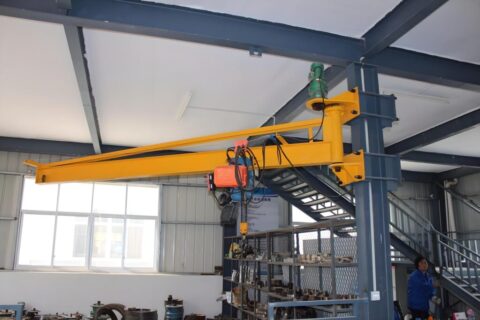
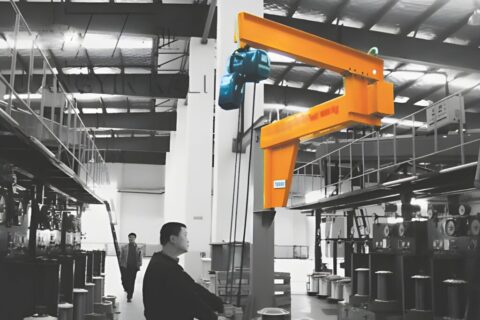
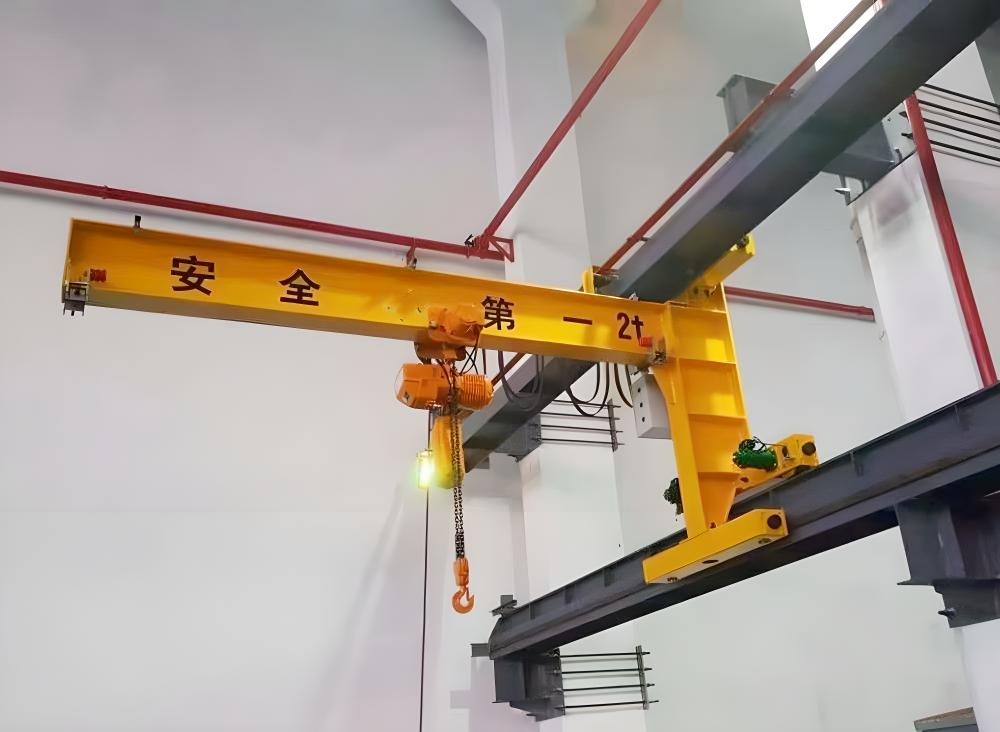
The BQ series Wall-Travelling Jib Crane (also known as wall-mounted jib crane) is an improved material handling solution developed from the wall-column jib crane. It travels longitudinally along rails mounted on the factory building's concrete columns, while the electric hoist provides both cross travel along the cantilever and vertical lifting. Available in rated capacities from 1 to 5 tons, with cantilever lengths from 4 to 12 meters and a standard lifting speed of 8m/min. Lifting height can be customized to meet specific user requirements.
The Wall-Travelling Jib Crane effectively extends the handling range in areas adjacent to walls, maximizing the utilization of factory floor space. The model range covers BQ1 through BQ5, with rated lifting capacities of 1t, 2t, 3t, and 5t respectively. Maximum working radius decreases as capacity increases (from 5–12m for BQ1 down to 4–7m for BQ5), ensuring a safe operating envelope at every capacity level.
Product Gallery
Product Features
Wall-Mounted Design, Zero Floor Space Footprint: The main structure is mounted on the side of the factory building's concrete columns and travels longitudinally along rails, taking up no floor space whatsoever. This makes it ideal for workshops where floor area is at a premium and the ground needs to remain clear for forklift traffic or material storage.
Three-Dimensional Coverage for Maximum Reach: The crane bridge provides longitudinal travel (along the rails), the trolley provides cross travel (along the cantilever), and the hoist provides vertical lifting — all three motions work in tandem to cover a large area near the wall. BQ1 offers a maximum working radius of 5–12m, and the longitudinal rails can be designed to match the full length of the factory building for long-distance handling requirements.
Compact Structure, Easy Transport and Installation: The wall-travelling jib crane features compact dimensions including upper and lower horizontal wheel bases and crane bridge wheel base, requiring minimal installation space. The cantilever uses a box-section or I-Beam profile, offering excellent structural rigidity with low dead weight.
High Lifting Speed for Superior Efficiency: Standard lifting speed is 8m/min, with both crane bridge and trolley travel speeds at 20m/min. The electric hoist is equipped with two-speed hoisting (8/0.8m/min) — slow speed for heavy loads and fast speed for light loads — striking the optimal balance between safety and productivity.
Dual-Rail Wall Mounting for Exceptional Stability: The system employs a dual-rail mounting configuration (upper rail + lower rail/floor rail) combined with horizontal and vertical Guide Roller assemblies, ensuring stable operation during handling and effectively preventing load swing.
Operating Principle
The Wall-Travelling Jib Crane operates on a three-dimensional motion principle: wall-mounted rail travel + cantilever slewing + electric hoist lifting. The crane bridge achieves longitudinal travel via the upper and lower guide rail system mounted on the factory building's concrete columns, driven by the travel motor. The trolley moves laterally along the bottom flange of the cantilever I-Beam, driven by the trolley hoist's travel mechanism. The electric hoist handles vertical lifting and lowering of loads.
During operation, the operator uses a Remote Control or pendant to position the crane bridge longitudinally above the handling area, then maneuvers the trolley laterally along the cantilever to align directly over the load, and finally controls the electric hoist to lift or lower the load. All three motions can be performed independently or simultaneously for maximum operational flexibility. The upper and lower horizontal wheel assemblies, together with the vertical wheel assemblies, ensure stable travel along the guide rails and prevent derailment and sway.
Structural Composition
The crane consists of the following core components:
Wall-Travelling Crane Bridge Frame: The main steel structure connecting the cantilever to the guide rails, comprising upper horizontal wheel assemblies, lower horizontal wheel assemblies, and vertical wheel assemblies. It travels longitudinally along rails mounted on the factory building's concrete columns. The crane bridge wheel base ranges from 4m for BQ1 to 5.5m for BQ5.
Cantilever Beam: Constructed with a box-section or I-Beam profile, ranging from 4 to 12 meters in length, mounted on the crane bridge frame. The bottom flange of the cantilever serves as the travel rail for the electric hoist trolley, with a Buffer stop fitted at the end to prevent over-travel.
Electric Hoist: Traverses laterally along the cantilever and performs vertical lifting of loads. Equipped with two-speed hoisting (8/0.8m/min), with lifting height customizable to meet specific user requirements.
Travel Rail System: Upper and lower rails mounted on the sides of the factory building's concrete columns, working in conjunction with the horizontal and vertical wheels of the crane bridge frame for guidance. Rail spacing and installation accuracy directly impact the operational stability and service life of the wall-travelling jib crane.
Electrical Control System: Operated via Wireless Remote Control or pendant, providing independent or simultaneous control of crane bridge travel, trolley travel, and hoist lifting. Equipped with Limit switches and emergency stop protection.
Technical Parameters
| Model | BQ1 | BQ2 | BQ3 | BQ5 |
|---|---|---|---|---|
| Rated Lifting Capacity (t) | 1 | 2 | 3 | 5 |
| Maximum Radius / Maximum Outreach (m) | 5~12 | 5~10 | 4~8 | 4~7 |
| minimum Radius / Outreach (m) | 1 | 1.1 | 1.2 | 1.3 |
| Vertical Wheel Base (m) | 2.5 | 2.5 | 3 | 3 |
| Upper Horizontal Wheel Base (m) | 2 | 2.5 | 3.3 | 4 |
| Lower Horizontal Wheel Base (m) | 2 | 2.5 | 3.3 | 4 |
| Crane Bridge / Long Travel Wheel Base (m) | 4 | 4.5 | 5 | 5.5 |
| Lifting Speed (m/min) | 8 | 8 | 8 | 8 |
| Long Travel Speed (m/min) | 20 | 20 | 20 | 20 |
| Cross Travel Speed (m/min) | 20 | 20 | 20 | 20 |
| Lifting Height (m) | User-Defined | |||
Typical Applications
Wall-side lifting in large-span workshops: Ideal for workshops or warehouses with large spans and high ceilings where lifting operations near the walls are frequent. The wall-travelling jib crane moves longitudinally along the wall, covering the entire working area along that side.
Material handling on production and assembly lines: With guide rails installed along the workshop wall, the wall-travelling jib crane delivers workpieces and raw materials to each workstation. Models BQ1 to BQ3 are suited for rapid lifting of small to medium components, with a lifting speed of 8m/min to keep pace with production cycles.
Cargo loading and unloading in warehouses and docks: For stacking and retrieving goods in warehouse areas near walls, or for loading/unloading at dockside. The wall-travelling jib crane takes up no floor space, allowing forklifts and personnel to move freely underneath — maximizing space utilization.
Heavy equipment maintenance areas: A BQ-type wall-travelling jib crane installed along the wall of a maintenance bay handles the disassembly, assembly, and transport of heavy components. The BQ5, with a rated lifting capacity of 5t, covers typical maintenance lifting requirements.
Selection Guide
By lifting capacity: For loads up to 1t, choose BQ1 with a maximum cantilever length of 5–12m; for 2t, BQ2 with 5–10m; for 3t, BQ3 with 4–8m; for 5t, BQ5 with 4–7m. The higher the capacity, the shorter the maximum cantilever length — verify the match between your lifting requirements and working radius during selection.
By workshop structure: The wall-travelling jib crane must be mounted on the side of concrete or steel structural columns. Confirm that column spacing, strength, and mounting positions meet the guide rail installation requirements. The wheel base for BQ1–BQ5 is 4–5.5m; column spacing must match, or extended mounting brackets may be used.
By working range: Cantilever lengths from 4 to 12m are available, selected based on the width of the working area. The longitudinal rail length is determined by the workshop length or the extent of the working zone, and can be designed to run the full length of the building or only within a specific workstation area.
Manufacturer Services
Henan Kelude Heavy Industry Co., Ltd. provides end-to-end services for BQ-type wall-travelling jib cranes, covering design, manufacturing, rail installation, and after-sales support.
Site survey and design: Our technicians visit your site to measure column spacing, building height, and wall structural strength, then deliver a crane installation plan and rail layout drawing. Production begins upon approval, with a lead time of 10–20 days (including rail fabrication).
Testing and commissioning: Each crane undergoes a static test at 1.25 times the rated load and a dynamic load test at 1.1 times the rated load before leaving the factory. After rail installation, straightness and levelness are calibrated to ensure smooth crane bridge travel. The crane is commissioned and handed over after full-system tuning.
After-sales warranty: Full machine warranty for 12 months (excluding electric hoist and wear parts on the rails), with a 24-month warranty on the motor and gearbox. After-sales requests are responded to within 48 hours nationwide.
Request a Quotation
Need a quotation for a BQ wall-travelling jib crane?
Provide your lifting capacity, cantilever length, column spacing, and other details — we'll prepare a customized solution and quotation within 2 hours.
Consultation Hotline: 13903802779
FAQ
Q: What's the difference between a BQ wall-travelling jib crane and a wall-column jib crane?
A: A wall-column jib crane is fixed to a single column, with a rotating cantilever but no longitudinal movement. A wall-travelling jib crane moves along rails mounted on the wall or columns, covering a much larger area. Wall-travelling jib cranes are ideal for applications requiring extended longitudinal coverage, while wall-column jib cranes suit fixed workstations.
Q: What are the requirements for factory building columns when installing a wall-mounted jib crane?
A: The columns must have sufficient strength (concrete or steel structure columns), and the column spacing must match the wheel base of the wall-travelling jib crane (4–5.5m for BQ1–BQ5 models). The upper and lower guide rails are mounted on the sides of the columns, so adequate mounting space on the column sides must be confirmed. If the column spacing is too wide, intermediate support columns or reinforced steel beams can be added.
Q: Can the cantilever of a wall-mounted jib crane rotate?
A: No. The cantilever of the BQ-type wall-travelling jib crane is fixed and cannot rotate (unlike the 360° rotation offered by wall-column jib cranes). Cross-travel motion is achieved by the electric hoist trolley moving along the cantilever. If cantilever rotation is required, consider the BZ-type wall-column jib crane or a column cantilever crane instead.
Q: How is the lifting height of the electric hoist determined?
A: The lifting height is custom-designed by the user based on the workshop height and lifting requirements. Standard electric hoists offer a lifting height range of 6–30m. When determining the lifting height, consider: the clear height of the workshop, the maximum height of the load to be lifted, and the safety margin between the hook and the hoist body (typically ≥500mm).
Q: How are the guide rails of a wall-mounted jib crane installed and maintained?
A: The guide rails are fixed to the sides of the factory building columns using dedicated mounting brackets. During installation, the straightness (≤±2mm/10m) and levelness of the rails must be adjusted and verified. Routine maintenance: check the rail mounting bolts for loosening monthly; inspect rail wear quarterly; and apply anti-rust oil to the rail working surface annually (for outdoor installations).
Q: Can a BQ wall-travelling jib crane be used in the same bay as an overhead crane?
A: Yes. The wall-travelling jib crane is mounted on the wall/column side and travels along the wall, while the overhead crane operates on the crane runway rails at the top of the workshop. The two operate at different height levels without interfering with each other. The wall-travelling jib crane is ideal for lifting in blind spots along the wall side that the overhead crane cannot reach, making the two systems complementary.