
MH Type Double Hook Point Gantry Crane
Product Introduction
The MHE Type Double-Hook Point Gantry Crane (also known as MHE Type Double-Hoist Gantry Crane or Double Electric Hoist Gantry Crane) is equipped with two independent electric hoists that can operate individually or in synchronization. It is specifically designed for single-crane tandem lifting of long, heavy loads. Unlike the standard MH Type single-hoist gantry, the MHE Type uses coordinated dual hook points to effectively resolve centering and leveling challenges during long-load handling, significantly boosting operational efficiency.
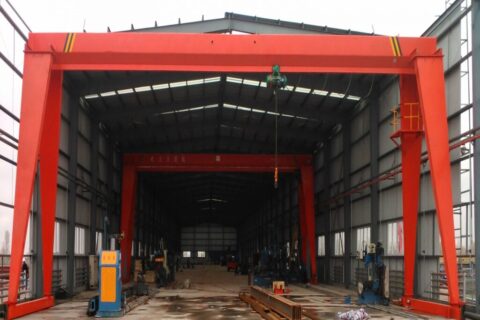
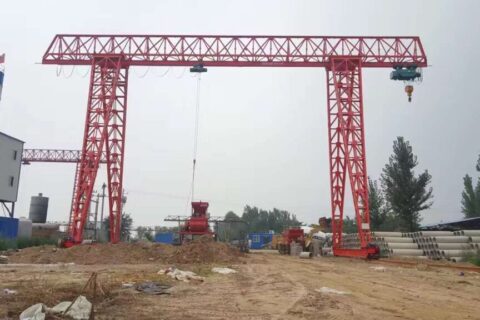
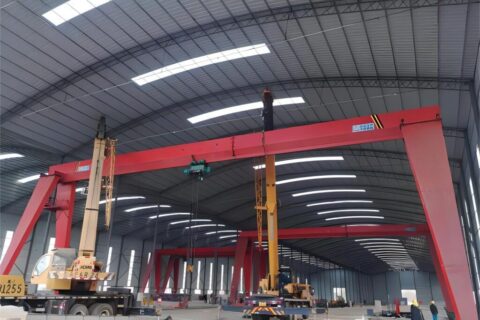
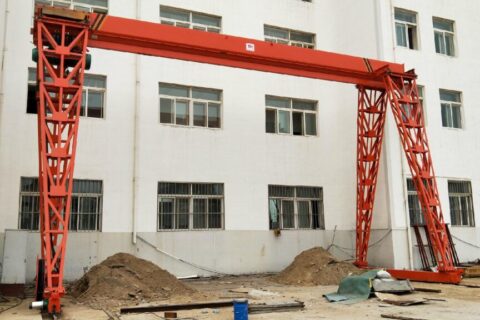
The MHE Type is a semi-customized machine with flexible lifting capacity combinations (e.g., 5+5t, 10+5t, 10+10t, 16+16t, etc.) and spans ranging from 12 to 31 meters. It is suitable for outdoor and indoor workshop applications including subway construction, stations and ports, warehouses and freight yards, construction sites, cement product plants, machinery assembly shops, and hydropower stations. The main girder structure is available in lattice truss, enclosed box, or combined box-lattice configurations.
Product Specifications
- Product Name: MHE Type Double-Hook Point Gantry Crane (Double-Hoist Gantry Crane)
- Model & Specification: MHE Type, common combinations 10(5+5)t / 15(10+5)t / 20(10+10)t / 32(16+16)t
- Place of Origin: Xinxiang, Henan (Kelude Heavy Industry)
- Customization Available: Span, lifting height, cantilever length, and dual-hoist capacity combinations can all be customized.
- Main Girder Structure: Lattice truss / Enclosed box / Combined box-lattice (selected based on operating conditions)
- Applicable Span: 12–31 m (custom spans available beyond standard range)
Product Photos
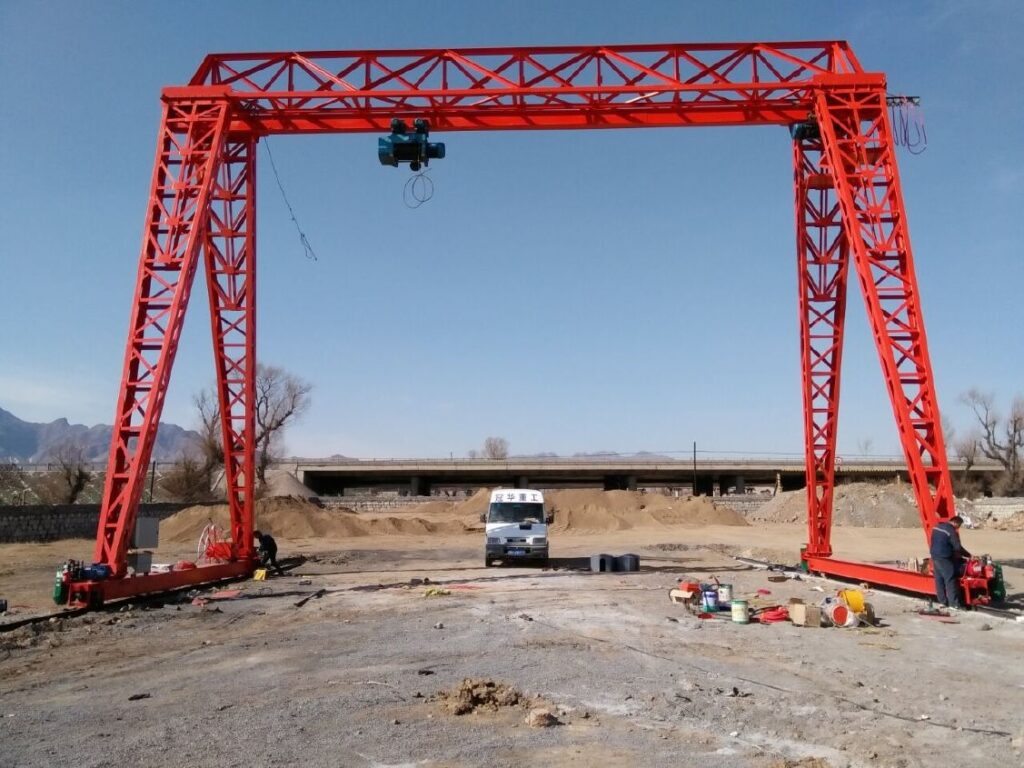
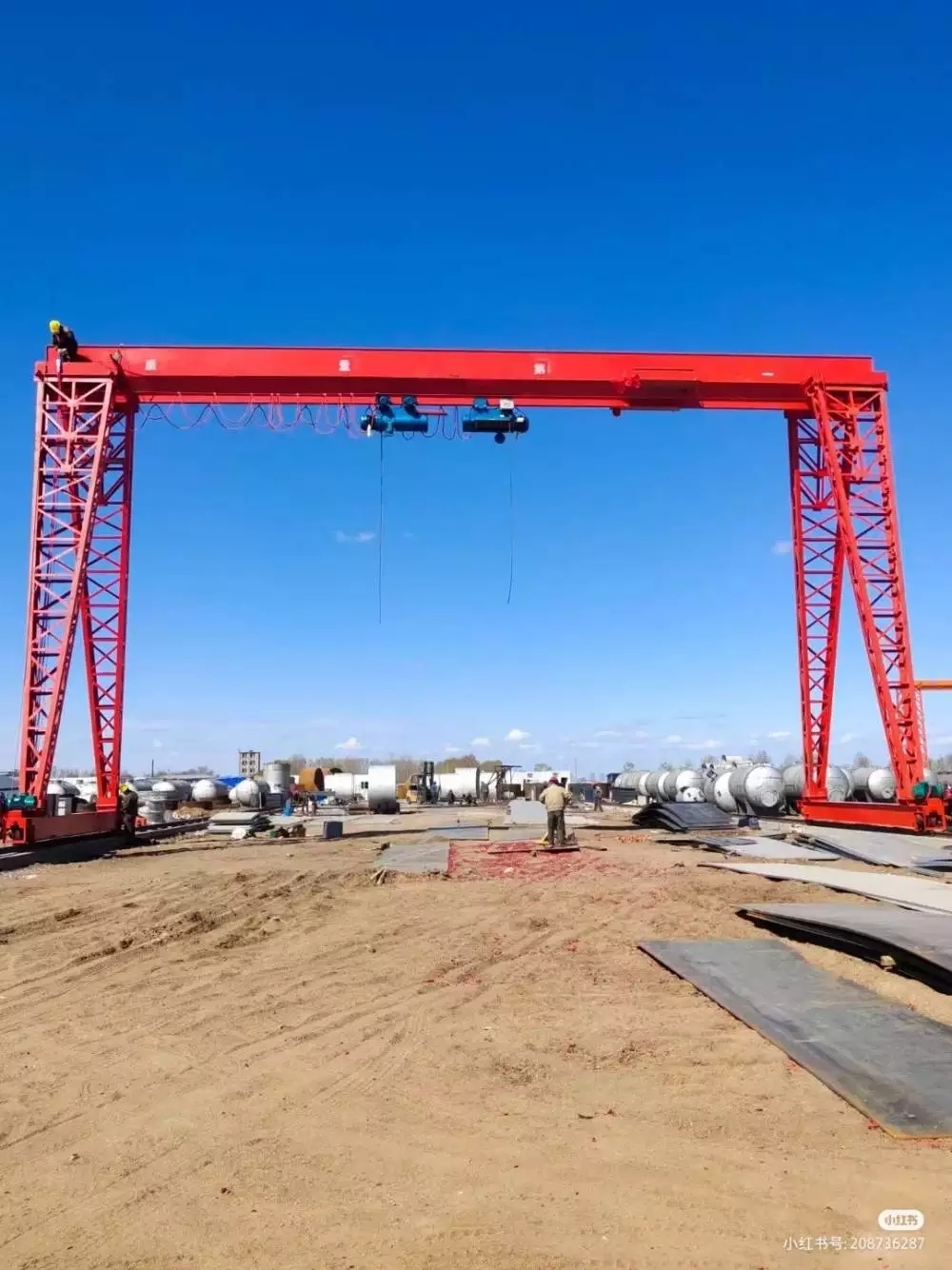
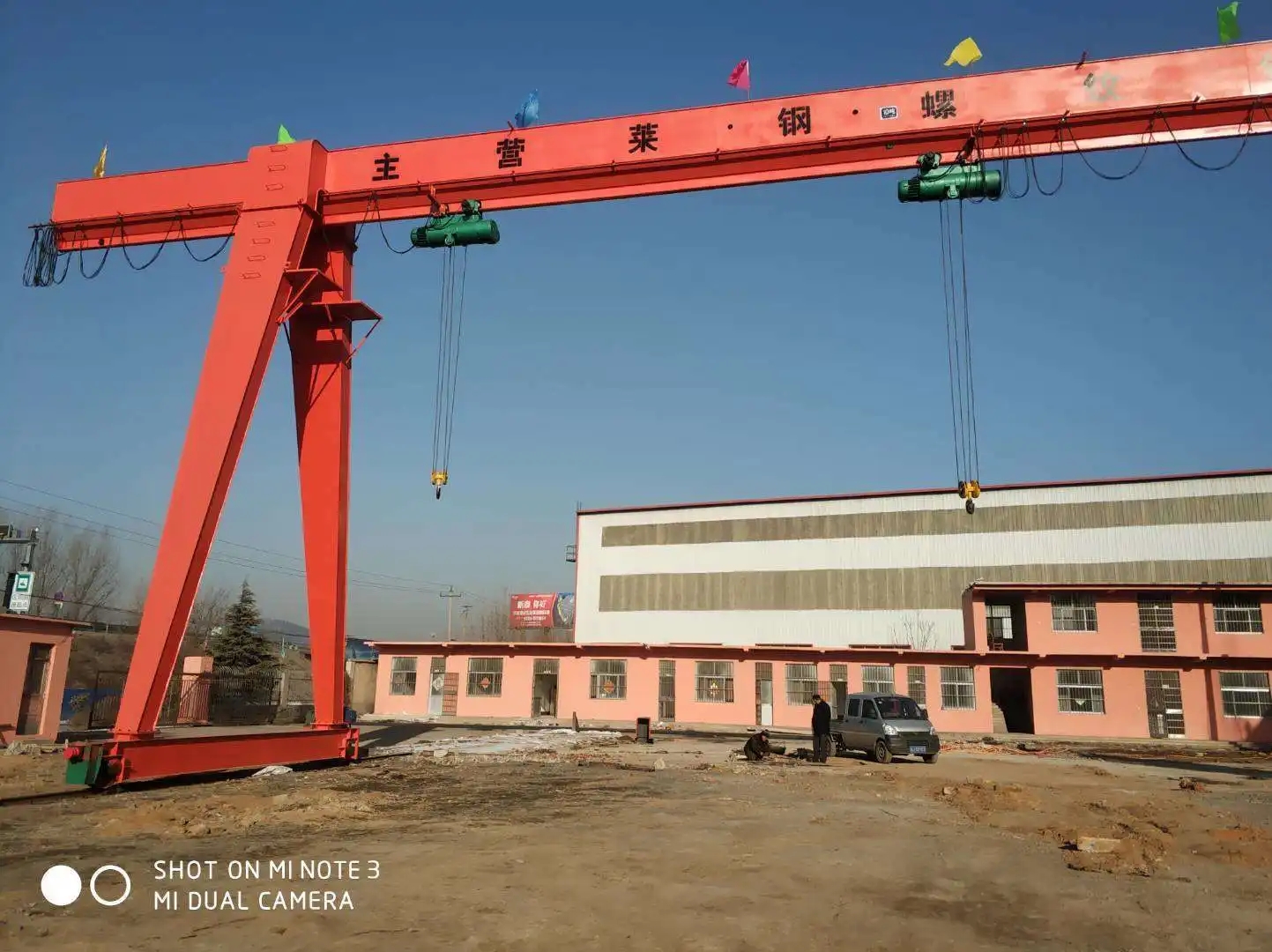
The images above show actual MHE Type Double-Hook Point Gantry Cranes. The dual electric hoists operate independently or in synchronization, with coordinated dual hook points for tandem lifting of long and oversized loads, resolving centering and leveling challenges.
Product Features
- Coordinated Dual-Hoist Tandem Lifting: The two electric hoists can operate independently (lifting at different positions) or in synchronization (jointly lifting extra-long loads). The dual hook points effectively solve centering and leveling issues for long loads, eliminating time-consuming manual adjustments.
- Main Girder Strength Verification: The two hoists may have identical capacities (e.g., 10t+10t) or different capacities (e.g., 10t+5t). However, the main girder must be verified based on whether the maximum single-hoist load or the combined dual-hoist total load governs the design, ensuring structural safety (e.g., when two 10t hoists tandem-lift a 20t load, the main girder is designed for 20t).
- Three Main Girder Configurations: Lattice truss (lightweight, good wind resistance) / Enclosed box (superior overall rigidity, aesthetically pleasing) / Combined box-lattice (cost-effective). Flexible selection based on operating conditions and budget.
- Designed for Oversized Loads: Specifically engineered for long, heavy items such as subway segments, concrete piles, steel structure components, and large molds. Dual hook points ensure even load distribution for stable and safe lifting.
- Multiple Operation Modes: Supports pendant control, wireless remote control, and operator cabin — with the flexibility to mix and match. The cabin can also be paired with a remote control.
- Semi-Customized with Fast Delivery: Rail dimensions, main girder configuration, and hoist combinations are determined based on site conditions and customer requirements. Strong non-standard design capability with a delivery lead time of 15–30 days.
Working Principle
The MHE Type Double-Hook Point Gantry Crane relies on the bridge travel mechanism to move longitudinally along ground rails. The two electric hoists each traverse independently along the lower flange of the main girder I-beam. During operation, depending on the load shape, either a single hoist can be used for individual lifting, or both hoists can be used in synchronized tandem lifting.
Synchronized Tandem Lifting Mode: Both hoists lift/lower simultaneously, with the Electrical Control System ensuring consistent lifting speed and even load distribution across the dual hook points. Ideal for long, heavy items such as pipe piles, steel beams, and molds — no manual centering or leveling required.
Independent Operation Mode: Each hoist is controlled separately, allowing loads to be lifted at different positions simultaneously. This effectively enables one gantry crane to handle lifting tasks at two workstations at once, significantly improving operational efficiency.
Product Structure
The MHE Type Double-Hook Point Gantry Crane consists of the following core components:
Main Girder Assembly: Available in lattice truss (lightweight, low wind resistance), enclosed box (superior rigidity), or combined box-lattice configurations. The main girder is strength-verified for the combined dual-hoist total load and fabricated from Q355B steel plate via welding.
Outrigger System: Standard straight-leg design in Q235B or Q355B material. The lower end of each outrigger is welded to a ground beam, which is secured to the concrete foundation with anchor bolts. One-sided or double-sided cantilevers can be customized as required.
Bridge Travel Mechanism: Comprises motor, gearbox, and driven/driving wheel blocks. Wheel material is ZG310-570 or 65Mn with induction-hardened tread surfaces to HRC40–50. Individually driven configuration is suitable for outdoor rail operation.
Dual Electric Hoists: Two CD1 Type wire rope hoists, each featuring a Conical Rotor Motor (with integrated braking), three-stage helical gear reducer, drum, wire rope (6×37+IWR), and hook block. The two hoists can be identical in capacity or mismatched (e.g., 5t+3t). MD1 two-speed hoists are available as an option for precise positioning.
Electrical Control System: Dual-hoist independent/synchronized control panel, including main circuit breaker, contactors, thermal overload relays, power-off limit switches, and overload limiter (optional). Control voltage: AC 36V safety voltage. Power supply via enclosed conductor rail or cable reel.
Technical Parameters
MHE Type Double Hoist Point Gantry Crane – General Technical Parameters
| Parameter Item | MHE type Parameter |
| Lifting Capacity Combination | 10(5+5)t / 15(10+5)t / 20(10+10)t / 32(16+16)t(Customizable / Non-standard) |
| Span | 12~31 m(12/19.5/22/23.5/25.5/26/29/31mCommonly Used) |
| Lifting Height | 6~30 m(6/9/12/18/24/30mCommonly Used) |
| Work Duty / Classification | A3 / M3 |
| Lifting Speed | ≤5t:8 m/min;10t:7 m/min;16t:3.5 m/min |
| Cross Travel Speed | 20 m/min(Quick Feasible 30 m/min) |
| Long Travel Speed | 20 m/min(Quick Feasible 30 m/min) |
| Power Supply | Three-Phase AC 380V 50Hz(Customizable for Export Voltage) |
| Operation Mode | Wired Pendant / Wireless remote control / Operator Cabin(Mix and Match Available) |
| Working Environment Temperature | -20℃~+40℃ |
| Main Girder Structural Configuration | Open Truss Type / Enclosed Box Type / Top Enclosed, Bottom Truss Type(Select as Required) |
Applications
- Metro & Utility Tunnel Construction: Handling and assembly of metro segments and shield tunnel components. The dual lifting points ensure precise alignment, significantly boosting assembly efficiency.
- Cement Product Plants: Lifting, transporting, and stacking long precast concrete components such as piles, poles, and box girders. The twin-hoist configuration prevents cracking during lifting.
- Steel Fabrication & Assembly: Fitting, welding, and transferring steel beams, columns, and large structural members. Coordinated dual lifting points keep loads stable throughout the process.
- Railway Stations, Ports, Warehouses & Freight Yards: Long-distance handling and loading/unloading of containers, heavy equipment, and steel materials. When operating independently, the two hoists can serve two workstations simultaneously.
- Hydropower Stations: Installation and maintenance of large equipment such as turbine runners and stators. Dual lifting points provide precise control during hoisting and positioning.
Selection Guide
Light-Duty Twin-Hoist Applications: MH Type 10(5+5)t, span 12–19.5m. Ideal for small cement product plants, steel fabrication workshops, and warehouses. Reference price: RMB 50,000–120,000.
Medium-Duty General Applications: MH Type 15(10+5)t to 20(10+10)t, span 19.5–26m. Suitable for metro construction, steel markets, and assembly yards. The main girder must be designed for either individual hoist loads or combined total load — this needs to be specified. Reference price: RMB 120,000–250,000.
Heavy-Duty Applications: MH Type 32(16+16)t and Above, span 26–31m. Designed for hydropower stations and large component fabrication plants. Foundation bearing capacity and wind protection (rail clamp or anchoring) must be confirmed. The main girder is recommended in enclosed box or lattice box construction. Reference price: RMB 250,000–500,000.
Selection Notes: Please provide the lifting capacity configuration (individual hoist capacities and whether joint lifting is required), span, lifting height, and main girder structure preference (lattice / enclosed box / open-top with lattice bottom). The Kelude Heavy Industry engineering team will provide a free selection proposal and foundation drawing.
Operating Instructions
Pre-Operation Checks: Verify that the wire ropes on both hoists are free of broken wires or strands, brake clearances are correct, limit switches are responsive and reliable, the synchronous control system for the twin hoists is functioning properly, and the remote control / pendant signal is stable.
Synchronized Lifting Operation: When using synchronized mode, ensure the load's center of gravity is positioned between the two lifting points. Perform a trial lift of 200mm before full lifting to confirm hoist synchronization and load balance. Overloading is strictly prohibited — neither hoist may exceed its rated load.
Independent Operation: When the two hoists operate independently, maintain adequate spacing to prevent load collision or wire rope entanglement. Each hoist is to be used within its own rated load.
Maintenance: Inspect wire rope wear and lubrication on both hoists monthly; check electrical components of the synchronous control system and brake friction linings quarterly; conduct a comprehensive annual safety inspection (including combined load test of both hoists, crane rail settlement measurement, and grounding resistance test).
Why Choose Kelude Heavy Industry
Proven Twin-Hoist System Expertise: Mature solutions available for 5+5t to 16+16t twin-hoist synchronized/independent control systems. High electrical synchronization accuracy and rigorous main girder strength verification ensure safe and reliable joint lifting.
Flexible Main Girder Options: Lattice (lightweight, wind-resistant) / Enclosed box (high rigidity) / Open-top with lattice bottom (economical). The optimal solution is recommended based on your operating conditions and budget — no single design is forced.
Full-Service Customization: Free on-site survey, main girder strength calculation, fabrication, installation, twin-hoist synchronization commissioning, operator training, and after-sales support. Immediate phone response, on-site within 48 hours.
Service & Support
Kelude Heavy Industry provides full life-cycle support for MH Type twin-lifting-point gantry cranes: free site survey, main girder strength calculation, steel structure fabrication, installation & commissioning, twin-hoist synchronization calibration, operator training, and annual maintenance. For additional models, technical parameters, and quotation, call 13903802779 or contact our online support — response within 24 hours.
Need a selection proposal or quotation for an MH Type twin-lifting-point gantry crane?
Contact the Kelude Heavy Industry sales & engineering team anytime for free design proposals and technical consultation.
FAQ
Q: What is the difference between the MH Type twin-lifting-point gantry crane and the MH Type single-hoist gantry crane?
A: The MH Type twin-hoist model is equipped with two electric hoists that can operate independently or in synchronized lifting mode. It is specifically designed to solve balance issues when handling long or heavy loads (such as metro segments, cement piles, steel beams, etc.) without requiring manual centering or leveling. The MH Type single-hoist model has only one hoist and is suitable for conventional single-point lifting applications. The main girder of the twin-hoist model must be verified against the combined rated load of both hoists, making it stronger than a single-hoist girder of equivalent capacity.
Q: Which national standards does the MH Type twin-lifting-point gantry crane comply with?
A: The MH Type is designed and manufactured in accordance with GB/T 14406-2011 "General-Purpose Gantry Crane" and JB/T 5663-2008 "Electric Hoist Gantry Crane". The twin-hoist electrical system complies with GB 5226.1 "Electrical Safety of Machinery". Installation supervision and inspection are carried out per TSG Q7014, and safety protection devices are configured per GB/T 6067 "Safety Rules for Lifting Appliances".
Q: How is the main girder of the MH Type twin-lifting-point gantry crane verified?
A: This is the key selection criterion. If two 10t hoists are used independently (not lifting the same load simultaneously), the main girder is designed for 10t. If they are used for synchronized lifting of a 20t load, the main girder must be designed for 20t. The user must clearly define the application scenario during selection—whether it's "independent lifting with a single hoist" or "synchronized lifting with two hoists." The main girder strength requirements differ significantly between these two working conditions, and incorrect verification can lead to safety accidents.
Q: What are the advantages of Kelude Heavy Industry's MHE Type double-lifting-point gantry crane?
A: Kelude Heavy Industry has a mature synchronous control system for dual hoists, and the MHE Type main girder undergoes rigorous strength verification. We provide free site surveys, dual-hoist synchronization commissioning, and operator training services.