
MHhs Truss Gantry Crane for Heavy Industrial Lifting
Product Introduction
The MHhs Truss Gantry Crane (also known as MHhs lattice girder gantry crane or truss-style gantry crane) is a variant of the gantry crane featuring a truss (lattice) main girder structure. Unlike the standard MH type with a box girder, the MHhs main girder is welded from angle steel or steel pipe into a truss configuration, offering lower wind resistance, reduced dead weight, and superior wind stability—making it particularly well-suited for large-span outdoor applications.
The MHhs series has a lifting capacity of 1 to 20 tons and spans of 17 to 35 meters. It is ideal for outdoor work sites such as subway construction, building projects, logistics and transportation, railway and highway projects, warehouses and freight yards, cement product plants, and hydropower stations. It can also be used indoors in workshops. The truss structure reduces steel consumption by 15% to 25% compared to a box girder of the same capacity, resulting in lower manufacturing costs.
Product Specifications
- Product Name: MHhs Truss Gantry Crane (lattice girder gantry crane)
- Model & Specification: MHhs type, lifting capacity 1–20 tons (custom non-standard manufacturing available)
- Place of Origin: Xinxiang, Henan (Kelude Heavy Industry)
- Custom Non-Standard Manufacturing: Span, lifting height, cantilever length, and variable cross-section configurations can all be customized
- Main Girder Structure: Truss (lattice) type, welded from angle steel / steel pipe
- Applicable Span: 17–35 meters (customizable)
Product Photos
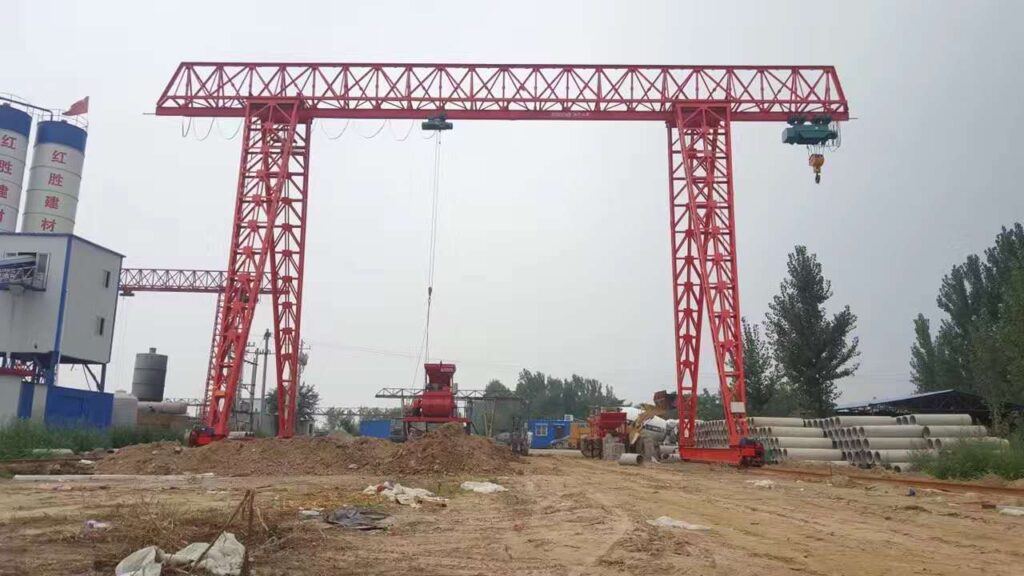
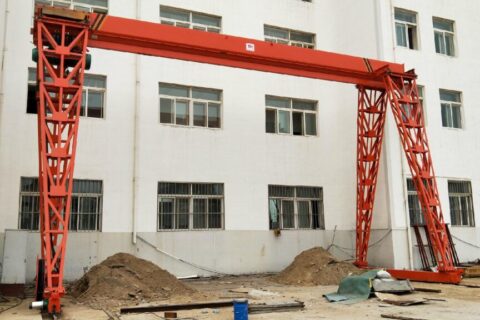
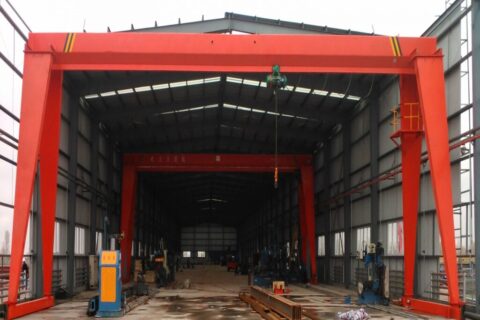
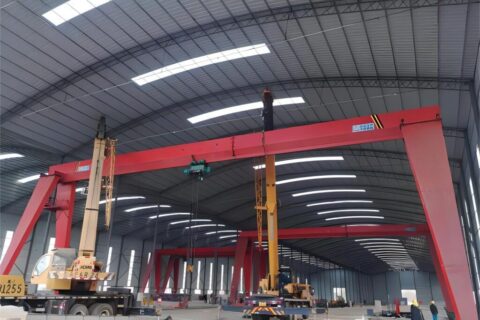
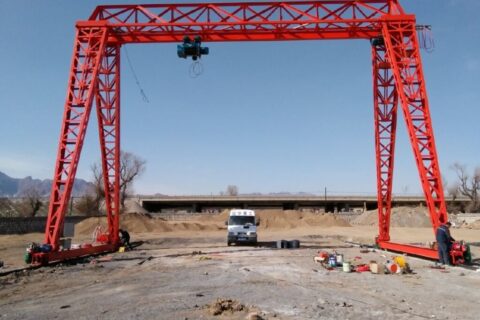
The images above show actual MHhs Truss Gantry Cranes. The open lattice structure of the truss girder provides low wind resistance and reduced dead weight, making it the preferred structural choice for large-span outdoor operations.
Product Features
- Lightweight truss main girder: The truss structure saves 15%–25% steel compared to a box girder of the same capacity, reducing overall dead weight and lowering foundation construction costs and crane rail load requirements.
- Superior wind resistance: The open truss design offers far lower wind load than a box girder, making it especially suitable for gantry crane operations in outdoor and coastal areas prone to strong winds.
- Clear advantage in large spans: Truss girders can achieve spans of over 35 meters, delivering better economics and structural efficiency than box girders in large-span applications.
- Adjustable lifting speed: Main hook lifting speed is selectable in multiple steps from 0.3 to 8 m/min to suit different hoisting requirements (slow speed for precision installation, fast speed for general material handling).
- Adjustable travel speed: Long travel speed is selectable from 10 to 40 m/min to accommodate different site conditions and coverage areas.
- Multi-industry applicability: From subway construction to cement product plants, from logistics freight yards to hydropower stations, the truss gantry crane is a universal solution for large-span outdoor operations.
Working Principle
The truss main girder of the MHhs gantry crane consists of top chords, bottom chords, and web members (diagonals/verticals) forming a triangular stable structure with sound load distribution and good stiffness. The electric hoist travels laterally along the I-beam rail on the bottom flange of the main girder, while the bridge travel mechanism drives the entire crane longitudinally along the ground rails.
Hoisting mechanism: The CD1 electric hoist uses a conical rotor motor with a three-stage helical gear reducer to wind the wire rope on the drum for hook lifting and lowering. Lifting speed can be selected based on load capacity and operating conditions, ranging from 0.3 m/min (heavy load, slow speed) to 8 m/min (light load, fast speed).
Travel mechanism: Long travel speed is adjustable from 10 to 40 m/min, with a cross-travel speed of 20 m/min. The electrical control system coordinates all mechanisms to complete material handling tasks across large-span areas.
Product Structure
The MHhs Truss Gantry Crane consists of the following core components:
Truss main girder: A triangular truss structure formed by top chords, bottom chords, and web members, welded from Q235B or Q355B angle steel or steel pipe. External cantilevers can be added at both ends of the main girder to cover stacking areas.
Outrigger system: Straight legs or truss-style outriggers made of Q235B or Q355B steel. The lower ends are welded to ground beams and secured to the concrete foundation with anchor bolts. Single or double external cantilevers can be designed as required.
Bridge travel mechanism: Motor + gearbox + driven/idler wheel blocks. Wheel material is ZG310-570 or 65Mn with medium-frequency induction hardened tread surfaces at HRC40~50. Travel speed is adjustable from 10 to 40 m/min.
Electric hoist: CD1/MD1 wire rope hoist, including conical rotor motor (with built-in brake), three-stage helical gear reducer, drum, wire rope, and hook block. Travels along the bottom flange of the main girder I-beam.
Electrical control system: Main circuit breaker, contactors, thermal overload relays, power-off limit switch, and overload limiter (optional). Control voltage is AC 36V safety voltage. Power supply is via enclosed conductor rail or cable reel.
Technical Parameters
MHhs Truss Gantry Crane General Technical Parameters
| Parameter Item | MHhs type Parameter |
| Lifting Capacity | 1~20 t(Available Custom Non-Standard Manufacturing) |
| Span | 17~35 m(17/18/21/22/24/25/27/30/35mCommonly used) |
| Lifting Height | 6~30 m(6/9/12/18/24/30mCommonly used) |
| Work Duty / Classification | A3 / M3 |
| Main Hook Lifting Speed | 0.3~8 m/min(Multiple options available, Determined by working conditions) |
| Cross Travel Speed | 20 m/min(Available Custom Non-Standard Manufacturing) |
| Long Travel Speed | 10~40 m/min(Multiple options available) |
| Power Supply | Three-phase AC 380V 50Hz(Customizable for export Voltage) |
| Operation Mode | Wireless remote control / Wired Pendant / Operator's cab |
| Main Girder Truss (lattice) type, welded from angle steel / steel pipe | Truss(Truss)Type, Angle Steel/Steel Pipe Welding |
| Structural advantages | Light dead weight, good wind resistance, saves 15–25% steel compared to box girder |
Product Drawings
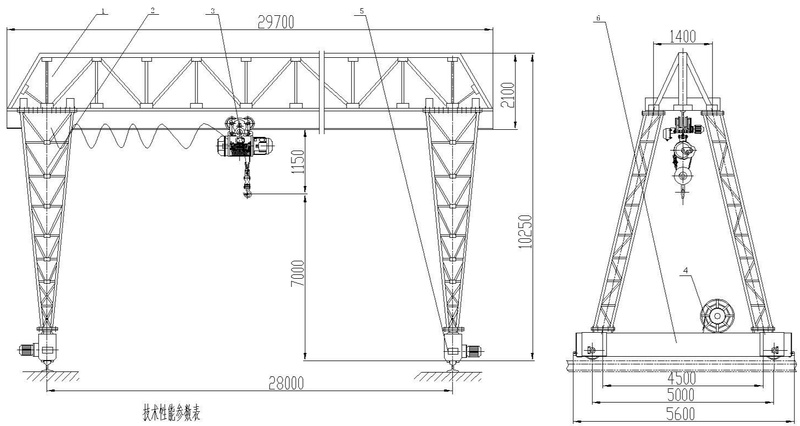
The above is a reference structural drawing of the MHhs Type Truss Gantry Crane. Actual dimensions are determined by design based on the required Lifting Capacity, Span, and Lifting Height.
Applications
- Metro Construction: Lifting and assembly of large components such as tunnel segments and shield tunneling equipment. The truss structure offers excellent wind resistance for open-air job sites.
- Construction Sites: Loading, unloading, and transfer of rebar, formwork, and steel structures. The long span covers the entire working area.
- Logistics & Freight Yards: Handling and transport of packaged goods and containers. The truss structure's light Dead Weight reduces foundation requirements.
- Concrete Product Plants: Yard handling of concrete products such as piles, utility poles, and cover plates.
- Hydropower Stations: Equipment installation and maintenance; the long-span Truss Gantry Crane covers the station's installation area.
Selection Guide
Light-Duty Applications: MHhs Type, 1~5t capacity, Span 17~22m. Suitable for logistics yards and small construction sites. Reference price: ¥30,000~80,000.
Medium-Duty General Applications: MHhs Type, 5~10t capacity, Span 22~30m. Suitable for metro construction, building sites, and concrete product plants. Reference price: ¥80,000~180,000.
Heavy-Duty Applications: MHhs Type, 10~20t capacity, Span 30~35m. Suitable for hydropower stations and large freight yards. Foundation load capacity and wind protection measures (Rail clamp or anchoring) must be verified. Reference price: ¥180,000~350,000.
Selection Notes: Please provide the required Lifting Capacity, Span, Lifting Height, and operating environment (indoor/outdoor, wind conditions). The Kelude Heavy Industry technical team will recommend the optimal solution between box girder and truss girder designs.
Operating Instructions
Pre-Operation Checks: Verify the Truss Girder structure is intact, Weld Seams are free of cracks, Wire Rope shows no broken wires or strands, Brake clearance is normal, and Limit Switches are responsive and reliable.
Operation: Perform a Trial Lift of 200mm to check the Brake before Hoisting. Although the truss structure offers good wind resistance, operations must stop in strong winds (wind speed > Force 6). Never stand under a suspended load.
Shutdown Procedure: After operations, raise the Hook to the upper Limit Switch, park the Trolley at the designated position, move the Crane Bridge to the anchoring area, and disconnect the main Power Supply. Engage the Rail clamps when parked outdoors.
Maintenance: Inspect truss members and Weld Seams monthly; check Brake Friction linings and Crane Rail Straightness quarterly; verify Tightening of truss node connections semi-annually; conduct a comprehensive safety Inspection annually.
Why Choose Kelude Heavy Industry
Professional Truss Structure Design: Truss members are analyzed and sized per GB/T 3811 Crane Design Standard. All node Weld Seams undergo UT Non-destructive testing to ensure structural safety.
Extensive Long-Span Experience: Proven track record with numerous Truss Gantry Crane projects up to 35m Span. Complete structural calculation reports and Foundation drawings are provided.
Full-Process Service: Free site survey, structural Design & Manufacturing, Installation & Commissioning, Operator Training, and after-sales support. Phone support with immediate response, on-site service within 48 hours.
Service & Support
Kelude Heavy Industry provides full life-cycle services for the MHhs Type Truss Gantry Crane: free site survey, truss structure design, manufacturing, Installation & Commissioning, Operator Training, and annual Maintenance. For more models, Technical Parameters, and Quotation, please call 13903802779 or contact our online support for a response within 24 hours.
Need a selection proposal or Quotation for the MHhs Type Truss Gantry Crane?
Feel free to contact the Kelude Heavy Industry sales and technical team for free design proposals and Technical consultation.
FAQ
Q: What is the difference between the MHhs Type Truss Gantry Crane and the standard MH Type box girder Gantry Crane?
A: The MHhs Type uses a truss (lattice) structure for the Main Girder, welded from angle steel or steel pipe into a triangular stable configuration. It is 15%~25% lighter than a box-girder design, offers lower wind resistance and better wind stability, making it ideal for long-span outdoor applications. The MH Type uses a box girder Main Girder, providing better overall Stiffness and a cleaner appearance, suitable for indoor or medium/small-span scenarios. The truss girder is more cost-effective, while the box girder is simpler to maintain.
Q: Which national standards does the MHhs Type Truss Gantry Crane comply with?
A: The truss structure of the MHhs Type Main Girder is calculated for Strength, Stiffness, and Stability per GB/T 3811 Crane Design Standard. Truss nodes follow the GB/T 1804 tolerance Standard. The complete crane is designed per JB/T 5663-2008 Standard for Electric Hoist Gantry Cranes. The Hoisting mechanism complies with JB/T 9008.1, and installation supervision and Inspection are carried out per TSG Q7014.
Q: How much cheaper is a truss gantry crane compared to a box girder gantry crane?
A: Because the truss structure uses less steel (saving 15%~25%), it is generally 10%~20% less expensive to manufacture than a box girder gantry crane of the same specification. Additionally, its lighter dead weight imposes lower demands on the foundation and crane rail, further reducing foundation engineering costs. However, the truss structure has more welded joints, requiring longer fabrication time—typically 3 to 5 days more than a box-girder crane.
Q: What are the advantages of Kelude Heavy Industry's MHhs truss gantry crane?
A: Kelude Heavy Industry designs the truss structure in accordance with GB/T 3811 Crane Design Standard, performing internal force analysis and section selection. All node weld seams undergo UT non-destructive testing. We provide free structural calculation reports and foundation drawings.