

LDY Type Metallurgical Electric Single Girder Crane
1. Product Overview
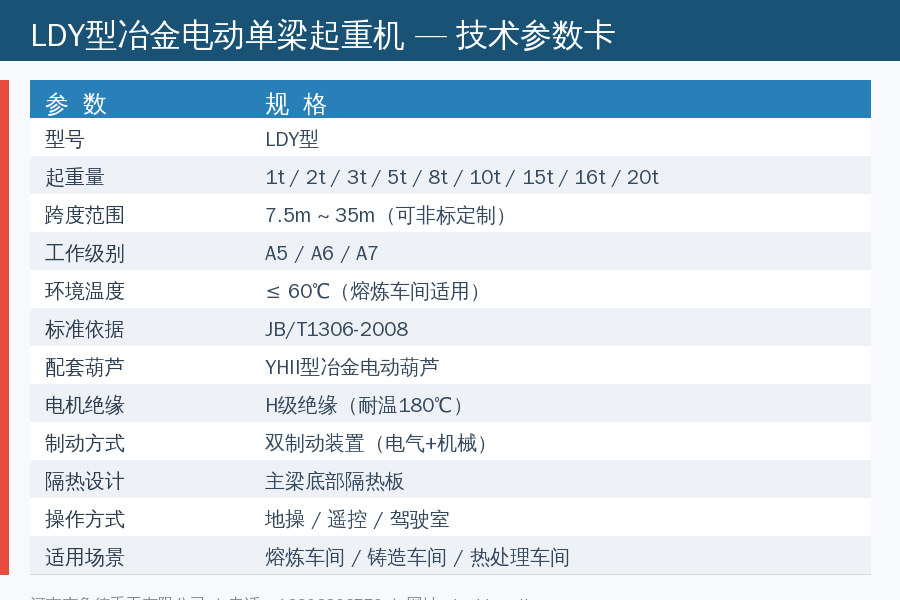
The LDY Type Metallurgical Electric Single-Girder Crane is a specialized lifting solution designed to JB/T1306-2008, paired with the YHII Type metallurgical electric hoist, with a lifting capacity of 1 to 20 tons. The key difference from a standard LDA single-girder crane is that the metallurgical crane is built for continuous operation in high-temperature environments (≤60°C) and rated at Duty Class A5~A7 (standard cranes are only A3). It features a dual braking system, Class H insulated motors, and heat insulation on the underside of the main girder. In short — a standard crane can't handle the heat of a smelting workshop; the metallurgical crane is engineered specifically for it. This article covers specifications, safety design, and selection considerations.
2. Specifications & Models
- Model: LDY Type
- Lifting Capacity: 1t, 2t, 3t, 5t, 8t, 10t, 15t, 16t, 20t
- Span: 7.5m, 8m, 9m, 10m, 12m, 15m, 16m, 19m, 22.5m, 35m; non-standard spans available on request
- Work Duty: A5, A6, A7
Product Images
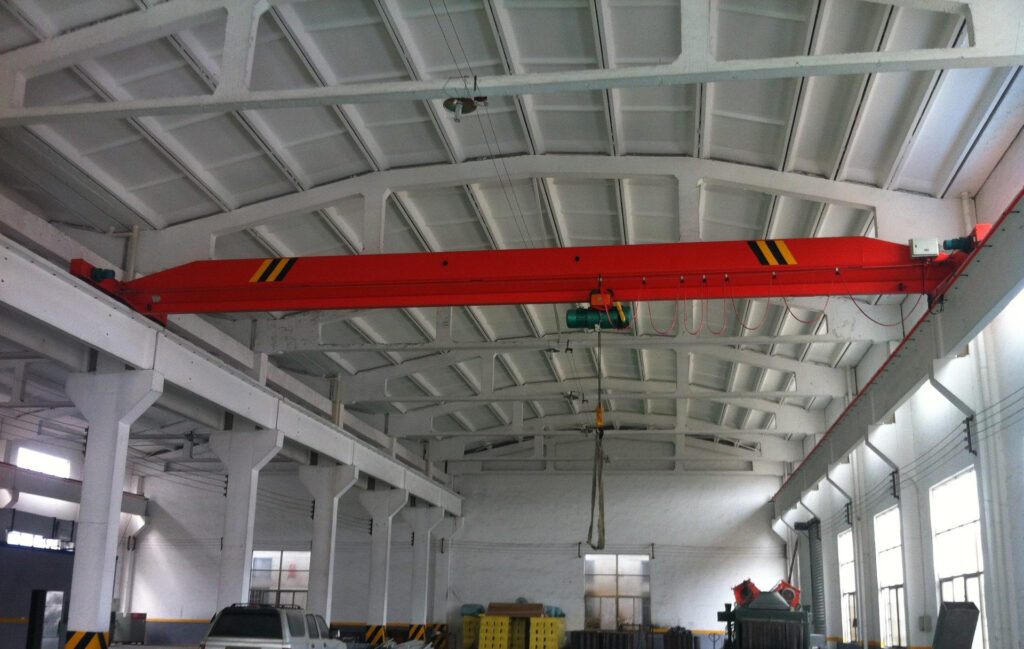
3. Application Scenarios & Environmental Requirements
The LDY Type Metallurgical Electric Single-Girder Crane is designed for operation under the following conditions: Work Duty A6, ambient temperature ≤60°C, relative humidity ≤85%, altitude up to 2000m, in non-corrosive, non-flammable, non-explosive environments within non-enclosed factory buildings.
Environmental Conditions:
1. Power supply: three-phase AC, 50Hz, 380V. (If the site power supply differs, specify the local voltage and frequency when ordering.) The allowable voltage fluctuation at the motor and electrical control equipment is +10% to -15% of rated voltage (at peak current). Internal voltage drop of the crane is 5%.
2. Working environment: With no other noise interference and a lifting height of no less than 5m, measured at ground level, the overall noise level shall not exceed 85 dB(A) for cranes with a lifting capacity of Q≤5t, and shall not exceed 90 dB(A) for cranes with a lifting capacity of Q≥5t.
Three Key Safety Designs for Metallurgical Environments
The biggest difference between a metallurgical crane and a standard crane isn't the lifting capacity — it's the ability to withstand high temperatures. The LDY Type differs from standard cranes in these three critical areas:
▎Dual Braking System — Stops Even If Power Fails
The metallurgical electric hoist is equipped with three independent braking devices: a travel brake, a safety brake (dual brake), and an overload limiter. A standard crane has only one brake — if it fails, the load drops. The dual braking system on a metallurgical crane means that even if one brake fails, the other will still hold the load. This is a mandatory safety requirement when handling ladles of molten steel or iron in smelting workshops.
▎Heat-Insulated Main Girder — Prevents Thermal Deformation
The underside of the LDY Type's main girder is lined with a special heat-insulating material. The girder is a solid-web box beam fabricated from U-channel steel and I-beams. The end carriages are of box-section construction, connected to the main girder with high-strength bolts and anti-shear flanges. The insulation layer prevents radiant heat from the melting furnace from directly heating the girder's steel plates — steel begins to anneal and lose strength when continuously exposed to temperatures above 300°C. The insulation keeps the girder temperature within design limits, ensuring structural integrity for over a decade.
▎Class H Insulated Motor + High-Temperature Cable — An Electrical System That Can Take the Heat
The hoisting motor of the metallurgical hoist uses a Class H insulated cone rotor motor (standard motors are Class B or F), providing two insulation classes higher heat resistance than standard motors. It's paired with high-temperature resistant cables, and electrical equipment is enclosed in heat-shielded protective covers. Standard motor insulation degrades rapidly when ambient temperatures exceed 40°C; Class H insulation maintains a sufficient safety margin even at 60°C. The main and control circuits use fewer components and simpler wiring, which also simplifies maintenance.
Structural Diagram
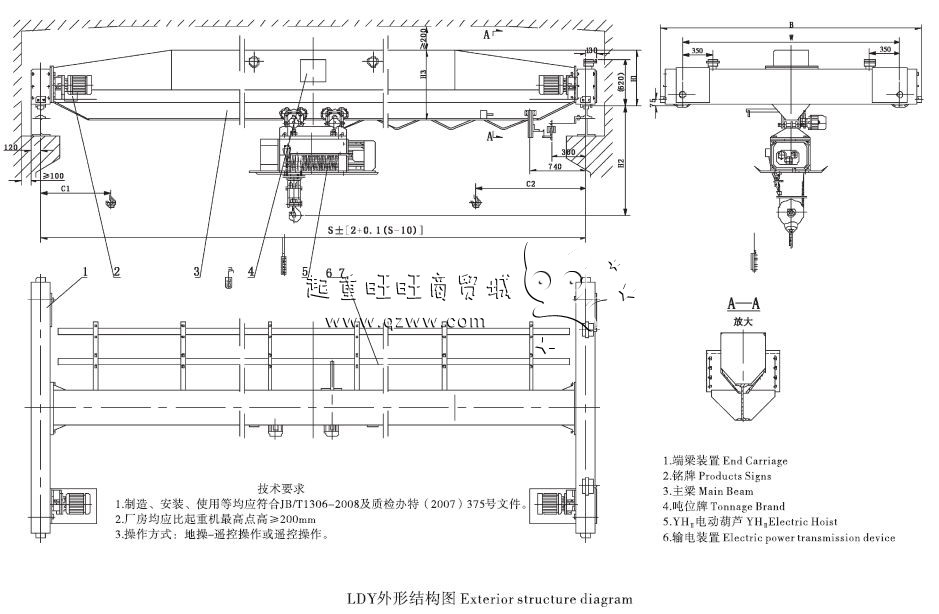
4. Main Components
The LDY Type Metallurgical Electric Single-Girder Crane consists of three main assemblies: the bridge frame, the metallurgical electric hoist, and the electrical system. The bridge frame supports and moves the load longitudinally, and is made up of the metal structure and the travel mechanism. The metal structure comprises the main girder, end carriages, and their connections. The travel mechanism consists of the drive unit, transmission, braking device, and wheel blocks. The metallurgical electric hoist handles lifting and cross-travel of the load. The electrical system is composed of the main circuit and the control circuit.
5. After-Sales Service
The LDY Type Metallurgical Electric Single-Girder Crane is warranted against quality defects under normal use for one year from the date of delivery. For products beyond the warranty period (excluding those that cannot be repaired), our company provides repair services at the cost of replacement parts.
Price Reference (for budgeting): The price of the LDY Type Metallurgical Electric Single-Girder Crane is based on lifting capacity and span. A 10t model with a 16m span is approximately RMB 80,000–120,000, while a standard LDA Type of the same specification is around RMB 50,000–70,000. As a factory-direct supplier, Kelude Heavy Industry offers wholesale pricing even for single-unit orders. Optional features are priced separately with transparent pricing.
Availability & Delivery: Metallurgical hoists and main girder insulation panels are kept in stock. Delivery is 7–10 days after parameter confirmation. Non-standard custom orders ship within 15–20 days. Every crane undergoes individual load testing before leaving the factory, and comes with a Certificate of Conformity and inspection report.
Metallurgical Crane Buying Guide: Key Considerations
Buying a metallurgical overhead crane is a different ballgame from purchasing a standard hoist. Here are the pitfalls to watch out for:
1⃣ Don't Under-Spec the Duty Class — Start at A5 Minimum
Standard LDA Type cranes are rated Duty Class A3, which handles a dozen or so cycles a day without issue. But a metallurgical crane in a smelting shop faces high lift frequencies, heavy loads, and elevated ambient temperatures — A5 is the absolute floor. If you're running 8+ hours of continuous duty per day, go with A6 or even A7. Under-spec the duty class, and you'll see fatigue cracks in the main girder and travel mechanism within two years. Replacing the whole crane at that point will cost you double what the upgrade would have upfront.
2⃣ Verify Your Site Temperature — Over 60°C Requires Customization
The LDY Type is designed for a standard ambient temperature of ≤60°C, and within that range, the insulated main girder and Class H motors perform as intended. But if your workstation sits too close to the melting furnace (e.g., lifting distance less than 5 meters from the furnace mouth), the ambient temperature can exceed 60°C. In that case, you'll need additional heat shields or radiant reflective panels. Tell the manufacturer your actual site temperature and furnace distance before ordering — don't guess.
3⃣ Dual Brake Isn't an Option — It's Standard
The LDY Type metallurgical electric hoist comes standard with a dual brake system (travel brake + safety brake). Some smaller manufacturers cut corners by fitting a standard hoist and passing it off as a metallurgical one to undercut prices. Check the hoist model on the spec sheet — it must be YHII type, not CD1 or MD1. The YHII hoist comes with dual brakes and an overload limiter built in. That's your safety baseline.
4⃣ Go with Angle Steel Conductor Rail for Power Supply
Metallurgical shops run hot and dusty, and cable reels have a high failure rate in these conditions (the cable jacket can melt, and the reel spring tends to fail). Angle steel conductor rail (angle iron busbar) is heat-resistant, shrugs off dust buildup, and delivers excellent conductivity — it's the standard power supply solution for metallurgical cranes. Standard enclosed conductor rail has a plastic housing that deforms under high heat; angle steel rail is all-metal and doesn't care about temperature. Spec the angle steel conductor rail from the start — slightly higher upfront cost, but you won't touch it for a decade.
FAQ
Q: How much more expensive is an LDY Type metallurgical crane compared to a standard LD Type single-girder crane? A: 30% to 60% more, depending on the configuration. The price difference comes down to three main components: the metallurgical electric hoist (YHII type costs roughly double a CD1), the Class H insulated motor, and the main girder insulation layer. A 10-ton, 16-meter span LDY Type costs approximately RMB 80,000–120,000 (including the hoist), while a standard LDA Type of the same specification is around RMB 50,000–70,000. The extra cost is a safety investment — don't skimp on it in a metallurgical workshop.e metallurgical crane compared to a standard LD Type single-girder crane?
A: 30% to 60% more, depending on the configuration. The price difference comes down to three main components: the metallurgical electric hoist (YHII type costs roughly double a CD1), the Class H insulated motor, and the main girder insulation layer. A 10-ton, 16-meter span LDY Type runs approximately ¥80,000–120,000 (hoist included), while a standard LDA Type of the same spec is around ¥50,000–70,000. The premium is your safety investment — not the place to cut corners in a metallurgical shop.
Q: Can an LDY Type metallurgical crane be used in a standard workshop?
A: Technically yes, but there's no point. The LDY's Duty Class A5–A7, dual brakes, and Class H motors are overkill for a standard workshop. And you'll pay 30%+ more than an LDA of the same capacity. If you're doing routine machining or warehouse lifting, an LDA is all you need. Metallurgical cranes are engineered for high-temperature, high-frequency, heavy-load applications.
Q: What special conditions are required for installing a metallurgical crane?
A: The same as a standard single-girder crane — you need factory building corbels and crane rails. But in a metallurgical shop, two things matter: first, the I-beam rail should be a heavy-duty profile (I45c or larger) because metallurgical cranes have higher dead weight; second, the electrical wiring needs proper heat insulation, and the control box should be positioned as far from heat sources as possible. Our technical staff will verify the site conditions during installation.
