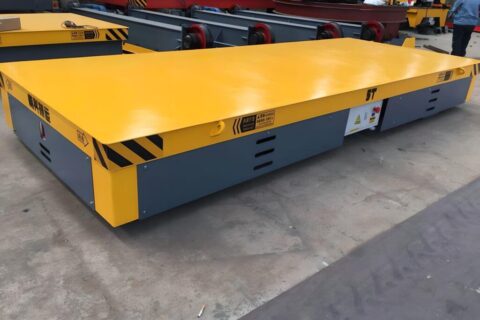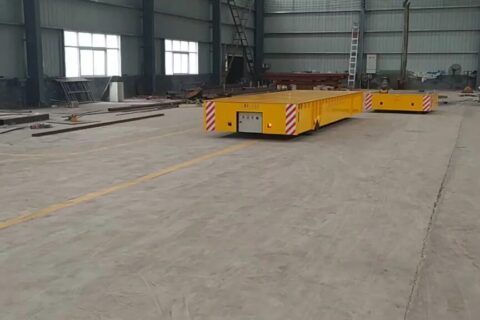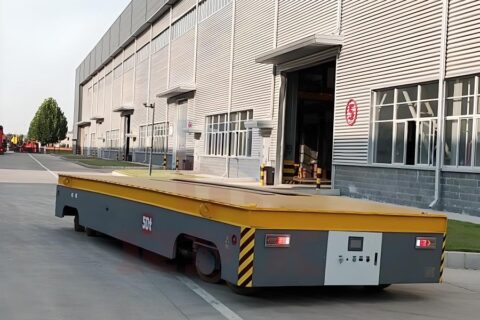

BWP Trackless Electric Flat Car for Heavy Load Transport
BWP Trackless Electric Flat Car Overview
The BWP trackless electric flat car—also referred to as a trackless electric platform truck or battery-powered trackless cart—is available in a wide range of load capacities, including BWP-2t, BWP-5t, BWP-10t, BWP-15t, BWP-20t, BWP-25t, BWP-30t, BWP-40t, BWP-50t, BWP-63t, BWP-70t, BWP-80t, and BWP-100t. Powered by onboard batteries and driven by DC motors with pneumatic tires, the BWP series requires no floor-mounted rails and operates freely on concrete, asphalt, and other hard surfaces. Its standout advantages are exceptional maneuverability and flexible steering.
Compared to rail-mounted electric flat cars (such as KPC, KPT, KPJ, KPX, and KPDS models), the BWP trackless design eliminates the need for embedded rails, making it ideal for temporary transport routes, frequently changing workshop layouts, and cross-facility material transfer. Equipped with pneumatic or solid rubber tires, the car is steered via a steering wheel or remote control, and four-wheel-steering models can rotate in place—offering far greater agility than rail-bound alternatives.
With load capacities from 2t to 100t, the BWP series suits a broad range of material handling applications, particularly in facilities where rail installation is impractical—such as steel structure workshops without pre-embedded tracks, outdoor transfer operations, and multi-bay factory buildings. Battery power eliminates the range limitations of cable- or rail-supplied systems, delivering a maximum travel distance of 3.5 km at full load. Optional upgrades include a hydraulic lifting platform, V-type saddles, remote control systems, and magnetic navigation for automated guided operation.
BWP Trackless Flat Car Photo Gallery
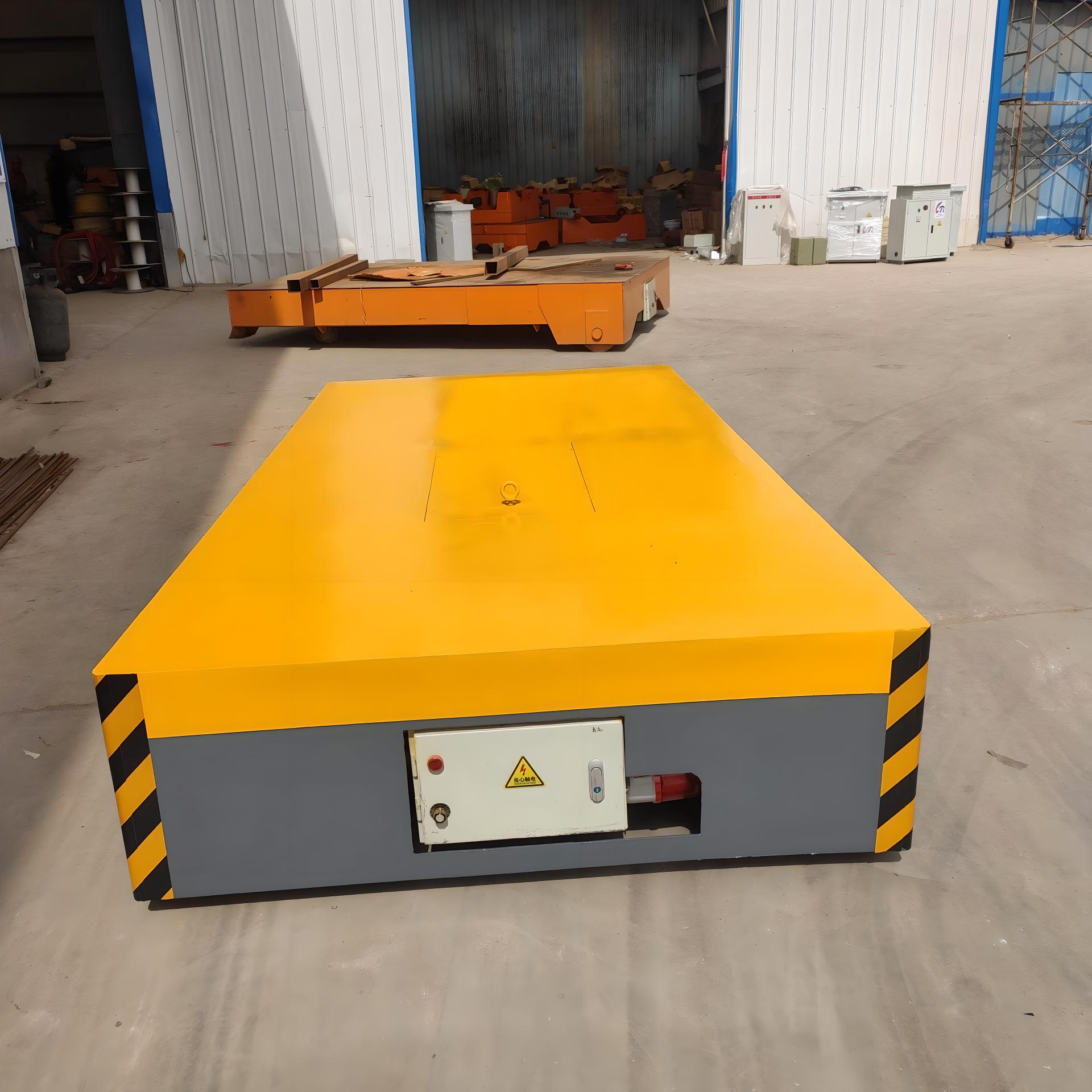
BWP Flat Car Models & Specifications
- Product Name: BWP trackless electric flat car
- Also Known As: trackless electric platform truck, battery-powered trackless cart
- Model Range: BWP series (BWP-2t to BWP-100t)
- Category: floor-level material handling equipment
- Power Supply: battery pack (DC 24V–72V)
- Motor Type: series-wound / separately excited DC motor
- Traction: pneumatic or solid rubber tires
- Speed Control: stepless control with electromagnetic braking
- Operation Mode: tethered pendant / remote control / operator cabin
- Steering: mechanical steering wheel or remote-controlled electric steering
- Manufacturing Origin: Changyuan, Xinxiang, Henan, China
- Customization: non-standard configurations available
- Production Lead Time: 15–25 days
- Service Area: nationwide
- Delivery: customer pickup or freight arranged
- Warranty: 12 months
Key Features & Benefits of BWP Flat Cars
- No Rails Required: Pneumatic tires allow operation on concrete, asphalt, and other hard surfaces. Eliminates the cost of embedded rail foundations, reducing factory building costs by 30%–50%. Ideal for temporary routes and reconfigurable workshop layouts.
- Superior Maneuverability: Mechanical steering via steering wheel (smaller models) or remote-controlled electric steering (larger models) with a minimum turning radius of 3–8 m. Four-wheel-steering versions can rotate 360° in place—perfect for tight spaces.
- Extended Battery Runtime: LiFePO₄ battery packs from 250 to 1,000 Ah provide 1.8–2.88 hours of continuous operation at full load, with a travel range of 2.2–3.5 km. A 5-minute battery swap option enables 24/7 operation.
- Braking Safety: Dual braking system combining hydraulic drum service brakes with electromagnetic parking brakes. Full-load braking distance ≤ 1.5 m (tested at 20 km/h). The parking brake engages automatically on power loss to prevent rollaway.
- Smart & Expandable: Optional magnetic tape navigation (accuracy ±20 mm), LiDAR SLAM autonomous navigation (no floor markers needed), and wireless remote control dispatching system for multi-car fleet coordination.
- Low Maintenance: Tire replacement interval of 6–12 months depending on floor conditions; battery cycle life of ≥800 cycles for lead-acid and ≥2,000 cycles for LiFePO₄. Routine maintenance is limited to tire pressure and brake system checks.
- Broad Load Capacity Range: Full coverage from 2t light-duty material delivery to 100t heavy cast steel component transfer, with multiple capacity options within the same series.
How the BWP Trackless Electric Flat Car Works
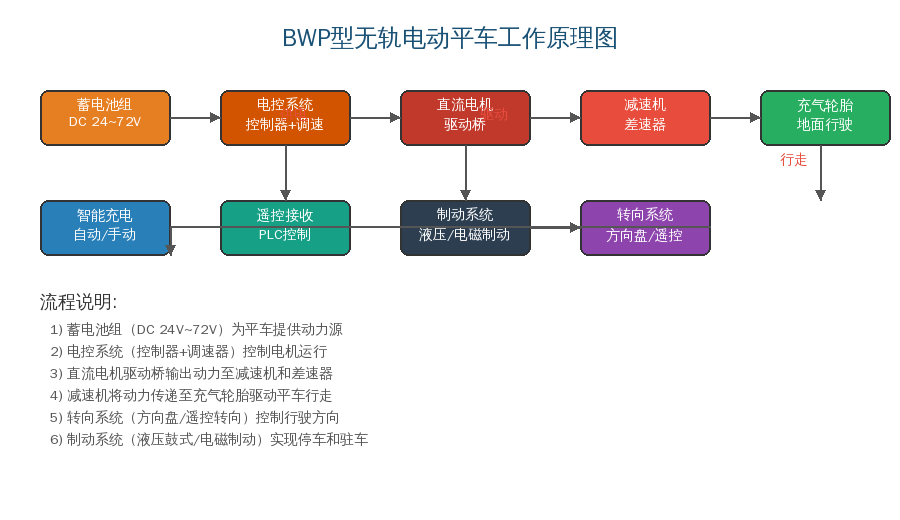
The operating principle of the BWP trackless flat car is built on a complete energy conversion chain: battery power → electrical control → DC motor drive → tire traction.
Step 1: Power Supply. The onboard battery pack (DC 24V–72V, 250–1,000 Ah) serves as the power source. Options include maintenance-free lead-acid or LiFePO₄ batteries, housed in a compartment beneath the chassis.
Step 2: Electronic Speed Control. The electrical control system (MOSFET/IGBT controller) receives operator commands via tethered pendant or remote control and applies PWM stepless speed control to the DC motor. The controller also monitors battery voltage, provides overcurrent protection, low-voltage alarms, and supports energy recovery (with optional regenerative braking).
Step 3: Mechanical Drive. The DC motor delivers power to the drive axle—comprising the main reducer, differential, and half-shafts—which transfers torque to the drive wheels. The differential allows the inner and outer wheels to rotate at different speeds during turns for smooth cornering.
Step 4: Motion Control. The operator steers via the steering wheel or remote control, adjusting the front wheel angle for direction changes. The hydraulic drum braking system applies stopping force as needed, while the electromagnetic parking brake locks automatically when the vehicle stops or loses power.
When battery charge drops below 20%, the control system triggers a low-voltage alarm to prompt recharging. The smart charger automatically shuts off when fully charged; charging time ranges from 4 to 8 hours depending on battery capacity.
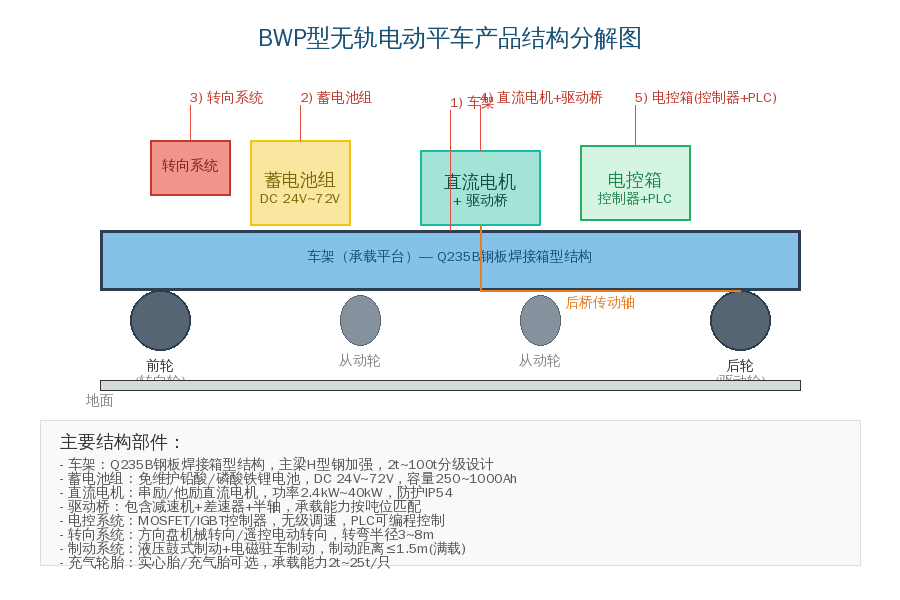
BWP Flat Car Construction & Main Components
The BWP trackless electric flat car consists of the following major structural components:
- Chassis (Load-Bearing Platform): Box-section structure welded from Q235B steel plate (≈S235JR), reinforced with H-Beam main girders, and designed in graduated capacities from 2t to 100t. Models rated 50t and above feature twin H-Beam construction with crosswise stiffening ribs, and the complete weldment is annealed to relieve internal stress. The table surface can be finished with checkered steel plate (anti-skid) or a steel tread plate.
- Battery Pack: Maintenance-free lead-acid battery or LiFePO₄ lithium battery, DC 24V–72V. The battery pack sits in a compartment beneath the chassis, mounted on sliding rails with quick-connect joints (supports battery swap in 5 minutes).
- DC Motor: Series-wound or separately excited DC motor, power rating from 2×1.2kW to 40kW. Series-wound motors deliver high starting torque (3–4 times rated), ideal for heavy-load starts; separately excited motors offer a wide speed control range, suited to frequent speed changes.
- Drive Axle: Includes the main reducer (gearbox), differential, axle shafts, and rear axle housing. Load capacity is matched to the tonnage rating; models 50t and above use a heavy-duty marine-type rear axle.
- Electrical Control System: MOSFET/IGBT PWM controller with stepless control, plus built-in overcurrent, over-temperature, and undervoltage protection. Optional PLC (Siemens S7-200 SMART) with Touch Screen (HMI) control.
- Steering System: Small-capacity models (≤30t) use a steering wheel with a mechanical recirculating-ball redirector; large-capacity models (≥40t) use electro-hydraulic power steering. Four-wheel-steer versions allow both front and rear axles to pivot, cutting the turning radius by 50%.
- Braking System: Hydraulic drum service brakes (dual-circuit) plus an electromagnetic fail-safe brake. The electromagnetic brake automatically locks the drive shaft when power is cut, preventing rollback on slopes.
- Tires: Pneumatic tires (standard) or solid tires (optional). Pneumatic tires provide better shock absorption and suit both indoor and outdoor use; solid tires carry heavier loads, are maintenance-free, and handle rough ground.
Technical Parameters for BWP Trackless Electric Flat Car
The table below lists the standard technical specifications for the BWP trackless electric flat car, covering key dimensions, battery parameters, drive ratings, and tire matching data for 13 models from 2t to 100t. Table dimensions, battery capacity, wheelbase, and other parameters can be customized to meet specific requirements.
BWP Trackless Electric Flat Car – Specification Table
| Flat Car Model | BWP-2t | BWP-5t | BWP-10t | BWP-15t | BWP-20t | BWP-25t | BWP-30t | BWP-40t | BWP-50t | BWP-63t | BWP-70t | BWP-80t | BWP-100t | |
| Rated Load Capacity(t) | 2 | 5 | 10 | 15 | 20 | 25 | 30 | 40 | 50 | 60 | 70 | 80 | 100 | |
| Table Dimensions | Length | 2000 | 2200 | 2300 | 2400 | 2400 | 3500 | 3500 | 5000 | 5500 | 5600 | 6000 | 6500 | 6600 |
| Width | 1500 | 2000 | 2000 | 2100 | 2200 | 2200 | 2200 | 2500 | 2600 | 2500 | 2600 | 2800 | 3000 | |
| Height | 450 | 500 | 550 | 600 | 600 | 700 | 700 | 800 | 800 | 850 | 900 | 950 | 1200 | |
| Wheel Base | 1080 | 1650 | 1650 | 1600 | 1650 | 1650 | 1650 | 2000 | 2000 | 1800 | 1850 | 1950 | 2000 | |
| Wheelbase | 1380 | 1680 | 1700 | 1830 | 1850 | 2700 | 2700 | 3600 | 2850 | 2900 | 3500 | 3500 | 4000 | |
| Wheel Diameter | Φ250 | Φ300 | Φ350 | Φ400 | Φ400 | Φ450 | Φ450 | Φ500 | Φ600 | Φ600 | Φ600(Counterweighted) | Φ600(Counterweighted) | Φ600(Counterweighted) | |
| Number of Wheels | 4 | 4 | 4 | 4 | 4 | 4 | 4 | 4 | 4 | 4 | 6 | 6 | 8 | |
| Ground Clearance | 50 | 50 | 50 | 50 | 50 | 50 | 50 | 50 | 50 | 75 | 75 | 75 | 75 | |
| Travel Speed(m/min) | 0-25 | 0-25 | 0-25 | 0-20 | 0-20 | 0-20 | 0-20 | 0-20 | 0-20 | 0-20 | 0-20 | 0-20 | 0-18 | |
| motor power(k W) | 2×1.2 | 2×1.5 | 2×2.2 | 2×3.5 | 2×4.5 | 2×5.5 | 2×5.5 | 2×6.3 | 2×7.5 | 2×10 | 2×12 | 30 | 40 | |
| Battery Capacity(Ah) | 250 | 180 | 250 | 330 | 400 | 400 | 450 | 440 | 500 | 600 | 600 | 800 | 1000 | |
| Battery Voltage(V) | 24 | 48 | 48 | 48 | 48 | 48 | 48 | 72 | 72 | 72 | 72 | 72 | 72 | |
| Continuous Full-Load Operation(h) | 2.5 | 2.88 | 2.8 | 2.3 | 2.2 | 1.8 | 2 | 2.6 | 2.5 | 2.2 | 1.8 | 2 | 1.9 | |
| Operating Range(km) | 3 | 3.5 | 3.4 | 2.8 | 2.7 | 2.2 | 2.4 | 3.2 | 3 | 2.7 | 2.2 | 2.4 | 2.3 | |
| Maximum Wheel Load(KN) | 14.4 | 25.8 | 42.6 | 64.5 | 77.7 | 94.5 | 110.4 | 142.8 | 174 | 221.4 | 152 | 185 | 190 | |
| Reference Weight(t) | 2.3 | 3.6 | 4.2 | 5.5 | 5.9 | 6.5 | 6.8 | 7.6 | 8 | 10.8 | 12.8 | 14.6 | 26.8 | |
Where to Use a Trackless Electric Flat Car
- Steel structure workshops / temporary facilities: The trackless design eliminates the need for embedded crane rails, making it ideal for steel structure workshops (no rail foundation), workshops under construction, or temporary production lines. When relocating, the flat car simply drives away—no rail removal required.
- Cross-workshop material transfer: Rail-bound flat cars are confined to a single track, but the BWP trackless model moves freely between multiple workshops for seamless cross-area logistics. It's especially effective for short-haul transfers from railcars to the workshop or from the workshop to the warehouse.
- Mold and heavy equipment handling: BWP models in the 50t–100t range carry large molds, heavy machine tools, and oversized steel structures. Paired with a hydraulic lifting platform, the car enables self-loading/unloading directly from the ground.
- Outdoor yards and docks: Pneumatic tires handle outdoor concrete and asphalt surfaces. Ideal for short-distance transport of steel plates, pipes, and castings in outdoor storage yards, with crane assistance for loading and unloading.
- Precision assembly lines: BWP models in the 2t–10t range can follow magnetic tape or laser navigation for automatic part delivery between assembly line stations, enabling AGV-style flexible logistics.
- Shipbuilding and aerospace: Large hull sections and aircraft components often can't be moved on fixed rails inside the factory. The BWP trackless flat car is the ideal solution—multiple units can be operated in tandem to handle extra-long workpieces.
How to Choose the Right BWP Flat Car
- Confirm load capacity: Select a model based on the maximum weight of the material to be transported plus a 20% safety margin. For example, for a 15t mold, we recommend the BWP-20t.
- Table dimensions: Standard sizes range from 2000×1500mm to 6600×3000mm. Extra-long workpieces can be accommodated with a custom extended table surface (up to 15m), and extra-wide items can be handled with dual-side steering and a widened table.
- Battery type: Lead-acid batteries (low cost) suit single-shift daily operations; lithium iron phosphate batteries (longer lifespan, lighter weight) are better for multi-shift or frequent charge/discharge cycles. A battery swap solution supports 24-hour continuous operation.
- Tire selection: For smooth workshop floors, choose pneumatic tires (better shock absorption); for outdoor gravel or metal shavings, solid tires (puncture-resistant); for cleanrooms, polyurethane-coated wheels (non-marking, floor-friendly).
- Steering mode: Front-wheel steering (standard) for straight-line back-and-forth transport; four-wheel steering for tight spaces (reduces turning radius by 50%); dual-axle steering for large flat cars.
- Automation needs: For automatic navigation, choose magnetic navigation (cost-effective, ±20mm accuracy) or laser SLAM navigation (high precision, no floor markers, ±10mm accuracy).
Operating Instructions for Your Electric Flat Car
- Delivery inspection: Upon receiving the flat car, check tire pressure (pneumatic tires: 0.4–0.6MPa), battery charge (should be >50%), bolt tightness, and braking system function.
- Charging: Use the included smart charger—connect the plug, and it automatically detects the battery type, starts charging, and cuts off when full. Do not operate the flat car while charging. Lead-acid batteries take 6–8 hours to charge; lithium iron phosphate batteries take 4–6 hours.
- Starting: Turn on the main switch, wait for the instrument panel to light up, then slowly push the direction handle or remote control accelerator to start. Accelerate smoothly to avoid shock to the drive system.
- Driving: Keep the steering wheel centered when driving straight (for steering models); slow down to below 5m/min before turning and turn the wheel gradually. When descending a slope with a full load, use the brake to control speed—never coast in neutral.
- Braking: Releasing the accelerator engages regenerative or resistance braking to decelerate; press the brake pedal to stop. When the power is off, the electromagnetic brake locks automatically. Always use the parking brake when stopping on a slope.
- Safety precautions: Do not overload, drive sideways on slopes, or carry passengers. If you notice unusual noise or odors while driving, stop and inspect immediately. Check tire pressure and brake fluid level weekly.
Why Choose Kelude for Trackless Electric Flat Cars
Compared to other BWP trackless electric flat car suppliers on the market, Kelude Heavy Industry differentiates itself in the following areas:
| Comparison Parameter | Kelude Heavy Industry BWPFlat Car | Market Comparable Products |
| Battery | Lead-Acid Compatible/Li Fe PO4 Optional, Li Fe PO4 Cycle Life≥2000Cycles, Fast Charging1CStandard | Lead-Acid Only, Li Fe PO4 Cycle Life≤800Cycles, Slow Charging0.2C, No Fast Charging Option |
| electrical control system | IGBT/MOSFET PWMSpeed control, Triple Protection: Overcurrent, Overtemperature, Undervoltage, Energy Feedback | Standard Contactor Speed control, No Protection or Single-Level Protection Only, None Energy Feedback |
| Drive Axle | Heavy-Duty Marine-Type Rear Axle(≥40tGrade), Differential Tested to100,000-Cycle Durability Testing | Light Truck Modified Axle, No Durability Rating Testing, Axle Shaft Prone to Fracture Under Prolonged Heavy Load |
| braking system | Hydraulic Dual-Circuit Braking+Electromagnetic Parking Brake, braking distance≤1.5m(Full Load20km/h) | Single-Circuit Hydraulic Braking, No Parking Brake Braking Or Only Manual Parking Brake |
| Frame Structure | Q345B (≈S355J2)High-Strength Steel(≥50tGrade), FEA Optimization, Weld Seam Ultrasonic Testing (UT) | Standard Q235B (≈S235JR), No Optimization Flaw detection, Prone to Under Prolonged Heavy Load Weld Seam Cracking |
| Automation Capability | Standard PLCInterface, Optional Magnetic Navigation/Laser SLAM/Multi-Vehicledispatching system | No Automation Interface, Navigation Not Supported Retrofit |
| After-Sales Warranty | 1Year Full-Machine Warranty,48Hour On-Site Response, Lifetime Technical Support | 6~12Months,72Response Time Exceeding Hours, Out-of-Warranty Service Fee Maintenance |
Service & Support
Kelude Heavy Industry provides full lifecycle support for every BWP series trackless electric flat car. Before purchase, our engineers conduct a free site survey and develop a customized technical solution based on your floor conditions, load parameters, and travel route. During manufacturing, we keep you informed with regular progress updates, and every flat car undergoes a 2-hour full-load running test, braking performance verification, and battery range validation before leaving the factory. After delivery, you get a 1-year comprehensive warranty, on-site response within 48 hours, and lifetime technical consultation. For wear parts and spares, we maintain a ready stock of battery packs, controllers, drive axle assemblies, brake shoes, tires, and other frequently replaced components—ensuring delivery and replacement within 3 days.
Frequently Asked Questions
Q: What is the difference between a BWP trackless electric flat car and an AGV?
A: The BWP trackless electric flat car is a heavy-duty transport vehicle operated by a driver or via remote control, designed for heavy loads (2–100t) and rugged durability. An AGV (Automated Guided Vehicle) is typically a light-duty unit (usually ≤5t) that navigates automatically. The BWP can be upgraded to AGV functionality by adding magnetic navigation or laser SLAM with a control system—while still offering far greater load capacity and structural strength than standard AGVs on the market.
Q: How long does a fully charged battery last?
A: Continuous running time at full load ranges from 1.8 to 2.88 hours depending on the model (see specification table), corresponding to a travel distance of 2.2–3.5 km. With no load, the range is significantly longer—up to 1.5 times the full-load figure. We recommend recharging when the battery level drops below 20%. Lithium iron phosphate batteries support fast charging, reaching 80% capacity in 1–2 hours.
Q: Can the flat car be used outdoors and in rain or snow?
A: The standard model is suitable for dry outdoor concrete surfaces. For use in rain or snow, we recommend the upgraded waterproof version, which features an IP65-rated electrical control box, waterproof motor, and sealed electrical joints. Avoid driving through areas where water accumulates deeper than 50 mm.
Q: Can tires be punctured by metal shavings?
A: Pneumatic tires are at risk of puncture in workshops with heavy metal shavings or welding slag. For such environments, we recommend solid tires (tubeless, air-free) or polyurethane-coated wheels. Kelude offers a puncture-resistant tire solution tailored to your working conditions.
Q: What national standards does the BWP trackless electric flat car comply with?
A: The BWP series is designed and manufactured in accordance with JB/T 6127-2010 (Electric Flat Car industry standard) and GB 5226.1-2019 (General requirements for electrical safety of machinery). The battery system meets GB/T 18332.1, and the braking system complies with GB 12676 (automotive braking system standard). Every unit undergoes full-load running and braking distance testing before shipment.
Q: Can the flat car operate on slopes?
A: The BWP flat car has a maximum gradeability of 5% at full load and 10% when empty. For steeper inclines, we recommend using a winch-assisted pulling system. Never drive across a slope or park on an incline, as this creates a rollover risk. When stopping on a slope, always engage the parking brake and use wheel chocks.
Need help selecting the right BWP trackless flat car?
Get a free technical solution, drawings, and quotation—send us your load capacity, table dimensions, and floor conditions, and we'll respond with a proposal within 30 minutes.
Consultation hotline: 13903802779 | Factory: Changyuan Crane Industrial Park, Xinxiang, Henan