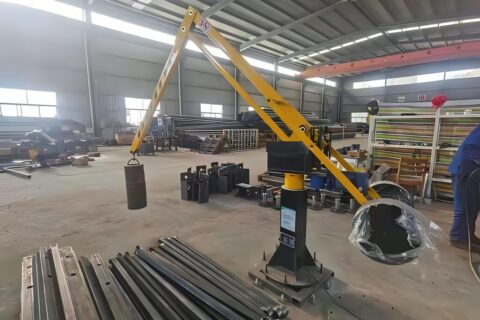
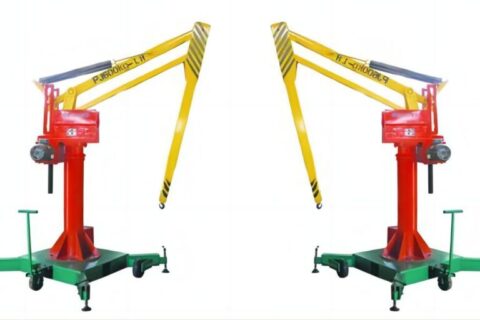
PJ Series Electric Rotating Balancer for Lathe Operations
Product Introduction
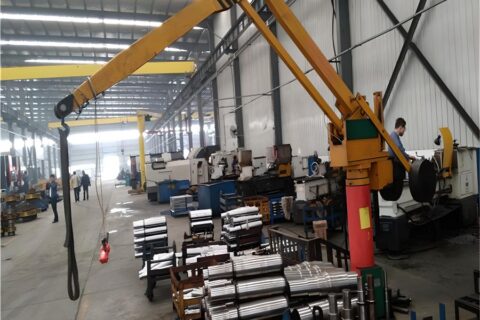
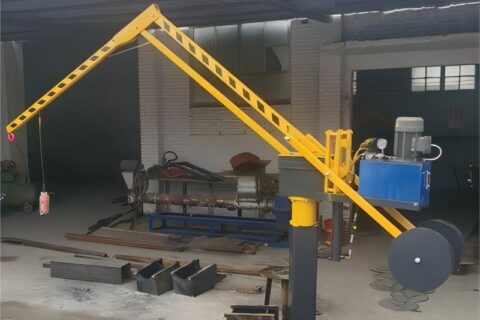
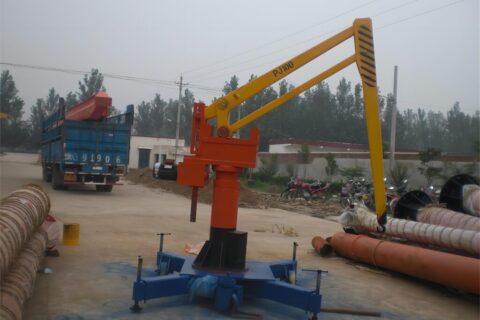
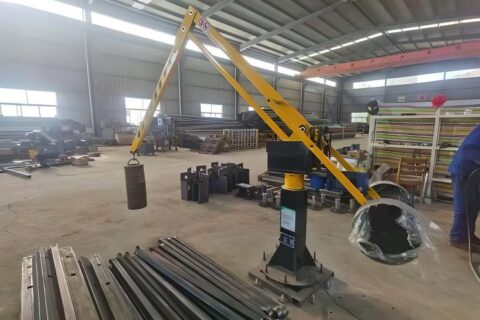
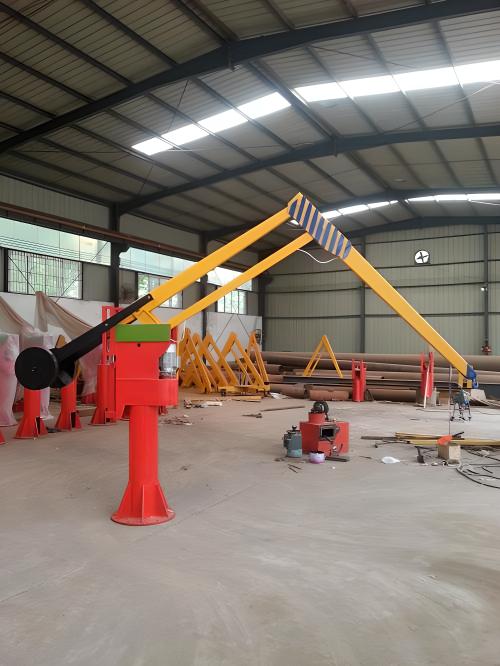
The PJ Balancer is an ideal medium and small-sized mechanical handling device. It operates on the four-bar linkage principle, combining manual and powered actions into a compound motion to move loads, allowing the suspended load to be held steadily at any point within the working area as needed. With a Lifting Capacity of 50~600kg, it is available in two structural series: low-column (low-profile) and high-column (high-profile). It features a compact footprint, low Dead Weight, and an elegant appearance, delivering safe, reliable, and effortless operation.
The PJ series Balancer is widely used for loading and unloading workpieces on machine tools, lifting and transporting components during medium-sized assembly and maintenance operations, bridging transfer stations on production lines, core setting and mold closing in foundries, and furnace charging and discharging in heat treatment workshops. It is now extensively applied across the automotive, tractor, diesel engine, agricultural vehicle, and machine tool manufacturing industries.
Product Gallery
Product Features
Four-bar linkage for precise positioning: Based on the four-bar linkage principle, the load can be moved freely in the horizontal plane with a simple manual push or pull. Once released, it stays securely in position anywhere within the working area — no additional locking required.
High and low column options: Available in standard high-profile (hmax=2500mm) and low-profile (hmax=2000mm) column configurations to suit different workshop heights and machine tool installation spaces. The core Hoisting mechanism is shared across both versions, simplifying Spare parts management and Maintenance.
345° wide-angle Rotation: The column offers a 345° Slewing angle, covering virtually the entire circular working area. The maximum working radius Rmax reaches 3200mm (PJ050/060), with a Level luffing range of 2200mm, providing extensive coverage around machine tool stations.
Easy operation, reduced physical strain: Electric Hoisting is controlled via push-button Inching Control, while horizontal movement and Rotation are achieved through simple manual push-pull action. The intuitive design allows a single operator to handle frequent Material Handling tasks with ease, significantly reducing physical labor.
Working Principle
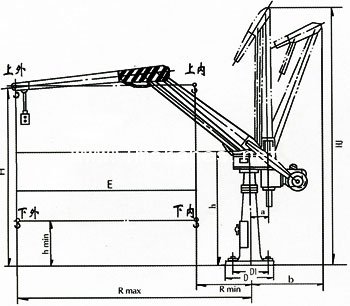
The PJ Balancer operates on a four-bar linkage combined with a screw-type Hoisting mechanism. The main structure consists of a Column, a four-bar linkage jib, a screw hoist, and a Hook block. The upper and lower arms of the four-bar linkage, along with the vertical connecting links, form a deformable quadrilateral through pivot joints. As the load moves horizontally, the quadrilateral expands or contracts while keeping the Hook block moving along a strictly vertical path, ensuring load stability.
During operation, the operator pushes or pulls the load via the handle, causing the four-bar linkage to expand or contract and allowing the load to move freely in the horizontal plane. Combined with the column's 345° Slewing, the entire working area is covered. Pressing the button controls the screw hoist's forward and reverse Rotation for smooth Hoisting and Lowering of the load. The simple combination of manual and powered actions creates a compound motion that makes operation effortless. An Overload Protector and limit switch are fitted to ensure safe operation.
Structural Composition
The Balancer consists of the following core components:
Column and Slewing mechanism: A steel pipe Column is fixed to a floor-mounted base, with a Slewing bearing at the top that enables 345° horizontal Rotation of the jib. Available in high-profile (2500mm) and low-profile (2000mm) heights.
Four-bar linkage jib: A deformable quadrilateral structure formed by an upper horizontal arm, a lower horizontal arm, and vertical connecting links, providing horizontal load movement and balanced support. The expansion range of the linkage determines the Level luffing distance (1730~2200mm).
Screw hoist: A transmission mechanism in which a Motor drives a threaded spindle to raise or lower a nut, offering smooth operation and reliable self-locking. Lifting speed ranges from 5.08 to 6.14m/min, decreasing as the Load increases.
Safety protection device: An Overload Protector (automatically cuts power when the Load exceeds the limit) and upper/lower limit switches (automatic stop at travel extremes) provide dual protection for safe operation.
Electrical Control System: Handle-mounted push buttons provide Inching Control of the Hoisting Motor's forward and reverse Rotation, making operation simple and intuitive.
Technical Parameters
| Parameter | PJ005 | PJ010 | PJ020 | PJ030 | PJ040 | PJ050 | PJ060 |
|---|---|---|---|---|---|---|---|
| Maximum lifting Weight (kg) | 50 | 100 | 200 | 300 | 400 | 500 | 600 |
| Maximum lifting height hmax (mm) | 2000 | 2000 | 2000 | 2000 | 2000 | 2500 | 2500 |
| Starting height hmin (mm) | 500 | 500 | 500 | 500 | 500 | 500 | 500 |
| Lifting range (mm) | 1500 | 1500 | 1500 | 1500 | 1500 | 2000 | 2000 |
| Maximum Slewing Radius Rmax (mm) | 2500 | 2500 | 2500 | 2500 | 2500 | 3200 | 3200 |
| minimum Slewing Radius Rmin (mm) | 580 | 580 | 770 | 770 | 770 | 1000 | 1000 |
| Level luffing (mm) | 1920 | 1920 | 1730 | 1730 | 1730 | 2200 | 2200 |
| Slewing Angle (°) | 345 | 345 | 345 | 345 | 345 | 345 | 345 |
| lifting speed (m/min) | 6.14 | 6.14 | 5.44 | 5.52 | 5.56 | 5.08 | 5.08 |
Note: The original table entry "Maximum lifting height" was a typo and has been corrected to "Maximum lifting height" (maximum lifting height).
Product Structure Diagram
Typical Applications
Machine Tool Loading/Unloading: For loading and unloading workpieces at lathes, milling machines, grinders, and other machining equipment. The PJ balancer effortlessly delivers workpieces to the table surface, saving labor, boosting efficiency, and reducing operator fatigue.
Assembly Line Transitions: For material transfer and transition between workstations on a production line. The PJ model's four-bar linkage provides a maximum horizontal reach of 2200mm, and with 345° rotation, it easily covers adjacent stations.
Core Setting and Mold Closing in Foundries: For sand core setting and mold closing in casting operations. The PJ balancer offers a lifting height of 2000–2500mm, ideal for medium-height tasks in foundry workshops.
Furnace Loading and Unloading in Heat Treatment: For loading and unloading workpieces in heat treatment processes. The balancer is highly maneuverable and provides smooth, stable lifting, reducing operational difficulty in high-temperature environments.
Selection Guide
By Load Capacity: Choose PJ005 for 50kg, PJ010 for 100kg, PJ020 for 200kg, PJ030 for 300kg, PJ040 for 400kg, PJ050 for 500kg, and PJ060 for 600kg. Models PJ005–PJ040 are low-profile (hmax=2000mm), while PJ050–PJ060 are tall-profile (hmax=2500mm).
By Working Range: PJ005–PJ040 offer a maximum radius of 2500mm with a horizontal reach of 1730–1920mm; PJ050–PJ060 offer a maximum radius of 3200mm with a horizontal reach of 2200mm. The larger-capacity models actually cover a wider area, making them suitable for handling large workpieces.
Low-Profile vs. Tall-Profile: Choose the tall-profile (standard) model when installation height is ≥2500mm, and the low-profile model for installation heights of 2000–2500mm. Low-profile PJ005–PJ040 provide a lifting range of 1500mm, while tall-profile PJ050–PJ060 provide a lifting range of 2000mm.
Manufacturer Services
Henan Kelude Heavy Industry Co., Ltd. provides end-to-end services for PJ series balancers, covering sales, installation, and after-sales support.
Quality Testing: Each unit undergoes a static test with 1.25 times the rated load before shipment. The four-bar linkage is subjected to repeated extension/retraction cycles to ensure smooth operation, and the screw lifting mechanism is endurance-tested through continuous lifting and lowering cycles.
After-Sales Warranty: Full machine warranty for 12 months, with an extended 24-month warranty on the screw lift and motor. After-sales requests are responded to within 48 hours.
Request a Quotation
Need a quotation for a PJ balancer?
Provide your load capacity, installation height, and application details, and we will tailor a solution for you within 2 hours.
Consultation Hotline: 13903802779
FAQ
Q: What is the difference between the PJ balancer and the PDJ balancer?
A: Both the PJ and PDJ series are balancers that operate on a similar four-bar linkage / parallelogram principle. The PJ series offers a lifting capacity of 50–600 kg, a hoisting speed of 5–6 m/min, and a slewing angle of 345°, available in both low-profile and tall column configurations. The PDJ series (e.g., PDJ025–525) covers a lifting capacity of 50–500 kg. The main differences lie in the specific dimensional and installation parameters, so the choice depends on your site conditions.
Q: How is the PJ balancer operated? Is training required?
A: Operation is very straightforward: use the push buttons to control lifting and lowering, and guide the load by hand for horizontal movement and rotation. A single operator can get the hang of it within minutes. We do recommend basic safety training for new operators to cover load limits and operating precautions.
Q: Why does the hoisting speed decrease as the load increases?
A: The PJ balancer uses the same motor model to drive the screw lift mechanism. As the load increases, the motor load rises and the screw speed drops slightly, reducing the hoisting speed from 6.14 m/min (PJ005) to 5.08 m/min (PJ050/060). This is a normal load-speed characteristic — the heavier the load, the slower the speed, which actually improves safety.
Q: Can the PJ balancer be equipped with variable-speed control?
A: The standard PJ balancer operates at a fixed hoisting speed. If variable-speed control is required, a custom Variable Frequency Speed Control solution can be provided, using a Frequency Inverter / VFD to adjust the motor speed and make the hoisting speed adjustable. This is ideal for precision assembly applications that demand fine speed control.
Q: Does the PJ balancer require a foundation for installation?
A: The PJ balancer base is secured to the floor with Anchor Bolts. We recommend drilling into a hardened floor surface and installing Expansion Bolts or embedding Anchor Bolts to ensure a stable base. If the floor's load-bearing capacity is insufficient, a concrete foundation must be poured first. The low-profile models have slightly less demanding floor requirements than the tall column models.