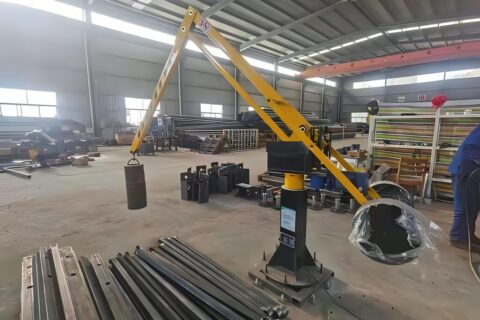
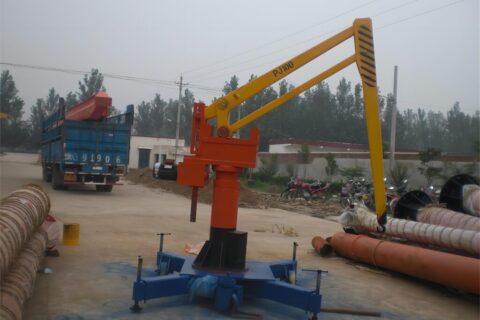
Mobile Balance Crane PDJ-Y for Industrial Lifting
Product Introduction
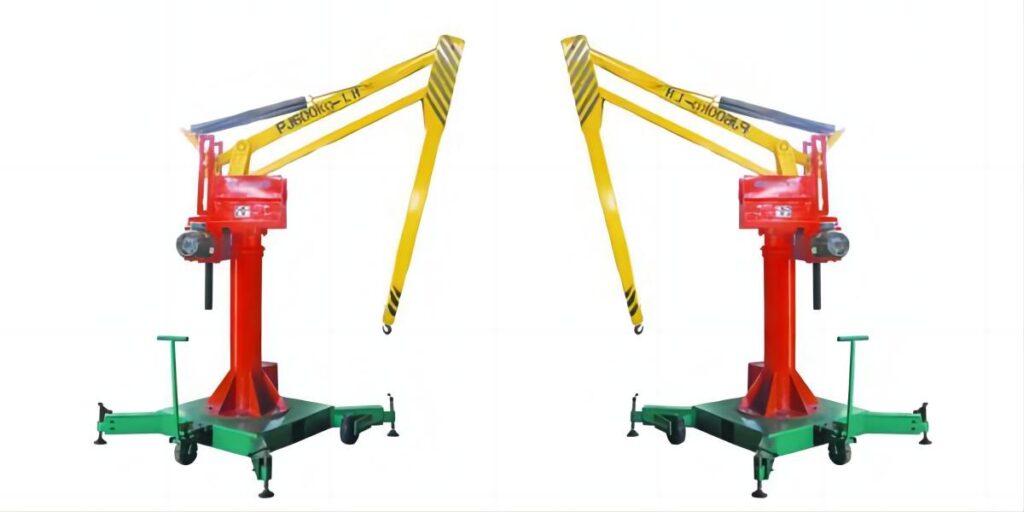
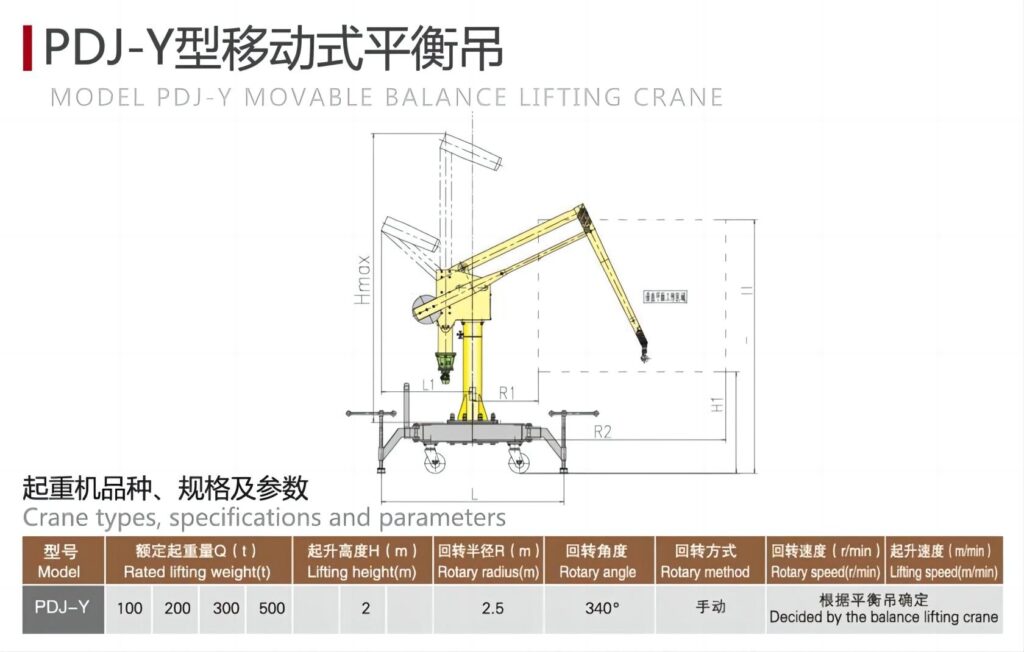
The PDJ-Y Mobile Balance Crane is a light-duty crane that mounts the PDJ Balancer on a mobile base, enabling lifting operations at non-fixed locations such as workshops and warehouses with flexibility and convenience. With a lifting capacity of 100–500 kg, a lifting height of 2 m, and a span customizable to customer requirements, the mobile base (trolley) allows the balancer to be easily moved between workstations without permanent installation—one unit covers multiple stations.
The YPDJA Mobile Balance Crane series is widely used for machine tool loading/unloading, workpiece handling between processes and along production lines, component assembly, as well as short-distance, high-frequency, intensive hoisting operations at stations, docks, warehouses, and similar venues. Depending on the application, either the PDJ high-profile or PDJ low-profile balancer can be selected to suit different site conditions.
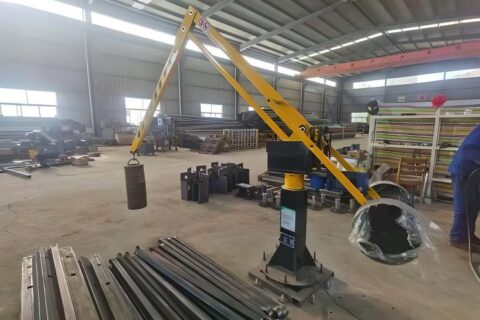
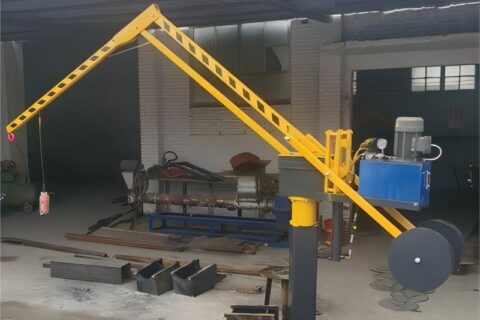
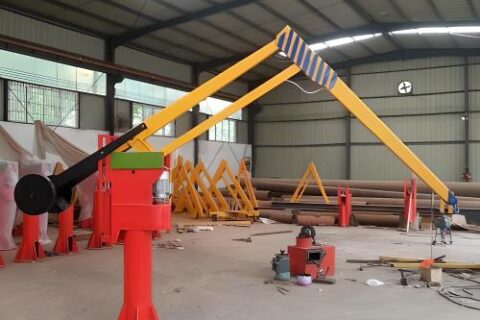
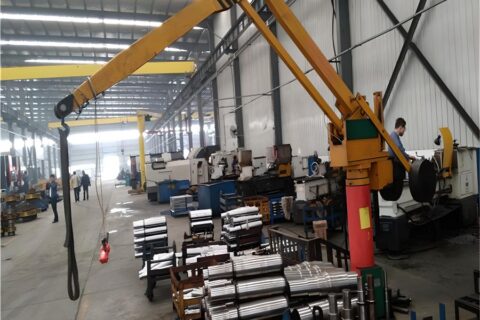
Product Gallery
Product Features
Mobile Base Design for Maximum Flexibility: Mounted on a mobile trolley, the balancer can be freely wheeled to any workstation in the workshop, eliminating the need for fixed lifting equipment at each station.
Proven PDJ Structure with Precise Positioning: Built on the PDJ balancer's parallelogram scaling principle and screw lifting mechanism, offering accurate positioning and effortless operation.
Three Power Options Available: Electric-mechanical (screw-driven lifting), pneumatic (air-powered, ideal for light-load explosion-proof environments), and hydraulic (suitable for heavier loads)—choose based on your operating conditions.
Wide Application Range: Ideal for short-distance, high-frequency, intensive hoisting tasks, effectively reducing labor intensity and improving work efficiency.
Working Principle
The PDJ-Y Mobile Balance Crane integrates the PDJ balancer's four-bar parallelogram boom and screw lifting mechanism onto a movable steel trolley base. Equipped with swivel casters, the trolley can be freely maneuvered across the workshop floor. Once positioned at the work site, the outriggers are extended to stabilize the unit before lifting operations begin.
The core of the balancer employs the parallelogram scaling principle combined with screw lifting: the parallelogram boom scales to achieve horizontal load movement, the column slewing covers the working area, and the screw lift—driven by an electric motor through a lead screw—handles vertical lifting. The mobile trolley enables seamless switching between multiple workstations.
Structural Composition
Comprising the following core components:
Mobile Trolley: Steel chassis with swivel casters and telescoping outriggers, available in three models—CS2/CS4/CS6—each rated for different load capacities. With outriggers retracted for travel, H1=1020~1600mm; with outriggers extended and locked, H1=1680~2620mm.
PDJ Balancer Main Body: Includes the column, slewing mechanism, parallelogram boom, and screw lift, delivering precise positioning and stable lifting.
Power System: Electric-mechanical (motor + lead screw) is the standard configuration, with optional pneumatic (air-driven) or hydraulic (hydraulic cylinder-driven) variants to suit different operating conditions.
Electrical Control System: Handheld pendant with push-button inching control for lifting/lowering, powered by 380V three-phase supply.
Mobile Trolley Technical Parameters
| Parameter | CS2 | CS4(CD4) | CS6(CD6) | |
|---|---|---|---|---|
| Complete machine Weight (kg) | — | 165 | 300 | 500 |
| minimum Turning radius (mm) | — | 1600 | 1600 | 2000 |
| travel speed | — | 25 | 25 | 25 |
| Trolley / Cross Travel Overall dimensions (mm) | Outrigger retraction H1 | 1020 | 1310 | 1600 |
| Outrigger retraction H2 | 1020 | 1310 | 1600 | |
| Outrigger retraction H3 | 260 | 260 | 260 | |
| Outrigger extension H1 | 1680 | 2195 | 2620 | |
| Outrigger extension H2 | 1680 | 2195 | 2620 | |
| Outrigger extension H3 | 280 | 280 | 280 |
Trolley Matching & Selection
| Drive mode | Trolley Model | Compatible with Balancer Model |
|---|---|---|
| Manual | CS2 | PJ(PJSZ)100, PJ(PJSZ)200 |
| CS4 | PJ(PJSZ)300, PJ(PJSZ)400 | |
| CS6 | PJ(PJSZ)500, PJ(PJSZ)600 | |
| Electric | CD2 | PJ(PJSZ)300, PJ(PJSZ)400 |
| CD2 | PJ(PJSZ)500, PJ(PJSZ)600 |
The original table had OCR defects in model designations (e.g., J(PJSZ)200, JPJSZ)400), which have been corrected to the standard format PJ(PJSZ).
Product Structure Diagram
Typical Applications
Multi-Station Workshop Hoisting: When multiple workstations in a workshop require alternating lifting operations, the PDJ-Y Mobile Balance Crane can be easily moved to wherever it is needed — one machine serving multiple stations.
Non-Fixed Warehouse Locations: For loading, unloading, and transporting goods across different warehouse zones, the unit offers flexibility without the need for permanently installed lifting equipment in every area.
Production Line Material Transfer: Ideal for moving workpieces and materials between stations on a production line, adapting quickly to changing production rhythms.
Equipment Maintenance Sites: For on-site maintenance and hoisting during unexpected equipment failures, the mobile balance crane can be positioned rapidly without being constrained by fixed installation points.
Selection Guide
By Power Type: Electric-mechanical (standard, motor + lead screw) suits most conventional working conditions; pneumatic is recommended for explosion-proof environments (chemical, dusty); hydraulic suits heavier loads (500kg and above).
By Load Capacity — Trolley Selection: 100–200kg: choose CS2 manual trolley; 300–400kg: choose CS4 manual or CD4 electric trolley; 500kg and above: choose CS6 manual or CD6 electric trolley.
By Operating Environment: 380V three-phase power supply, altitude not exceeding 2000m. For flammable or explosive atmospheres, a pneumatic explosion-proof model is mandatory. Do not use for lifting molten metal, toxic substances, or flammable/explosive materials.
Manufacturer Support
Henan Kelude Heavy Industry Co., Ltd. provides full sales and after-sales services for the PDJ-Y Mobile Balance Crane.
Quality Testing: Each unit undergoes a 1.25× rated load test before shipment, along with trolley maneuverability and support stability checks.
After-Sales Warranty: Full machine warranty for 12 months; screw lift and electric motor covered for 24 months. After-sales requests are responded to within 48 hours.
Request a Quotation
Need a quotation for the PDJ-Y Mobile Balance Crane?
Provide your load capacity requirements, power type, and number of workstations, and we will tailor a solution for you within 2 hours.
Consultation Hotline: 13903802779
FAQ
Q: What is the difference between the PDJ-Y and the PJhs Mobile Balance Crane?
A: The PDJ-Y is a PDJ high-profile/low-profile balancer mounted on a mobile cart. Its main parameters match the PDJ series (lifting capacity 100–500 kg, lifting height 2 m). The PJhs is a PJ-series balancer mounted on a mobile cart, offering a wider lifting capacity range (100–1000 kg). Both share the same core operating principle; the difference lies in the balancer body series.
Q: How do I choose between electric-mechanical, pneumatic, and hydraulic power?
A: Electric-mechanical (standard): A motor drives a screw to raise and lower the load. Suitable for the vast majority of workshop environments at a moderate cost. Pneumatic: Driven by compressed air; ideal for chemical, painting, and dusty environments with explosion-proof requirements, and for light loads (<=300 kg). Hydraulic: Driven by a hydraulic cylinder; suited for heavy loads (>=500 kg), offering smooth lifting but at a higher cost.
Q: Does the Mobile Balance Crane require anchor bolts?
A: No, the PDJ-Y Mobile Balance Crane does not require permanent anchor bolt fixing. Once positioned at the work site, extend the cart's telescoping support legs and adjust the leveling screws so the legs make ground contact and slightly lift the cart, removing wheel load. Stability is maintained by the cart's dead weight and counterweight. For added stability, extra counterweight blocks can be placed on the support leg bases.
Q: Can the lifting height of the Mobile Balance Crane be customized?
A: Yes. The standard lifting height is 2 m, and higher or lower heights can be customized to meet customer requirements. A taller lifting height requires a correspondingly longer column, and the cart stability must be recalculated. We recommend a maximum lifting height of 3 m to ensure stability during movement.
Q: Can the PDJ-Y Mobile Balance Crane be used on uneven floors?
A: Yes. The cart's support legs feature an adjustable screw design, allowing each leg to be extended independently to accommodate a certain degree of floor unevenness. A floor levelness of <=10 mm/m is recommended. For floors with significant slopes or severe unevenness, level the work area before operation.