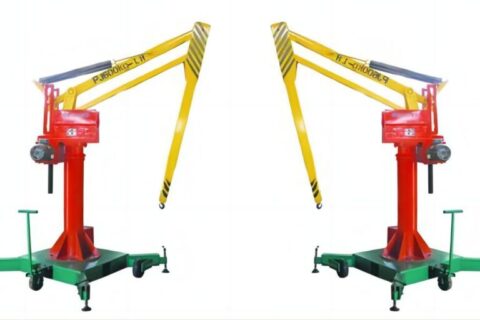
PAY Hydraulic Balancer for Industrial Lifting
Product Introduction
The PAY series hydraulic balancer is a lightweight material handling unit driven by a hydraulic system. Compared with conventional mechanical balancers, the hydraulic balancer stands out for its stepless speed control, precise positioning, smooth handling, and energy efficiency—moving loads of several hundred kilograms feels as effortless as handling a few pounds. The lineup includes 10 models ranging from PAY0225 (200kg) to PAY1532 (1500kg), with R2=2500~3200mm and a slewing angle of 345 degrees.
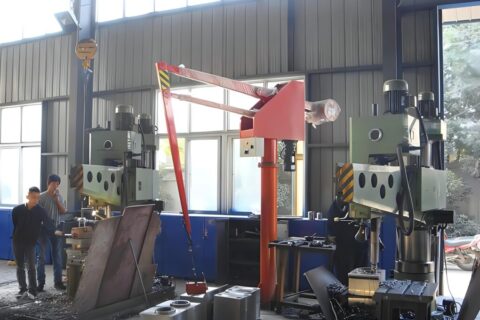
Hydraulic balancers are ideal for machine tool loading/unloading, machinery maintenance, and other indoor material handling tasks in factory workshops, particularly where fine positioning and heavier loads are involved. The hydraulic system delivers stepless control, allowing hoisting and lowering speeds to be freely adjusted to suit operational needs (6~8m/min), with positioning accuracy far exceeding that of mechanical balancers.
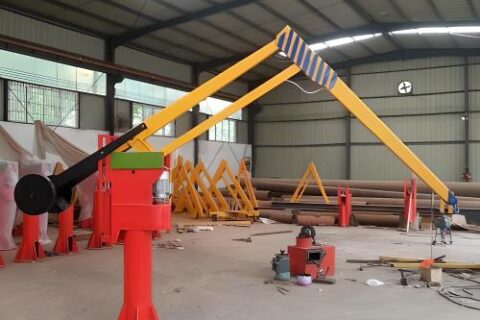
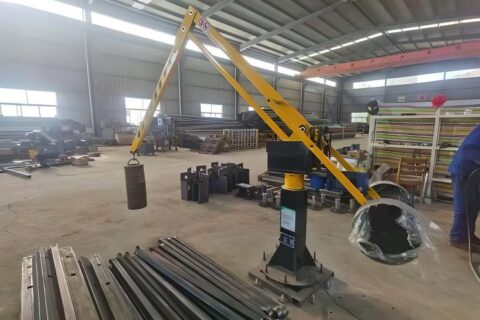
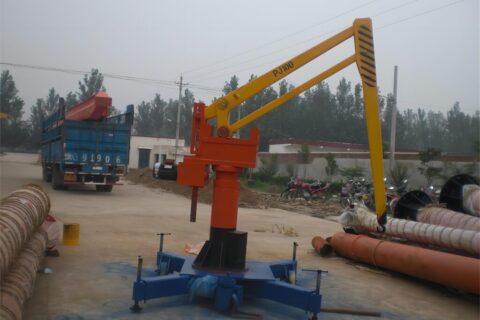
Product Gallery
Product Features
Hydraulic Stepless Control with Precision Positioning: The hydraulic drive delivers infinitely variable-speed control, letting the operator adjust hoisting and lowering speeds freely (6~8m/min). Load speed and position can be finely controlled, achieving far greater positioning accuracy than mechanical balancers.
Smooth Handling with a Light Touch: A hydraulic cylinder replaces the lead screw and nut drive, delivering smoother, more fluid motion. Moving loads of several hundred kilograms feels as easy as handling a few pounds, significantly reducing operator fatigue.
Wide Load Range: Ten models cover 200~1500kg with R2=2500~3200mm for broad application coverage. Smaller-capacity models suit precision assembly work, while larger models handle heavy material handling tasks.
Compact Structure, Minimal Footprint: The hydraulic power unit is integrated into the base, keeping the overall structure compact with no extra floor space required. H=2800~4500mm accommodates various workshop heights.
Working Principle
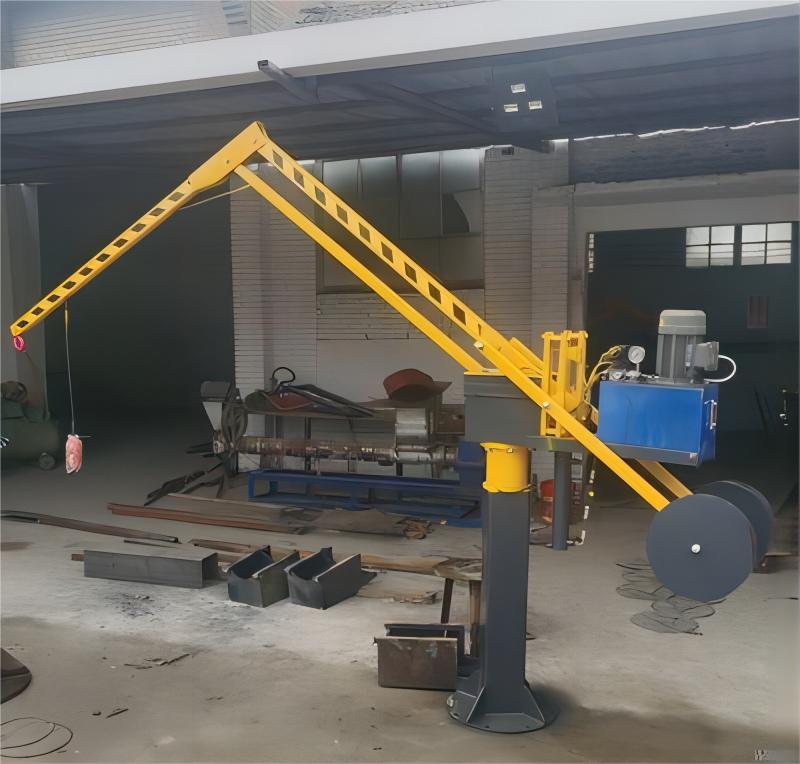
The PAY hydraulic balancer operates on a hydraulic drive combined with a parallelogram arm mechanism. A motor drives the hydraulic pump station to generate high-pressure oil, which is delivered through the hydraulic pipeline to the hydraulic cylinder. The cylinder's telescoping action raises and lowers the parallelogram arm. Unlike mechanical screw lifting, the hydraulic system achieves stepless speed control by regulating the flow and pressure of the hydraulic oil, giving the operator full command over lifting speed and applied force.
The parallelogram arm forms a deformable four-bar linkage through pivoted joints. As the load moves horizontally, the linkage expands or contracts while keeping the hook traveling along a vertical path. The column slewing mechanism provides 345 degrees of rotation for broad work-area coverage. The hydraulic system is equipped with an overload protection valve and a hose-burst valve that automatically locks the oil circuit in the event of an unexpected hydraulic hose failure, preventing load drop.
Structural Composition
Comprising the following core components:
Hydraulic Power Unit: The motor, hydraulic pump, oil tank, and control valve group integrated into the base, providing a stable and reliable hydraulic power source.
Hydraulic Cylinder: The actuating element that raises and lowers the parallelogram arm, replacing the mechanical lead screw for smoother motion. Built-in cushioning reduces impact during lifting and lowering.
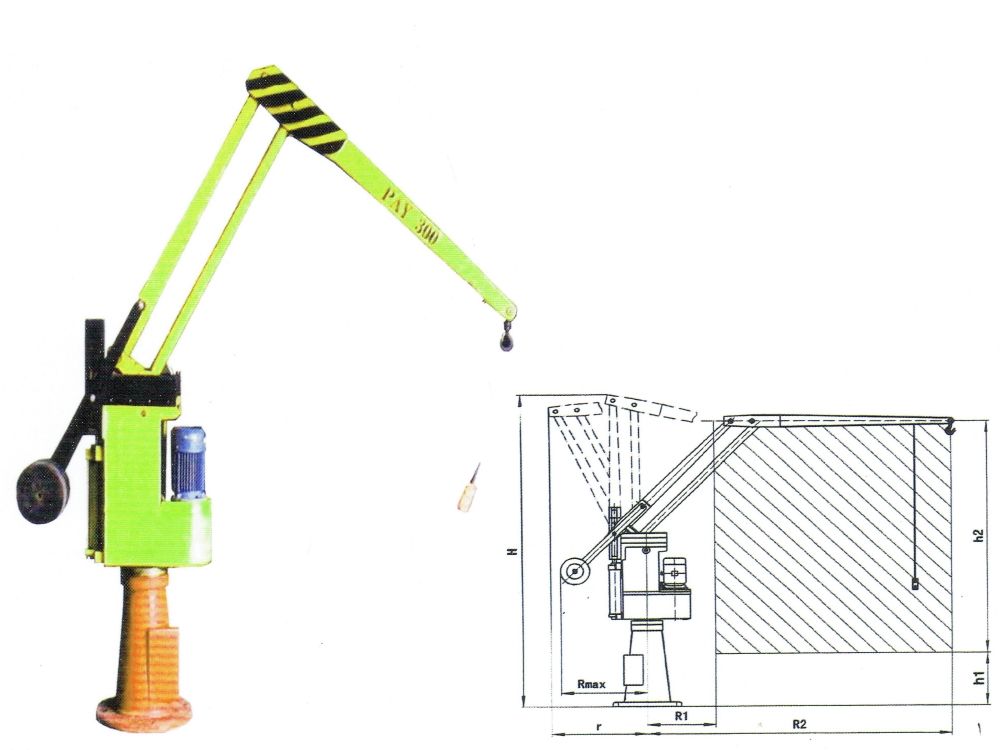
Parallelogram Arm: A deformable four-bar linkage with R1=700~1400mm and R2=2500~3200mm, offering flexible level luffing.
Column and Slewing Mechanism: A steel pipe column with a 345-degree slewing bearing at the top supporting the arm. Available in multiple heights from H=2800~4500mm.
Hydraulic Control System: A hydraulic control valve on the handle regulates oil flow to provide infinitely variable hoisting speed control—intuitive and precise in operation.
Technical Parameters
| Parameter | PAY0225 | PAY0325 | PAY0425 | PAY0525 | PAY0532 | PAY0625 | PAY0632 | PAY0832 | PAY1032 | PAY1532 |
|---|---|---|---|---|---|---|---|---|---|---|
| Rated Lifting Capacity (kg) | 200 | 300 | 400 | 500 | 500 | 600 | 600 | 800 | 1000 | 1500 |
| hoisting speed (m/min) | 6~8 | 6~8 | 6~8 | 6~8 | 6~8 | 6~8 | 6~8 | 6~8 | 6~8 | 6~8 |
| R2 (mm) | 2500 | 2500 | 2500 | 2500 | 3200 | 2500 | 3200 | 3200 | 3200 | 3200 |
| R1 (mm) | 780 | 700 | 700 | 800 | 1100 | 800 | 1100 | 1290 | 1320 | 1400 |
| R (mm) | 660 | 860 | 860 | 1300 | 1300 | 1300 | 1300 | 1440 | 1450 | 1450 |
| Rmax (mm) | 615 | 750 | 750 | 940 | 1050 | 940 | 1050 | 1210 | 1210 | 1210 |
| H (mm) | 2800 | 3000 | 3000 | 3100 | 3880 | 3100 | 3880 | 4250 | 4300 | 4500 |
| H1 (mm) | 400 | 400 | 400 | 500 | 500 | 500 | 500 | 500 | 500 | 500 |
| H2 (mm) | 1600 | 1600 | 1600 | 1500 | 2000 | 1500 | 2000 | 2000 | 2000 | 2000 |
| Slewing Angle (°) | 345 | 345 | 345 | 345 | 345 | 345 | 345 | 345 | 345 | 345 |
Product Description
- Product Name: Hydraulic Balancer
- Model & Specification: PAY Series
- Category: Series lifting equipments
- Place of Origin: Changyuan, Xinxiang, Henan
- Customization: Available upon request
- Stock Status: Limited stock available
- Production Lead Time: 7–10 days
- Packaging: Wrapped in plastic film
- Supply Scope: Nationwide
- Delivery Method: Customer pickup or freight arranged
- Installation: Quoted separately
- After-Sales Warranty: 12-month warranty
Product Structure Diagram
Typical Applications
Precision Machine Tool Loading & Unloading: The hydraulic stepless control is ideally suited for precision machine tool loading where positioning accuracy is critical, allowing the operator to fine-tune workpiece placement speed and position.
Die & Mold Maintenance and Replacement: Precise die alignment requires smooth, accurate lifting. The PAY hydraulic balancer enables slow, stepless positioning to protect molds from collision damage.
Heavy Component Assembly: The PAY1032/1532 models handle heavy components from 1000 to 1500 kg. The hydraulic drive delivers minimal fluctuation and precise positioning, making it ideal for precision assembly of large equipment.
Fine Work Environments: For material handling in electronics, optics, and precision instrumentation, the hydraulic balancer offers far superior smoothness and positioning accuracy compared to mechanical balancers.
Selection Guide
Model Coding: PAY model coding follows this rule: PAY + Load Capacity (in hundreds of kg) + R2 (in hundreds of mm). For example, PAY0225 = 200 kg capacity + R2 = 2500 mm; PAY0532 = 500 kg capacity + R2 = 3200 mm. When selecting, first confirm the required load capacity, then choose the R2 range.
Hydraulic vs. Mechanical: For fine positioning and stepless control, choose the hydraulic type (PAY). For budget-conscious applications with less demanding positioning accuracy, the mechanical type (PJ/PDJ) is suitable. Hydraulic models offer a larger load capacity range (up to 1500 kg), while mechanical models are simpler to maintain.
Installation Height: PAY0225–0425 models require H = 2800–3000 mm, suitable for standard low-profile factory buildings. PAY0525–0625 models require H = 3100 mm. PAY0532–1532 models require H = 3880–4500 mm and need taller factory buildings.
Manufacturer Services
Henan Kelude Heavy Industry Co., Ltd. provides full sales and after-sales support for PAY hydraulic balancers, as well as Design & Manufacturing and Installation & Repair services for PJ balancers, PDJ series balancers, explosion-proof balancers, and custom non-standard balancers.
Quality Inspection: Each unit undergoes a static test with 1.25 times rated load before shipment. The hydraulic system is subjected to a 24-hour pressure holding test and continuous lifting/lowering endurance testing.
After-Sales Warranty: Full machine warranty for 12 months, with extended 24-month warranty on the Hydraulic Pump Station and Hydraulic Cylinder. After-sales requests are responded to within 48 hours.
Request a Quotation
Need a quotation for the PAY hydraulic balancer?
Provide your load capacity requirements, working radius, and workshop height, and we will provide a customized solution within 2 hours.
Consultation Hotline: 13903802779
FAQ
Q: Which is better, a hydraulic balancer or a mechanical (screw-type) balancer?
A: The hydraulic type (PAY) offers stepless control for precise operation, smooth and shock-free lifting, and a larger load capacity (up to 1500kg). The mechanical type (PJ/PDJ) features a simpler structure with lower failure rates, reduced maintenance costs, and a more economical price. Recommendation: choose hydraulic for precise positioning; for general applications, the mechanical type offers better value for money.
Q: Can the hoisting speed of the hydraulic balancer be adjusted?
A: Yes. The hydraulic system achieves stepless control by regulating the flow of hydraulic oil, with a standard speed range of 6~8m/min. The operator can freely adjust the hoisting speed via the Hydraulic Control Valve on the handle — slow speed for precise positioning, full speed for rapid transfer.
Q: Does the hydraulic oil in the hydraulic balancer need regular replacement?
A: Yes. It is recommended to replace the Hydraulic Oil after the first 500 hours of use, and thereafter every 2000 hours or once a year. We recommend using No. 46 Anti-wear hydraulic oil. Regularly check the oil level and oil quality — replace the oil immediately if it deteriorates or becomes contaminated. Inspect the Hydraulic Pipeline and joints quarterly for any leaks.
Q: What do the 25 and 32 suffixes in the PAY models represent?
A: 25 and 32 denote the maximum Working Radius R2 (in hundreds of mm). 25 = R2=2500mm, 32 = R2=3200mm. For the same Load Capacity, two R2 options are available (e.g., PAY0525 = 500kg/R2=2500, PAY0532 = 500kg/R2=3200). A larger R2 provides broader coverage but also increases the column height H accordingly.
Q: Is the hydraulic balancer suitable for outdoor use?
A: The PAY hydraulic balancer is primarily designed for indoor, non-exposed applications. For outdoor use, the following precautions are necessary: ① Provide rain protection for the Hydraulic Power Unit; ② The recommended Ambient Temperature is 0~40°C; ③ At low temperatures, increased hydraulic oil viscosity may affect hoisting speed — a low-temperature Hydraulic Oil should be used; ④ For prolonged outdoor use, regularly check the Sealing of the Hydraulic Pipeline and joints.