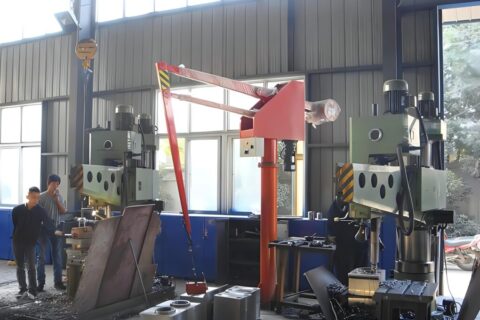
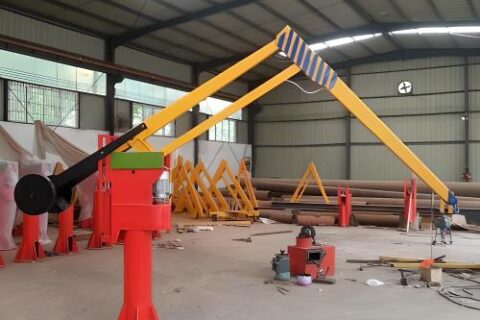
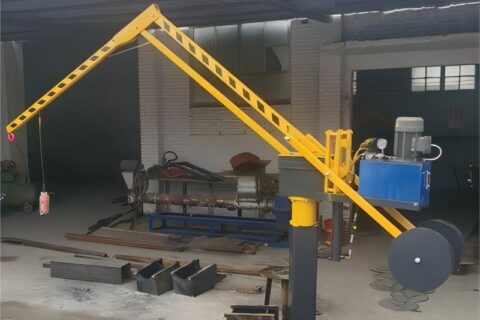
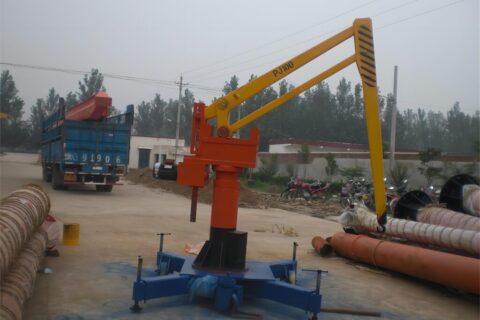
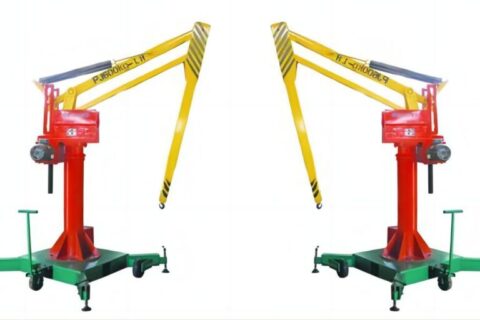
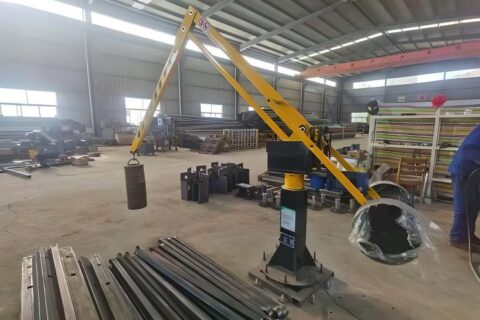
PDJ Series High-Type Electric Fixed Balancer for Material Handling
Product Introduction
The PDJ High-Type Balancer is a new type of material handling equipment that utilizes the pantograph principle of a balanced quadrilateral to achieve precise positioning and free movement. It features a unique screw lifting mechanism, equipped with reliable overload protection and limit protection devices. Lifting capacity ranges from 0.05 to 0.5t, with a working area of 1500 (height) × 1960mm × 300° (slewing angle). Variable frequency speed control or wireless remote control can be configured based on customer requirements. The company also manufactures the PDJ (High-Type) and PDJ-A Low-Type Balancers to meet material handling needs in various spaces and heights.
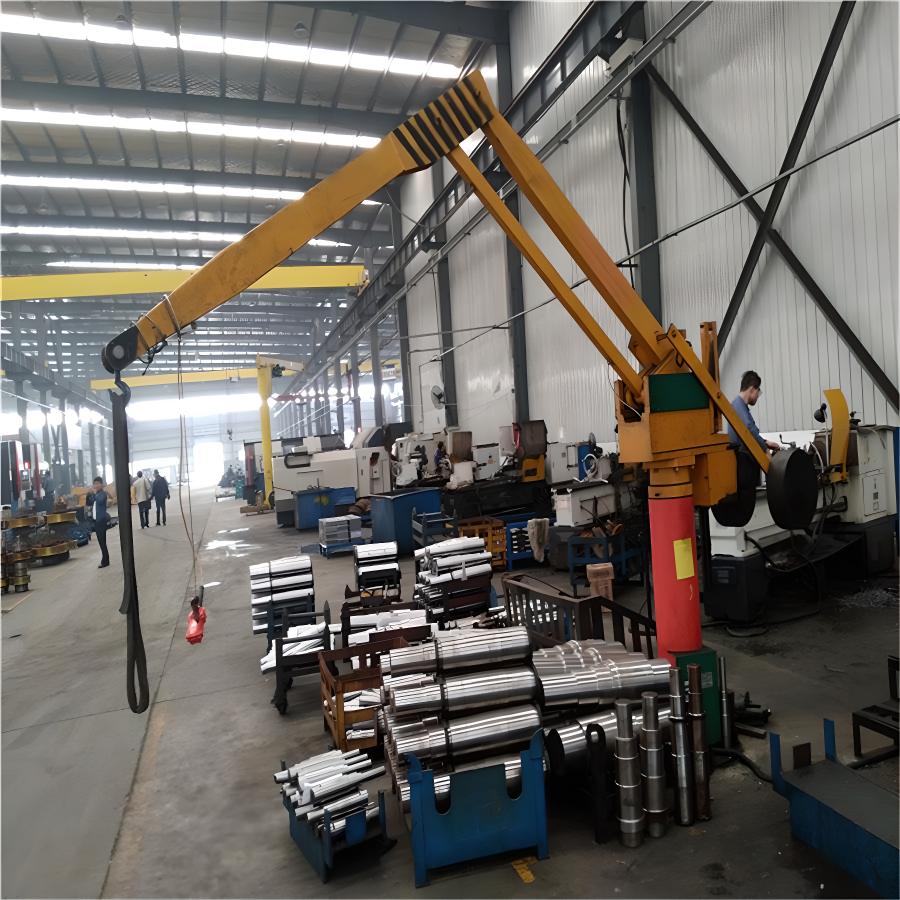
The PDJ series High-Type Balancer includes five models: PDJ025 (50kg), PDJ125 (100kg), PDJ225 (200kg), PDJ325 (300kg), and PDJ525 (500kg). It is widely used for fixed-point material handling in industries such as machining, mold manufacturing, and electronic assembly, and is particularly well-suited for frequent loading and unloading operations beside machine tools and workbenches.
Product Images
Product Features
Pantograph Quadrilateral Principle for Precise Positioning: Utilizing the pantograph scaling principle of a balanced quadrilateral, the load can be freely positioned anywhere within the working area. Movement in all directions is smooth and effortless — the operator simply pushes or pulls lightly to reach the desired position.
Screw Lifting Mechanism for Safety and Reliability: Featuring a unique screw-driven lifting transmission mechanism, equipped with overload protection and limit position protection devices. This dual-safety design eliminates the risk of load detachment and over-travel operation.
300° Wide Slewing Range: The column slewing angle of 300° covers most of the working area. The maximum cantilever radius R2 reaches 2500mm, with smaller-tonnage models offering an even larger working range — ideal for frequent loading/unloading beside machine tools.
High and Low Type Options: The standard PDJ model suits locations with sufficient headroom, while the PDJ-A Low-Type is designed for confined, low-ceiling environments. Both models share the same core lifting mechanism, ensuring interchangeable spare parts and simplified maintenance.
Optional VFD / Remote Control: Depending on operating conditions, variable-frequency speed control can be configured to regulate lifting speed, or a wireless remote control can be installed for remote operation, enhancing both convenience and safety.
Working Principle
The PDJ High-Type Balancer operates on the pantograph quadrilateral scaling principle combined with a screw lifting mechanism. The main structure consists of a column, a parallelogram jib assembly, a screw lifter, and a hook. The upper and lower horizontal arms of the parallelogram jib are hinged to form a deformable quadrilateral — as the load moves horizontally, the quadrilateral scales while keeping the hook on the same vertical line. The screw lifter drives the lead screw via an electric motor, causing the nut to travel up or down along the screw, thereby achieving vertical lifting of the load.
During operation, the operator holds the handle near the hook and pushes or pulls lightly to move the load within the horizontal plane — the parallelogram jib scales accordingly, and combined with the 300° column slewing, the entire working area is covered. Pressing the control button activates the screw lifter in forward or reverse for smooth hoisting and lowering of the load. The overload protection device automatically cuts off motor power when the load exceeds the rated capacity, and the limit protection device stops operation automatically at the upper and lower travel limits, ensuring safe operation at all times.
Structural Composition
The balancer consists of the following core structural components:
Column and Slewing Mechanism: A steel pipe column is fixed to a floor-mounted base, with a top slewing device supporting 300° horizontal rotation of the jib, covering a large working area.
Parallelogram Jib Assembly: A deformable quadrilateral structure composed of an upper horizontal arm, a lower horizontal arm, and vertical connecting links, enabling horizontal movement of the hook and balanced load support. The jib scales flexibly for light and effortless operation.
Screw Lifter: A unique transmission mechanism in which the motor rotates the lead screw, driving the nut up or down. Compact in structure, smooth in transmission, and featuring excellent self-locking performance — the load will not slip even during a power failure. Lifting speed: 6.2~7.8m/min.
Safety Protection Devices: Includes an overload protector (automatically cuts off power when load exceeds the limit) and limit switches at the upper and lower travel limits (automatic stop), providing dual protection to ensure safety.
Electrical Control System: Handle-mounted push-button operation controls forward and reverse rotation of the lifting motor. Optional variable-frequency speed control (optional) or wireless remote control (optional) can be configured.
Technical Parameters
| Model | Rated Lifting Capacity (kg) | R1 (mm) | R2 (mm) | r (mm) | Hmax (mm) | h1 (mm) | H2 (mm) | lifting speed (m/min) |
|---|---|---|---|---|---|---|---|---|
| PDJ025 | 50 | 400 | 2500 | 800 | 3650 | 350 | 1500 | 7.5 |
| PDJ125 | 100 | 400 | 2500 | 800 | 3650 | 350 | 1500 | 7.5 |
| PDJ225 | 200 | 400 | 2500 | 800 | 3650 | 350 | 1500 | 7.5 |
| PDJ325 | 300 | 540 | 1050 | —¹ | 3950 | 500 | 1500 | 7.8 |
| PDJ525 | 500 | 500 | 1100 | —¹ | 3950 | 500 | 1500 | 6.2 |
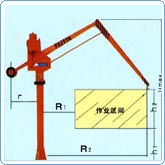
¹ The r values for PDJ325 and PDJ525 are not specified in the original tables; please refer to actual product measurements. R2 = maximum working radius, R1 = minimum working radius, Hmax = maximum height, h1 = lowest hook position height, H2 = column height.
Product Structure Diagram
Typical Applications
Frequent Loading/Unloading Next to Machine Tools: The PDJ Balancer is ideal for loading and unloading workpieces at lathes, milling machines, grinders, and other machine tools. The operator can effortlessly push or pull to position the workpiece onto the table surface, saving effort and boosting efficiency.
Die Handling and Assembly: For die changes and handling beside injection molding machines and die-casting machines, the PDJ325/525 can carry dies weighing 300~500kg, enabling quick die installation, removal, and positioning.
Electronics/Light Industry Assembly Lines: For material handling at assembly stations for small to medium-sized components, the Balancer offers flexible operation and precise positioning, improving assembly efficiency and reducing operator fatigue.
Warehouse Parts Sorting: For sorting, handling, and loading light parts in warehouses, the Balancer's 300° slewing and 2.5m working radius cover extensive shelving areas.
Selection Guide
Select by Load Capacity: Choose PDJ025 for loads up to 50kg, PDJ125 for 100kg, PDJ225 for 200kg, PDJ325 for 300kg, and PDJ525 for 500kg. Note: PDJ025/125/225 share the same arm structure (R2=2500mm, wide coverage), while PDJ325/525 have a different arm structure (R2≈1050~1100mm).
Select Standard or Low-Profile by Installation Height: Choose the PDJ standard (high-profile) model when installation height is ≥3650mm; choose the PDJ-A low-profile model when installation space is below 3650mm. The low-profile model suits lower factory buildings or limited space beside machine tools.
Select by Usage Frequency: For frequent operation, we recommend the optional Variable Frequency Speed Control (adjustable lifting speed) for greater precision and ease. For multi-station shared use, consider the optional Wireless remote control for more flexible operation.
Manufacturer Services
Henan Kelude Heavy Industry Co., Ltd. provides full-process services for the PDJ series high-profile Balancer, including sales, installation, and after-sales support.
Quality Inspection: Each unit undergoes a static test with 1.25 times rated load before shipment. The screw lifting mechanism is subjected to continuous endurance testing, and the Overload Protector and limit protection devices are individually verified.
After-Sales Warranty: Full Machine Warranty for 12 months, with a 24-month warranty on the screw lift and motor. After-sales requests are addressed within 48 hours.
Request a Quotation
Need a Quotation for the PDJ Balancer?
Provide your load capacity requirements, installation height, and usage frequency, and we will customize a solution for you within 2 hours.
Consultation Hotline: 13903802779
FAQ
Q: What is the difference between a PDJ Balancer and a standard Chain Electric Hoist?
A: The PDJ Balancer uses a screw lifting mechanism and a parallelogram arm structure. The operator can move loads horizontally with a gentle push or pull, while vertical movement is automatically controlled by the motor, enabling easy one-handed operation. A standard chain hoist requires simultaneous control in both horizontal and vertical directions, offering lower operating accuracy and convenience compared to the Balancer.
Q: How does the overload protection on the Balancer work?
A: The PDJ Balancer is equipped with a mechanical overload protection device. When the suspended load exceeds approximately 110% of the rated load, the Overload Protector automatically cuts off the motor power supply, stopping the motor and triggering an alarm. After the overload condition is resolved, simply reset the device to resume operation.
Q: Why do the PDJ025/125/225 models have a Working Radius of 2500mm while the PDJ325 only reaches 1050mm?
A: This is due to differences in the arm structure. The PDJ025~225 models (50~200kg) share the same lightweight arm assembly, which offers a wide parallelogram extension range with R2 reaching 2500mm. The PDJ325/525 models (300~500kg) feature a reinforced arm structure and a larger column cross-section, which increases load capacity but correspondingly reduces the arm extension range.
Q: Can the Balancer be installed on uneven floors?
A: The base of the PDJ Balancer must be installed on a flat, hardened surface. If the floor is uneven, leveling shims can be added beneath the base to compensate. A floor Levelness of ≤3mm/m is recommended to ensure the column remains vertical and the Balancer slews smoothly.
Q: What is the difference between the PDJ standard-height and PDJ-A low-headroom models? How do I choose the installation height?
A: The standard PDJ model has a maximum height of Hmax=3650mm, suitable for standard factory buildings (clear height ≥4m). The PDJ-A low-headroom model has a maximum height of approximately 2400mm, designed for low-ceiling facilities or areas with limited overhead space above machinery. When selecting a model, measure the actual clear height at the installation site, accounting for roof structure and load height while leaving a safe clearance margin.