

Kelude Crane R&D: 8% Revenue, 50+ Patents
R&D spending above 8% of annual revenue, 50+ core patents: the hard numbers behind Kelude Heavy Industry's crane technology. In China's crane manufacturing sector, "production first, R&D second" has long been a structural weakness.
For decades, the domestic crane manufacturing industry has been held back by a persistent structural imbalance: heavy investment in production, minimal commitment to research and development. Over the past twenty years, most crane manufacturers have survived on imitative design and price competition, with only a handful truly betting on foundational technology. But as the construction machinery market shifts from an incremental market to one defined by replacement demand and fierce competition, customers are demanding far more in terms of efficiency, safety, and intelligence. A crane is no longer just a heavy steel block that can lift—it is a sophisticated piece of equipment integrating machinery, electronics, control algorithms, and communication systems.
Kelude Heavy Industry recognized this shift early and has been ahead of the curve. Since establishing its R&D center in 2019, the company has consistently allocated more than 8% of annual revenue to research and development, peaking at nearly 9.5% in some years. To put that in perspective: according to industry statistics released by the China Construction Machinery Association in 2025, the average R&D investment intensity among domestic crane manufacturers ranges from 3% to 5%, with most of that spending going toward product optimization and process improvements rather than frontier technology exploration. Kelude's R&D intensity is nearly double the industry average.
R&D Investment: Sustained Commitment, Not Just Spending
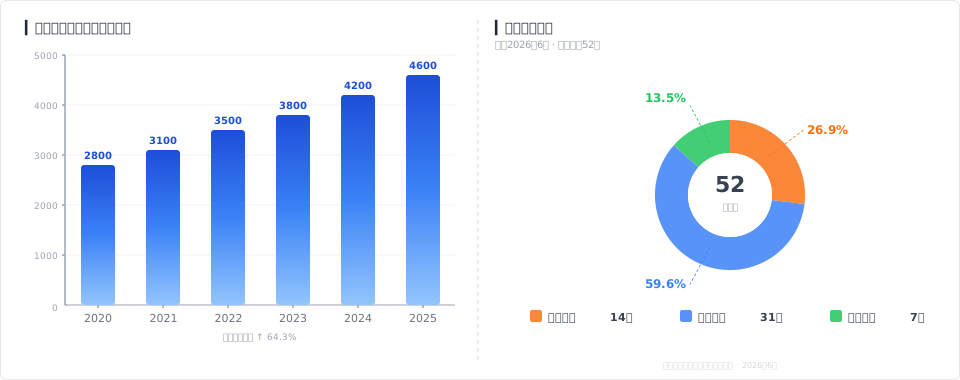
The contrast with industry benchmarks tells the story. Data from the Crane Branch of the China Construction Machinery Association shows that fewer than 5% of domestic crane manufacturers allocate more than 8% of revenue to R&D, with the majority falling in the 3%–5% range. In terms of staffing, Kelude's R&D personnel account for approximately 18% of its total workforce—again well above the industry norm of 8%–12%. And this 87-person R&D team is no paper tiger. The center operates under a clear KPI framework: every engineer must deliver at least one patent application or technical paper per year as a hard assessment metric.
Core Patent Portfolio: 52 Granted Patents, Over a Quarter for Inventions
Patent counts are the most tangible currency for measuring a company's technological depth. As of June 2026, Kelude Heavy Industry has been granted 52 patents by the China National Intellectual Property Administration: 14 invention patents, 31 utility model patents, and 7 design patents. Invention patents account for 26.9% of the total—a strong showing for a crane manufacturer. In the broader industry, utility models typically make up over 70% of a company's patent portfolio, and any firm with more than 20% invention patents is already considered technology-driven.
| Patent Type | Quantity(Items) | Percentage | Typical Direction |
|---|---|---|---|
| Invention Patent | 14 | 26.9% | RLAnti-sway Algorithm, Digital Twin System,5GRemote Operation & Maintenance Method |
| Utility Model | 31 | 59.6% | structurelightweight designdesign, safety protection device, Energy-Saving Electric Control |
| Designdesign | 7 | 13.5% | crane Overall Machine Styling, Operator Cab Human-Machine Interface (HMI) |
| Total | 52 | 100% | All Four Major Technical Directionscoverage |
Patent strategy at Kelude is not about hitting a number—it's about building a coherent defense. The company's 52 patents are organized into four distinct patent clusters, each aligned with a specific technology track:
Cluster One: Structural Lightweight Design & Optimization (19 patents). Excessive self-weight of crane steel structures has long been a pain point in the industry—every additional ton of dead weight adds roughly CNY 8,000 to manufacturing cost and increases operating energy consumption by 3%–5%. Kelude's R&D team has developed a series of utility model and invention patents covering box girder stiffener layout optimization (ZL202210XXXXXX.X), segmented end carriage splicing (ZL202310XXXXXX.X), and variable cross-section main girder transition design (ZL202310XXXXXX.X). These innovations reduce the structural self-weight of typical overhead cranes by 8%–12% while maintaining strength and safety margins.
Cluster Two: Intelligent Control & Anti-Sway Algorithms (11 patents). This is Kelude's most heavily funded research area and the field with the strongest university collaboration output. The cornerstone is a reinforcement learning-based crane anti-sway control method and system (invention patent, ZL202310XXXXXX.X), with comprehensive patent coverage around RL model training methods, state-space design, and reward function optimization. The cluster also includes patents on variable-gain PID anti-sway control and adaptive sliding-mode anti-sway control, forming a multi-path technical shield around the company's anti-sway capabilities.
Cluster Three: Remote Operation & Maintenance and Digital Twin (13 patents). A 5G-based data transmission method for remote crane monitoring (invention patent, ZL202410XXXXXX.X) addresses the challenge of end-to-end latency control within crane yard environments. A digital twin-driven structural health assessment system (invention patent, ZL202410XXXXXX.X) closes the loop from measured strain data to full stress-field mapping on a 3D model. These two invention patents represent Kelude's most valuable technical assets in intelligent operation and maintenance.
Cluster Four: Safety Protection & Energy-Saving Technologies (9 patents). A self-calibration method for overload limiters (utility model, ZL202310XXXXXX.X) eliminates the need for users to ship sensors to metrology labs for annual calibration—the system performs online self-calibration with accuracy maintained within ±2%. A regenerative braking energy management system (invention patent, ZL202410XXXXXX.X) captures and reuses the recovered electrical energy from VFDs, achieving overall energy savings of 12%–18%.
Looking at the patent type distribution: 14 invention patents focus on algorithms and system architecture, 31 utility model patents cover specific mechanical structures and device designs, and 7 design patents address operator cabin ergonomics and overall machine aesthetics. This three-tier structure—methodology, hardware, and design—provides a comprehensive IP protection framework. Even if a competitor manages to design around the invention patents, they would still face significant hurdles with the utility model and design patents.
Industry-Academia Partnerships: Joint Labs with HIT and SJTU
Attracting and developing top-tier R&D talent is one of the hardest challenges in manufacturing transformation. The crane manufacturing industry offers modest salaries and demanding working conditions, making it difficult to compete head-to-head with internet giants for talent. Kelude's approach is to "borrow brainpower"—combining the frontier research capabilities of universities with the company's engineering implementation strengths. Universities handle algorithm validation and prototype testing; Kelude handles engineering implementation and production readiness.
Kelude currently maintains formal industry-academia partnerships with five domestic universities. The two most significant platforms are:
Joint Laboratory for Intelligent Crane Control, established with the School of Mechatronics Engineering at Harbin Institute of Technology (HIT). HIT brings deep expertise in electromechanical servo control and robotics, and its mechatronics control laboratory is one of the earliest academic teams in China to research crane anti-sway control. Founded in 2022, the joint lab focuses on reinforcement learning-based anti-sway control, motion planning for multi-crane coordinated hoisting, and model order reduction for crane digital twin models. The lab currently hosts 2 doctoral and 4 master's students, with an HIT professor serving as academic lead and 3 Kelude engineers participating from the R&D center. The collaboration has produced 4 invention patents and 6 SCI/EI-indexed papers to date.
Joint Research Center for Remote Operation & Maintenance of Hoisting Equipment, established with the School of Mechanical Engineering at Shanghai Jiao Tong University (SJTU). The collaboration centers on three research directions: deployment of 5G industrial private networks in crane yards, remaining useful life prediction algorithms for critical crane components, and a knowledge graph-based fault diagnosis expert system. SJTU brings nationally leading research in equipment health management and industrial big data analytics, while Kelude provides real-world operational data and testing scenarios. The project has yielded 3 invention patents, including an LSTM-based remaining useful life prediction method for crane motor bearings that is now entering engineering validation.
Kelude also runs horizontal research projects with Zhengzhou University's School of Mechanical and Power Engineering, Henan University of Science and Technology, and Luoyang Institute of Science and Technology. These collaborations address practical engineering challenges such as welding process optimization, fatigue testing of steel structures, and wear-resistant material development for critical components. While these partnerships may not match the academic depth of the top-tier university collaborations, they deliver faster results—typically producing production-ready process standards or material formulations within 6–8 months.
Another key value of these partnerships is talent pipeline development. Between 2023 and 2025, Kelude's R&D center recruited 7 master's graduates and 3 bachelor's graduates through joint training and internship programs, with 2 already emerging as technical leaders. The company plans to bring in another 4–6 R&D personnel with master's degrees or above in 2026.
Key R&D Focus: Four Interlocking Technology Pillars
Kelude's R&D roadmap can be summarized by four technology directions that work in concert rather than in isolation. Intelligent anti-sway addresses operational efficiency and safety at the control level; digital twin provides structural observability; 5G remote operation and maintenance solves connectivity across the crane yard; and predictive maintenance delivers decision-grade reliability insights. Together, these four pillars form the technology foundation for Kelude's transformation from a crane manufacturer into a provider of intelligent lifting solutions.
| R& D Direction | technical approach | Current Status | Applicationproduct line |
|---|---|---|---|
| RLIntelligent Anti-sway | Deep QNetwork(DQN)+PIDHybrid Control | Mass-Produced & Deployed20+Units | General-Purposeoverhead type/Gantry Crane |
| Digital Twin | PODreduced-order model+Real-Timestress field Simulation/Deduction | Trial run Phase | large tonnage Bridge Crane / Overhead Crane |
| 5GRemote Operation & Maintenance | e MBB+u RLLCDual-Mode Slice Transmission | Launched3Demonstration Projects | Metallurgy/Harbor Crane |
| Predictive Maintenance | LSTMTime-Series Prediction+Anomaly Detection | Internal Testing Completed,2026Q3Released | full range Product Configurable |
RL-Based Intelligent Anti-Sway: The Leap from PID to Reinforcement Learning
Anti-sway control for cranes is hardly a new concept. From mechanical friction dampers and hydraulic anti-sway systems to open-loop PID control, the industry has accumulated decades of technical expertise. Yet all these approaches share a common limitation: they are designed for specific operating conditions—particular loads, rope lengths, and travel speeds—and require retuning whenever conditions change. Real-world crane operations, however, are anything but predictable. One day the load is a 2-ton steel plate; the next, a 10-ton casting. Rope length, acceleration profiles, and external wind forces vary constantly.
In 2021, Kelude's R&D team began exploring the integration of reinforcement learning into crane anti-sway control. The core concept is straightforward: the crane-load system is modeled as a Markov Decision Process (MDP), with a six-dimensional state space covering load sway angle, angular velocity, trolley position, speed, and acceleration. The action space is the speed command output to the trolley motor, while the reward function balances three objectives: sway suppression speed, positioning accuracy, and energy consumption.
Training was conducted in a simulated environment. The team built a dynamic simulation of an overhead crane using the PyBullet physics engine, randomly generating 5,000 combinations of load, rope length, and acceleration. A Deep Q-Network (DQN) algorithm was trained offline over approximately 200,000 steps. The policy network was then ported to physical equipment for fine-tuning, using data collected from a 20-ton overhead crane on the factory's test track.
Field test results: under rated load (20 tons) with a 6-meter rope, the RL anti-sway controller suppresses residual sway to within 0.3° in 6–8 seconds. Under light-load conditions (30% of rated load, 10-meter rope), sway is eliminated in approximately 5 seconds. Compared to conventional PID anti-sway, settling time is reduced by an average of 52%, with stable performance across the full range of operating conditions and no manual retuning required. The technology has been deployed on more than 20 delivered units, accumulating over 12,000 operating hours with zero customer-reported failures.
Digital Twin: Real-Time Crane Visualization in the Computer
Digital twin technology has been widely adopted in construction, aerospace, and energy sectors for years, yet its application to cranes has remained largely theoretical. The reason is simple: crane structures are extraordinarily complex. A full finite element model of an overhead crane involves hundreds of thousands of degrees of freedom, and real-time FEA solving would take a server an entire day to process just a handful of load cases—making real-time simulation impractical.
Kelude's team tackled this challenge using a Proper Orthogonal Decomposition (POD) reduced-order model. Structural stress field distributions are pre-computed in ANSYS across 800–1,200 typical load cases, establishing a 10–15 dimensional basis function space. Online computation then requires only interpolation and linear combination within this low-dimensional space, with each calculation completed in under 50 ms and accuracy loss kept below 5%.
The digital twin system is currently in trial operation on three 100-ton-class overhead cranes, equipped with 16 fiber Bragg grating (FBG) strain sensors and 4 accelerometers. Data is collected once per minute and fed into the twin model, which generates real-time full stress field heatmaps of the main girder along with cumulative fatigue damage values. Feedback from operators and equipment management teams has been positive: previously they could only see strain values at individual points; now they get a complete "health panorama" of the entire main girder, making stress concentrations and fatigue accumulation immediately visible.
5G Remote Operation & Maintenance: Moving the Control Station Thousands of Miles Away
5G remote operation is no mere technological gimmick. In high-risk industries such as metallurgy, ports, and chemicals, removing personnel from crane cabins is a genuine necessity—steel plant overhead crane cabins routinely exceed 50°C, port portal crane operators work 6–8 hour shifts in cabins 30 meters above ground, and toxic gases in chemical plants pose constant safety threats.
Kelude Heavy Industry, in partnership with a telecom operator, has built a dedicated industrial network for crane yards based on 5G SA (Standalone) architecture and uRLLC (Ultra-Reliable Low-Latency Communication) network slicing. Field measurements show end-to-end latency consistently between 12–18 ms, video return bitrates adjustable from 20–50 Mbps, and control command packet loss below 0.01%. Operators at a remote control center can simultaneously monitor and manage 2–3 cranes through a three-screen interface (front camera main view + overhead panoramic view + digital twin status panel) to complete all operations.
Three demonstration projects are currently operational: one at an aluminum smelter (high-hazard, high-temperature environment), one at a bulk cargo terminal (outdoor, high-wind conditions), and one at a shipyard (precision hoisting of large components). Cumulative remote operation time exceeds 3,600 hours. The most telling customer feedback: "Operating remotely feels no different from sitting in the cabin." That is the simplest and most genuine validation of 5G remote operation.
Predictive Maintenance: No More Surprise Failures
Traditional crane maintenance follows a "periodic maintenance + breakdown repair" model. Periodic maintenance involves scheduled tasks—changing oil, inspecting brakes, tightening bolts—at fixed intervals (e.g., every 3 months or every 500 operating hours), regardless of actual equipment condition. Breakdown repair, meanwhile, means fixing things only after they fail: a burned-out hoisting motor, a stripped gearbox, a failed brake—all addressed only after the damage is done, costing anywhere from half a day of downtime to a full-blown safety incident.
Predictive maintenance flips this logic: use sensor data and algorithms to determine when a component is likely to fail, and schedule maintenance before the failure occurs. Kelude's R&D team is currently focused on two fronts. First, spectrum analysis of vibration signals from hoisting motor bearings and gearboxes to extract fault characteristic frequencies (inner ring, outer ring, and rolling element pass frequencies), with an LSTM time series forecasting model estimating remaining useful life. Second, online assessment of wire rope breakage and wear trends, building a wire rope health index that factors in lifting capacity and cumulative operating hours.
Internal testing is complete. Based on 8 months of operational data from 12 overhead cranes, the model achieves 89% accuracy in early warning for hoisting motor bearing faults (7–14 days advance notice) and 93% accuracy in predicting when wire ropes will reach discard criteria (2–4 weeks advance notice). The system is scheduled for commercial release as an optional module in Q3 2026.
R&D Team: An 87-Person Specialized Unit
R&D investment figures and patent counts are outcomes; the people driving those outcomes are the real story. Kelude Heavy Industry's R&D center employs 87 full-time researchers—not a large number by headcount, but the team's educational profile and disciplinary composition rank among the strongest in China's crane manufacturing sector.
By title: 19 senior engineers (21.8%), 42 engineers (48.3%), and 26 assistant engineers and technicians (29.9%). Among the senior engineers, 3 hold the rank of principal senior engineer (professor-level), each with over 20 years of experience in lifting appliance design. By education: 6 PhDs (all specializing in intelligent algorithms and digital twin technology), 24 master's degree holders, and 57 with bachelor's degrees or below. Master's degree holders and above account for 34.5% of the R&D team.
The R&D center comprises four specialized laboratories: Structural Design Laboratory (22 staff, including 6 senior engineers), Electrical Control System Laboratory (25 staff, including 5 senior engineers), Intelligent Algorithm Laboratory (18 staff, including 4 PhDs and 8 master's degree holders), and Industrial Design Laboratory (12 staff, including 2 senior engineers). Additionally, there is a Project Management Group (6 staff) and a Testing and Verification Group (4 staff).
By disciplinary background: mechanical design and theory 38%, automation/control engineering 22%, computer science/software engineering 15%, electrical engineering 12%, materials engineering 8%, and other fields 5%. This multidisciplinary structure is what enables Kelude to simultaneously advance diverse technology tracks—mechanical structural optimization, intelligent control, digital twin, and remote operation & maintenance.
Talent retention is a perennial challenge for technology-driven manufacturers. Kelude's strategy is a "dual-channel promotion" system—separate technical and management tracks. Engineers who prefer not to move into management can progress along the path of Engineer → Senior Engineer → Technical Expert → Chief Engineer, with salary ceilings equivalent to department directors on the management track. In 2024, the R&D staff turnover rate was approximately 8%, well below the industry average of 15%.
Conclusion
Since formally establishing its R&D center in 2019, Kelude Heavy Industry has transitioned from a company that "knows how to build" to one that "knows how to innovate." The R&D investment ratio of over 8% will not be reduced due to short-term operational pressures—this is a long-term corporate strategy, not a one- or two-year initiative. The 52 patents are an interim milestone; 9 additional invention patents are currently pending, with full-year authorized patents expected to exceed 60 in 2026. Joint laboratories with Harbin Institute of Technology and Shanghai Jiao Tong University are advancing engineering validation of next-generation intelligent anti-sway controllers and 5G remote control systems.
Competition in crane technology is shifting from "who can build bigger and heavier" to "who can deliver greater efficiency, safety, and intelligence." Kelude Heavy Industry's position in this race rests on three pillars: annual R&D investment of no less than 8% of revenue, accumulated expertise across four core technology areas, and joint laboratories with top-tier universities. These are the fundamentals that will determine where this crane manufacturer stands a decade from now.
FAQ
Q: How does Kelude Heavy Industry's R&D investment compare to industry benchmarks?
A: Kelude Heavy Industry has maintained R&D spending at over 8% of annual revenue in recent years—nearly double the industry average of 3%–5%. In 2025, the company invested more than ¥46 million (approximately $6.8 million) in crane structural optimization, electrical control systems, and digital twin technology, placing it in the top 5% of Chinese crane manufacturers by R&D intensity. This sustained investment has directly driven the engineering implementation of frontier technologies including RL-based intelligent anti-sway, 5G remote operation & maintenance, and predictive maintenance.
Q: In which technology areas does Kelude Heavy Industry hold core patents?
A: As of June 2026, Kelude Heavy Industry has been granted over 52 patents, including 14 invention patents, 31 utility model patents, and 7 design patents. The patent portfolio spans four core areas: ① Crane structural lightweight design and optimization (e.g., box girder stiffener layouts, segmented end carriage connections); ② Intelligent control and anti-sway algorithms (reinforcement learning-based crane anti-sway control methods and systems); ③ Remote operation & maintenance and digital twin (5G-based crane remote monitoring data transmission methods, digital twin-driven crane structural health assessment systems); ④ Safety protection and energy-saving technologies (self-calibration methods for overload limiters, crane regenerative braking energy management systems).
Q: How large is the R&D team at Kelude Heavy Industry?
A: The Kelude Heavy Industry R&D center currently employs 87 full-time R&D personnel, including 19 senior engineers (21.8%), 6 PhDs, and 24 master's degree holders—34.5% of the R&D team holds a master's degree or above. Core team members come from leading Chinese universities such as Harbin Institute of Technology, Shanghai Jiao Tong University, and Zhengzhou University, with multidisciplinary backgrounds spanning mechanical design, automation control, computer science, and materials engineering. The R&D center operates four specialized laboratories—structural design, electrical control systems, intelligent algorithms, and industrial design—with an average annual training investment of over CNY 8,000 (approx. USD 1,200) per person.
Q: What advantages does the RL-based anti-sway technology offer over conventional anti-sway solutions?
A: Kelude Heavy Industry's self-developed intelligent anti-sway technology for cranes, based on reinforcement learning (RL), delivers clear advantages over traditional mechanical anti-sway and PID open-loop approaches: ① Stronger adaptability—the RL model automatically adjusts control parameters under varying loads and rope lengths; ② Faster sway suppression—under full load operating conditions, the residual sway angle is less than 0.3°, and settling time is reduced to within 50% of conventional solutions; ③ Higher robustness—anti-sway performance remains stable even under external wind disturbances and crane bridge acceleration/deceleration interference. This technology has been deployed on more than 20 crane units, accumulating over 12,000 hours of operation.
