
KBK Flexible Crane Standard Components
KBK Flexible Crane Standard Components are a modular light-duty suspension crane system consisting of standard track profiles, flexible suspension devices, trolleys, and chain electric hoists, designed for workstation-level material handling in workshops. Built on standardized modular components, the system can be flexibly configured on-site into monorail conveyors, single main girder suspension cranes, or twin main girders suspension cranes, covering light-load handling scenarios from 50 kg to 2000 kg.
Product Types
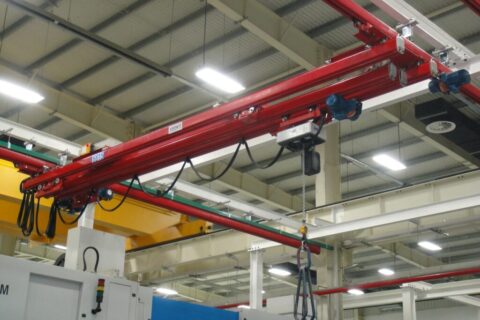
The standardized KBK system components can be flexibly combined into the following three main configurations:
KBK Monorail Conveyor — A single track arranged in a straight or curved line, with manual or electric travel, suitable for point-to-point handling along the line. Lifting capacity: 50–500 kg.
KBK Flexible Single Main Girder Suspension Crane — A single main girder with a track trolley, covering a rectangular working area. Lifting capacity: 125–1000 kg; span ≤ 9 m.
KBK Flexible Twin Main Girders Suspension Crane — A twin main girder with cross-beam structure, covering a larger rectangular working area. Lifting capacity: 250–2000 kg; span ≤ 10 m, with smoother travel.
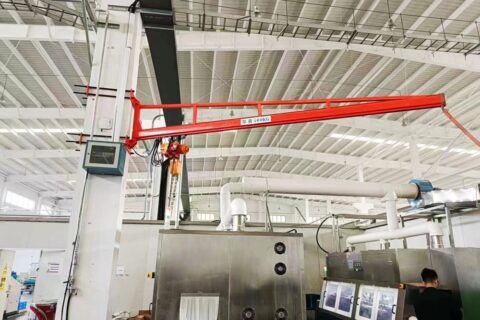
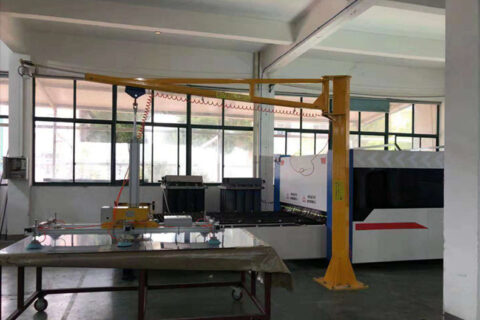
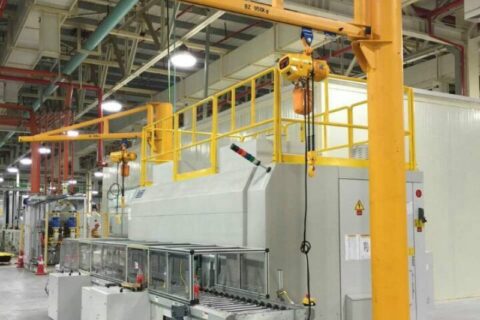
Product Images
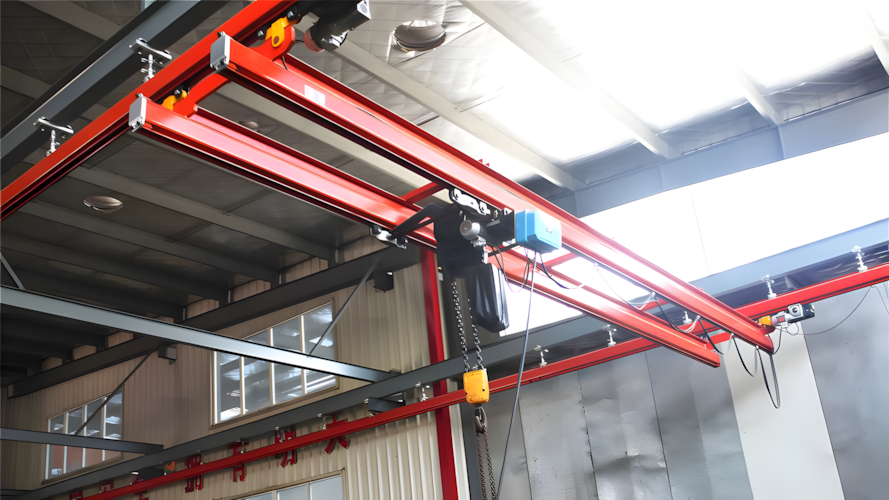
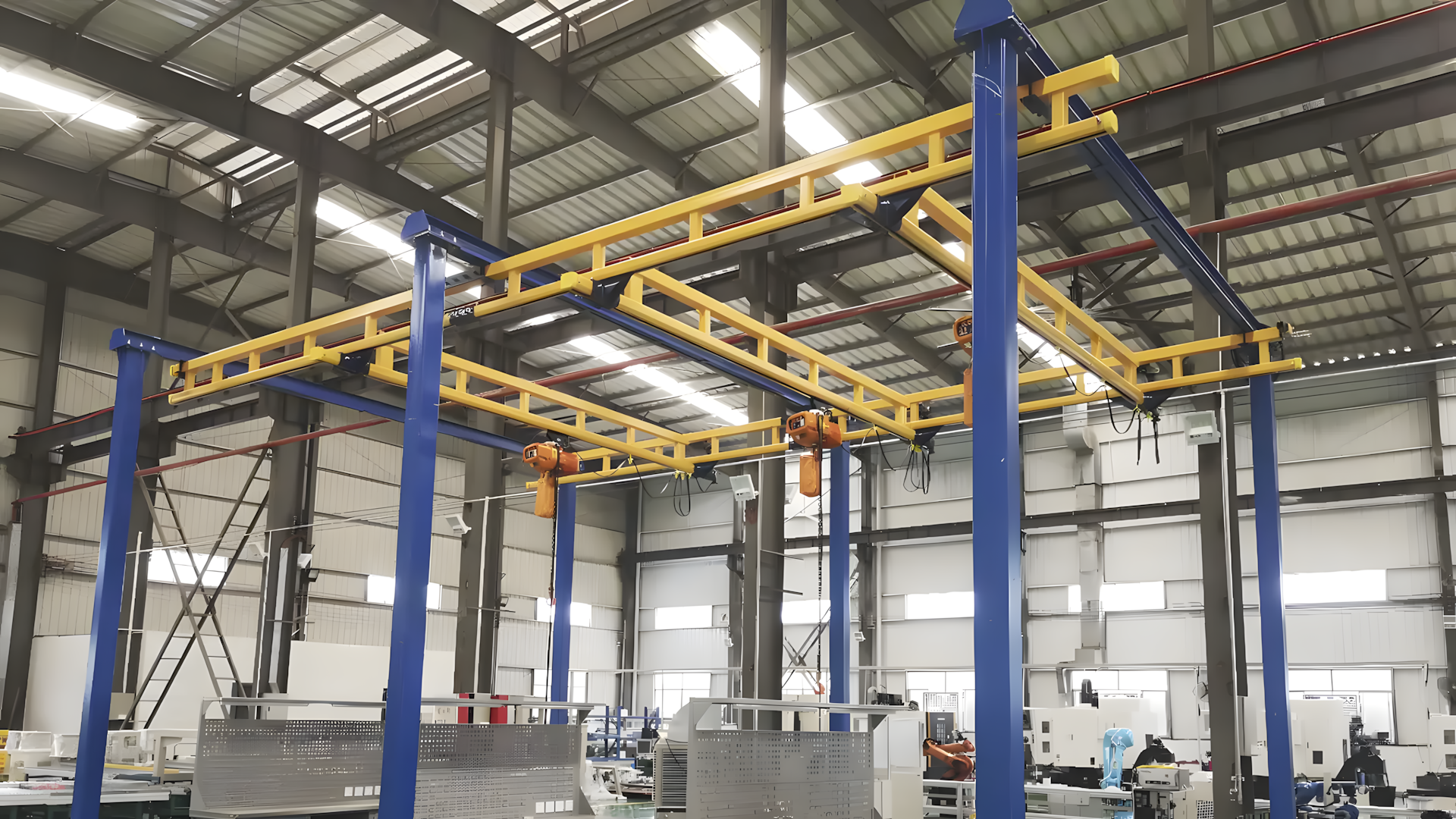
Technical Parameters
KBK Flexible Single Main Girder Suspension Crane
| Parameter | KBK-S-125 | KBK-S-250 | KBK-S-500 | KBK-S-1000 |
|---|---|---|---|---|
| Rated Lifting Capacity(kg) | 125 | 250 | 500 | 1000 |
| Maximum Span(m) | 9 | 8 | 6.5 | 4 |
| Crane Rail Model | KBK 100 | KBK 200 | KBK 300 | KBK 500 |
| Hoist Configuration | DHS-0.125 | DHS-0.25 | DHS-0.5 | DHS-1 |
| Lifting Speed(m/min) | 10 | 10 | 8 | 8 |
| Travel Mode | Manual/Electric | |||
| Work Duty / Classification | A3~A4 | |||
KBK Flexible Double-Girder Suspension Crane
| Parameter | KBK-D-250 | KBK-D-500 | KBK-D-1000 | KBK-D-2000 |
|---|---|---|---|---|
| Rated Lifting Capacity(kg) | 250 | 500 | 1000 | 2000 |
| Maximum Span(m) | 10 | 8 | 6 | 5 |
| Crane Rail Model | KBK 200 | KBK 300 | KBK 500 | KBK 1000 |
| Hoist Configuration | DHS-0.25 | DHS-0.5 | DHS-1 | DHS-2 |
| Lifting Speed(m/min) | 10 | 8 | 8 | 6 |
| Travel Mode | Electric | |||
| Work Duty / Classification | A3~A5 | |||
Product Features
Modular Design: The KBK system uses standardized rail profiles and connectors that can be flexibly combined into monorail, single main girder, or twin main girder configurations to suit specific workstation needs. Expansion and retrofit are straightforward.
Lightweight Design: Closed cold-formed steel or aluminum alloy rails offer low dead weight and a compact cross-section, reducing load requirements on the factory building. Installation requires no heavy lifting equipment.
Flexible Suspension: Ball-joint flexible suspension units absorb minor structural deformation of the factory building, ensuring smooth trolley travel along the rail. With a maximum suspension point spacing of 3.2 m, fewer suspension points are needed.
Low Running Resistance: The precision-formed interior of the rail minimizes cross travel resistance, making manual pushing easy and electric operation energy-efficient.
Curved Rail Capability: Curved rails with a minimum radius of R=1000 mm are available, accommodating circular workstations and curved material handling paths to flexibly match production line layouts.
Complete Package: Built-in conductor rail power supply, standard chain electric hoist, and optional manual, electric, or remote control operation modes.
Applications
Automotive Parts Assembly Lines: Station-level material handling for engines, gearboxes, axles, and more. Lifting capacity from 125 to 1000 kg, covering linear or rectangular work areas.
Photovoltaic and Electronics Manufacturing: Lightweight material handling for silicon wafers, solar cells, electronic components, and more. Aluminum alloy rails are available to meet Class 1000 cleanroom requirements.
Food and Pharmaceutical Workshops: Aluminum alloy rails produce no dust and feature a hard anodized surface, making them suitable for food packaging lines and pharmaceutical dispensing lines.
Warehousing and Logistics: Pairs with KBK stacker systems for high-density storage, order picking, and transfer of light loads such as bins and pallets.
Machining Operations: Repetitive handling tasks such as die changes, workpiece loading/unloading, and finished part transfer reduce operator fatigue and boost productivity.
Maintenance and Repair Stations: Hoisting for maintenance of engines, pump bodies, motors, and similar equipment. Covers dead spots and enables precise positioning.
Structural Diagram
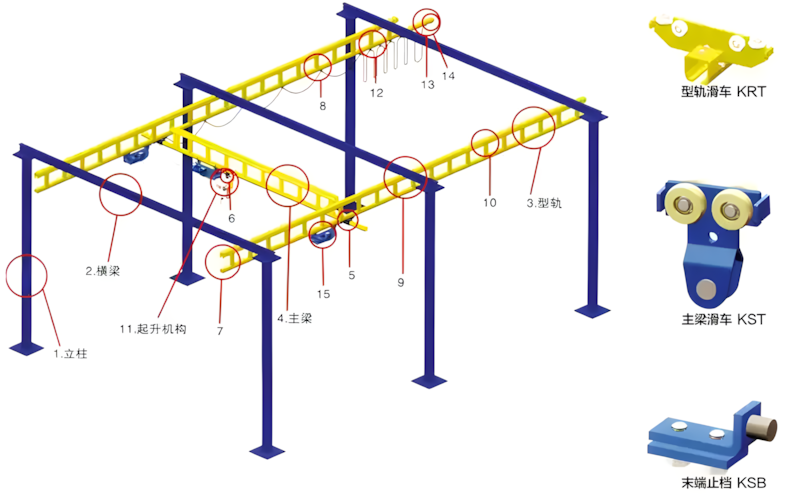
| Dimensions(mm)/Lifting Capacity(kg) | 125 | 250 | 500 | 1000 |
| L | 9000 | 8000 | 6500 | 4000 |
| L1 | 8500 | 7500 | 6000 | 3500 |
| L2 | 107 | 107 | 232 | 232 |
| L3 | 487 | 437 | 512 | 412 |
| B | 173 | 173 | 423 | 423 |
| H | 1200 | 1220 | 1300 | 1430 |
| h | 730 | 730 | 730 | 730 |
Note: L—maximum span, L1—effective lifting range, L2—end distance, L3—crane rail cantilever end, B—rail center distance, H—maximum hoisting height, h—lifting point distance.
Inspection & Maintenance
Pre-Service Inspection: Verify work zone markings, power supply voltage and frequency, and safety clearances; manually push the trolley to ensure smooth travel without resistance.
Daily Inspection: Visually inspect components for damage and wear; perform functional checks on all mechanisms and safety devices.
Maintenance: To be carried out by trained personnel; retighten bolts after 1–2 months of service; disconnect the power supply before maintenance. To dismantle the trolley, remove the rail joints sequentially; replace the current collector if the trolley axle shaft shows wear. Follow the standard maintenance cycle for single-shift operation; shorten the cycle for multi-shift or severe operating conditions.
FAQ
Q: What is the main difference between a KBK flexible single main girder and a twin main girder suspension crane?
A: The single main girder design uses one KBK rail for support, with a span of ≤9m and a lifting capacity of 125–1000kg. The twin main girder design features two parallel main girders plus a cross-beam structure, offering a span of ≤10m and a lifting capacity of up to 2000kg, providing larger coverage and smoother operation.
Q: Can a KBK system be retrofitted into an existing factory building?
A: Yes. It uses modular components and flexible suspension that can be fixed directly to the factory structure, requiring no major civil works or structural modifications.
Q: What is the maintenance interval for a chain electric hoist?
A: Replace the chain every 2 years; check wear and elongation monthly. Check electrical insulation annually.
Q: Can KBK rails be curved?
A: Yes, with a minimum turning radius of R=1000mm. Curved tracks are suitable for circular workstations and are for manual operation only.