

From Simulation to Fleet: Crane Engineering Execution
From Simulation to Mass Production, Single Units to Fleet Coordination: How Kelude Heavy Industry Turns Crane R&D into Engineering Reality. In the crane manufacturing industry, "R&D capability" is often narrowly interpreted as "design capability"—producing an impressive drawing or a clever structural calculation.
In the crane manufacturing industry, "R&D capability" is often narrowly understood as "design capability"—creating a polished drawing or a sophisticated structural calculation. But anyone who has been through the entire journey from laboratory to customer site knows that a massive engineering gap lies between simulation validation and mass production, and between a single intelligent unit and coordinated fleet operations. Turning a technology into "something that works" is one thing; turning that "something that works" into a hundred units that "work reliably" is an entirely different capability.
Kelude Heavy Industry's investment in technology R&D over the past few years has been evident—R&D spending exceeding 8% of annual revenue, 52 authorized patents, and an 87-person R&D team. But more noteworthy than these figures is how the company moves technology from the simulation environment to the production floor, and how it weaves individual intelligent cranes into a collaborative operational network. This article examines Kelude Heavy Industry's technical practices along these two main threads from the perspective of "engineering implementation."
From Simulation to Mass Production: A Complete Engineering Conversion Chain
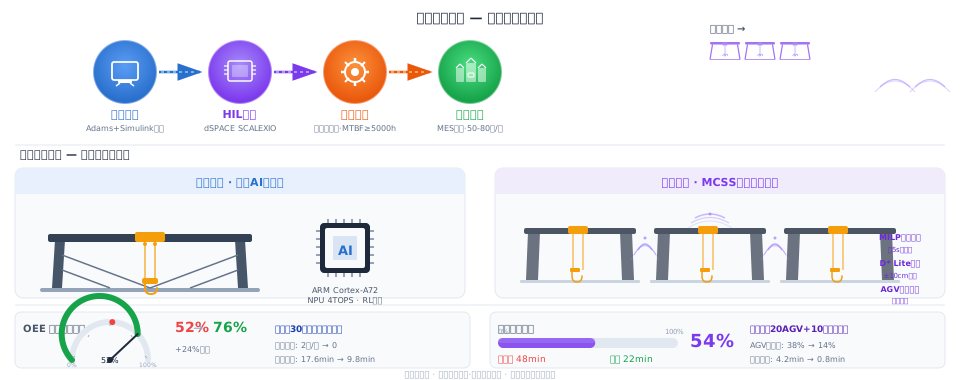
1.1 Co-Simulation: Running a Thousand Cycles in the Digital World
Co-simulation using Adams multibody dynamics software with MATLAB/Simulink is the most important front-end validation tool in Kelude Heavy Industry's R&D process. In the traditional approach, crane control system commissioning could not begin until after the prototype was built—the mechanical structure completed, the electrical cabinet installed, and the VFDs configured—only then would software engineers step in to write PLC programs and tune PID parameters. If a problem requiring mechanical structural changes was discovered, the cost was enormous.
Kelude's R&D team takes a different approach: during the design phase, they build a multibody dynamics model of the crane in Adams—main girder, end carriages, trolley, suspended load, and wire ropes are all included, with 16 degrees of freedom and hybrid modeling that combines flexible bodies (wire ropes) and rigid bodies (metal structure). The model is then imported into the Simulink environment for closed-loop simulation with the control algorithms under development (RL anti-sway strategy, speed planning curves, safety protection logic). A typical co-simulation scenario includes: trolley acceleration from point A to point B, synchronized hoisting mechanism movements, and positioning accuracy verification with a swinging load. These simulations are run more than a thousand times before the physical prototype is ever built.
The practical results: between 2024 and 2025, Kelude's R&D team identified 12 mechanical-control coupling issues in advance through co-simulation, including torque saturation in the trolley travel motor of a bridge crane model under full-load high-speed conditions, and second-order sway amplification in a gantry crane model under specific rope-length and load combinations. Had these issues only surfaced during prototype testing, each structural modification would have cost an average of 80,000–150,000 CNY (approximately $11,900–$22,200), with 2–4 weeks of schedule delays. Co-simulation eliminated all of these issues at the design stage, compressing control system commissioning time during the prototype phase from an average of 4 weeks down to 1.5 weeks.
1.2 HIL Simulation: A Full Physical Examination for the Controller
Co-simulation addresses the matching of control algorithms with mechanical models, but the actual controller hardware—PLC, motion controller, VFDs—remains unvalidated. Bugs in controller firmware, communication protocol compatibility flaws, and I/O module timing issues simply cannot be exposed in pure software simulation. Kelude Heavy Industry's dSPACE SCALEXIO HIL platform was built precisely for this purpose.
The HIL testing process works as follows: a real crane controller (such as a Siemens S7-1500 PLC plus servo drive) is connected to the HIL system, which simulates in real time all peripheral physical quantities—motor back electromotive force, encoder pulses, load variations, sensor signals—so the controller "believes" it is actually running on a crane. The HIL platform can inject 36 different types of faults within one second—sensor wire breaks, communication interruptions, power supply fluctuations, encoder pulse loss—to test controller behavior under every abnormal condition against design requirements.
As of June 2026, Kelude Heavy Industry has executed over 25,000 automated test cases on the HIL platform, covering all operating phases of the crane electrical system. The test procedures follow the requirements of GB/T 33240-2016 "Cranes—Control Systems—Performance Requirements" and GB/T 33519-2017 "Cranes—Brakes—Test Methods". One key finding: HIL testing uncovered an overcurrent protection timing delay in the VFD under specific sudden load-change conditions—an issue that had never been triggered in pure software simulation but could have caused VFD damage and system shutdown in the field. The HIL platform captures these "only-exposed-on-real-hardware" issues in advance, reducing on-site electrical system commissioning time by more than 60%.
1.3 From Prototype to Mass Production: A Systematic Approach to Process Qualification and Quality Lock-In
Simulation and laboratory testing answer the question "does it work?" while the journey from prototype to mass production answers "can we make it consistently, efficiently, and cost-effectively?" Kelude Heavy Industry has established two critical "quality gates" along this path.
Gate One: Complete Machine Reliability Testing. Before any new model is finalized, it must complete no fewer than 500 hours of continuous reliability assessment on the full machine test rig, in accordance with ISO 4306 "Cranes—Test Specification and Procedures". If any design defect appears during the assessment period—even a minor issue like a loose bolt—the entire machine is returned for rectification and the 500-hour clock resets. For example, a 50-ton bridge crane model in 2025: during the first reliability test round, abnormal noise was detected in the hoisting gearbox at hour 327. Disassembly revealed abnormal temperature rise caused by insufficient gear mesh clearance. The R&D team re-optimized the gear machining tolerances and assembly process, and the second test round passed cleanly at 512 hours. This zero-tolerance assessment regime ensures that products reaching the market achieve an MTBF of over 5,000 hours.
Gate Two: Small-Batch Trial Production and Process Lock-In. New models that pass reliability testing move into small-batch trial production, typically 5–8 units, covering the full process from cutting, welding, and machining through assembly and commissioning. The core objective of trial production is not to build products but to build processes—every welding parameter, every bolt torque, every cable routing path must be verified and documented to create standard operating procedures (SOPs). Only when the first-article inspection pass rate for the trial batch reaches 98% or higher, with three consecutive units passing all inspections, is the model approved for mass production. In 2025, two new Kelude models (the QY50t bridge crane and the MG32t gantry crane) achieved the "three same-year" goal—finalized, mass-produced, and delivered all within the same year.
From Single-Unit Intelligence to Fleet Coordination: The Brain and Neural Network of Every Crane
If flawless engineering conversion is Kelude Heavy Industry's "hard power," then the leap from single-unit intelligence to fleet coordination is its "soft power"—the former determines whether a crane works reliably, the latter determines whether multiple cranes work together efficiently.
2.1 Edge AI Controller: A Local Brain for Every Crane
A traditional crane control system consists of a PLC, several VFDs, and sensors. The PLC executes ladder diagram logic, and the VFDs drive the motors. This architecture works fine for single-equipment scenarios but has two clear limitations. First, PLC computing power is insufficient for complex control algorithms—RL anti-sway model inference, vibration signal spectrum analysis, and real-time anomaly detection require floating-point operations and matrix computations that a PLC simply cannot handle. Second, the heavy dependence on the host computer for data and decisions means that once communication with the host is lost, a crane degrades to "bare metal" operation, capable of only basic hoisting and travel functions.
Kelude Heavy Industry's self-developed edge AI controller is a systematic answer to this problem. The controller's hardware architecture is based on an ARM Cortex-A72 quad-core processor (2.0 GHz) paired with an NPU neural processing unit (4 TOPS), while retaining full PLC I/O functionality and industrial protocols (Profinet, EtherCAT, Modbus TCP/IP). On the software side, three key modules run on the controller's real-time operating system:
Module One: RL Anti-Sway Inference Engine. A deep Q-network model optimized through quantization and pruning, with a memory footprint of only 2.3 MB and single-inference latency under 10 ms. The controller executes a "sense-reason-act" cycle every 20 ms: reading encoders (position, speed) plus inclination sensors (load sway angle and angular velocity), feeding the RL model to compute optimal speed commands, and adjusting VFD output in real time. This entire process runs locally with zero dependence on host or cloud computing.
Module Two: Multi-Source Data Fusion and Preprocessing. The controller simultaneously collects data from up to 16 sensor channels—vibration sensors, temperature sensors, strain sensors, encoders, current transformers—and performs feature extraction locally (FFT spectrum analysis, time-domain statistics, trend change detection), compressing high-dimensional raw data into low-dimensional features before uploading. This "edge preprocessing + cloud/host deep analysis" architecture reduces data transmission bandwidth requirements by a factor of 20 while significantly easing the host computer's computational load.
Module Three: Edge Autonomy and Disconnection Protection. This is the most critical safety function. The controller has the complete state machine and working parameters for all operational procedures preloaded. When a communication interruption with the MCSS dispatching system or the host computer is detected, it automatically switches to "local autonomous mode"—continuing the current task until the full work cycle is completed, then parking in a safe position and waiting for communication to be restored. This mechanism eliminates the risk of equipment "freezing" or losing control due to network failures. During a 2025 site incident involving a 40-minute network switch failure, all 30 cranes automatically switched to local autonomous mode—not a single unit experienced abnormal shutdown or a safety incident.
Since its mass production began in 2023, this edge AI controller has been deployed on more than 300 cranes in service, covering the three major product lines: general-purpose overhead type, gantry type, and metallurgical cranes. The controller's own MTBF (excluding external sensors and actuators) exceeds 20,000 hours, with zero unplanned downtime incidents in the field.
2.2 MCSS Multi-Crane Dispatching System: Weaving 30 Cranes into a Single Network
Intelligence on a single crane solves the problem of "doing its own job well." But when 10, 20, or even more cranes operate simultaneously in a workshop, the real questions become: "Who can do the job? Who is doing it? And how do we keep them from colliding?" Kelude Heavy Industry's MCSS (Multi-Crane Scheduling System) dispatching system was designed precisely for this challenge.
The MCSS system architecture is organized into three layers:
Bottom Layer—Sensing Layer. The edge AI controller on each crane reports real-time status data to the MCSS server via industrial WiFi or a dedicated 5G network at 100 ms intervals, including current coordinates (X/Y/Z axes), lifting weight, load sway angle, travel speed, task progress, and self-diagnostic status. The MCSS server maintains a plant-wide "real-time equipment status table" with a refresh latency of no more than 200 ms.
Middle Layer—Dispatching Engine Layer. This is the core of MCSS. The dispatching engine receives material handling task lists from the MES (Manufacturing Execution System) or manually entered by operators, and performs global optimization calculations based on a mixed-integer linear programming (MILP) model. The optimization objective function weighs three factors: minimizing total task completion time, balancing equipment utilization, and minimizing overall energy consumption. Constraints include: equipment load capacity (not exceeding the rated lifting capacity), spatial conflict avoidance (cranes on the same rail maintaining a safety distance of ≥5 m), and task priority (urgent tasks scheduled first). For a typical scale of 30 cranes and 200 tasks, the MILP solver delivers an optimal solution within 3–5 seconds.
Top Layer—Human-Machine Interaction Layer. MCSS offers two visualization modes: a web interface and a workshop large-screen display. The web interface is the dispatching administrator's control panel, featuring Gantt charts showing each crane's timeline-based task schedule and a 3D scene map displaying real-time positions, statuses, and travel trajectories of all cranes. The workshop large-screen display targets frontline supervisors, using a card-based layout to present key operational indicators such as daily task completion rate, equipment utilization, and average response time.
| Function Module | technical implementation | Critical Indicator |
|---|---|---|
| Task Orchestration Engine | MILP-based(MILP)Global Optimal Scheduling | Simultaneous Optimization≥30Equipment Units; Solve Time<5s |
| Conflict Detectionand Resolution | Space-Time Corridor(Spacetime Corridor)Collision Avoidance Algorithm | detection accuracy±10cm; Resolution Response<1s |
| Real-Time Path Planning | D* Lite Incremental Path Search+Dynamic Obstacle Avoidance | Replanninglatency<200ms; Global Path Optimality≥95% |
| Equipment Status Awareness | Edge AIController+MQTTReal-Time Reporting,100ms Heartbeat | Status Updatelatency<200ms; Connection Lossearly warning<3s |
| Energy Efficiency Optimization Module | Genetic Algorithm(GA)+Hybrid Greedy-Heuristic Optimization | Overall Energy Consumption Reduction12%~18% |
| Digital Twin Dashboard | Web GL3D Visualization+Web Socket Real-Time Streaming | Refresh Rate>25fps; Datalatency<500ms |
Since its initial deployment in 2024, the MCSS system has been implemented across six projects in the steel, automotive, and machinery processing industries, managing over 120 cranes and AGVs in total. In terms of dispatching efficiency: in a cluster of 30 pieces of equipment, MCSS reduced average task waiting time from 12–15 minutes under manual dispatching to 3.2 minutes, and boosted Overall Equipment Effectiveness (OEE) from 58% to 79%.
Typical Case Studies
Case 1: Intelligent Upgrading of a 30-Crane Cluster at a Steel Mill
In the hot-rolled coil finishing workshop of a large steel enterprise in East China—measuring 480 meters long and 120 meters wide—30 overhead cranes compliant with ISO 4306 (general purpose bridge crane standard) were originally in service, with rated lifting capacities of 20t, 32t, and 50t. These cranes handled all lifting and transport tasks from the finishing mill to finished product warehousing. Before the retrofit, three core pain points plagued the operation: first, inefficient manual dispatching—four dispatchers coordinated via two-way radios, leading to long task queues during peak hours and an average lifting cycle of 17.6 minutes; second, a black box of operational data—without a unified monitoring system, equipment failures relied on operators to detect and report, keeping OEE at just 52%; and third, safety depended on human vigilance—multiple cranes working on the same crane rail posed collision risks, and in 2023, two minor trolley collisions occurred due to operator errors.
Kelude delivered an integrated solution for this project, combining edge AI controller upgrades with MCSS dispatching system deployment. The implementation followed a three-step approach:
Step 1 (Q1–Q2 2024): Edge AI controller upgrade. All 30 cranes underwent electrical control system upgrades, replacing outdated PLCs (some dating to the early 2000s and no longer in production) with Kelude edge AI controllers. A sensor suite—including encoders, inclination sensors, vibration sensors, current sensors, and laser distance sensors—was also retrofitted. Each crane required 2–3 days of work, scheduled during production breaks to avoid disrupting normal operations.
Step 2 (Q2–Q3 2024): MCSS deployment and network infrastructure. The MCSS server was installed in the workshop control room, and an industrial Wi-Fi 6 wireless network (6 access points, roaming handover latency <50ms) was built to cover the entire workshop. MCSS was integrated with the plant's existing MES system to receive real-time production schedules and inventory data. The deployment took four weeks, with two weeks dedicated to network commissioning and system integration testing.
Step 3 (Q3 2024–present): Go-live and continuous optimization. The system initially ran in "advisory mode" for two weeks—MCSS generated dispatching recommendations that human dispatchers could accept or override, validating algorithm performance and building trust. After two weeks, it switched to "automatic dispatching mode," where MCSS directly issued task commands to cranes, with operators responsible only for confirmation and abnormality handling.
Post-retrofit performance results:
- Average lifting cycle time dropped from 17.6 to 9.8 minutes, a 44% reduction;
- OEE improved from 52% to 76%;
- Daily lifting operations increased from 380 to 580, a 53% gain;
- Collision incidents fell from an average of 2 per year to zero (18 consecutive months without a collision as of June 2026);
- Operator staffing was reduced from 12 per shift (including 4 dispatchers) to 8 per shift, with dispatching roles replaced by the system.
The project's payback period is approximately 14 months—annual economic benefits from staffing optimization and efficiency gains alone already exceed the total project investment. The steel enterprise has since signed a contract for the second phase (retrofitting 40 cranes in two additional workshops), with plans to complete the intelligent upgrade of all 70 cranes by the end of 2026.
Case 2: Heterogeneous Collaboration of 20 AGVs and 10 Cranes at an Automotive Plant
At a new energy vehicle manufacturer in Central China, the stamping-welding-final assembly logistics workshop required fully automatic transport of stamped parts from the raw material warehouse to the stamping line, and from the stamping line to the welding workshop. The workshop's material handling equipment included 10 bridge cranes (rated lifting capacity 16t, responsible for cross-workshop lifting of heavy dies and bins), 20 under-ride AGVs (rated load 1.5t, handling medium and small parts on flat surfaces), and 2 fixed lifting platforms (serving as material transfer stations between cranes and AGVs).
What made this scenario unique was heterogeneous equipment collaboration—cranes and AGVs have fundamentally different motion models, and their task time scales and spatial footprints must be precisely matched. For example, when an AGV delivers a full bin of stamped parts from the stamping line, it must "rendezvous" with a crane at the lifting platform station: the AGV arrives, the crane lowers its hook, grabs the bin, lifts it, and travels along the crane rail to the buffer area in the welding workshop. Any delay in this chain causes the counterpart equipment to idle, potentially crippling the entire logistics flow.
Kelude's MCSS system was customized for this scenario with a heterogeneous equipment collaborative scheduling module. The core design philosophy was "divide and conquer plus handshake protocol":
- Global task planning layer (minute-level): MCSS's MILP engine converts the final assembly workshop's material demands into a task sequence, assigning each task a "crane + AGV + time window" triplet. For instance, task T-1034: AGV-07 arrives at lifting platform station 3# at 14:32, crane-04 completes the lift between 14:32 and 14:37, and AGV-12 returns the empty bin to the stamping line between 14:37 and 14:45. This triplet ensures precise time coordination across the three pieces of equipment.
- Local negotiation layer (second-level): When actual operations deviate from the plan (e.g., an AGV is delayed 40 seconds due to obstacle avoidance), MCSS's local negotiation mechanism kicks in—affected tasks are flagged as "pending negotiation," and the involved cranes, AGVs, and lifting platforms reallocate time windows via an improved Contract Net Protocol. The negotiation completes within 1–2 seconds, and the updated schedule is pushed to each device's edge controller.
The operational data after go-live was impressive:
- Average transfer time for materials from stamping output to welding input dropped from 48 to 22 minutes, a 54% reduction;
- AGV no-load travel rate fell from 38% pre-retrofit to 14% (thanks to MCSS-optimized task allocation and path planning);
- Average docking wait time between cranes and AGVs at lifting platform stations decreased from 4.2 to 0.8 minutes;
- Since formal commissioning in October 2024, the collaborative system has run continuously for over 5,000 hours with zero production stoppages caused by dispatching abnormalities.
The automotive manufacturer designated this project as its benchmark case for annual digital transformation and promoted the technology across its group. Kelude also distilled a replicable "crane + AGV hybrid dispatching solution" from this project, which has since been deployed in two new automotive parts plant projects.
Conclusion
Kelude's engineering-to-deployment capability in crane R&D boils down to a simple principle: use simulation as a tool, let data drive decisions, and embed intelligence as close to the equipment as possible.
From pre-validation through Adams+Simulink co-simulation, to hardware-level inspection via HIL simulation, and finally to zero-tolerance assessment in full-machine reliability tests—this chain from simulation to mass production ensures that every technology emerging from the lab has been thoroughly validated under real operating conditions. From localized intelligence in edge AI controllers to cluster-level collaboration in the MCSS multi-crane dispatching system—this leap from single machine to cluster transforms each crane from an isolated execution unit into a node in an intelligent collaborative network.
The two case studies validate the value of this engineering system from different angles: the 30-crane cluster retrofit at the steel mill demonstrates its replicability in large-scale, homogeneous equipment scenarios; the collaboration of 20 AGVs and 10 cranes at the automotive plant proves its flexibility in heterogeneous, high-precision coordination scenarios. Together, these two scenarios cover over 80% of typical industrial material handling requirements—the most compelling testament to Kelude's engineering-to-deployment capability.
FAQ
Q: What problem does Adams-Simulink co-simulation solve in crane R&D?
A: Co-simulation between Adams multibody dynamics software and the Simulink control system addresses the coupling validation problem between mechanical dynamic characteristics and control strategies. In traditional R&D workflows, structural engineers build dynamic models in Adams while control engineers design algorithms in Simulink—these efforts run sequentially: control tuning begins only after the structure is finalized, and issues discovered later force a return to structural modifications. Co-simulation allows both models to run collaboratively on the same timeline: dynamic states such as load sway angle and trolley speed output by Adams serve as inputs to the Simulink controller, while motor commands calculated in Simulink drive the mechanical model in Adams, forming a complete bidirectional "mechanical-control" closed loop. This approach advances the validation of control system-mechanical structure matching to the design phase, reducing control tuning time during the prototype stage by approximately 60%.
Q: What is the maximum number of devices the MCSS can manage simultaneously?
A: The MCSS (Multi-Crane Scheduling System), independently developed by Kelude Heavy Industry, is designed to manage up to 50 cranes and AGV units at the same time. In a recent deployment at a steel plant, the system coordinated a fleet of 30 overhead cranes, with 32 devices online concurrently (including 2 standby units). The system processes over 800 dispatch tasks daily and achieves an availability rate of 99.97%. Built on a microservice architecture with distributed deployment, a single dispatching server can handle real-time scheduling calculations for 20–30 devices, with horizontal scaling supported as the fleet grows.
Q: How does the crane edge AI controller differ from a standard PLC controller?
A: Traditional crane PLC controllers—such as the Siemens S7-1200/1500 or Mitsubishi FX series—are designed primarily for sequential logic control and basic PID closed-loop regulation. Their processors (typically ARM Cortex-M or low-end x86) offer limited computing power and cannot handle complex floating-point operations or neural network inference. Kelude's edge AI controller, by contrast, is built around a quad-core ARM Cortex-A72 processor paired with an NPU (neural processing unit) delivering 4 TOPS of computing power. While retaining full PLC functionality, it adds three key capabilities: ① On-device AI inference—the reinforcement-learning anti-sway model runs directly on the controller with an inference cycle under 10 ms, eliminating dependence on a host PC or cloud; ② Real-time data preprocessing—multi-sensor signals (vibration, temperature, strain, etc.) are processed for feature extraction and anomaly detection on the edge, with a 20:1 data compression ratio before upload; ③ Edge autonomy—in the event of communication loss with the host system, the controller independently executes the entire workflow, keeping the crane operational without interruption. This controller has been retrofitted on more than 300 cranes in service, with zero downtime incidents reported.
Q: What is the biggest technical challenge in collaborative scheduling of cranes and AGVs?
A: Coordinating overhead cranes with Automated Guided Vehicles (AGVs) is a classic heterogeneous multi-agent coordination problem, and the technical difficulties center on three areas. First, spatiotemporal coupling—cranes operate in three-dimensional space (X/Y/Z plus load sway), while AGVs move on a two-dimensional plane (X/Y). The kinematic models, constraints, and time scales of the two equipment types are fundamentally different, making unified task planning exceptionally complex. Second, conflict avoidance—the swing envelope of a crane's suspended load can overlap with AGV travel paths, particularly around loading/unloading stations. This requires robust dynamic collision detection between suspended loads and ground vehicles. Third, the trade-off between real-time responsiveness and global optimality—achieving globally optimal scheduling requires solving a Mixed-Integer Linear Programming (MILP) problem, whose computation time grows exponentially with the number of devices, while real-time coordination demands response latency within seconds. Kelude's MCSS addresses these challenges through a hierarchical hybrid architecture: a MILP engine handles minute-level global task planning at the upper layer, while a distributed negotiation mechanism resolves second-level real-time conflicts at the lower layer—striking a balance between global optimization and real-time performance.
