
How to Choose a Crane for a Pharmaceutical Logistics Center

At a Glance: Kelude Heavy Industry provides a complete crane configuration solution for pharmaceutical logistics centers, covering four storage zones — cool storage, cold storage, controlled substances, and ambient temperature. Designed for lifting capacities from 0.5 to 10 tons and spans from 8 to 28 meters, the complete plant investment ranges from approximately $18,000 to $178,000. The cool storage area is equipped with stainless steel single-girder electric cranes (2–5 t), the cold storage area uses Arctic-service cranes rated for -20°C (2–5 t), the controlled substances area features explosion-proof cranes (Ex d IIB T4, 1–3 t), and the ambient area is fitted with standard LD type single-girder cranes (3–10 t) — all meeting GSP requirements for temperature/humidity control, cleanliness, and segregated pharmaceutical storage.

Crane Configuration for Pharmaceutical Logistics Centers

Cool Storage | Cold Storage | Controlled Substances | Ambient / Full-Case

Lifting equipment at pharmaceutical logistics centers — including drug distribution hubs and GSP-certified warehouses — must accommodate a wide range of demands: GMP-grade cleanliness, cold-chain low-temperature operation, explosion-proof protection, and standard ambient duty.

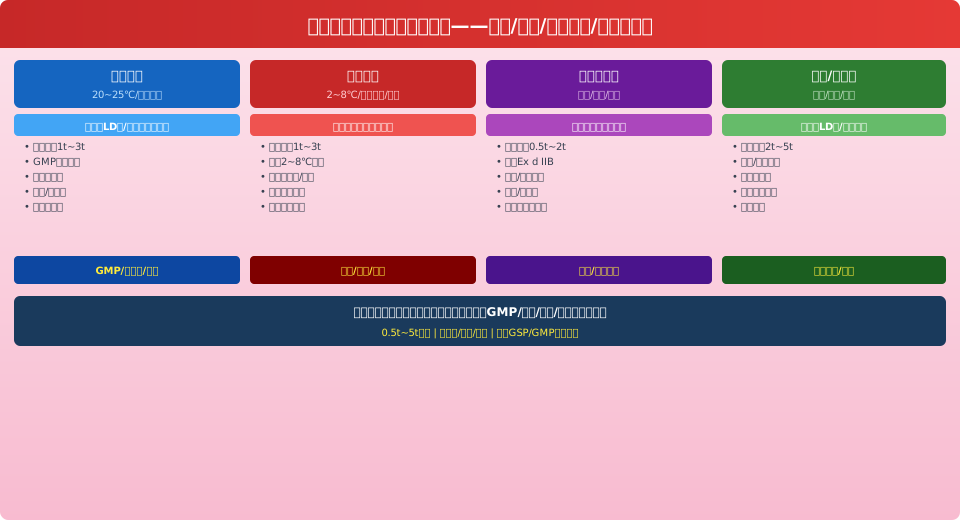
Pharmaceutical Logistics Centercraneconfiguration solution——Cool Storage/Cold Storage/Controlled Substances Storage/Ambient Temperature Four-Zone Warehouse Area

Zone 1 — Cool Storage

• Lifting capacity 1–3 t, LD type / stainless steel electric hoist

• GMP cleanliness compliance

• Stainless steel construction

• Corrosion-resistant / easy to clean

• Low-noise operation

• Kelude configures stainless steel + GMP cleanliness

GMP / Stainless Steel | Clean | Low-Noise

Zone 2 — Cold Storage

• Lifting capacity 1–3 t, frost-resistant electric hoist

• Low-temperature operation at 2–8°C

• Frost-resistant lubricating oil / sealing

• Insulated door compatibility

• Anti-condensation design

• Kelude configures cold-chain-specific hoists

Low-Temp 2–8°C | Frost-Resistant | Cold-Chain Rated

Zone 3 — Controlled Substances

• Lifting capacity 0.5–2 t, explosion-proof electric hoist

• Explosion-proof Ex d IIB

• Ethanol / reagent explosion protection

• Sealed / leak-proof

• Temperature & humidity monitoring integration

• Kelude configures pharmaceutical-grade explosion-proof hoists

Ex d Rated | Controlled Substances | Sealed & Leak-Proof

Zone 4 — Ambient / Full-Case

• Lifting capacity 2–5 t, LD type / electric hoist

• Pallet / full-case handling

• High-rack integration

• Standard industrial environment

• Cost-effective

• Kelude configured with ambient-temperature storage hoist

Unit Load Handling | Economical | High-Rack Storage

Selection Parameters: Four-Zone Comparison

Parameter ItemCool Storage AreaRefrigerated Storage AreaControlled Substances AreaAmbient Temperature/Full Case
recommended modelLD Type/stainless steel hoistFreeze-Protected HoistExplosion-proof electric hoistLD Type/Electric Hoist
Lifting Capacity1t~3t1t~3t0.5t~2t2t~5t
EnvironmentrequirementsGMPCleanroom/20~25℃Cold Chain/2~8℃Explosion-proof/SealingAmbient Temperature
Special Material304Stainless SteelAnti-Freeze SealingExplosion-proof EX d IIBStandard Coating / painting
Kruud SolutionStainless Steel+GMPRefrigerated Cold Chain DutyPharmaceutical Explosion-proofWarehousing Hoist
$178,000–$1,780,000
Total Plant Investment
0.5–10 t
Lifting Capacity Range
8–28 m (26–92 ft)
Span Range
A3–A5
Work Duty Classification
GSP Specification
Pharmaceutical Standard
10,000–50,000 m²
Warehouse Area

Lifting Requirements Across Four Pharmaceutical Warehouse Zones

Cool storage (20–25°C) demands stainless steel construction and cleanroom design to meet GMP standards. Refrigerated storage (2–8°C) requires low-temperature lubricants and anti-condensation engineering. Controlled substances storage is the only zone in pharmaceutical logistics that may require explosion-proof equipment. Kelude tailors lifting solutions to the specific demands of each warehouse zone.

Kelude — Service Advantages

Kelude has specialized in crane systems for pharmaceutical logistics for years, delivering GSP-compliant lifting solutions for drug distribution centers and pharmaceutical manufacturing warehouses. Our product line covers the full range of cold-storage, explosion-proof, and cleanroom configurations, addressing the distinct requirements of cool, refrigerated, controlled-substance, and ambient storage zones.

Low-Temperature Solutions for Refrigerated Warehouses
Refrigerated (2–8°C) and freezer (-18 to -25°C) environments challenge crane performance: lubricant viscosity increases 5–10×, seals harden and shrink, condensation freezes, and steel becomes brittle at low temperatures. Kelude addresses these issues with low-temperature lubricants (pour point ≤ -40°C), cold-resistant seals (EPDM or silicone rubber), and Q345E steel with low-temperature toughness (impact energy ≥ 34 J at -40°C). The electrical control box is equipped with heating and dehumidification to prevent condensation-related short circuits.
Explosion-Proof Design for Controlled Substances
Warehouses storing controlled substances (narcotics and psychotropics) require explosion-proof design, as these areas may also hold toxic or flammable solvents. Kelude explosion-proof cranes feature Ex d IIB T4 explosion protection, with explosion-proof motors and electrical control boxes on the electric hoist. A dual-operator, dual-key authorization system is also integrated — two operators must each present a card and turn a key simultaneously to start the crane — meeting strict controlled-substance security requirements.
GSP-Compliant Temperature & Humidity Monitoring
Pharmaceutical logistics cranes must not compromise the stability of warehouse temperature and humidity. Kelude's thermal management approach: motor and control box heat is dissipated through external heat sinks, keeping additional heat load out of the storage zone. Built-in temperature and humidity sensors continuously monitor motor and control box operating conditions, triggering automatic alarms when limits are exceeded. The system also integrates with the warehouse BMS — if the BMS detects abnormal temperature or humidity, the crane automatically locks and stops operation.

FAQ

Q: How do you select wire rope and lubricating oil for cold storage environments?
A: For cold storage environments at -25°C: use galvanized wire rope with manganese phosphating coating (passes -40°C low-temperature impact toughness testing), synthetic PAO full-synthetic oil (pour point ≤ -45°C), and low-temperature silicone rubber seals for the gearbox (remains flexible at -60°C). Kelude's Low-Temperature Type Electric Hoist has passed -30°C low-temperature operation testing—running continuously at full load for 4 hours without any issues.
Q: How do pharmaceutical logistics cranes meet GSP requirements?
A: GSP (Good Supply Practice) requires constant temperature and humidity in storage areas—cool rooms at or below 20°C and cold rooms between 2–8°C—with alarms and corrective actions triggered when conditions deviate. Kelude cranes are engineered to comply with GSP through the following measures: ① Motors and electrical control boxes are mounted externally to dissipate heat without raising the storage area temperature; ② Integration with the facility's BMS—when temperature or humidity exceeds setpoints, the BMS automatically locks the crane to prevent operation; ③ Stainless steel surfaces are easy to clean and dust-free, meeting GMP cleanliness standards.
Q: How does the dual-person, dual-lock operating system work in a controlled-substance warehouse?
A: Controlled substances (narcotics, psychotropics, anesthetics, and radioactive materials) require dual-layer access control. Starting the crane requires two physical keys—held separately by two different administrators—plus individual biometric verification (fingerprint or facial recognition) and authorization from the Warehouse Management System (WMS). The crane can only be started when all three verification layers are passed simultaneously. The entire lifting and transport operation is recorded on video, and each operation generates a log entry (operator, time, drug name and quantity lifted), which must be retained for at least 5 years.
Q: Can the same crane specification be used for both cool storage and ambient-temperature warehouses?
A: Not recommended. Cool storage (20°C) and ambient-temperature warehouses (30°C) have slightly different environments, but the difference is minimal, so a standard crane of the same specification (operating temperature -10~+40°C) can be used for both. However, cold storage (2~8°C) requires a Low-Temperature Type, and freezer storage (-18~-25°C) requires a deep Low-Temperature Type. Kelude Heavy Industry recommends the standard UR model for both cool storage and ambient-temperature warehouses, while cold storage and freezer storage should be customized with Low-Temperature Type cranes based on the actual temperature conditions.

Related News

contact

contact us

phone:
+86 13903802779

mail:3915269@qq.com

Working hours: Monday to Friday

Wechat
Wechat
SHARE
TOP