
Cranes for E-Commerce Warehousing & Logistics

In short: Kelude Heavy Industry provides crane configuration solutions for e-commerce warehousing and logistics centers covering the four key stages—receiving, storage, picking, and shipping. Designed for lifting capacities from 0.25 to 10 tons and spans from 8 to 30 meters, the complete plant investment in lifting equipment typically ranges from approximately $15,000 to $150,000. The receiving area is equipped with an LD single-girder electric crane (3–10 t) working alongside the unloading dock; the storage area uses stackers or a KBK system (1–3 t); the picking zone relies on a lightweight KBK flexible suspension (0.25–1 t); and the shipping area is fitted with an automatic palletizing KBK system (0.5–2 t)—all built to handle the high-frequency, fast-turnaround, high-throughput demands of e-commerce logistics.

Crane Solutions for E-Commerce Warehousing & Logistics Centers

Receiving / Unloading Area | High-Rise Storage Area | Picking / Packing Area | Shipping / Loading Area

Lifting equipment in e-commerce warehousing and logistics centers is all about light weight, flexibility, and mobility. Kelude Heavy Industry delivers complete lifting solutions that cover every step from the unloading dock to the shipping bay.

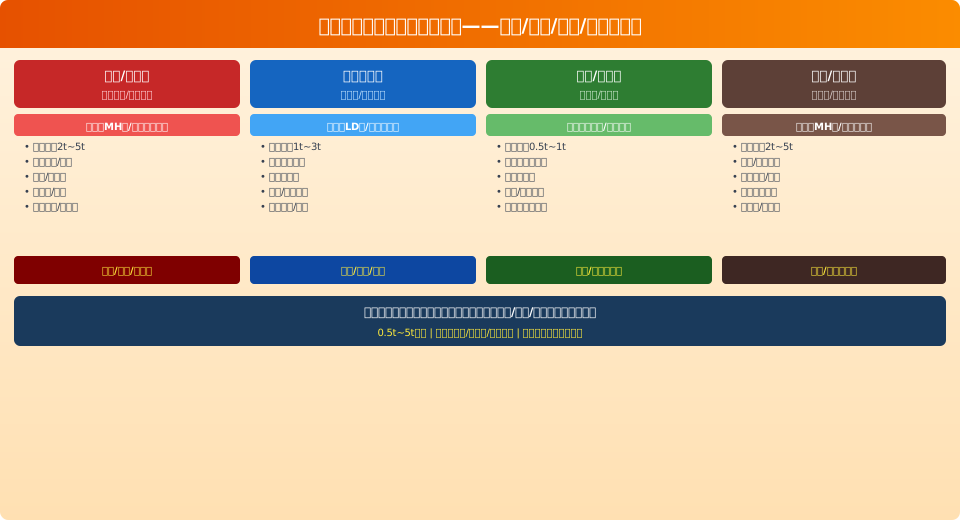
E-commerce Warehousing & Logistics CentercraneSolution——Receiving/Storage/Order Picking/Four-Stage Dispatch Process

Scenario 1: Receiving / Unloading Area

• Lifting capacity 2–5 t, MH type / electric hoist gantry crane

• Unloading platform / vehicles

• Outdoor / semi-outdoor operation

• Mobile / flexible

• Fast loading & unloading / high efficiency

• Kelude configures mobile gantry cranes

Unloading / Pallet | Mobile | Fast Handling

Scenario 2: High-Rise Storage Area

• Lifting capacity 1–3 t, LD type / coordinated with stackers

• High-rise racking maintenance

• Stacker inspection & repair

• Fire protection / pipeline lifting

• Lightweight & flexible / remote control

• Kelude configures warehouse-specific hoists

High-Rise / Lightweight | Maintenance | Warehouse-Specific

Scenario 3: Picking / Packing Area

• Lifting capacity 0.5–1 t, jib crane / electric hoist

• Conveyor line equipment maintenance

• Packaging machine repair

• Compact / space-efficient

• Multiple units covering the assembly line

• Kelude jib cranes cover the packaging line

Lightweight | Assembly Line Maintenance | Jib Crane

Scenario 4: Shipping / Loading Area

• Lifting capacity 2–5 t, MH type / mobile gantry

• Bulk / pallet loading

• Outdoor platform / flexible

• Mobile multi-station operation

• High efficiency / low cost

• Kelude mobile gantry crane

Loading | Mobile flexibility | High efficiency, low cost

Selection Parameters: Four-Zone Comparison

Parameter ItemReceiving/Unloading AreaHigh-Rise Storage AreaOrder Picking/Packing AreaShipping/Truck Loading Bay
recommended modelMH Type/GantryLD Type/Hoistjib crane/HoistMH Type/Mobile Gantry
Lifting Capacity2t~5t1t~3t0.5t~1t2t~5t
FeaturesMobile/High-SpeedHigh-Lift/VersatileCompact/Multi-UnitMobile/High-Efficiency
EnvironmentOutdoor/Semi-OutdoorIndoorIndoor MezzanineOutdoor/Semi-Outdoor
Kruud SolutionMobile GantryWarehouse-Specific Hoistjib cranecoverageMobile Gantry
$15,000–$150,000
Total Plant Investment
0.25–10 t
Lifting Capacity Range
8–30 m
Span Range
A3~A5
Work Duty Classification
100,000 Orders/Day
Throughput Capacity
20,000–100,000 m²
Warehouse Floor Area

Lifting Solutions for E-Commerce Receiving & Shipping Docks

Receiving and shipping operations in e-commerce warehouses take place at dock doors, where mobile gantry cranes or portable electric hoist gantries are used to load and unload pallets and loose cargo. Kelude's mobile MH-type gantry crane can be repositioned to any dock door on demand, with a single unit covering 5–8 loading bays.

Lifting for Storage & Order Picking Zones

Maintenance of stacker cranes and racking systems in high-bay warehouses calls for lightweight, flexible LD-type single-girder cranes or electric hoists (1–3 t). In the picking and packing area, a jib crane (0.5–1 t) is sufficient for servicing conveyor lines and packaging machines.

Kelude Heavy Industry — Service Advantages

Kelude Heavy Industry has years of experience delivering crane and material handling solutions tailored to e-commerce warehousing and distribution. From dock receiving to automated palletizing and dispatch, we provide end-to-end lifting and transport systems covering standard cranes and KBK flexible systems — helping e-commerce logistics operators boost warehouse efficiency and order fulfillment capacity.

High-Speed Unloading at Receiving Docks
E-commerce warehouses typically receive 20–50 inbound trucks per day, so unloading speed is critical. Kelude recommends an LD-type single-girder electric crane (3–10 t) paired with jib cranes and telescopic belt conveyors, achieving unloading rates of 50–80 pallets per hour — 3–5 times faster than manual handling. The crane covers the full width of the dock platform, and when integrated with automatic barcode scanning, inbound shipment data is recorded into the Warehouse Management System (WMS) in real time.
Light-Duty KBK Systems for Picking Zones
Lifting needs in e-commerce picking areas (shelf bins or totes) are characterized by light, high-frequency handling (under 100 kg per lift). Kelude deploys 125–250 kg KBK suspension systems with electric balancers. KBK rails run along picking aisles, allowing operators to move totes by hand for put-away and replenishment — eliminating forklift aisles and increasing warehouse space utilization by 20%–30%.
Automated Palletizing at Shipping Docks
Palletizing parcels at the shipping area (300–800 packages per hour) demands a highly efficient lifting system. Kelude's KBK system, combined with an automated palletizing spreader (vacuum lifter with vision guidance), enables automatic pickup and stacking of cartons in various sizes. KBK rails transport parcels from the sortation line exit to the shipping pallet position in 15 seconds or less per cycle. Integrated with a WCS, the system delivers fully automatic palletizing while reducing manual labor by 60%–80%.

FAQ — Frequently Asked Questions

Q: What lifting capacity is suitable for an electric single-girder crane in an e-commerce warehouse receiving area?
A: The receiving area typically handles two types of delivery vehicles: heavy trucks (17.5m flatbed) and light trucks (4.2m box truck). Heavy trucks carry full pallet loads (single pallet weight: 0.5–1.5t), for which a 5–10t LD single-girder electric crane is recommended. Light trucks carry loose parcels (individual items <30kg), for which a KBK flexible system (lifting capacity 125–500kg) is recommended. Kelude suggests configuring both large and small cranes in the receiving area based on the mix of delivery vehicle types.
Q: What can be done when the KBK crane rail height is too low in an e-commerce picking zone?
A: For low-headroom workshops (clear height under 4 m), the following solutions are available: ① Use a KBK low-headroom rail profile (rail height of only 80 mm); ② Select a low-headroom electric chain hoist with a minimum installation height of just 400 mm; ③ Mount the KBK suspension beam to the bottom chord of the roof truss instead of beneath the floor slab. Kelude's low-headroom solution allows KBK systems to be installed in workshops with a clear height of 3.2 m, while maintaining a 2.8 m clearance below the rail for unobstructed passage.
Q: Where does the efficiency bottleneck lie in an automated palletizing system?
A: The efficiency bottleneck in an automated palletizing system typically isn't in the KBK crane or lifting spreader—it's in package identification and positioning. Package sizes vary widely (from a minimum shoebox at 0.1 m³ to a large appliance at 0.5 m³), and uneven inbound spacing disrupts palletizing rhythm. Kelude Heavy Industry's KBK + vision-guided palletizing solution cuts identification and positioning time down to 2 seconds per item, with a KBK travel speed of 1.5 m/s, achieving a palletizing rate of 600 items per hour.
Q: How do e-commerce warehouse cranes integrate with WMS/WCS systems?
A: Kelude Heavy Industry crane control systems support integration with leading WMS/WCS platforms (SAP EWM, MA, FLUX, etc.) via OPC UA or MQTT protocols. Once connected, the system enables: ① At goods receipt, the WMS issues pallet information that is automatically linked to RFID tags; ② During picking, the WCS sends task instructions to the crane terminal display, including bin location and quantity; ③ At shipping, the crane automatically delivers packages to the designated outbound dock and updates WMS inventory in real time. No manual scanning or data entry is required.

Related News

contact

contact us

phone:
+86 13903802779

mail:3915269@qq.com

Working hours: Monday to Friday

Wechat
Wechat
SHARE
TOP