
Crane Selection for Automotive Manufacturing Plants

Key Takeaways Automotive manufacturing plants typically divide crane deployment by process area: the stamping shop uses QD-type double-girder bridge cranes with dual hooks (20–80 t) for die handling (approx. $110,000–$520,000 per unit, VFD + anti-sway control with ±5 mm positioning accuracy); the welding shop uses multiple LD/LH-type cranes (3–10 t) running in parallel for body-in-white transfer ($18,000–$45,000 per unit, anti-collision + remote control); and the final assembly shop uses KBK/underslung cranes (2–5 t) at individual workstations for powertrain mating ($4,500–$22,000 per station, chain hoists + balancers). Auxiliary stations are each equipped with BZD jib cranes to cover blind spots. Total crane investment for a full vehicle plant typically ranges from $450,000 to $1.6 million.

Automotive manufacturing is a classic discrete manufacturing industry, and the four main process shops—stamping, welding, painting, and final assembly—have distinctly different crane requirements. The stamping shop needs large-tonnage double-girder cranes with dual hooks for die changes; the welding shop requires multiple light-duty overhead cranes running in parallel to handle body-in-white transfer; and the final assembly shop relies on a large number of workstation-level KBK/underslung cranes for powertrain mating. This article follows the main production flow—stamping, welding, and final assembly (painting shops typically do not install cranes due to cleanliness requirements)—and provides crane selection recommendations and investment references for each shop.

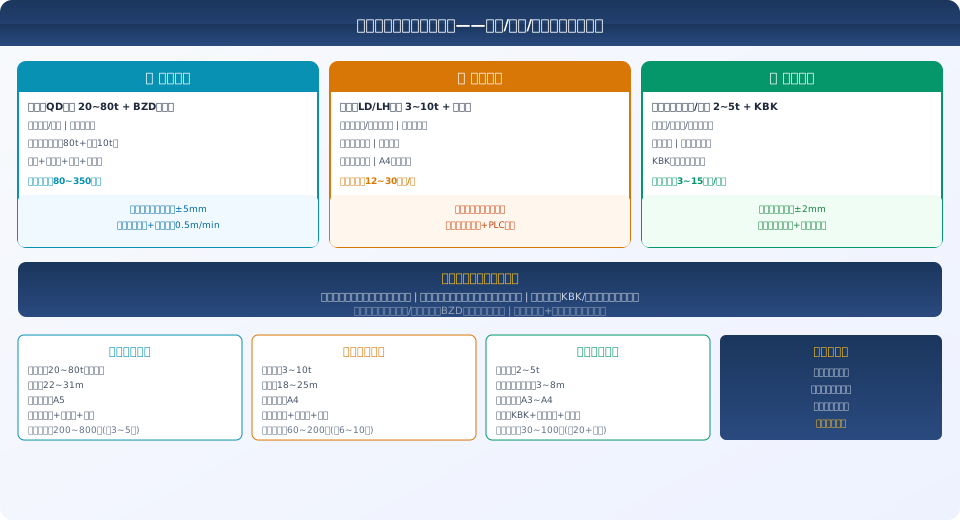
AutomotivemanufacturingWorkshopcrane selectionconfiguration——Stamping/Welding/Final Assembly LineWorkstationsLifting Plan

Stamping Shop: Large-Tonnage Double-Girder Cranes with Dual Hooks

Cranes in the stamping shop are dedicated to die changing and maintenance. Automotive body panel dies typically weigh between 8 and 40 t per set (with the largest reaching 65 t), so large overhead cranes are required to transport dies from the die storage area to the press line and to perform die changes. A typical stamping line consists of 6–8 presses, with die changes occurring 1–4 times per shift depending on the number of vehicle models and batch sizes.

Recommended Solution: QD-type double-girder bridge crane with a lifting capacity of 20–80 t (sized for the heaviest die + spreader + 1.2 safety factor), a span of 22–31 m (covering the die storage area, press line, and material handling aisles), and a work duty classification of A5. The dual hook configuration (main hook 80 t / auxiliary hook 10 t, or main hook 50 t / auxiliary hook 10 t) is essential in a stamping shop—the main hook handles the dies while the auxiliary hook lifts draw beads, base plates, and other accessories. Variable frequency speed control combined with anti-sway control enables precise die positioning with an alignment accuracy of ±5 mm. The recommended operation mode is a combination of operator cab and radio remote control.

Investment Reference: A QD32t crane costs approximately $74,000–$119,000, a QD50t ranges from $119,000–$222,000, and a QD80t runs between $222,000 and $520,000. A stamping shop typically installs 3–5 overhead cranes, bringing the total investment to $297,000–$1.19 million.

Welding Shop: Multiple Light-Duty Overhead Cranes in Parallel

The welding shop handles the welding and assembly of the body-in-white (BIW), which is the welded sheet metal body structure. Individual BIW sub-assemblies—such as side frames, roof panels, and floor pans—weigh between 0.3 and 2 t each and must be transferred between welding stations. The welding shop is characterized by densely packed workstations, high crane utilization (a lift is required every 2–3 minutes), and multiple cranes operating simultaneously within the same bay.

Recommended Solution: LD-type single-girder electric overhead cranes (3–5 t) or LH-type electric hoist overhead cranes (5–10 t), with spans of 18–25 m and a work duty classification of A4 (high frequency, light load). A typical welding shop is equipped with 6–10 overhead cranes, with one crane shared by every 2–3 workstations. Variable frequency speed control ensures smooth start/stop to prevent load swing that could collide with fixtures, while radio remote control allows the operator to move freely on the shop floor.

Anti-Collision Plan: When multiple cranes operate in parallel within the same bay, an anti-collision system is mandatory. A three-tier approach is recommended: travel switch hard limits as the final line of defense, laser distance measurement (accuracy ±0.1 m; automatic deceleration when spacing drops below 3 m and automatic stop below 1 m), and PLC-based zone scheduling that assigns each crane its own working area and prevents cross-zone operation. The cost of an anti-collision system is approximately $740–$2,970 per crane.

Final Assembly Shop: Workstation-Level KBK and Underslung Cranes

The final assembly shop is responsible for mating major assemblies including the engine, transmission, front and rear axles, seats, and tires. Each workstation has distinct lifting requirements—engine mating demands precise alignment (±2 mm accuracy), transmission installation requires tilt adjustment, and seat installation calls for light and flexible handling. The cranes used here are not traditional overhead or gantry types, but rather a large number of decentralized, workstation-level light lifting systems.

Recommended Solution: KBK flexible light crane systems (rail + trolley) and underslung single-girder cranes (monorail or twin-rail), with lifting capacities of 2–5 t (sufficient for the heaviest powertrain assembly) and a coverage range of 3–8 m per workstation. The hoisting mechanism uses chain electric hoists (quiet, ideal for indoor use) or pneumatic balancers (operating force ≤30 N, accuracy ±1 mm). Mounting type: suspended from the plant's roof truss structure, taking up no floor space. A final assembly shop typically configures 20–40 workstation lifting points.

Workstation Layout Recommendations: Engine mating stations use a 3 t KBK crane with a chain hoist and pneumatic balancer for fine alignment; transmission mating stations use a 2 t KBK crane with a chain hoist (tilt spreader optional); front/rear axle mating stations use a 3 t underslung single-girder crane with an electric hoist; and seat/tire lines use a 1 t KBK crane with a chain hoist for light-load, low-cost handling. Investment per KBK workstation is approximately $4,500–$22,000. For more options in light workstation lifting equipment, refer to the jib crane selection guide and electric hoist selection parameters.

Configuration Comparison and Investment Summary Across the Three Shops

Shop Recommended Crane Type Lifting Capacity Key Features Typical Quantity Investment per Unit
Stamping QD-type double-girder bridge crane (dual hook) 20–80 t VFD + anti-sway control, ±5 mm positioning, cab + remote control 3–5 units $74,000–$520,000
Welding LD/LH-type single-girder electric overhead crane 3–10 t Anti-collision system, radio remote control, VFD smooth start/stop 6–10 units $18,000–$45,000
Final Assembly KBK flexible light crane / underslung single-girder crane 2–5 t Chain hoist or pneumatic balancer, ceiling-mounted, workstation-level coverage 20–40 stations $4,500–$22,000 per station

Total crane investment for a complete vehicle manufacturing plant typically falls in the range of $450,000–$1.6 million, depending on plant capacity, the number of press lines, and the level of automation. The figures above are provided as planning references; final costs will vary based on specific configuration requirements, span, lifting height, and optional features.

← Scroll left / right to view full table →
Workshop recommended model Lifting Capacity configuration Quantity special requirements Reference Price(10k/Unit) Subtotal(10k CNY)
StampingQDDouble Hookoverhead type20~80t3~5UnitDouble Hook+anti-sway control+Dual Control50~350200~800
Welding AssemblyLD/LHoverhead type3~10t6~10Unitanti-collision+remote control+Variable Frequency Drive (VFD)12~3060~200
Final AssemblyKBK/Underhung Crane2~5t20~40WorkstationChain hoist/pneumatic balancer3~15/Workstation30~100

Total investment in automotive plant crane systems typically ranges from approximately $445,000 to $1.63 million USD (excluding the painting workshop). The stamping shop accounts for the largest share (about 60–70%), while the welding and final assembly shops each represent 15–20%. Kelude Heavy Industry offers a one-stop service covering solution design, manufacturing, and installation for crane systems across all workshops of an automotive plant.

Six Key Data Points for Automotive Plant Lifting Equipment

Stamping Shop
QD type double-hook overhead crane, 20–80 t, for die handling and frequent start/stop duty. VFD speed control with micro-motion, classification A6–A7.
Welding Shop
Multiple LD/LH type cranes, 3–10 t, arranged in parallel for handling welding fixtures and sub-assemblies. Equipped with anti-collision system and remote control operation.
Painting Workshop
Explosion-proof electric hoist, Ex tb IIIC, designed for paint solvents and cleanroom requirements. Stainless steel lifting spreaders with anti-static features.
Final Assembly
QD/LH type, 10–32 t, for engine and powertrain installation. VFD creep speed of 0.3 m/min with anti-sway control system.
EV Battery Handling
Specialized spreaders for EV battery packs weighing 300–800 kg. Kelude supplies dedicated battery-pack lifting spreaders with tilt monitoring.
Whole-Plant Solution
Kelude Heavy Industry provides a unified crane solution across all four workshops—standardized electrical controls, common spare parts, and centralized maintenance, reducing total cost by 20%.

Frequently Asked Questions

Q: Why is anti-sway control necessary for die changes in the stamping shop?

A: Stamping dies weigh 8–40 t each and can cost anywhere from tens of thousands to several million dollars, with surface accuracy requirements measured in microns. If the load swings during lifting, the die can strike the press bed or columns, causing severe damage. The anti-sway control system uses the VFD to precisely manage acceleration and deceleration curves (S-curve profiling), reducing load swing from ±500 mm without control down to ±20–50 mm. Combined with the remote control's creep speed (as low as 0.5 m/min), the operator can accurately position the die into the press guide rails from just 1 m away.

Q: How is safety ensured when multiple cranes operate in the same bay of the welding shop?

A: Multiple cranes working in the same bay is one of the most common accident risks in a welding shop. Safety is addressed at two levels—hardware and software. At the hardware level, each crane is fitted with limit switches at both ends (the first line of defense against collision), and laser distance sensors continuously monitor the gap between cranes. At the software level, the PLC enforces a minimum safety distance (3 m triggers deceleration, 1 m triggers stop), while the supervisory system assigns work zones to prevent cranes from entering restricted areas. A third critical rule: the operator must visually confirm the clearance before operating the remote control. Kelude's welding shop solutions come standard with a laser-based anti-collision system.

Q: Should the final assembly shop use a KBK flexible crane or a jib crane?

A: The two serve different purposes. A KBK flexible crane is ideal for covering linear workstations (coverage extends along the rail direction with limited width)—a single 5 m KBK rail can serve 3–4 adjacent stations. A jib crane is better suited for circular coverage (a 3–6 m rotation radius covers one workstation plus a surrounding buffer zone). In the final assembly shop, we recommend a KBK system for the engine marriage line (long rail with multiple pick points) and jib cranes for the powertrain sub-assembly area (each station operates independently without interference). Kelude Heavy Industry supplies both KBK systems and BZD jib cranes.

Q: Do cranes in automotive manufacturing plants require special equipment inspection?

A: Yes. QD type overhead cranes in the stamping shop (rated capacity ≥3 t with lifting height ≥2 m) fall under special equipment regulations and must be registered for use and undergo annual periodic inspections. LD/LH type cranes in the welding shop (≥3 t) are also subject to the same requirements. KBK and underslung cranes in the final assembly shop must also be inspected if the rated capacity is ≥3 t and lifting height ≥2 m—though most assembly stations have lifting capacities of 2–3 t, which sits right at the threshold: 2.5 t does not trigger inspection, while 3 t does. We recommend confirming the capacity and lifting height combination during the equipment procurement stage to determine whether regulatory inspection applies.

Kelude Heavy Industry Double-Girder Overhead Crane

Kelude Heavy Industry's double-girder overhead crane is a heavy-duty material handling solution engineered for demanding industrial environments. Designed for high-capacity lifting and frequent operation cycles, this crane delivers exceptional reliability, precise load positioning, and long service life—making it the preferred choice for steel plants, shipyards, machinery workshops, and warehouse operations.

Robust Structural Design for Heavy Loads

The double-girder configuration provides superior rigidity and load distribution compared to single-girder designs. The main girders are fabricated from high-strength steel plates with full-penetration welds, ensuring structural integrity under continuous heavy-duty service. This design allows for higher lifting capacities and greater hook coverage, maximizing the usable floor space in your facility.

Key Features and Benefits

  • High lifting capacity: Available in capacities from 5 tons up to 100 tons, with custom configurations available for special applications.
  • Optimized headroom: Low-headroom design maximizes the effective lifting height, making it ideal for facilities with limited ceiling clearance.
  • Precise load control: Variable frequency drive (VFD) technology enables smooth acceleration and deceleration, reducing load swing and enabling precise positioning.
  • Enhanced safety systems: Equipped with overload protection, limit switches, emergency stop, and anti-sway control as standard features.
  • Durable components: All key components—including the hoist, trolley, and end carriages—are sourced from reputable manufacturers and rigorously tested for reliability.

Technical Specifications

Lifting capacity 5–100 tons (metric)
Span 10.5–31.5 m (34–103 ft)
Lifting height 6–18 m (20–59 ft)
Hoisting speed 0.8–8 m/min (2.6–26 ft/min)
Trolley travel speed 2–20 m/min (6.6–66 ft/min)
Crane travel speed 3–30 m/min (10–98 ft/min)
Working duty A5–A7 (ISO 4301)
Power supply 380V / 50Hz (custom voltages available)
Control mode Cabin / pendant / wireless remote

Customization Options

Every facility has unique requirements. Kelude Heavy Industry offers extensive customization options to tailor the double-girder overhead crane to your specific application:

  • Explosion-proof configurations for hazardous environments
  • Corrosion-resistant coatings for marine or chemical applications
  • High-temperature or low-temperature operation packages
  • Special lifting attachments (C-hooks, spreader beams, magnets, grabs)
  • Automated or semi-automated control systems for smart factory integration

Quality Assurance and Compliance

Our double-girder overhead cranes are designed, manufactured, and tested in accordance with ISO 4301 and ISO 12480 standards. Each crane undergoes rigorous quality inspections at every stage of production, from raw material verification to final load testing. We are committed to delivering products that meet or exceed international safety and performance requirements.

After-Sales Support and Service

Kelude Heavy Industry provides comprehensive after-sales support to ensure your crane operates at peak performance throughout its service life. Our services include professional installation guidance, operator training, preventive maintenance programs, and fast-response spare parts supply. With our global service network, we are always ready to support your operations wherever you are.

Frequently Asked Questions

Q: What is the lead time for a double-girder overhead crane?
A: Standard lead time is typically 45–60 days from order confirmation, depending on the configuration and customization level. We will provide an accurate delivery schedule upon receiving your detailed requirements.

Q: Can the crane be installed outdoors?
A: Yes, with appropriate weatherproofing and protective coatings, our double-girder cranes can be installed for outdoor service. We will recommend the suitable protection level based on your site conditions.

Q: What maintenance is required?
A: Regular maintenance includes daily visual inspections, periodic lubrication of moving parts, and scheduled checks of electrical and mechanical components. We provide a detailed maintenance manual with every crane, and our service team is available for scheduled maintenance visits.

Q: Do you provide installation supervision?
A: Yes, we offer on-site installation supervision by our experienced engineers. Alternatively, we can provide detailed installation drawings and instructions for your own installation team.

Contact Us for a Customized Solution

A: Ready to enhance your material handling efficiency? Contact our engineering team today to discuss your requirements and receive a tailored solution for your facility. Our experts will help you select the right crane configuration, provide a competitive quotation, and ensure timely delivery.

Related News

contact

contact us

phone:
+86 13903802779

mail:3915269@qq.com

Working hours: Monday to Friday

Wechat
Wechat
SHARE
TOP