

Interpretation of the ASME B30.20 Standard, “Safety Requirements for Down-Hook Lifting Devices”
📌ASME B30.20 "Safety Requirements for Down-Hook Hoisting Devices"It is an important technical standard in the crane industry. This standard, part of the ASME B30 series, is a safety technical specification specifically for below-the-hook lifting devices. It systematically stipulates the design and manufacture, rated load calibration, inspection intervals, and safe usage requirements for various lifting accessories, clamps, lifting beams, vacuum pads, and other material-handling devices.
This standard provides a unified technical basis for designers, inspection agencies, and users. Krude Heavy Industry strictly adheres to the technical requirements of this standard throughout the product development and manufacturing processes to ensure the equipment’s compliance and reliability.
Scope and Purpose of the Standard
ASME B30.20, “Safety Requirements for Bottom-Hook Lifting Devices,” primarily specifies the technical requirements and safety criteria for bottom-hook lifting devices on cranes, and applies to all types of lifting machinery with a rated lifting capacity of 0.5 metric tons or more. This standard not only covers the design and manufacture of new equipment but also provides clear technical guidance for the inspection, maintenance, and modification of in-service equipment. As a key component of the crane standards system, this standard is harmonized with standards such as the EN 13001 series and ISO 4309, collectively forming a comprehensive system of technical specifications. The technical parameters and safety factor requirements specified in the standard provide designers with a clear basis for design and offer quantifiable criteria for type testing and factory acceptance inspections conducted by third-party inspection agencies.
Core Technical Specifications
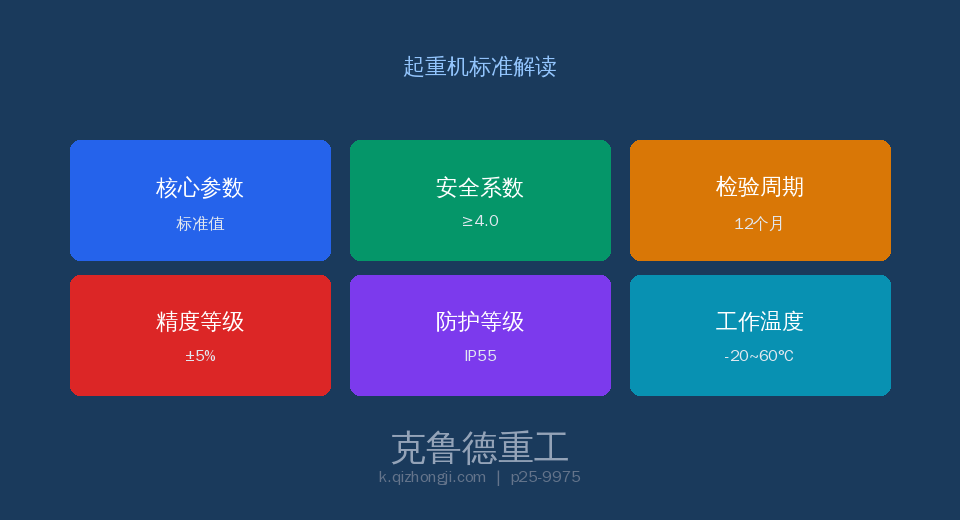
According to the technical specifications of ASME B30.20, the design and manufacture of bottom-hook lifting devices must meet a series of stringent technical requirements. These parameters are determined based on extensive experimental data and safety engineering theory, covering the entire process from material selection to structural design. The range of safety factors specified in the standard fully accounts for the fatigue life and ultimate load conditions of lifting equipment under severe operating conditions. In practical engineering applications, designers must select an appropriate combination of parameters based on factors such as the equipment’s duty class, load conditions, and operating environment. The parameter cards below illustrate the core technical specifications of this standard:
Comparative Analysis of Key Technical Parameters
The following comparison table systematically contrasts the key parameters specified in ASME B30.20 with general engineering practice. The data in the table are values derived from the standard’s mandatory or recommended provisions; it is recommended that these be strictly followed during design, selection, and factory inspection.
| Project | Technical Requirements | Note |
|---|---|---|
| Design Safety Factor | ≥3.0 (yield strength)/≥5.0 (breaking load) | Take the stricter of the two |
| Welding and Manufacturing | Welding Performed by an AWS D1.1-Certified Welder | Critical Weld 100%UT |
| Rated Load Marking | Permanent Nameplates/Engraving | Includes net weight, rated load, and date of manufacture |
| Vacuum Suction Cup | Maintain a vacuum level of ≥80% | Dual-Source System with Vacuum Pump and Accumulator |
| Clamping Force of the Fixture | ≥2.5 times the weight of the load | Automatic locking + pressure-loss hold ≥ 1.5 times |
| Inspection Level | Initial (Before Commissioning)/Monthly/Annual | Initial 1.5-times static load test for 10 minutes |
Inspection Requirements and Frequency
ASME B30.20 sets forth specific requirements for factory inspections, type testing, and periodic inspections of lower-hook lifting devices. Factory inspections shall be conducted unit by unit by the quality inspection department at the manufacturer’s facility; equipment that passes inspection shall be accompanied by a detailed inspection report and a certificate of conformity. The periodic inspection interval for in-service equipment is determined based on the service class and operating environment, and generally shall not exceed 12 months.
| Project | Technical Requirements | Note |
|---|---|---|
| Initial Inspection | 1.5 times the rated static load + 1.1 times the dynamic load | Before being put into service or after renovation |
| Monthly Inspection | Wear/Deformation/Cracks/Functionality | Maintenance personnel perform and document |
| Annual Inspection | Comprehensive Testing + Load Verification | Conducted by a Certified Inspector |
| Magnetic Particle Inspection | MT for Welds and Stress Concentration Zones | After an annual inspection or major maintenance |
Safety Operation and Management Requirements
Safety operations and daily management play a crucial role in the implementation of ASME B30.20. The standard places particular emphasis on the importance of operator qualifications and training, requiring that all operators undergo specialized training and obtain the appropriate qualifications before being allowed to work. Equipment-using entities should establish a comprehensive equipment record management system to document in detail the entire process of installation, use, maintenance, and inspection. Any identified safety hazards must be addressed in accordance with the corrective action procedures specified in the standard to ensure that the equipment remains in a safe and controlled condition at all times. In addition, the standard imposes restrictive requirements on the use of equipment under extreme operating conditions.
Frequently Asked Questions
Q: What are the definitions and classifications of lower-hook lifting devices according to ASME B30.20?
Answer: A lower-hook lifting device refers to a material-handling device installed below a crane hook that is used to directly grasp and transport materials. It includes lifting beams, lifting slings, clamps, vacuum cups, electromagnetic pads, and specialized tooling. The standard classifies these devices into standard types (manufacturer-standardized products) and special types (customized to customer requirements), with different design verification and inspection requirements for each. Regardless of the type, a static load test at 1.5 times the rated load must be conducted before use. Krud Heavy Industry can customize a variety of non-standard lifting devices and provide design calculations and test reports.
Q: What are the safety design requirements for fixtures?
Answer: The clamping force of the clamping device must be at least 2.5 times the weight of the load, and it must maintain a residual clamping force of at least 1.5 times the load’s weight even if the hydraulic or pneumatic power source loses pressure. The clamping device should have an automatic locking function, and the clamping force should automatically increase as the load increases during the lifting process. The clamping surfaces should be designed with anti-slip grooves or pads, and the jaws should have appropriate hardness (typically HRC 40–50). Each clamp should be marked in a conspicuous location with its rated load, applicable plate thickness range, and usage restrictions. The clamp should be replaced when the wear on the clamping surfaces exceeds 20% of the original thickness.
Q: What are the technical requirements for a vacuum suction cup device?
Answer: The vacuum suction cup system must meet the following requirements: The vacuum level must be maintained at ≥80% of the rated value; it must be equipped with dual power sources—a vacuum pump and an accumulator—such that if one fails, the other system can maintain the vacuum for at least 5 minutes; Each suction cup must be independently controlled and equipped with a vacuum gauge; the rubber seals of the suction cups must be oil-resistant, resistant to aging, and of moderate hardness. Vacuum retention capacity must be tested prior to use, and the leakage rate must not exceed 5%/min of the rated vacuum level. The surface of the suction cups must be clean and free of oil, and the surface of the load being lifted must be flat and free of through-holes.
Q: What are the provisions regarding testing requirements and record-keeping in this standard?
Answer: The standard requires three types of inspections: initial inspection (conducted before commissioning or after modification, consisting of a static load test at 1.5 times the rated load and a dynamic load test at 1.1 times the rated load); monthly inspection (conducted by maintenance personnel to check for wear, deformation, cracks, and functionality); and annual inspection (a comprehensive inspection by a certified inspector, including MT testing). All inspection records must include the device serial number, rated load, inspection date, inspection items, inspection results, and the inspector’s signature. Records must be retained until the device is scrapped or the next inspection of the same type is completed. Scrapped devices must be destroyed; continued use after repair is strictly prohibited.
🔧 — Specializing in crane design and manufacturing, our products strictly comply with the ASME B30.20 standard system. We provide full-lifecycle services ranging from conceptual design, manufacturing, and installation to after-sales maintenance. If you would like to learn more about how this standard is specifically applied to our products, please contact our technical team to obtain detailed technical documentation.
