ASME B30.11 Monorail and Underslung Crane Safety Standard Explained

ASME B30.11 — Safety Standard for Monorails and Underslung Cranes is a key technical specification in the crane industry. As part of the ASME B30 series, this standard specifically addresses the safe use of monorail systems and underslung cranes, setting out systematic requirements for rail installation, trolley design, electric hoist configuration, electrical systems, and safeguarding measures.

The standard provides a unified technical basis for design personnel, inspection bodies, and end users. Kelude strictly implements the technical requirements of this standard throughout its product development and manufacturing processes, ensuring equipment compliance and reliability.


Scope and Application of the Standard

ASME B30.11 — Safety Standard for Monorails and Underslung Cranes defines the technical requirements and safety indicators for monorail and underslung crane systems, covering all lifting appliances with a Rated Lifting Capacity of 0.5 t and above. The standard applies not only to the design and manufacturing of new equipment but also provides clear technical guidance for the inspection, maintenance, and modification of cranes already in service. As a key component of the crane standard system, it aligns with the EN 13001 Crane Safety Standard series and ISO 4309 Wire Rope Inspection Standard, together forming a comprehensive technical specification framework. The technical parameters and safety factor requirements set out in the standard give design personnel a clear design basis, while also providing quantifiable acceptance criteria for third-party inspection bodies performing type tests and factory inspections.


Monorail and underslung crane safety standard diagram


Core Technical Parameter Framework

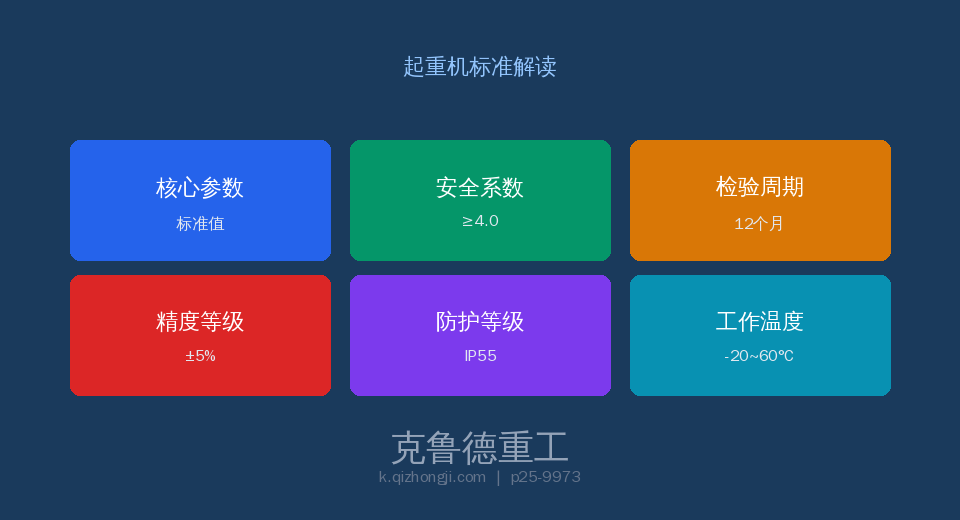
Under ASME B30.11, the design and manufacturing of monorail and underslung cranes must satisfy a rigorous set of technical parameter requirements. These parameters are established on the basis of extensive test data and safety engineering theory, covering everything from material selection to structural design. The safety factor ranges specified by the standard take full account of fatigue life and limit load conditions under severe operating environments. In practical engineering applications, design personnel must select appropriate parameter combinations based on the equipment's Work Duty classification, load spectrum, and operating conditions. The parameter cards below summarize the core technical indicators defined by the standard:

Rail Installation
I-Beam / H-Beam
Trolley Wheel
Tread Hardness HB300–380
Rail Joint
Misalignment ≤1 mm / Gap ≤3 mm
Rail Deflection
≤L/400 at Rated Load
Buffer Stop
Buffers at Both Ends
Inspection Interval
Annual Comprehensive Inspection

Comparative Analysis of Key Technical Parameters

The comparison table below systematically benchmarks the core parameters specified in ASME B30.11 against general engineering practice. All values shown are either mandatory or recommended provisions of the standard and should be strictly implemented during design and selection as well as factory acceptance testing.

Itemtechnical requirementsDescription
rail selectionIStructural Steel/H-Beam(Per Spanand Load)lower flange of I-beam As Trolley Tread Surface
trolley wheel HardnessTread surface HB300~380Hardened Depth≥20mm
Rail Joint AccuracyVertical Misalignment≤1mm, joint gap≤3mmJoint Smooth Transition, Step-Free
Crane Rail DeflectionRated Load≤L/400No-load Camber≥L/1000
Crane Rail End Buffer stopBoth Ends Equipped BufferBuffer stop Strength≥Trolley Maximumimpact load
Suspension ComponentDual Nut Anti-Loosening+Cotter PinPeriodic Inspectiontightening torque

Inspection Requirements and Intervals

ASME B30.11 sets forth specific requirements for Factory Acceptance Testing, Type Testing, and periodic inspection of monorail and underhung cranes. Factory Acceptance Tests must be performed on each unit at the manufacturer's facility by the quality inspection department, with compliant equipment accompanied by a detailed inspection report and a certificate of conformity. The periodic inspection interval for in-service equipment is determined by its work duty classification and operating environment, and generally does not exceed 12 months.

Itemtechnical requirementsDescription
Crane Rail InspectionDeflection/Wear/Joint/FastenerAnnual+Tread Surface Wear≤Original Thickness20%
Trolley InspectionCrane wheel/Bearing/Guide Roller/ConnectionQuarterly+Wheel flange≥Original Thickness50%
Buffer stop DeviceBuffer/Limit Switch/Anti-DropMonthly+Buffer Function Normal
suspension systemhanger rod/Bolt/ConnectorAnnual+tightening torque Spot Check10%

Safe Operation and Management Requirements

Under ASME B30.11, safe operation and routine management are central to the standard's requirements. The standard places strong emphasis on operator qualification and training, requiring that all operators complete specialized training and hold the appropriate credentials before operating the equipment. User units must establish a comprehensive equipment file management system that documents the full installation, use, maintenance and inspection history of the equipment. Any safety hazards identified must be addressed through the rectification procedure specified in the standard, ensuring the equipment remains in a safe and controllable condition at all times. The standard also imposes restrictions on equipment use under extreme operating conditions.

ASME B30.11 Monorail System FAQ

Q: What are the technical requirements for rail installation under ASME B30.11?

A: The standard sets out detailed accuracy requirements for monorail track installation. Vertical misalignment at rail joints must not exceed 1 mm, joint gaps must not exceed 3 mm, and joints must transition smoothly with no steps. Under rated load, track deflection must not exceed 1/400 of the span (L/400); at no-load, a camber of at least L/1000 should be provided to compensate for elastic deformation. The track must be fabricated from I-beam or H-Beam sections, with the lower flange serving as the running surface for the trolley. Buffer stops must be installed at both ends of the track, complete with Buffers. Kelude uses laser measuring instruments for track surface accuracy verification during monorail system installation.

Q: What are the selection criteria and technical requirements for trolleys?

A: Monorail Trolleys are available in two configurations: manual push type and electric travel type. The Wheel Tread hardness of trolley wheels must be within HB300–380, with a hardened layer depth of no less than 20 mm. Wheels must be replaced when Wheel flange wear exceeds 50% of the original thickness. The travel wheels must maintain full contact with the lower flange of the track — all four wheels must bear evenly with no three-point contact condition. The clearance between Guide Rollers and the Web plate of the track should be adjusted within the 2–5 mm range. Trolleys must be equipped with a fall protection device to prevent derailment in the event of rail wear or unexpected conditions. Electric trolleys must be fitted with a Travel Limit Switch and Buffer.

Q: What are the requirements for end stops and safety protection devices?

A: The standard requires Buffer stops at both ends of the monorail system, with sufficient strength to withstand the maximum impact load generated when a trolley strikes the stop at rated speed. Buffer stops must be equipped with Buffers (polyurethane or hydraulic type) to absorb impact energy. In addition, maintenance zones along the track must be provided with service sections and locking devices to ensure the safety of maintenance personnel. On downward-sloping sections (inclined installations), an anti-runaway device must also be installed. In monorail system design, the strength of Buffer stops is verified against 1.5 times the maximum impact load.

Q: What items are covered by routine and periodic inspections of monorail systems?

A: Daily Inspection is performed by the operator before each use: visual inspection of the track and trolley condition, and functional testing of travel and Hoisting / Lifting operations. Monthly inspections are carried out by maintenance personnel to check: the condition of Buffer stops and Buffers, wear on trolley wheels and Guide Rollers, and any loosening of suspension connections. Annual inspections are conducted by a certified inspector and cover: track surface wear (not exceeding 20% of original thickness), track Deflection Measurement, torque spot checks on suspension fasteners, and electrical system insulation and Grounding testing. All inspection records must be filed in the equipment file management system.


— Specialized in crane design and manufacturing, our products strictly comply with the ASME B30.11 standard system, offering lifecycle service from solution design and manufacturing and installation through to after-sales maintenance. To learn how this standard is applied in our products, contact our technical team for detailed technical documentation.

Related News

contact

contact us

phone:
+86 13903802779

mail:3915269@qq.com

Working hours: Monday to Friday

Wechat
Wechat
SHARE
TOP