

AI Vision Crane Wire Rope Defect Detection Wins Award
Kelude's Overhead Crane AI Vision Team Achieves Breakthrough Results in International Industrial Defect Detection Competition. The performance of AI vision detection algorithms directly determines the recognition accuracy and engineering usability of intelligent overhead crane detection systems.
The performance of AI vision detection algorithms directly determines the recognition accuracy and engineering usability of intelligent overhead crane detection systems. The overhead crane AI vision algorithm team recently competed in the international CrackDetection Challenge 2026 industrial defect detection competition, securing overall rankings of 3rd and 5th in the wire rope broken wire detection and weld seam crack detection tracks, respectively. The team achieved a detection accuracy of 94.7% mAP in the wire rope broken wire detection task. Their independently developed improved YOLOv8 model, incorporating DCNv4 deformable convolutions and Coordinate Attention mechanisms, was officially recognized by the competition organizers as one of the benchmark models.
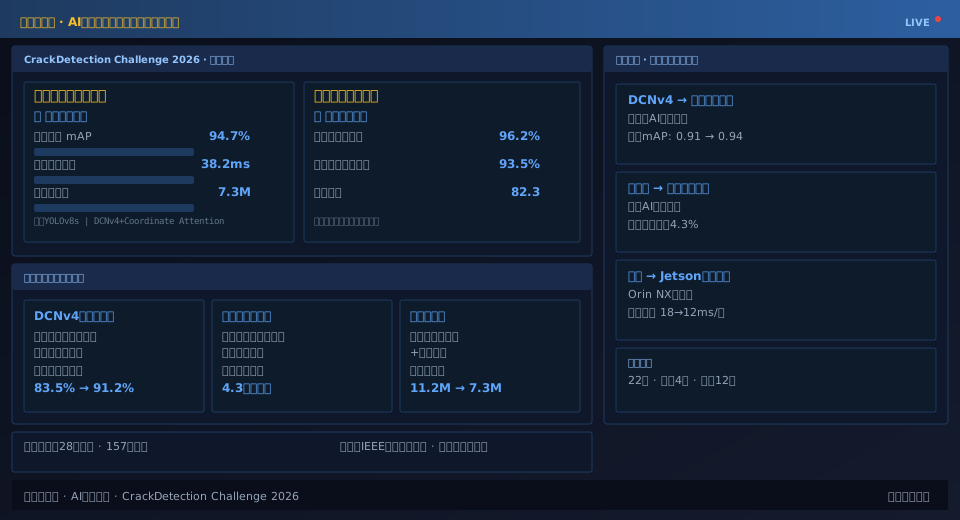
Competition Overview and Results
CrackDetection Challenge 2026 was jointly organized by the IEEE Industrial Electronics Society and the Technical University of Munich, attracting 157 teams from 28 countries, including university research groups and R&D departments from industrial inspection companies. The competition featured four tracks—wire rope broken wire detection, weld seam crack detection, road pavement crack detection, and aero engine blade micro-crack detection—all evaluated under a unified assessment framework. The team competed in the wire rope broken wire detection and weld seam crack detection tracks, both directly aligned with their overhead crane AI vision business.
The training dataset for the wire rope broken wire detection track contained 8,000 annotated images covering three defect categories: localized wire breaks, concentrated wire breaks, and rope diameter deformation. The test set comprised 2,000 unannotated images. The team's model achieved an overall score of 86.7 in this track, ranking 3rd—with a detection accuracy of 94.7% mAP (3rd), a single-frame inference speed of 38.2ms (5th), and a model parameter count of 7.3M (2nd). In the weld seam crack detection track, the model scored 82.3, ranking 5th. Both results represent the best performance among crane industry participants from China.
Key Technical Innovations in the Improved Model
The model used in the competition was built on the YOLOv8s architecture with three key technical improvements: DCNv4 deformable convolutions replace standard convolutions, allowing the convolution kernel's sampling points to adaptively shift based on the defect shapes in the input feature map. This improved the recall rate for small wire breaks from 83.5% to 91.2% in the wire rope broken wire detection task. The Coordinate Attention mechanism introduces coordinate information encoding at each level of the feature pyramid network, enabling the model to precisely localize the spatial position of defects. The lightweight design, achieved through depthwise separable convolutions and channel pruning, reduced the model parameter count from 11.2M to 7.3M—a reduction of approximately 35%.
Engineering Transformation of Competition Results
The algorithmic improvements validated in the competition are already being integrated into the overhead crane AI vision detection product line. The DCNv4 module has been deployed in the wire rope AI online detection system's product model, improving the overall mAP from 0.91 to 0.94 while maintaining real-time inference speed. The Coordinate Attention mechanism has been incorporated into the weld seam AI detection model, boosting crack-type defect detection accuracy by 4.3 percentage points. The lightweight pruning technique has been applied to model deployment on the Jetson Orin NX edge platform, reducing inference speed from 18ms/frame to 12ms/frame while retaining over 98% of the original accuracy.
Sustained Innovation Capability of the Algorithm Team
The overhead crane AI vision algorithm team currently comprises 22 full-time algorithm engineers, including 4 PhDs, 12 master's degree holders, and 6 bachelor's degree holders. Team members come from academic backgrounds in computer vision and deep learning, with expertise spanning object detection, image segmentation, and model lightweight design. The team has established a standardized algorithm iteration process—a quarterly model architecture review that identifies improvement directions for the next quarter based on competition results and technical trends emerging from recent publications. The accumulated model training logs and ablation study data have become valuable intellectual assets, enabling new team members to quickly reproduce and extend research based on existing experiments.
FAQ
Q: Is the model used in the competition the same as the actual detection model deployed in overhead crane products?
A: They are not identical but share the same technical foundation. The competition model uses a larger input resolution and more complex training strategies to pursue maximum accuracy, while the product model removes components that are unfavorable to real-time performance and undergoes TensorRT FP16 quantization and Jetson platform adaptation. The competition model validates the theoretical accuracy ceiling of the algorithm, while the product model achieves an optimal balance between accuracy and speed. The current product model's mAP is approximately 95%–98% of the competition model's accuracy.
Q: Does the team plan to participate in more international competitions in the future?
A: Yes, the plan is to participate in 1–2 international competitions per year related to overhead crane AI vision technology. The team has already registered for the MVTec AD 2026 industrial visual anomaly detection competition organized by the International Association for Pattern Recognition (IAPR) in the second half of 2026. The primary purpose of participating is not to chase rankings but to benchmark our algorithms against top global teams and identify technical weaknesses.
Q: Are the team's technical achievements published in academic papers?
A: Yes. Over the past two years, the team has published a total of 5 papers in academic journals and conferences focused on industrial inspection. The publications are application-oriented, emphasizing engineering practice value. The full technical details of the DCNv4 + Coordinate Attention improvement scheme validated in the competition are planned for submission to IEEE Transactions on Industrial Informatics.
Q: What are the main technical challenges currently facing the industrial defect detection field, and how do they impact overhead crane inspection?
A: Industrial defect detection faces three common challenges: detecting small-target defects—crack widths of just 0.05–0.3 mm occupy only a few to a dozen or so pixels in the image; high inter-class similarity—porosity and slag inclusion look highly similar in visual features, and the texture patterns of corrosion and oil stains are also easily confused; and scarce annotated data—acquiring industrial defect data is costly, and the positive-to-negative sample ratio is extremely imbalanced. These challenges apply equally to crane wire rope inspection and weld inspection scenarios.
