

Overhead Crane Factory Earns Provincial Green Factory Certification
Kelude's overhead crane manufacturing plant earns provincial Green Factory certification, with energy consumption per RMB 10,000 of output down 18% year-on-year. The facility passed the provincial Green Factory assessment, which evaluates performance across four dimensions: infrastructure, management systems, energy and resource input, and waste treatment.
Green manufacturing is the path forward for sustainable development in the equipment manufacturing industry. Kelude's overhead crane plant has recently been officially certified as a provincial-level Green Factory, making it one of the first crane manufacturers in Henan Province to receive this recognition. The plant's composite score across energy consumption, carbon emissions, water resource utilization, and waste treatment met the provincial Green Factory evaluation standard. This article provides a systematic overview of the Green Factory assessment framework, energy-saving retrofit measures, cleaner production technologies, and management system development.
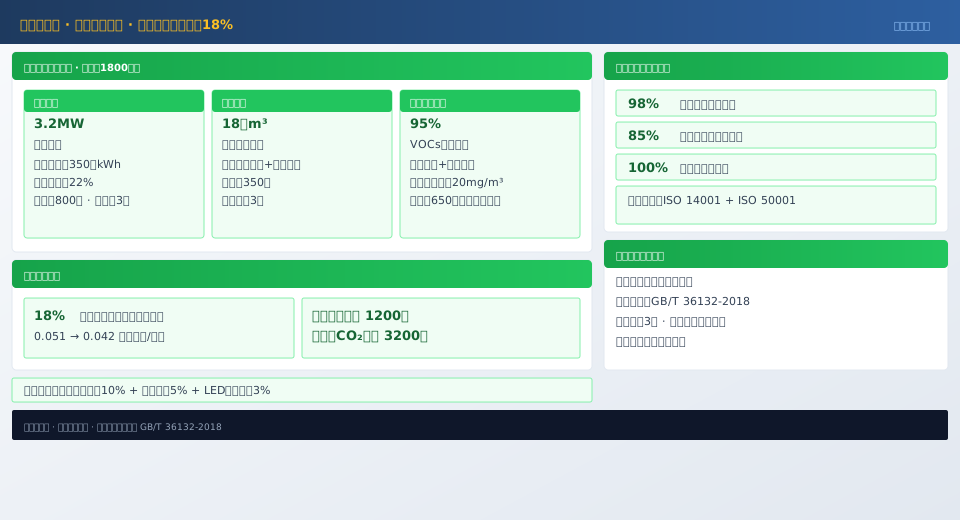
Green Factory Certification Criteria
The Green Factory evaluation follows GB/T 36132-2018 "General Principles for Green Factory Evaluation" and the Henan Province Green Factory assessment guidelines, scoring plants across six dimensions: infrastructure, management systems, energy and resource input, products, environmental emissions, and performance. The plant achieved full marks in two areas: building energy-efficiency design under the infrastructure dimension, and ISO 14001 and ISO 50001 system certifications under the management systems dimension.
Three Major Energy-Saving Retrofits
The solar PV project installed a distributed rooftop photovoltaic system with an installed capacity of 3.2 MW, generating approximately 3.5 million kWh annually and covering about 22% of the plant's total electricity demand. The waste heat recovery project fitted heat exchange units on the exhaust ducts of the painting workshop's drying ovens and the welding workshop's preheating furnaces. The recovered heat is used for winter workshop heating and for heating pretreatment bath solutions in the painting line, saving roughly 180,000 cubic meters of natural gas per year. The painting exhaust treatment project uses a zeolite rotor concentrator combined with catalytic combustion for VOCs abatement, achieving a treatment efficiency above 95% and an exhaust concentration below 20 mg/m³ — well under the 40 mg/m³ limit set by Henan provincial standard DB41/T 1234-2020.
Cleaner Production and Resource Recycling
In the cutting process, steel offcuts are sorted and recycled at a rate of 98%. Welding slag is collected and sent to specialized recyclers. Paint and thinner containers from the coating process are all handled by licensed hazardous waste treatment facilities, achieving a 100% compliant disposal rate. Industrial wastewater is treated at the on-site treatment station and reused in production, with a water recycling rate of 85%.
Management Systems and Continuous Improvement
The plant operates a dual management framework comprising the ISO 14001 environmental management system and the ISO 50001 energy management system. Under the energy management system, baseline energy consumption benchmarks and performance indicators have been established for all major energy-using equipment. Monthly energy data is analyzed, and any process exceeding its baseline triggers a targeted improvement initiative.
FAQ
Q: Does Green Factory certification directly affect the energy performance of overhead crane products?
A: Green Factory certification primarily targets the manufacturing process rather than the products themselves. However, greener manufacturing indirectly improves product environmental performance — cranes assembled in the workshop benefit from energy-efficient processes and eco-friendly materials. Standard-model cranes undergo hoisting mechanism energy-efficiency testing before delivery, ensuring the variable-frequency speed control system meets or exceeds the national standard's Energy Efficiency Class 2 requirement. Energy consumption data from the product use phase is collected through the remote operation and maintenance platform and feeds into the energy-efficiency optimization of future products.
Q: What is the investment scale and payback period for the Green Factory energy-saving retrofits?
A: The total investment for the three major retrofit projects is approximately RMB 18 million (about $2.67 million). The solar PV project accounts for roughly RMB 8 million (about $1.19 million) of this, with expected annual power generation revenue of about RMB 2.8 million (approximately $415,000) and a payback period of around 3 years. The waste heat recovery project cost about RMB 3.5 million (approximately $519,000), saving an estimated RMB 1.2 million (about $178,000) per year in natural gas costs, with a payback period of roughly 3 years. The painting exhaust treatment project required about RMB 6.5 million (approximately $964,000), primarily driven by environmental compliance costs with no direct economic return. The full RMB 18 million investment is expected to be recovered through energy savings within 5 to 6 years.
Q: How was the 18% year-on-year reduction in energy consumption per RMB 10,000 of output achieved? What were the main energy-saving measures?
A: The 18% reduction came from three combined measures: solar PV generation cut purchased electricity by about 22% (contributing roughly 10 percentage points of the total reduction); waste heat recovery reduced natural gas consumption by approximately 18% (contributing about 5 percentage points); and LED lighting upgrades plus variable-frequency drive retrofits on air compressors lowered auxiliary energy use by around 15% (contributing about 3 percentage points). Energy consumption per RMB 10,000 of output dropped from 0.051 tonnes of standard coal equivalent to 0.042 tonnes.
Q: What is the validity period and re-evaluation requirement for provincial Green Factory certification?
A: The provincial Green Factory certification is valid for 3 years. During the validity period, the plant must submit an annual Green Factory operation report covering key indicators such as energy consumption, carbon emissions, and environmental emissions. Before the validity period expires, a re-evaluation application must be submitted; facilities that pass the review retain their certification. Under GB/T 36132-2018, the re-evaluation requires the company to provide energy audit reports and environmental monitoring reports from the preceding three years, with all monitored indicators meeting or exceeding the baseline values established at the time of initial certification.
