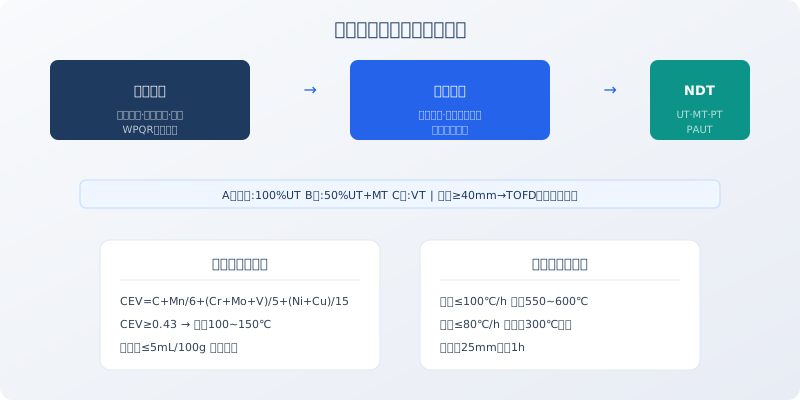
ISO 23857 Welding Quality Requirements for Crane Steel Structures
Standard Overview: ISO 23857 "Cranes — Quality Requirements for Welding of Steel Structures" is a dedicated welding quality standard published by ISO/TC 96 in 2022, superseding ISO 7363. The standard introduces a weld quality classification system based on ISO 5817 (Levels B/C/D), defines permissible defect types and size limits for welds under different stress classifications, and adds specific welding requirements for high-strength steels (yield strength ≥ 460 MPa).
Crane steel structures are moving toward high-strength, lightweight design — Q460, Q550, and even Q690 grade steels are now widely used in the boom structures of large gantry cranes and crawler cranes. High-strength steels have higher carbon equivalent values and greater cold-cracking susceptibility, placing stricter demands on welding procedures. ISO 23857 builds on the former ISO 7363 by adding a dedicated section on high-strength steel welding and refining the weld quality classification assessment method, making it the most current and comprehensive international standard for crane steel structure welding.
Weld Quality Classification System (Levels B/C/D)
ISO 23857 references ISO 5817 Welding — Fusion-welded joints — Quality levels to classify crane steel structure welds into three levels: B, C, and D. Level B (strict) applies to butt welds on the tension flange of main girders subject to fatigue load and to end carriage connection welds — individual porosity diameter ≤ 1.5 mm is permitted, while cracks, lack of fusion, and incomplete penetration are not allowed. Level C (moderate) applies to main girder web plate butt welds and support welds — surface porosity ≤ 2 mm and undercut depth ≤ 0.5 mm are permitted. Level D (general) applies to non-load-bearing structural welds such as walkway brackets — undercut ≤ 1 mm and individual porosity ≤ 3 mm are allowed.
Compared with the previous ISO 7363, ISO 23857 shifts the acceptance levels from "A/B/C" to "B/C/D," effectively raising the minimum acceptance standard — weld defects that were acceptable at Level C under the old standard are no longer permitted in the new version.
Special Requirements for High-Strength Steel Welding
ISO 23857 adds a dedicated chapter on welding high-strength steels with yield strength ≥ 460 MPa. Carbon equivalent (CEV) is calculated using the IIW formula: CEV = C + Mn/6 + (Cr + Mo + V)/5 + (Ni + Cu)/15. When CEV ≥ 0.43%, preheating to 100–150°C is required before welding, interpass temperature must be maintained at 150–200°C, and post-weld heat treatment at 200–250°C for 2 hours followed by slow cooling is required to prevent cold cracking.
Filler metal selection principles: ① Strength matching — weld metal yield strength must not be lower than the specified value of the base material; for example, Q550 grade steel requires filler wire with yield strength ≥ 550 MPa (AWS ER110S-1 or ISO G 62 4 M21 Mn3NiCrMo). ② Low hydrogen — diffusible hydrogen content ≤ 5 mL/100g (use vacuum-packed low-hydrogen filler materials and consume within 4 hours of opening). ③ Toughness matching — impact energy ≥ 47 J at -20°C to meet outdoor low-temperature operating condition requirements for cranes.
Enhanced Welding Procedure Qualification Record (WPQR) Requirements
ISO 23857 requires the following additional inspection items for welding procedure qualification of high-strength steels: ① Hardness test — maximum hardness in the heat-affected zone (HAZ) ≤ HV350 (per ISO 9015-1); excessive hardness indicates cold-cracking susceptibility and microstructural embrittlement. ② Cross-weld tensile test on cruciform joints — to assess lamellar tearing susceptibility; required for T-joints with thickness ≥ 20 mm. ③ CTOD fracture toughness test — test reports with CTOD values ≥ 0.15 mm (at -20°C) must be provided for crane steel structure welds used in bridge and nuclear power applications.
Qualification coverage range: Base material thickness groups follow ISO 15614-1. When the test plate thickness t ≤ 25 mm, the qualification covers 0.75t to 1.5t. A reduction in preheating temperature of more than 25°C requires requalification (stricter than the 50°C threshold in ISO 7363), reflecting the sensitivity of high-strength steels to temperature windows.
Advances in Non-Destructive Testing
ISO 23857 recommends phased array ultrasonic testing (PAUT) as a replacement for conventional single-crystal probe UT in non-destructive testing of full penetration welds in high-strength steels. PAUT advantages: sectorial scanning at multiple angles produces two-dimensional imaging of the weld cross-section, enabling detection of small defects oriented in various directions; detection sensitivity is approximately 6 dB higher than conventional UT; results can be digitally stored and reconstructed in 3D, facilitating traceability and trend analysis.
For critical welds with plate thickness ≥ 60 mm, ISO 23857 requires UT inspection to be performed in two stages: the first at 50% of the plate thickness during welding (intermediate inspection to detect root defects early and avoid difficult rework after the weld is completed), and the second 48 hours after welding completion (final inspection to capture delayed cracks). Both inspections must be documented in formal test reports.
| Steel Grade | Yield Strength(MPa) | CEVThreshold Value | Preheating Temperature(℃) | Welding Consumable Matching |
|---|---|---|---|---|
| Q355B (≈S355JR) | 345 | ≤0.43 | No Preheating | ER50-6 |
| Q460 | 460 | ≥0.43 | 100~150 | ER80S-G |
| Q550 | 550 | ≥0.48 | 120~180 | ER110S-1 |
FAQ: Welding Standards, Defects & EU Certification
Q: Which standard should I use now — ISO 23857 or ISO 7363?
A: ISO 23857:2022 supersedes ISO 7363:1986, and new export projects should prioritize ISO 23857. For legacy contracts still in force that explicitly reference the ISO 7363 edition, the terms of the contract apply. The 2022 revision of the Chinese standard GB 50661 Code for Welding of Steel Structures has aligned several acceptance clauses with ISO 23857, and the two standards are converging technically. Kelude Heavy Industry's welding procedures for crane steel structures exported overseas are already executed to ISO 23857 Grade B.
Q: What is the most common problem when welding high-strength steel?
A: Cold cracking (hydrogen-induced delayed cracking) is the number-one risk in high-strength steel welding. Preventive actions include: ① Strictly control hydrogen sources — use low-hydrogen filler materials, remove oil, rust, and moisture from the groove, and preheat before welding to drive off hydrogen; ② Control the cooling rate — hold the weld and slow-cool after welding, and never use forced air cooling below 200°C; ③ Perform post-weld dehydrogenation promptly — heat to 250°C immediately after welding and hold for 2–4 hours; ④ Re-inspect with UT after 48 hours — delayed cracks typically appear within 24–48 hours after welding, so immediate inspection can miss them.
Q: Why do butt welds in the web plate cause so many issues?
A: Butt welds in the web plate are the most problem-prone area in main girder fabrication. Two main reasons: ① High restraint in the through-thickness direction — shrinkage stress cannot be relieved, leading to lamellar tearing; ② Web plates are typically 6–12 mm thick, which falls in the thin-plate welding range, so improper heat input control can cause burn-through or excessive welding distortion. Process countermeasures: use fine-wire (Φ1.2 mm) CO₂ gas-shielded welding with heat input controlled at 0.8–1.5 kJ/mm; groove angle of 50°–60° with a root face of 1–2 mm; for T-joints, deposit a transition layer on the web groove face on the flange side before filling the weld.
Q: What welding certifications are required to export cranes to the EU?
A: Crane steel structures exported to the EU generally require: ① ISO 3834-2 certification for Quality requirements for fusion welding — Comprehensive quality requirements (equivalent to EN ISO 3834-2); ② EN 1090-2 Execution of steel structures and aluminium structures — Technical requirements for steel structures at execution level EXC3 (corresponding to ISO 23857 Grade B welds); ③ CE marking declaration of conformity under EN 1090-1. All three are mandatory — the welding facility must hold ISO 3834-2 system certification, and the product must carry the EN 1090 CE mark. Kelude Heavy Industry holds ISO 3834-2 welding quality system certification (certificate number verifiable online via SGS).