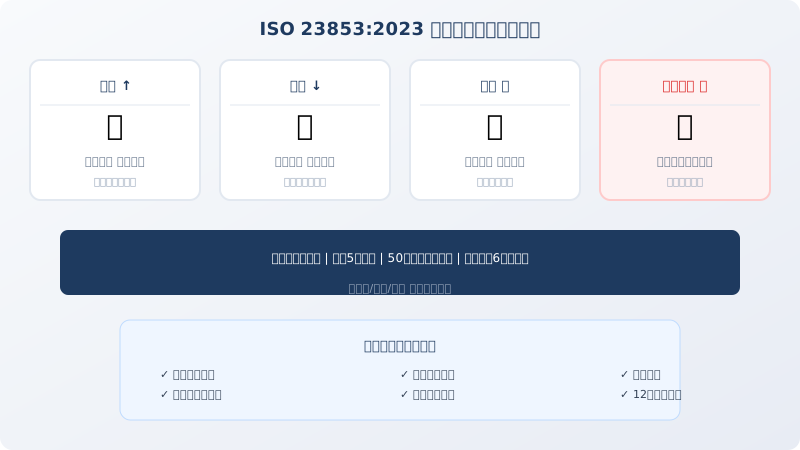

ISO 23853:2023 Crane Slinger-Signaller Competency
Standard Overview: ISO 23853:2023 "Cranes — Training of slingers and signallers" is the personnel qualification standard most recently revised and published by ISO/TC 96 in 2023. It specifies the theoretical knowledge, practical skills, and health conditions required for slingers (rigging, hooking, unhooking) and signallers in crane lifting operations. This standard complements ISO 15513 "Cranes — Competency requirements for crane drivers" and together they cover qualification management for all personnel roles in lifting operations.
Approximately 40% of crane lifting accidents are attributed to improper rigging or signal communication errors. Excessive sling angles that multiply rope tension, incorrect lift point selection that shifts the center of gravity, and ambiguous hand signals that lead to misoperation — when these seemingly basic steps go wrong, the consequences range from dropped loads and damaged materials to catastrophic equipment failure and fatalities. ISO 23853:2023 establishes a standardized competency framework for slingers and signallers across three dimensions: knowledge, skills, and health.
Theoretical Knowledge Requirements for Slingers
ISO 23853 requires slingers to master the following core theoretical knowledge: ① Lifting spreader selection — selecting the appropriate wire rope diameter and lifting sling specification based on the load weight, center of gravity position, and spacing between lift points, with the wire rope safety factor not lower than the values specified in ISO 4308 (running ropes ≥5, rigging ropes ≥5); ② Lifting angle and rope tension calculation — for every 30° increase in the included angle between two legs, the tension in each leg increases by 15% to 100%; when the included angle exceeds 90°, rope tension rises sharply, and lifting is strictly prohibited when the angle exceeds 120°; ③ Center of gravity estimation — for a homogeneous rectangular object, the center of gravity is at the geometric center; for irregular objects, a trial lift just clear of the ground is required to observe the inclination trend and determine the actual center of gravity.
Slingers must also be familiar with the discard standards for various lifting spreaders: wire rope is discarded when the number of broken wires within one lay length reaches 10% of the total wire count; synthetic web slings must be taken out of service when the identification label is missing or illegible; chain slings are discarded when the pitch of any single link is elongated by more than 5% of the original pitch.
Signaller Command and Communication Skills
ISO 23853 specifies three standard signaling methods and their applicable conditions. Hand signals — used during daylight hours with good visibility, the signaller positions themselves at the optimal location with an unobstructed line of sight to the crane operator; gestures must be decisive and clear with fully extended arms, giving only one instruction at a time. Flag signals — used for distances beyond 50 m or when complex backgrounds obscure hand signals, using red and green signal flags. Radio voice signals — used at night, in poor visibility, or when obstructions block visual contact; communication must be standardized and concise (e.g., "Main hook hoisting — slow — stop"), and casual conversational language is prohibited in place of standard commands.
ISO 23853 places particular emphasis on the "one-to-one" principle: a single crane may only accept commands from one signaller during a lifting operation. The emergency stop signal (both arms raised and waved crossed, or repeated "stop" over the radio) is authorized for all personnel — any worker who identifies a hazard may issue the emergency stop signal, and the crane operator must execute it immediately without hesitation.
Practical Skills Assessment Criteria
Practical assessment is required after theoretical training before qualification certification can be granted. The practical assessment items for slingers under ISO 23853:2023 include: ① completing center of gravity estimation and lifting spreader selection for an irregular load within 15 minutes; ② completing rigging operations for single-point, two-point, and four-point lifts, with wire ropes or slings properly tensioned and wire rope clips correctly installed (U-bolt on the short end of the rope, spacing at 6 to 7 times the rope diameter); ③ correctly demonstrating any 6 of the 12 standard hand signals within 5 minutes.
Signaller assessment: in a simulated lifting scenario, the crane operator completes a full lifting sequence relying solely on the signaller's commands — lifting the load from point A, traversing a 3 m high obstacle, and lowering it within a circular target area of 0.5 m diameter — all within 5 minutes. Striking the obstacle or landing outside the target zone constitutes a failure.
Health Requirements and Periodic Recertification
ISO 23853:2023 requires slingers and signallers to meet the following health conditions: binocular uncorrected or corrected visual acuity of at least 0.7, normal color discrimination (able to accurately identify red, yellow, and green); average hearing threshold of no more than 25 dB across the 500 Hz, 1000 Hz, and 2000 Hz frequency bands; no uncontrolled hypertension (blood pressure ≤160/100 mmHg), no history of epilepsy, and no vertigo disorders. Personnel over 50 years of age undergo annual medical examinations; those under 50 are examined every two years.
Qualification certificates are valid for 5 years, and refresher training plus recertification assessment must be completed within 3 months prior to expiration. Personnel who have been away from lifting operations for more than 6 consecutive months must pass a practical reassessment before returning to duty to reinstate their qualification.
| Signal Mode | Applicable Conditions | Effective Range | Requirements |
|---|---|---|---|
| Hand Signals | Daytime/Good Visibility | ≤50m | 12pcs Standard Decisive and Clear Hand Signals |
| Flag Signals | Long Distance/Complex Background | 50~200m | Red and Green Two-Color Signal Flags |
| Radio Communication | Nighttime/Obstruction/Adverse Weather | Unlimited | Standard Terminology No Colloquial Language |
FAQ
Q: Can one crane operator take signals from two signallers at the same time?
A: In principle, no. ISO 23853 is explicit: "one operator takes signals from only one signaller" to prevent conflicting commands. The only exception is during a handover in transfer operations—when the load moves from Zone A to Zone B and the signaller's line of sight becomes obstructed, the signaller in Zone A may hand over control to the signaller in Zone B via radio. The handover must be clearly announced ("control transferred"), and once the receiving signaller confirms, the original signaller must stop signalling immediately. At any given moment, only one signaller holds "primary control."
Q: What makes web slings better than wire rope, and when should they not be used?
A: Synthetic web slings offer a low dead weight, flexibility that protects the load surface from damage, and resistance to acid and alkali corrosion. They are ideal for lifting precision equipment (motors, machine-tool spindles), coated or painted parts, and stainless-steel vessels. However, web slings must not be used when: ① the load temperature exceeds the sling's rated limit (standard polyester slings ≤100°C, aramid slings ≤250°C); ② the load has sharp edges without edge protection; ③ the sling body shows visible cuts, chemical burns, or broken stitching; ④ the sling has been stored outdoors and shows severe UV aging (whitened color, stiff and brittle feel). In these cases, switch to wire rope or chain slings.
Q: How do you coordinate a tandem lift with two cranes?
A: A tandem lift requires a dedicated lifting plan and a single lift director to coordinate the entire operation. Each crane operator works with their own signaller (two signallers in total), and both signallers take instructions from the lift director. The director issues synchronized commands to both cranes via radio, and the hook height difference between the two cranes must stay within 300 mm during both hoisting and lowering. Before the lift, calculate the actual load on each crane to ensure it does not exceed 75% of the rated load (tandem-lift derating coefficient of 0.75), and run a no-load synchronization trial to confirm clear communication.
Q: Are hand signals the same under Chinese and ISO standards?
A: Most hand signals are identical, but a few differences exist. For example, "Emergency Stop" is signaled by crossing and waving both arms overhead in both ISO 23853 and the Chinese standard GB 5082 (Lifting and Handling Signals)—these match. However, "slow hoisting" in the Chinese standard is a single hand raised above the head, palm up, with small up-and-down movements, while ISO 23853 requires the other hand to simultaneously point in the direction of movement. For international projects or when working with foreign operators, we recommend holding a hand-signal alignment session before work begins to confirm that all signals are understood identically.