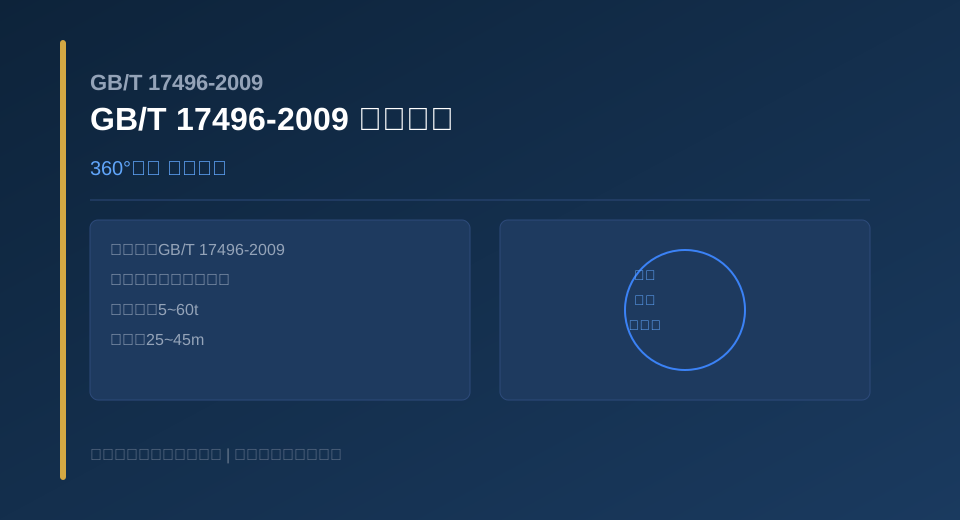

GB/T 17496-2009 Port Portal Crane Technical Specifications

GB/T 17496-2009 "Harbor Portal Cranes — Technical Specification" is the governing standard for harbor portal crane design and performance. It defines the technical requirements, test methods, inspection rules, and marking, packaging, storage, and transport provisions for harbor portal cranes. This standard complements the product standard GB/T 17495-2009 for harbor portal cranes.

GB/T 17496-2009 establishes the technical specification for harbor portal cranes, covering classification, technical requirements, test methods, and inspection rules. Harbor portal cranes are the backbone of bulk and general cargo handling at ports, offering high lifting capacities, flexible luffing, and a wide slewing range.

GB/T 17496-2009


Product Classification and Main Structure

The main structural components of harbor portal cranes covered by GB/T 17496-2009 include: Portal frame (portal base) — supported on crane rails via travel wheels; the portal's internal clearance allows trains and trucks to pass through, a key feature distinguishing harbor portal cranes from other portal crane types. Slewing platform — mounted on the slewing bearing atop the portal frame, carrying the boom, hoisting mechanism, luffing mechanism, and slewing mechanism.

Boom system — Harbor portal cranes use either lattice booms or box-section booms. Lattice booms are lightweight with low wind resistance, ideal for large working radii; box-section booms offer greater rigidity and load-bearing capacity. Hoisting mechanism — employs a double-drum or multi-drum design (one drum for main hoist, another for auxiliary hoist or grab open-close). Luffing mechanism — uses rack-and-pinion or screw-type luffing.

Technical Parameters and Performance

Core parameters specified in the standard: Lifting capacity of 5–60 t (hook duty) or 5–40 t (grab duty). Working radius — maximum radius of 25–45 m, minimum radius of 7–12 m. Lifting height — 12–28 m above rail, 10–20 m below rail. Work duty classification of A6 to A8 (heavy or extra-heavy duty). Lifting speed of 30–60 m/min.

Derricking speed of 30–60 m/min. Slewing speed of 1–1.5 r/min. Rail gauge (distance between crane travel wheels) of 6–15 m. Wheelbase (front-to-rear distance of portal travel wheels) of 6–12 m. Travel speed of 15–30 m/min. Each mechanism operates under duty cycle S3 (intermittent duty, 40%–60% duty cycle).

Safety Devices and Protection Systems

Mandatory safety devices include: load limiter (alarms and cuts hoisting power on overload), load moment limiter (LML) (prevents overturning from excessive working radius), hoisting height limit switch, lowering limit switch, luffing limit switches (at maximum and minimum radius), and slewing limit switch (restricts slewing angle to prevent cable twisting). An anemometer provides automatic warning at wind force ≥6.

An anti-collision device is also required when multiple portal cranes operate on the same rail track. Wind protection measures include rail clamps (to lock the crane to the rail after operation), anchor devices (to secure the crane during storm warnings), and windproof cables. Travel limit switches and buffers are fitted at both ends of the crane travel rail.

Testing and Inspection Requirements

Factory Acceptance Test: no-load test (full travel of all mechanisms to verify operational reliability and limit switch function), rated load test (comprehensive check at 100% SWL), and static load test (at 1.25 × rated load to check deformation of main structural components). Type test is conducted every 5 years, adding fatigue life and durability tests.

Routine inspections: daily checks of brakes, limit switches, and safety devices on all mechanisms; monthly inspection of main structural components (portal frame, boom, slewing platform) for weld seams and base metal integrity; quarterly checks of rail foundation settlement and rail gauge variation; annual comprehensive safety assessment and load test. Anti-corrosion inspection — coating condition is checked every 2 years with timely touch-up repairs (corrosion is severe in marine environments). Kelude offers related products and technical services.

Lifting Capacity

5–60 t

Working Radius

Max: 25–45 m
Min: 7–12 m

Lifting Height

12–28 m above rail
10–20 m below rail

Work Duty

A6 to A8

Slewing Angle

360° full rotation

Derricking Speed

30–60 m/min

Kelude Heavy Industry: Overhead & Gantry Crane Solutions

Kelude Heavy Industry specializes in the design, engineering, and manufacturing of heavy-duty overhead cranes, gantry cranes, and electric hoists. Our product range covers a wide spectrum of applications, from single-girder and double-girder bridge cranes to versatile gantry systems and explosion-proof hoists. We provide complete material handling solutions tailored to the specific needs of workshops, warehouses, and industrial production lines.

Frequently Asked Questions (FAQ)

Q: What is the typical lead time for a standard overhead crane?
A: Lead times vary depending on the crane specifications and configuration. For standard single-girder cranes, the typical lead time is 4-6 weeks. Double-girder cranes and customized systems may require 8-12 weeks. We provide a detailed delivery schedule upon order confirmation.

Q: Do you provide installation services?
A: Yes, we offer professional installation services by our trained technicians. Alternatively, we can provide detailed installation drawings and supervision if you prefer to use your own installation crew.

Q: What safety certifications do your cranes have?
A: Our cranes are designed and manufactured in accordance with international standards including ISO 4301 for crane classification and IEC 60204-32 for electrical equipment. We can also provide certification to other specific standards upon request.

Q: Can you customize a crane for a specific application?
A: Absolutely. We specialize in custom-engineered solutions. Our engineering team will work closely with you to assess your requirements and design a crane that meets your exact specifications, including capacity, span, lifting height, and special features.

Q: What is your warranty policy?
A: We offer a standard 12-month warranty on all our crane products, covering defects in materials and workmanship. Extended warranty options are also available.

Q: How do I determine the right crane capacity for my needs?
A: Crane capacity is determined by the weight of the heaviest load you need to lift, plus the weight of the lifting attachment. It is recommended to add a safety margin of 15-20% to the calculated load. Our sales engineers can assist you in selecting the appropriate capacity.

Q: Do you offer spare parts?
A: Yes, we maintain a comprehensive inventory of spare parts for all our crane models. You can order parts directly through our website or by contacting our service department.

Q: What are the maintenance requirements for an overhead crane?
A: Regular maintenance is essential for safe and reliable operation. This includes daily visual inspections, periodic lubrication, and annual comprehensive inspections by qualified personnel. We provide a detailed maintenance manual with every crane and offer service contracts for scheduled maintenance.

Q: Can your cranes be used outdoors?
A: Yes, we offer gantry cranes and outdoor overhead cranes specifically designed for external use. These are equipped with weatherproof enclosures, corrosion-resistant coatings, and specialized components to withstand harsh environmental conditions.

Q: What is the maximum span available for your double-girder cranes?
A: Our standard double-girder cranes can be designed with spans up to 40 meters. For special applications, larger spans can be engineered upon request.

Q: Do you provide remote control operation?
A: Yes, all our cranes can be equipped with wireless remote controls for convenient and safe operation. We offer both radio remote controls and pendant push-button stations.

Q: Are your cranes compliant with ISO 4301?
A: Yes, our crane designs and classifications adhere to ISO 4301 standards, ensuring they meet international requirements for performance and safety.

Q: Can you help with the design of a crane runway?
A: Yes, we can provide guidance and recommendations for crane runway design, including rail selection, column loads, and installation tolerances. Our engineering team can review your building drawings and offer expert advice.

Q: What is the difference between a single-girder and a double-girder crane?
A: A single-girder crane uses one bridge beam and is typically lighter and more cost-effective for lower capacities and spans. A double-girder crane uses two bridge beams, offering higher lifting capacity, greater hook height, and more stability for heavy-duty applications.

Q: How often should a crane be load tested?
A: A load test should be performed during initial commissioning and then periodically as part of your safety inspection program. The frequency depends on usage and local regulations. We recommend an annual load test as a best practice.

Q: Do you offer training for crane operators?
A: Yes, we provide comprehensive operator training programs, covering safe operating procedures, load handling techniques, and routine maintenance checks. Training can be conducted at our facility or on-site at your location.

Q: What is the maximum lifting height for your cranes?
A: The lifting height is customized based on your building height and application requirements. We have designed cranes with lifting heights exceeding 30 meters. Our team will work with you to determine the optimal lifting height for your facility.

Q: Can your cranes be integrated with existing automation systems?
A: Yes, our cranes can be equipped with various automation features, including programmable logic controllers (PLCs), sensors, and remote monitoring capabilities. This allows for seamless integration into your existing production or warehouse management systems.

Q: What is the price range for a standard 10-ton overhead crane?
A: The price varies depending on the span, lifting height, and specific features. As a general reference, a standard 10-ton single-girder crane with a 20-meter span is approximately $66,600. For an accurate quote, please contact us with your detailed requirements.

Q: How do I request a quote?
A: You can request a quote by filling out the contact form on our website, emailing us directly, or calling our sales team. Please provide your specific requirements, including capacity, span, lifting height, and any special features, to receive a prompt and accurate quotation.

Parameter harbor portal crane Standard Portal crane
Lifting Capacity 5~60t 5~100t
Work Duty / Classification A6~A8 A4~A6
Lifting Speed 30~60m/min 10~20m/min
Working Efficiency High Medium
Automation Level High(Available PLC Control) Manual operation
Anti-corrosionrequirements High(Marine Environment) Medium

FAQ

Q: What are the main structural components of a harbor portal crane?

A: A harbor portal crane consists of the portal frame (portal base), slewing platform, boom system, hoisting mechanism, luffing mechanism, slewing mechanism, and travel mechanism. The portal frame is supported on crane rails via travel wheels, and its interior clearance allows trains and trucks to pass through. The slewing platform is mounted on the slewing bearing atop the portal frame and carries the boom and all mechanisms. The boom is available in either lattice or box-section construction.

Q: How does a harbor portal crane differ from a standard portal crane?

A: Harbor portal cranes are designed for a higher work duty classification (A6~A8) and faster hoisting and derricking speeds (30–60 m/min) to meet the demanding productivity requirements of port operations. They also require a more robust anti-corrosion coating system suited to the marine atmospheric corrosive environment. In addition, harbor portal cranes offer a higher degree of automation and can be equipped with PLC control and container spreaders.

Q: What safety devices are required on a harbor portal crane?

A: Mandatory safety devices include: a load limiter (with overload alarm and automatic cutoff of hoisting power), a load moment limiter (LML) to prevent overturning caused by excessive working radius, a hoisting height limit switch, a lowering limit switch, a luffing limit switch, a slewing limit switch, and an anemometer (with automatic alarm at wind force ≥6). For multiple cranes operating on the same crane rail, an anti-collision device is also required.

Q: What are the anti-corrosion and rust-prevention requirements for harbor portal cranes?

A: Given the marine atmospheric corrosive environment, harbor portal cranes demand a high level of corrosion protection. The steel structure must be sandblasted to Sa2.5 grade prior to coating. The coating system comprises a zinc-rich primer (dry film thickness ≥80 μm), an epoxy micaceous iron oxide intermediate coat (≥120 μm), and a polyurethane topcoat (≥80 μm), for a total DFT of ≥280 μm. Coating condition should be inspected every 2 years, with prompt touch-up repairs as needed.

Related News

contact

contact us

phone:
+86 13903802779

mail:3915269@qq.com

Working hours: Monday to Friday

Wechat
Wechat
SHARE
TOP