
How to Choose Crane Duty Class: FEM and ISO Explained

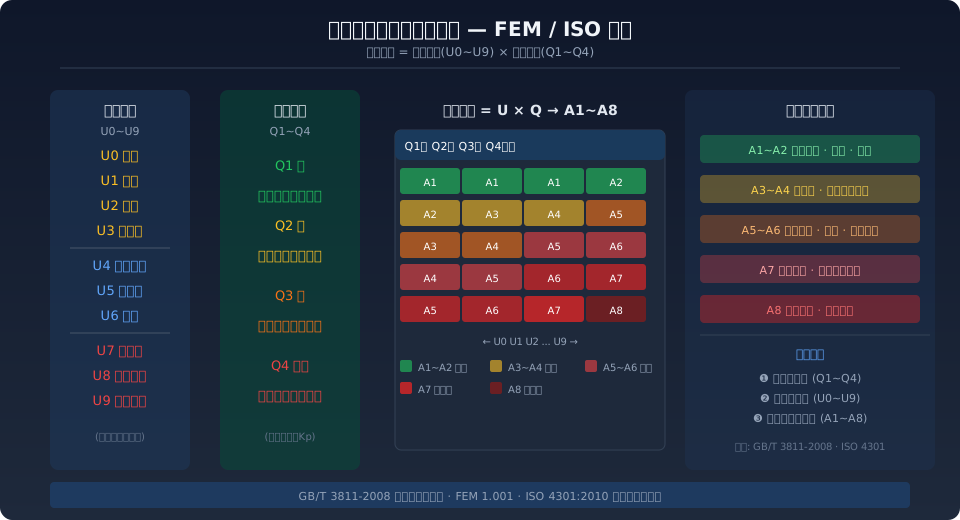
The crane service rating (A1~A8) is determined by the intersection of two independent dimensions: the utilization class (U0–U9, based on total number of duty cycles) and the load spectrum (Q1–Q4, based on the load spectrum factor Kp). The classification system in ISO 4301 is fully aligned with ISO 4301:2010, while FEM 1.001 uses a separate 1Am–4m classification scheme. Selecting the wrong service rating accelerates wear — potentially shortening service life by 30%–50% — and in severe cases can lead to structural fatigue failure.

In crane selection, the service rating is the third most critical parameter after lifting capacity and span. A 10t crane specified with too low a service rating may develop structural issues such as main girder deflection or end carriage cracking within just 3–5 years of operation. Conversely, over-specifying the rating can double the equipment cost. This article explains the classification logic and selection methodology for service ratings A1~A8 in about five minutes.

The service rating is defined in accordance with ISO 4301. It is not a "quality grade" — a crane rated A8 is not "better" than one rated A3; rather, the rating reflects the assumed intensity of use at the design stage. A crane rated A3 used in a A8 duty cycle will wear out prematurely, while a A8 crane operating under A3 conditions is simply over-engineered. Understanding this distinction is the first step toward correct crane selection.

Crane service rating classification system A1~A8


What Is a Crane Service Rating: Two Dimensions, One Classification

The service rating is determined by two independent variables: the utilization class (U0–U9), which describes the total number of duty cycles expected over the crane's design life, and the load spectrum (Q1–Q4), which describes how the loads lifted relate to the rated lifting capacity. The intersection of these two dimensions is looked up in the ISO 4301 Cranes — Classification table to obtain the corresponding service rating A1~A8.

Utilization class U is defined by the total number of duty cycles Ct: U0 ≤ 1.6×10⁴ cycles (occasional use), U9 > 4×10⁶ cycles (extremely intensive use). Each successive class represents roughly a doubling of cycles. Based on an 8-hour working day and 10 cycles per hour, U4 (1.25×10⁵ cycles) corresponds to approximately 3 years of service, while U6 (5×10⁵ cycles) corresponds to roughly 12 years — which is the design basis for most industrial cranes.

Load spectrum Q is defined by the load spectrum factor Kp: Q1 (Kp ≤ 0.125, rated load rarely lifted), Q2 (0.125 < Kp ≤ 0.25), Q3 (0.25 < Kp ≤ 0.5), and Q4 (0.5 < Kp ≤ 1.0, rated load lifted frequently). For example, a workshop crane in an assembly shop typically handles components rather than fully assembled machines, so Kp is usually around 0.15 (Q2). In contrast, a steel mill lifting magnet picks up loads close to the rated capacity on every cycle, giving a Kp often above 0.7 (Q4).


FEM vs. ISO Classification: How the Two Systems Compare

The FEM (European Materials Handling Federation) standard uses its own classification approach, dividing crane mechanisms into eight classes from 1Dm to 4Dm, each representing a different combination of design life and load spectrum. FEM 1Am/1Bm corresponds to ISO A1~A2, FEM 1Cm–2m corresponds to A3~A4, FEM 3m corresponds to A5~A6, and FEM 4m corresponds to A7~A8. The two systems are interchangeable for engineering purposes.

Electric hoists on bridge cranes commonly use FEM 2m (equivalent to ISO A3~A4), which suits typical machining workshops. European Standard double-girder cranes are typically specified with FEM 3m–4m (equivalent to ISO A5~A7) for heavy-duty continuous operations in steel and aluminum plants. Notably, FEM classification allows the mechanisms (hoisting/travel) and the structure to be rated independently — for instance, the main girder may be designed to 4m while the crane bridge travel mechanism is configured to 3m. This split-rating approach helps optimize cost.

ISO 4301 Crane Design Standard is a full equivalent adoption of the ISO 4301 classification system, with A1~A8 defined identically to the international standard. For export projects, the technical agreement typically lists both the ISO service rating and the FEM class so European customers can cross-reference the two systems.


Work Duty / Classification FEM (Fédération Européenne de la Manutention)Grade Service Frequency Typicalload spectrum Typical Application Scenarios Design Life Reference
A1~A2 1Am/1Bm Occasional(≤500h/Years) Light Duty(≤30%Rated) Maintenance Workshop·Electrical Room·Pump House ≥15Years
A3 1Cm/2m Infrequent(≤1000h/Years) Light Duty~Medium Duty(≤50%Rated) Machining·Assembly Line·General Warehouse ≥10Years
A4 2m Moderate(≤2000h/Years) Medium Duty(≤60%Rated) Automotive Plant·Textile Mill·Home Appliances Assembly ≥10Years
A5 3m Frequent(≤4000h/Years) Medium Duty~Heavy Duty(≤70%Rated) steel structure Plant·Shipyard Block·Casting ≥10Years
A6 3m Very Frequent(≤6000h/Years) Heavy Duty(≤80%Rated) steel coil Warehouse·Aluminum Ingot Yard·Scrap Steel ≥8Years
A7 4m High Duty Strength(≤8000h/Years) Heavy Duty~Extra Heavy Duty(≤95%Rated) Steel Mill Continuous Casting·Lifting magnet·Forging ≥8Years
A8 4m Ultra Heavy Duty Strength(≥8000h/Years) Extra Heavy Duty(≈100%Rated) Grab (grab bucket)Ship Unloading·Port Bulk Cargo·Mining ≥8Years
U0 Occasional Use
≤1.6×10⁴ Total Duty Cycles
U4 Moderate Frequency
1.25×10⁵ cycles ≈ 3-year life basis
U6 Frequent Use
5×10⁵ cycles ≈ 12-year life basis
Q1 Light Load Spectrum
Kp≤0.125 Rarely at Rated Load
Q3 Heavy Load Spectrum
Kp≤0.50 Frequent Rated Lifts
Q4 Very Heavy Load
Kp≤1.0 Continuous Rated Lifts

Typical Applications for Each Service Rating

Ratings A1 to A2 (Light Duty) suit maintenance workshops, electrical rooms, and pump stations where lifts are infrequent. Operating time typically ranges from 0.5 to 2 hours per day, with loads generally below 30% of the rated capacity. For instance, an overhead crane used for hydroelectric dam inspections, operating only 2-3 times a year for overhauls, can be adequately specified with a rating of A1 to A2.

Ratings A3 to A4 (Medium Duty) represent the most common classification for industrial cranes, covering applications like machining workshops, assembly lines, and general warehouses. These cranes typically operate 4-8 hours daily with predominantly light-to-moderate loads. Over 80% of electric single-girder and double-girder cranes in China fall into this A3 to A4 category. A 10t electric single-girder crane with a A3 rating meets the demands of most small and medium-sized factories.

Ratings A5 to A6 (Heavy Duty) are intended for environments with frequent lifts and substantial loads. Steel fabrication shops, foundries, and shipyard block assembly areas commonly use A5, while steel coil storage and aluminum ingot yards require A6. These cranes often work 12-16 hours per day, with a calculated mechanism life of no less than 10 years. Component selection standards are correspondingly higher—ratings of A5 and above mandate hardened gear reducers.

Ratings A7 to A8 (Extra Heavy / Continuous Duty) are reserved for extreme conditions in metallurgy and port operations. Examples include ladle cranes for transporting molten steel in continuous casting bays (A7), grab-type ship unloaders (A8), and overhead cranes with lifting magnets for scrap handling (A7 to A8). These applications are characterized by loads frequently approaching the rated capacity (Q3-Q4), extremely high cycle frequencies (U7-U9), and severe consequences of failure. Consequently, structural safety factors, wire rope safety margins, and brake redundancy are all specified one level higher than for medium-duty cranes.


Selecting the Right Service Rating: A 3-Step Guide

Step 1: Determine the Load Spectrum (Q). Analyze or estimate the actual load distribution. Record the load for each lift over a week and calculate the load spectrum factor Kp = Σ(ti/T × (Pi/Pmax)³). If precise data is unavailable, estimate based on the application: machining workshops typically fall under Q2, stamping/foundries under Q3, and grab/lifting magnet operations under Q4.

Step 2: Determine the Utilization Class (U). Calculate the total number of duty cycles over the design life: (operating hours/day) × (cycles/hour) × (working days/year) × (design life in years). For example: 8 hrs × 10 cycles/hr × 250 days × 10 years = 2×10⁵ cycles, corresponding to class U5. Note that "8 working hours" does not equal "8 hours of crane operation"—the Cyclic Duration Factor (ED%) for mechanisms is typically 40%-60%, meaning actual running time is about 50% of the nominal time.

Step 3: Determine the Service Rating (A) from the table. Using U5 (fairly frequent) and Q3 (heavy) as an example, consulting the ISO 4301 table yields a rating of A5. It is advisable to select one class higher for an added safety margin: if your calculation results in A4, design to A5 instead. The cost increase for this extra class is typically 8%-15%, but it can extend the crane's service life by over 30%—a highly cost-effective investment.

Common Misconception: Assuming a "10t crane should automatically be rated A3". Lifting capacity and service rating are independent parameters. A 10t bridge crane could be rated A3 for assembly line duty or A7 for steel coil handling. The two configurations differ significantly in price, structural dimensions, and reducer specifications. When specifying a crane, you must clearly define four parameters: lifting capacity, span, lifting height, and service rating.


FAQ

Q: Why is there a 30%-50% price difference between cranes rated A3 and A5 when they look identical?

A: Each increase in service rating involves significant upgrades: the main girder section height increases by 10%-15% (with thicker plates and more stiffeners), the reducer upgrades from soft to hardened tooth flanks (adding ~40% to its cost), the electric motor is selected for S4/S5 duty (one frame size larger), the braking system doubles from a single to a dual brake setup, and electrical components are derated for heavy-duty use. For example, a 10t × 22.5m bridge crane: a A3 configuration might cost around $18,000-$22,000, while a A5 configuration would be in the $27,000-$33,000 range.

Q: Is FEM 2m exactly equivalent to ISO A4?

A: Not exactly. FEM 2m corresponds to a range within ISO A3~A4, closer to A4. The key difference is that FEM allows separate classification for the hoisting and crane travel mechanisms, whereas ISO typically assigns a single classification for the entire crane. For projects destined for Europe, we recommend specifying both the FEM rating and the ISO work duty to avoid disputes during acceptance. Kelude's export cranes come standard with dual ratings: FEM 3m / ISO A5.

Q: Can a crane rated for A3 occasionally lift its rated load?

A: Yes. Load spectrum Q2 by definition permits occasional lifts at rated load (≤10% of duty cycles). However, "occasional" is bounded: no more than 2–3 rated-load lifts per day, each lasting no longer than 5 minutes. If you're performing 10 or more rated-load lifts daily, the load spectrum has moved into Q3 territory, and the work duty should be raised accordingly. Operating beyond the design strength will accelerate main girder deflection by 2–3 times.

Q: Does the work duty affect annual inspections and discard criteria?

A: Yes. Under TSG 51-2023 Crane Safety Technical Supervision Regulation, cranes rated at A6 and above require 100% Non-destructive testing of butt welds on flange plates of primary load-bearing members (main girders, end carriages), compared to 20% sampling for cranes rated below A5. During periodic inspections, fatigue-critical areas (mid-span lower flange of the main girder, end carriage corner joints) on cranes rated A7~A8 are inspected at twice the frequency. Discard criteria are triggered when main girder deflection exceeds S/750 for cranes rated below A4, or S/1000 for those rated A5 and above.

Choosing the right work duty directly impacts the safety and cost-effectiveness of a crane over its 20-year full life cycle. Selecting one grade lower may save a few thousand dollars upfront, but one grade higher can save tens of thousands in maintenance costs over the years—a trade-off worth calculating carefully.

Related News

contact

contact us

phone:
+86 13903802779

mail:3915269@qq.com

Working hours: Monday to Friday

Wechat
Wechat
SHARE
TOP