

Co-Authored Two Crane AI Visual Inspection Industry Standards
Kelude co-authored two industry standards for AI vision inspection on cranes, advancing the standardization of intelligent overhead crane technology. Standard development marks the critical leap for technology-driven companies from competing on products to competing on rules.
Standard development marks the critical leap for technology-driven companies from competing on products to competing on rules. Two association standards for crane AI visual inspection led by Kelude Heavy Industry — T/CMIF 1XX-2025 Technical Specification for AI Visual Safety Monitoring and Management Systems on Bridge Cranes and T/CMIF 1XX-2025 General Technical Requirements for AI Online Wire Rope Inspection Systems on Cranes — have recently passed review by the China Machinery Industry Federation and been officially released. Both documents took effect on July 1, 2025. This article provides a systematic overview from four perspectives: the background of standard development, core technical requirements, the drafting process, and the industry impact after implementation.
Why These Standards Were Developed
In recent years, multiple manufacturers have launched overhead crane safety monitoring and wire rope inspection products based on AI vision. However, significant differences in detection accuracy indicators, alarm logic, and safety response strategies across vendors have made it difficult for users to compare and select products, while also increasing the complexity of acceptance reviews by special equipment inspection bodies. The goal of these two standards is to establish unified technical specifications within the industry, giving AI vision inspection products clear benchmarks for functionality, performance, and safety requirements.
Core Technical Requirements of the Two Standards
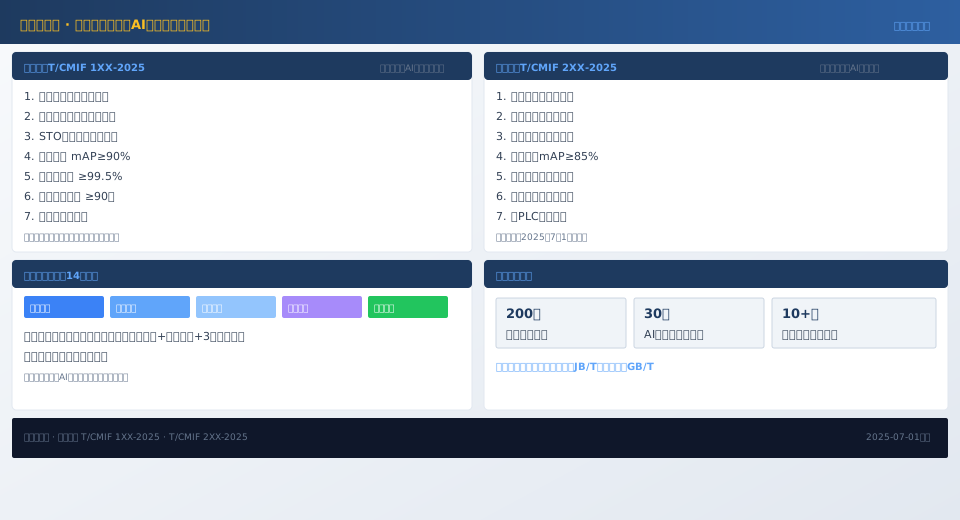
T/CMIF 1XX-2025 Technical Specification for AI Visual Safety Monitoring and Management Systems on Bridge Cranes defines the functional requirements for safety monitoring systems, including personnel detection zone partitioning, trigger logic for three-level alarm strategies and alarm delay criteria, interface definitions and transmission protocols for STO (Safe Torque Off) signals, a minimum personnel detection mAP of 90% under normal lighting conditions, system availability of no less than 99.5%, and a data recording and storage period of at least 90 days.
T/CMIF 1XX-2025 General Technical Requirements for AI Online Wire Rope Inspection Systems on Cranes specifies the functional requirements for AI-based wire rope inspection systems, covering the minimum detectable defect sizes for three defect categories — wire breaks, wear, and corrosion — detection coverage, a comprehensive detection mAP of no less than 85%, fault classification and alarm rules, storage and traceability of inspection data, and interface requirements between the system and the crane control system. The release of these two standards fills the gap in association standards for AI visual inspection in the domestic crane industry.
How the Standards Were Drafted
The drafting process for both standards spanned 14 months, covering five phases: project initiation and feasibility review, draft preparation, public comment solicitation, technical review, and final approval and release. The working group was led by Kelude Heavy Industry, in collaboration with the Henan Provincial Special Equipment Inspection and Testing Institute, the School of Mechanical and Power Engineering at Zhengzhou University, and three overhead crane user companies.
Industry Impact After Implementation
The standards will directly influence the product development direction of approximately 200 crane manufacturers and around 30 AI vision technology suppliers in China. By unifying detection accuracy, alarm logic, and interface protocols, the standards give users a quantifiable benchmark for product selection across the industry. Since the release, more than 10 crane manufacturers have contacted the working group to inquire about technical details and product certification pathways. The standards also provide special equipment inspection bodies with a clearer acceptance basis for AI visual safety monitoring systems during routine inspections. The next phase is to upgrade both association standards to machinery industry standards (JB/T) or recommended national standards (GB/T).
FAQ
Q: What is the difference between association standards, industry standards, and national standards? How authoritative are they?
A: Association standards are issued by social organizations such as the China Machinery Industry Federation and sit at a lower level than industry standards (JB/T) and national standards (GB/T), but they carry the same legal effect. The development cycle for association standards is typically 12 to 18 months, considerably faster than industry standards (usually 24 to 36 months) and national standards (usually 36 to 48 months). For the fast-evolving AI vision field, the rapid response advantage of association standards is particularly significant. After 2 to 3 years of practical implementation, a proven association standard can be upgraded to an industry standard or national standard.
Q: Are the technical indicators in the standards based on Kelude's own product performance parameters?
A: The personnel detection mAP ≥ 90% requirement in the safety monitoring system standard is set below Kelude's own product level of mAP ≥ 95% under normal lighting conditions, leaving a reasonable margin to accommodate performance variations across different manufacturers and lighting environments. Similarly, the comprehensive mAP ≥ 85% requirement in the wire rope inspection standard is below Kelude's own product level of mAP ≥ 93%. The principle behind setting these indicators is to establish an industry baseline, not to cap the standard at any single manufacturer's technological level.
Q: Do the standards mandate the installation of AI visual inspection systems on cranes?
A: The standards are not mandatory. Currently, crane safety monitoring relies primarily on traditional safety protection devices such as limit switches, overload limiters, and anti-collision devices. AI visual inspection systems are treated as value-added functionality rather than a mandatory requirement. However, following the development trend of GB/T 28264-2017 Safety Monitoring and Management System for Lifting Appliances, and as AI vision technology matures and safety supervision requirements tighten, it is expected that within the next 3 to 5 years, AI visual safety monitoring may become a recommended configuration for certain special working conditions, such as metallurgical foundry cranes and explosion-proof cranes.
Q: How can other crane manufacturers obtain the text of these two standards? Which products have been certified under the standards?
A: Official copies of the standard can be purchased through the National Public Service Platform for Standards Information or the Standards Management Department of the China Machinery Industry Federation. Currently, two products fully meet the requirements of both standards: the overhead crane AI visual safety monitoring system and the Wire Rope AI online detection system, both of which passed all required inspections and verifications prior to the standard's release. The inspections were conducted by the third-party inspection body of the China Academy of Machinery Science and Technology, and all technical indicators specified in the standard were passed on the first attempt.
