
ISO 11661:2009 Crane Operator Training Requirements Explained

ISO 11661:2009 "Cranes — Operator Training — General Requirements" is the international benchmark for crane operator training. It defines the full scope of training requirements for all crane types, covering training systems, theoretical instruction, hands-on practice, assessment and certification, and continuing education — all aimed at ensuring certified operators possess the competence required for safe operation.


Training System and Program Stages

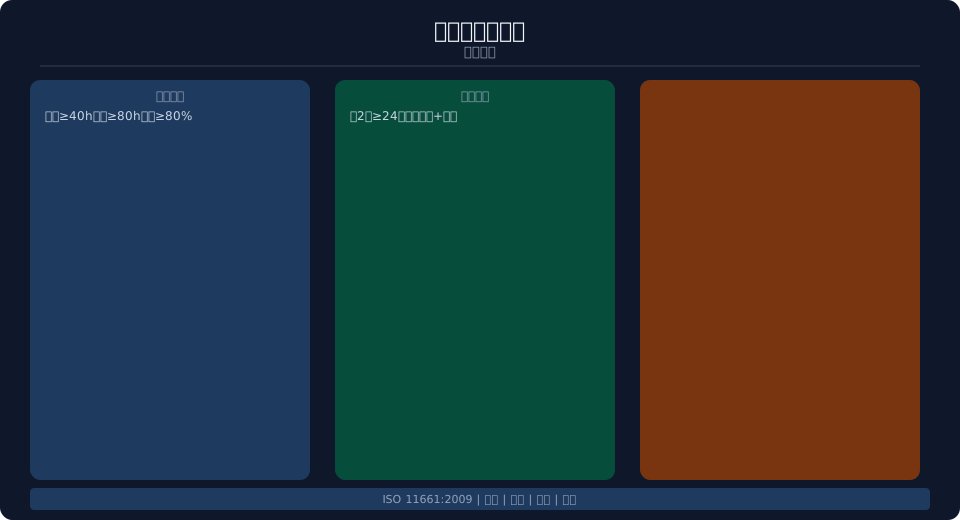
The training framework established by ISO 11661:2009 is structured in four progressive stages. Stage 1 — Foundation Training: designed for beginners with no prior experience, covering crane fundamentals and general safety regulations, with a minimum of 40 training hours. Stage 2 — Machine-Specific Training: focused on the specific crane type (overhead, gantry, tower, or mobile), covering structural principles and operating techniques for that machine, with a minimum of 60 hours. Stage 3 — Hands-On Practice: at least 80 hours of practical training on certified training grounds using dedicated training cranes, of which a minimum of 40 hours must be on actual equipment; the remaining hours may be completed on a simulator. Stage 4 — Assessment and Certification: operators must pass both theoretical and practical examinations to obtain their certificate, which remains valid for 2 years. Training providers must hold recognized accreditation and employ qualified instructors.


Training Overview


Theoretical Instruction and Examination

The theoretical training course comprises six core modules. Crane Fundamentals (10%): types, structures, and working principles of lifting appliances. Safety Regulations (25%): safe operating procedures, safety standards, personal protective equipment (PPE) usage, and accident prevention. Load and Stability (20%): load calculation, stability assessment, and the use of load moment limiters (LML). Signals and Communication (15%): standardized hand signals, whistle signals, and wireless communication procedures. Standards and Regulations (15%): relevant ISO standards, national codes, and industry specifications. Accident Case Studies (15%): analysis of typical crane accidents, root causes, and preventive measures. Each session includes in-class quizzes, and the program concludes with a comprehensive closed-book theoretical examination of at least 120 minutes, with a passing score of 80 or above. A dedicated safety module of at least 4 hours covers safety regulations, case analysis, and a safety commitment statement. Kelude offers crane operator training services in full compliance with ISO 11661:2009.

Foundation Training
≥40h
Machine-Specific Training
≥60h
Hands-On Practice
≥80h
Theory Pass Mark
≥80
Certificate Validity
2 years
Instructor-to-Student Ratio
1:4 / 1:20
Stage Training Hours Content Assessment
Fundamentals ≥40 Machinery Fundamentals/safety regulations In-Class Quiz
Crane Type ≥60 Crane Configuration/Operating Techniques theoretical examination
Hands-On Practice ≥80 Basic/Combined/Emergency/Special practical assessment
Certification —— Theory+Hands-On Practice ≥80Points/85%

Instructor Qualifications & Ongoing Education

Theoretical instructors must hold a college degree or above, or a mid-level professional title, with a valid operator certificate and at least 5 years of experience. Practical instructors are required to have an advanced operator certificate (with a minimum of 2,000 hours of machine operation), 10 years of field experience, and 200 hours of teaching training. Assessors must hold an advanced certificate, have 10 years of experience, and complete 40 hours of assessor-specific training; they cannot simultaneously serve as instructors. Each practical instructor may supervise no more than 4 trainees at a time, while theoretical classes are capped at 20 students per session. Certificates are valid for 2 years, after which refresher training of at least 24 hours—covering new standards, case studies, and simulator practice—is mandatory. Accumulating 3 or more violations or involvement in accidents triggers early refresher training. Kelude Heavy Industry provides certified training instructors and standardized training facilities, offering comprehensive training and assessment services.

Personnel Qualification Experience Headcount
Theory Instructor Associate Degree/Intermediate ≥5Years ≤20Person(s)/Class
Practical Instructor Advanced Certificate/2000h ≥10Years ≤4Person(s)
assessor assessor Advanced Certificate ≥10Years Independent
Safety Supervisor Safety Officer Certificate ≥3Years Full Duration

Frequently Asked Questions

Q: How is the training system structured?

A: It consists of four stages: fundamentals (min. 40h), machine-specific training (min. 60h), hands-on practice (min. 80h, with at least 40h on actual equipment), and assessment and certification. Certificates are valid for two years and require refresher training upon expiry.

Q: What does the theoretical training cover?

A: The curriculum includes machinery fundamentals (10%), safety regulations (25%), load stability (20%), signal communication (15%), regulatory compliance (15%), and case studies (15%). A dedicated safety module of at least 4 hours is mandatory. The final closed-book exam lasts a minimum of 120 minutes, and a score of 80 or above is required to pass.

Q: What does the hands-on training involve?

A: It covers basic operations (positioning deviation within 100mm in 5 minutes), combined operations (multi-directional maneuvering), emergency operation (fault response), and special working conditions (confined spaces, oversized loads, and multi-person coordination). Each exercise is scored individually, with video recordings retained for at least 3 years.

Q: What are the qualifications for trainers?

A: Theoretical instructors must hold a college degree or higher with at least 5 years of relevant experience. Practical trainers must have an advanced certification, a minimum of 10 years of field experience, and at least 200 hours of training delivery. Assessors operate independently from trainers. The instructor-to-student ratio is 1:4 for hands-on sessions and 1:20 for theoretical classes. Kelude offers comprehensive training and assessment services.

Related News

contact

contact us

phone:
+86 13903802779

mail:3915269@qq.com

Working hours: Monday to Friday

Wechat
Wechat
SHARE
TOP