
EN 60204-32:2008 Crane Electrical Safety Requirements Explained
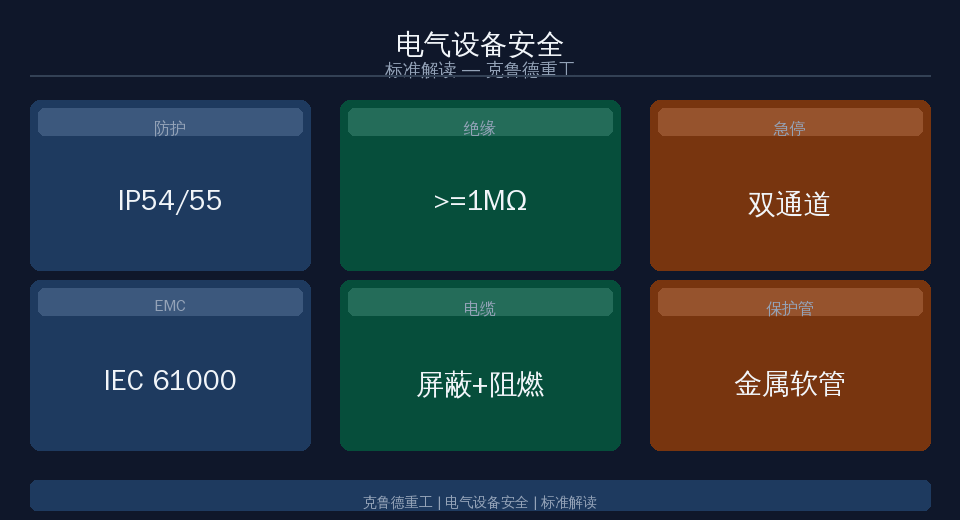
EN 60204-32:2008 — Safety Requirements for Electrical Equipment of Cranes — is the European safety standard governing crane electrical systems and carries mandatory legal effect across the EU. The standard specifies Protection Rating requirements for Control Cabinets (IP54 indoor / IP55 outdoor), Insulation Resistance (power circuits ≥1MΩ, dielectric withstand 1500V for 1 min), emergency stop circuits (dual channel, red mushroom-head actuator ≥25mm diameter, manual twist-to-release), Electromagnetic Compatibility (EMC) (radiated immunity 30V/m, ESD 8kV/15kV, fast transients 2kV at 5kHz, surge 1kV/2kV), and Cable selection (shielded, flame-retardant, protected by metal hose).

EN 60204-32 Electrical Safety Requirements
EN 60204-32 is legally binding throughout the EU. Control Cabinets must meet IP54/55. Insulation Resistance must be ≥1MΩ with a 1500V dielectric test. Emergency stop circuits require dual channel redundancy with a red mushroom-head actuator ≥25mm in diameter and manual reset. EMC compliance covers radiated immunity at 30V/m, ESD at 8kV/15kV, fast transients at 2kV/5kHz, and surge at 1kV/2kV. Kelude designs its electrical systems according to the standard.
Parameters and Inspection
Cable types include YCW rubber-sheathed, KVVP shielded, and STP-120 shielded twisted pair. Power and control lines must maintain a minimum spacing of 300mm, with metal hose Fixing at intervals no greater than 500mm. Grounding resistance must not exceed 4 ohms. Kelude has passed the full suite of EMC tests.
| Parameter | Requirement |
|---|---|
| Protection | IP54/55 |
| insulation | >=1MΩ |
| emergency stop | dual channel+Manual Reset |
| EMC | IEC 61000 |
| Cable | Shielding+Flame Retardant |
| Protective Conduit | metal hose |
| Inspection | Method |
|---|---|
| Factory Default | unit by unitaccording to the standard |
| type test | New Product/Per2Year |
EN 60204-32 specifies the complete electrical safety chain in detail—from the power supply input to the motors of each mechanism, from the control cabinet to the on-site push-button pendants, and from the main circuit to the control circuit. It covers all aspects including protection, insulation, emergency stop, EMC, and installation. The technical file includes the electrical schematic, wiring diagrams, layout drawings, and a component list. Kelude designs and manufactures crane electrical control systems for export to Europe in accordance with EN 60204-32.
EN 60204-32 provides detailed requirements for the entire electrical safety chain—from power input to mechanism motors, from the control cabinet to field push-button pendants, and from the main circuit to the control circuit. It covers protection, insulation, emergency stop, EMC, and installation. Cable selection follows these principles: YCW rubber-sheathed cables for power cables (oil- and weather-resistant), KVVP shielded cables for control cables to reduce electromagnetic interference, and STP-120 shielded twisted pair cables for signal cables to suppress common-mode interference in sensor signal transmission. Power lines and control lines are routed separately with a spacing of ≥300mm to prevent strong electric fields from coupling into control signals through capacitive interference. Cables are routed through metal hoses for protection, with fixing intervals of ≤500mm. Kelude designs and manufactures crane electrical control systems for export to Europe in accordance with EN 60204-32, passing the full EMC type test suite.
FAQ
Q: What are the enclosure protection and insulation requirements for control cabinets under EN 60204-32:2008?
A: Control cabinets installed indoors require IP54 (dustproof and splash-proof), while outdoor installation requires IP55 (dustproof and water jet proof). Insulation resistance for power circuits must be ≥1MΩ, measured with a 500V megohmmeter (insulation tester). The dielectric test is conducted at 1500V/50Hz for 1 minute with no breakdown or flashover. The emergency stop button is a red mushroom-head type with a diameter of ≥25mm, configured with dual-channel redundancy—one channel cuts the power circuit and the other triggers an alarm. It features manual twist-to-release reset.
Q: What are the EMC (electromagnetic compatibility) requirements under EN 60204-32:2008?
A: Radiated immunity is 30V/m across a frequency range of 80MHz to 1GHz, ensuring stable operation in environments with strong interference sources such as frequency inverters (VFDs) and motors. Electrostatic discharge testing covers 8kV contact discharge and 15kV air discharge, simulating static release when an operator touches the control panel. Fast transients are tested at 2kV/5kHz to simulate transient interference from switching operations. Surge testing is performed at 1kV line-to-line and 2kV line-to-ground, simulating lightning strikes and power supply switching. Cables are protected using shielded twisted pair cable routed through metal hoses.
Q: What are the cable selection and routing requirements under EN 60204-32:2008?
A: YCW rubber-sheathed cables are used for power cables, KVVP shielded cables for control cables, and STP-120 shielded twisted pair cables for signal cables. Power lines and control lines are routed separately with a spacing of ≥300mm to avoid electromagnetic coupling interference. Cables are routed through metal hoses for protection, with hose fixing intervals of ≤500mm. Cable entry and exit points are fitted with IP68 waterproof cable glands. The control cabinet is reliably grounded with a resistance of ≤4 ohms.
Q: How does Kelude configure its electrical systems in compliance with EN 60204-32?
A: Kelude designs and manufactures crane electrical control systems for export to Europe in accordance with EN 60204-32:2008. The configuration includes control cabinets rated IP54 (indoor) / IP55 (outdoor), insulation resistance of ≥1MΩ, and dual-channel emergency stop. Cables use shielded twisted pair with metal hose protection, power and control lines are spaced at ≥300mm, and grounding resistance is ≤4 ohms. The system is equipped with EMC filters, output reactors, and surge protection devices, and passes the full EMC type test suite for stable operation in industrial electromagnetic environments.