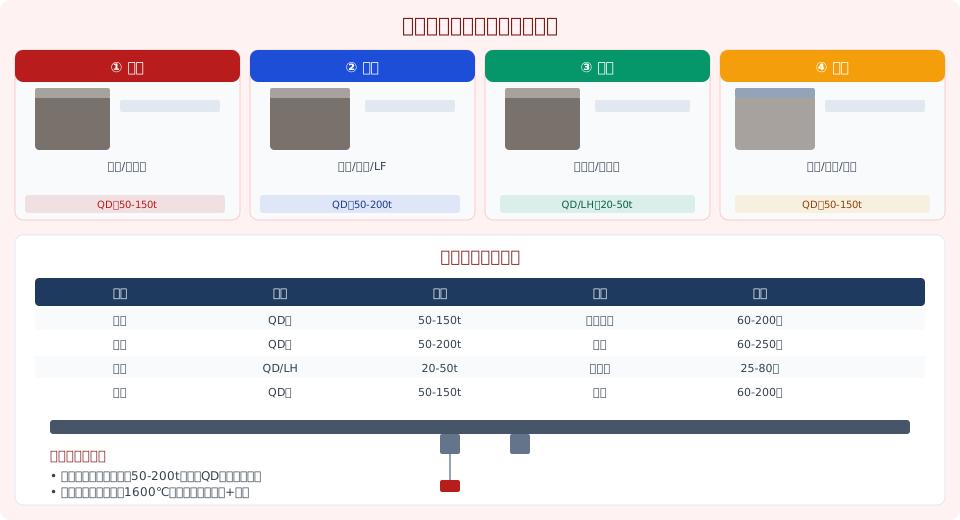
Crane Configuration Solutions for Metallurgical Equipment
Cranes for metallurgical equipment manufacturing are configured across four production stages: ironmaking, steelmaking, continuous casting, and rolling. For blast furnace ironmaking, QD Type cranes from 50 to 150 short tons (45–136 metric tons) are used; for converter steelmaking, QD Type cranes from 50 to 200 short tons (45–181 metric tons); for continuous casting segment frames, QD/LH Type cranes from 20 to 50 short tons (18–45 metric tons); and for rolling mill rolls, QD Type cranes from 50 to 150 short tons (45–136 metric tons). Complete plant solutions range from $300,000 to $2.5 million.
Blast Furnace Shell Handling for Ironmaking
Blast furnace shell sections weigh 10–50 short tons (9–45 metric tons) each, while hot blast stoves range from 20 to 80 short tons (18–73 metric tons). The recommended solution is the QD Type crane rated at 50–150 short tons (45–136 metric tons). Kelude cranes come standard with a Dual Braking System and anti-sway control.
Cooling staves (copper cooling plates) are installed on the inner surface of the furnace shell with tight spacing. Each stave weighs 1–5 short tons (0.9–4.5 metric tons) and must be installed sequentially. Kelude's cranes for the ironmaking area are matched to a staged lifting plan that follows the blast furnace platform layout.
Converter Trunnion Ring Assembly for Steelmaking
Converter shells weigh 50–150 short tons (45–136 metric tons) and trunnion rings 50–100 short tons (45–91 metric tons). The recommended solution is the QD Type crane rated at 50–200 short tons (45–181 metric tons). Kelude cranes feature heat-resistant wire rope and an insulated operator cabin.
The trunnion ring — a circular structure 6–10 m (20–33 ft) in diameter and weighing 50–100 short tons (45–91 metric tons) — is the critical component connecting the converter shell to the tilting mechanism. Machining and assembly accuracy requirements for the trunnion ring are extremely stringent (ovality tolerance ≤ 3 mm). Kelude's cranes for the steelmaking area are equipped with a large-tonnage Dual Braking System.
High-Precision Segment Installation for Continuous Casting
Segment frames weigh 10–30 short tons (9–27 metric tons) and molds 5–10 short tons (4.5–9 metric tons). The recommended solution is the QD/LH Type crane rated at 20–50 short tons (18–45 metric tons). Kelude cranes come standard with variable frequency micro-speed control.
Roller density in continuous casting segment frames is high, with 10–20 rollers per segment and roller spacing of 100–500 mm (4–20 in). When a segment needs replacement, it must be lifted out as a complete unit (10–30 short tons / 9–27 metric tons). Kelude cranes for the continuous casting area require a lifting height of at least 15 m (49 ft).
Precision Roll Changing for Rolling Mills
Work rolls and backup rolls weigh 5–50 short tons (4.5–45 metric tons). The recommended solution is the QD Type crane rated at 50–150 short tons (45–136 metric tons) fitted with a roll-specific C-Hook featuring a polyurethane liner.
Cold mill work rolls (200–600 mm / 8–24 in diameter) and backup rolls (800–1,600 mm / 31–63 in diameter) have a roll surface hardness of HSD 85–95. The roll surfaces must not be scratched or dented during lifting and transport. Kelude's roll C-Hooks come standard with a 10 mm (0.4 in) polyurethane liner, reducing roll change time by 40%.
Ironmaking QD Type50-150t | Steelmaking QD Type50-200t heat-resistant | Continuous Casting QD/LH20-50t |
Steel Rolling QD Type50-150t C-Hook | heat-resistant Wire Rope+Heat Insulation | complete plant 30-25010,000 |
Metallurgical Crane Configuration Table
| Equipment | Model | tonnage | Core | Special | investment |
|---|---|---|---|---|---|
| Ironmaking | QD Type | 50-150t | furnace shell | Dual Brake | 40-15010,000 |
| Steelmaking | QD Type | 50-200t | Converter | heat-resistant wire rope | 50-25010,000 |
| Continuous Casting | QD/LH | 20-50t | Segment | variable frequency micro-speed | 25-8010,000 |
| Steel Rolling | QD Type | 50-150t | Roll | C-Hook | 40-15010,000 |
Kelude Heavy Industry brings proven experience in heavy-duty, heat-resistant crane systems for the metallurgical sector. From converter hoisting in the 50–200t range to large-scale blast furnace component turnover and C-Hook lifting spreaders for rolling mill rolls, our solutions are engineered to handle the dual demands of extreme loads and high-temperature environments.
Metallurgy Heavy load QD Type50-200t+Dual Brake | heat-resistantdesign heat-resistant wire rope+Heat Insulation Operator Cabin | Roll Lifting spreader C-Hook+polyurethane liner |
Metallurgical Crane FAQ: Key Answers
Q: What lifting height is required for converter hoisting?
A: The furnace shell stands 6–12 m tall, so a lifting height of at least 15 m is needed. Kelude's standard QD model reaches up to 24 m.
Q: What accuracy can be achieved for continuous casting segment positioning?
A: Arc alignment is held to within 0.5 mm, supported by laser measurement systems.
Q: Why do metallurgical cranes require heat-resistant components?
A: The converter mouth radiates 200–400°C, so both the electrical systems and wire ropes must be heat-resistant.
Q: How do I select the right lifting spreader for rolling mill rolls?
A: Use a C-Hook for work rolls in the 5–20 t range, and a spreader beam for backup rolls from 20–50 t.