
ISO 9926-3:2007 Jib Crane Operator Training Procedures Explained
ISO 9926-3:2007, "Cranes — Training of Crane Operators — Part 3: Training Procedures for Jib Crane Operators," is the dedicated standard governing jib crane operator training. It defines training course requirements, assessment criteria, and certification management specific to the operating characteristics of jib cranes, including portal base, mast, deck, and floating crane configurations.
Training Course Structure and Curriculum
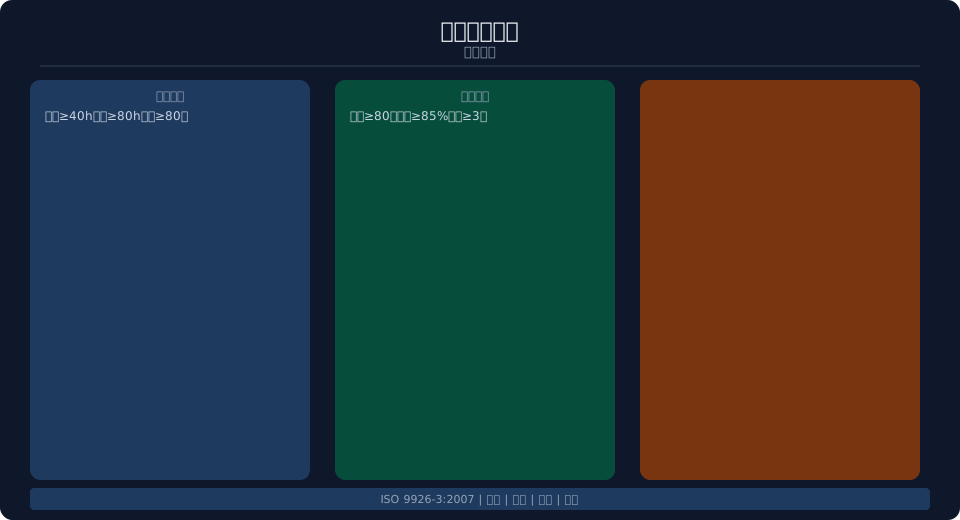
Jib crane operator training is divided into theoretical and practical components. Theoretical training requires a minimum of 40 hours and covers six core modules: structural principles of jib cranes, including the structural differences and working principles of portal base, mast, deck, and floating crane types (15%); safety operating procedures, covering jib-crane-specific safety requirements such as stability control during luffing, suspended load sway control during slewing, and wind load assessment (25%); load parameters, including load chart interpretation for jib cranes and rated lifting capacity under various boom length and working radius combinations (20%); signal communication, covering standard hand signals, wireless communication procedures, and special signal requirements for multi-crane coordinated operations (15%); standards and regulations, including ISO 12480 and ISO 9927 as applied to jib cranes (15%); and accident case studies, examining typical jib crane incidents such as overturning, boom fracture, and overload (10%).
Practical Training and Assessment Requirements
Practical training requires a minimum of 80 hours on actual equipment, covering: basic operations — individual hoisting, luffing, slewing, and traveling maneuvers with a deviation tolerance of ≤100 mm; combined operations — simultaneous two-direction coordination, such as slewing while luffing; special working conditions — lifting in confined spaces, marine operations on floating cranes, and heavy-lift procedures; and emergency operations — emergency stop procedures, manual boom lowering when hydraulic system pressure is lost, and related contingency responses.
The practical assessment consists of five components: daily inspection (10 points, 10 minutes) — identifying pre-set hazards; fixed-point lifting (30 points, 8 minutes) — positioning from point A to point B with a deviation of ≤100 mm; combined operation (20 points, 5 minutes) — simultaneous two-direction maneuvering; emergency operation (20 points, 3 minutes) — emergency stop and load release; and safety behavior (20 points). A total score of ≥85% is required to pass; scores below 70% require retraining. Assessors must hold certification, remain independent from instructors, and video recordings must be captured at ≥1080p and retained for at least 3 years. Certificates are valid for 2 years.
| Inspection Item | Content | Time Limit | Score Value |
|---|---|---|---|
| Daily Inspection | Identification Hazard | 10min | 10 |
| Fixed Point | AB≤100mm | 8min | 30 |
| Compound | Bidirectional | 5min | 20 |
| Emergency | emergency stop+Release | 3min | 20 |
| Safety | Full-process Awareness | Full Process | 20 |
Instructor Qualifications & Refresher Training
Theoretical instructors must hold an associate degree or higher and possess a valid operator certificate with at least 5 years of experience. Practical instructors are required to hold an advanced Jib Crane operator certificate (with a minimum of 2,000 hours of operating time), have 10 years of field experience, and complete 200 hours of instructional training. Assessors must hold an advanced certificate, have 10 years of experience, and complete 40 hours of assessor training; they cannot serve concurrently as instructors. Operator certificates are valid for 2 years, after which refresher training of at least 24 hours is mandatory, covering updated standards, case studies, and simulator practice. Operators with 3 or more recorded violations or at least 1 incident must undergo early refresher training. Kelude Heavy Industry provides certified training instructors and standardized training facilities, delivering crane operator training and assessment services in compliance with ISO 9926-3.
| Personnel | Qualification | Experience | Headcount |
|---|---|---|---|
| Theory Instructor | Associate Degree/Intermediate Title | ≥5Year | ≤20Person/Class |
| Practical Instructor | Advanced Certificate/2000h | ≥10Year | ≤4Person |
| assessor | assessor Credential | ≥10Year | Independent |
| Safety Supervisor | Safety Officer Certificate | ≥3Year | Full Process |
Frequently Asked Questions
Q: What special topics are covered in theoretical training for boom crane operators?
A: Compared to overhead crane training, boom crane courses add machine-specific content: boom stability control during luffing, load sway during slewing, wind load assessment, and signal coordination for multi-crane operations. Theoretical training requires a minimum of 40 hours.
Q: What special exercises are included in boom crane practical training?
A: Special operating conditions cover lifts in confined spaces, marine operations (floating cranes), and heavy-lift procedures. Emergency operation training includes manual boom lowering in the event of hydraulic pressure loss. Practical training requires a minimum of 80 hours on actual equipment.
Q: How is the practical assessment scored and what are the acceptance criteria?
A: Daily inspection 10 points + spot positioning 30 points (deviation ≤100mm) + combined maneuver 20 points (dual-direction) + emergency response 20 points (emergency stop + load release) + safety practices 20 points. A total score of ≥85% is required to pass; below 70% requires retraining. Assessors operate independently.
Q: How long is a boom crane operator certificate valid and when is refresher training required?
A: The certificate is valid for 2 years. Refresher training of at least 24 hours (covering new standards, case studies, and simulator practice) must be completed before expiry. Early refresher training is required after 3 or more recorded violations or any single incident. Kelude provides training and assessment services.