

KBK Systems to Intelligent Overhead Cranes: Kelude Product Ecosystem
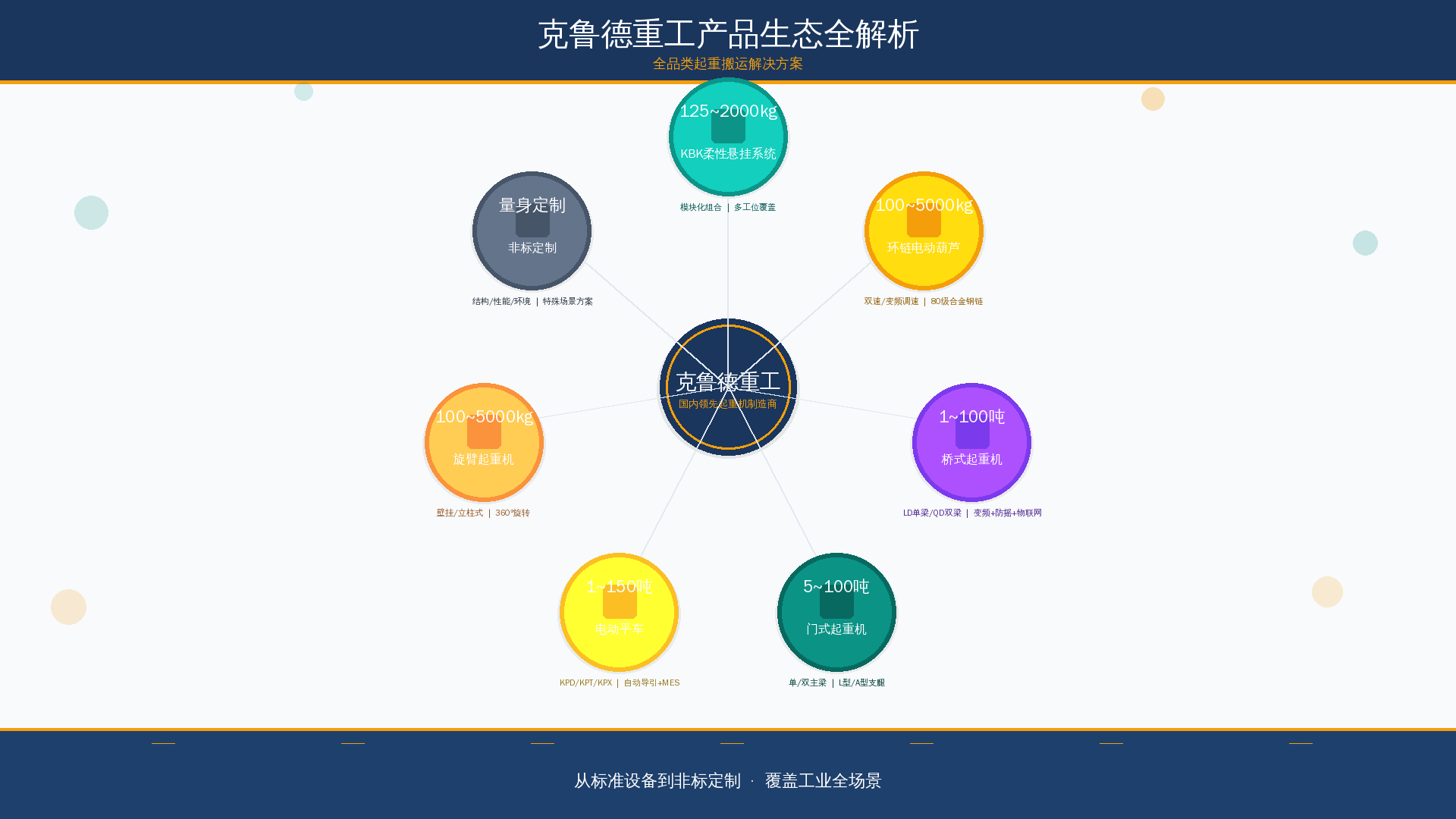
In modern industrial production, lifting equipment forms the backbone of material handling and production-line logistics. From simple KBK flexible suspension systems to complex intelligent bridge cranes, and from chain electric hoists to electric flat cars and jib cranes, each product category brings its own structural characteristics, application scenarios, and selection logic. As a leading crane manufacturer in China, Kelude has built a comprehensive product ecosystem covering all major crane types and adapting to diverse operating conditions, delivering integrated solutions ranging from standard equipment to fully customized designs for clients across industries. This article provides a systematic breakdown of Kelude's core product portfolio and the technical advantages behind each line.
KBK Flexible Suspension Systems: Modular Lightweight Cranes
The KBK flexible suspension system is Kelude's signature light-duty crane product, widely used in material handling applications across automotive manufacturing, electronics assembly, food processing, warehousing, and logistics. Its core design philosophy centers on modularity and lightweight construction—by combining standardized track profiles, suspension components, and trolleys, the system can be configured into single-rail, single-girder, or double-girder layouts to suit different shop-floor arrangements and load requirements. The defining advantage of the KBK system is its flexibility: tracks can be routed in straight lines, curves, or multi-directional switching paths to match actual production needs, with turntables and switches enabling multi-station coverage—something conventional bridge cranes cannot easily achieve.
Kelude's KBK system stands out first in track design. Standard KBK rails are cold-formed into a C-channel profile with an integrated sliding track underneath, allowing electric hoists or manual trolleys to travel smoothly. The rails are made from high-strength alloy steel with a galvanized surface finish, offering superior corrosion resistance and durability compared to ordinary hot-rolled sections. Standard rail lengths are 3 m and 6 m, and can be extended indefinitely using connector pieces to cover any span or work-area length.
In terms of structural configurations, the KBK single-girder system consists of one main beam supported by suspension brackets at both ends, with a rated load of 125–1,000 kg and a maximum span of 7 m—ideal for light-load, narrow-span workstations. The KBK double-girder system uses two parallel main beams, rated for 250–2,000 kg with spans up to 10 m, delivering greater rigidity and stability for medium loads and wider spans. For applications requiring coverage of a larger floor area, the KBK single-rail system can be laid out in an X-Y grid pattern, using turntables and curved rails to serve multiple stations—particularly well suited for fixed-point material handling along assembly lines.
Key selection criteria for Kelude KBK systems include: lifting capacity (single-point load), span (workstation width), rail length (coverage area), suspension method (fixed point or mobile trolley), and drive type (manual or electric). For detailed specifications and configuration options of standard KBK components, refer to the KBK flexible crane standard components (KBK-type underslung crane) and the KBK flexible modular underslung crane (KBK-LS type). For electronics and food processing environments with strict cleanliness requirements, the KBK system can also be supplied with stainless steel rails and dust-proof trolleys to meet cleanroom standards.
Chain Electric Hoists: Compact Lifting for Light-to-Medium Duty
Chain electric hoists are another core product line at Kelude and serve as the lifting mechanism for KBK systems, jib cranes, and single-girder bridge cranes. Compared to wire rope hoists, chain hoists offer lighter deadweight, greater lifting heights, smoother operation, and simpler maintenance—making them the preferred choice for light-to-medium lifting tasks and high-frequency duty cycles.
Kelude's chain hoist range covers rated loads from 100 kg to 5,000 kg, with lifting speeds available in single-speed and two-speed configurations. Single-speed hoists typically operate at 4–8 m/min, suitable for general material handling. Two-speed hoists provide fast and slow settings (e.g., 8/2 m/min)—fast speed for rapid hook travel when unloaded, slow speed for precise load positioning—making them the go-to choice for precision assembly work. For applications demanding even finer positioning accuracy, Kelude offers VFD-controlled electric hoists with stepless speed regulation across 10%–100% of rated speed.
Structurally, Kelude chain hoists use a planetary gear reduction mechanism for high transmission efficiency and low noise. The motor is an asynchronous induction motor with IP54 protection and Class F insulation, built to withstand harsh industrial environments. The brake is a disc-type electromagnetic brake that engages automatically on power loss for safe and reliable stopping. The lifting chain is grade 80 alloy steel, heat-treated for strength, with a breaking load exceeding four times the rated load in compliance with international safety standards. The chain container is made of abrasion-resistant canvas to prevent tangling and wear.
Key selection factors for Kelude chain hoists include: rated load (including the weight of the lifting attachment), lifting height, work duty classification (M3~M5), supply voltage (380V/220V/440V options), and mounting type (fixed, suspension, or trolley-mounted). Trolley-mounted hoists travel along KBK rails or I-beams, either manually or electrically driven, enabling material handling across a wide area.
Bridge Cranes: Versatile Overhead Lifting for Industrial Facilities
Bridge cranes are Kelude's traditional strength, offered in two main types—single-girder and double-girder—with rated loads from 1 ton to over 100 tons and spans from 7.5 m to 35 m. They are the most widely used overhead lifting equipment in industrial plants, where the crane bridge travels along runway rails mounted on the building columns, and the hoist moves transversely across the bridge, creating a three-dimensional X-Y-Z material handling envelope.
Kelude's single-girder bridge crane (LD type) consists of a single main girder, two end carriages, and an electric hoist, with rated loads of 1–20 tons and spans of 7.5–28.5 m. The main girder is fabricated from H-beam or box-section steel, the end carriages are welded steel structures, and the wheels are forged steel. The crane travel mechanism uses individual drive—each end carriage is driven by its own gear motor—combined with a VFD for soft start and speed control. The single-girder bridge crane offers a simple structure, low deadweight, and minimal load on the building structure, making it the most cost-effective solution for light-to-medium duty applications. This product complies with JB/T 1306-2008 "Electric Single-Girder Crane" and passes rigorous factory acceptance testing and quality certification.
Kelude's double-girder bridge crane (QD type) comprises two main girders, a trolley, and two end carriages, with rated loads of 5–100 tons and spans of 10–35 m. The main girders use box or truss construction, and the trolley travels along rails mounted on top of the girders. The hoisting mechanism is either an electric hoist or a dedicated wire rope winch, and both the crane travel and trolley travel use individual drives. The QD crane can be equipped with a main and auxiliary hook for alternating heavy and light lifts. Double-girder bridge cranes deliver high rigidity, excellent stability, and generous lifting heights, making them the standard choice for heavy industrial plants, steel mills, and machine shops handling large tonnages and wide spans. This product meets the technical requirements of FEM 1.001 "General Purpose Bridge Crane", with the main girder structure validated through finite element analysis and welding procedure qualification records (WPQR) to ensure long-term reliability.
On the intelligence front, Kelude bridge cranes support a range of upgrade options, including: variable-frequency speed control systems (providing stepless speed regulation for hoisting, long travel, and cross travel while eliminating start/stop shock and extending mechanical life); radio remote control operation (replacing traditional cab and pendant controls, allowing the operator to work from a safe distance); anti-sway control (using algorithms to dampen load swing, improving positioning efficiency and operational safety); lifting capacity limiters (automatic alarm and shutdown on overload to prevent equipment damage); and IoT-based remote monitoring (sensors capture real-time operational data such as motor current, brake status, and travel distance, feeding into the Kelude cloud platform for predictive maintenance and fault warning). These intelligent features transform the conventional bridge crane from a simple lifting tool into a data acquisition terminal within the smart factory. The design and manufacturing of Kelude bridge cranes strictly follow ISO 4301 "Crane Design Standard", ensuring sufficient strength, rigidity, and fatigue resistance throughout the design life.
Gantry Cranes: Heavy-Duty Lifting for Outdoor Applications
Gantry cranes—also known as portal cranes or "goliath" cranes—are Kelude's primary solution for outdoor material handling. Unlike bridge cranes, the gantry crane's bridge structure is supported directly on ground-level rails, eliminating the need for building runway beams. This makes them the go-to choice for open-air stockyards, freight terminals, ports, rail yards, and precast concrete plants.
Kelude gantry cranes are classified by main girder configuration into single-girder and double-girder types. The single-girder gantry crane (MDG type) offers rated loads of 5–50 tons with spans of 18–35 m, featuring a box-section or I-section main beam supported by legs on one side. The single-girder design uses less steel and offers lighter deadweight, making it particularly economical for medium-duty applications up to 20 tons. The double-girder gantry crane (MGD type) handles rated loads of 10–100 tons with spans of 20–42 m; the two main girders share the load through the legs and cross beams, delivering superior rigidity and wind resistance for heavy-duty, wide-span outdoor operations.
In terms of leg configuration, Kelude gantry cranes are available with L-type or A-type legs. L-type legs offer a simple, cost-effective design suited to small and medium capacities. A-type legs provide greater rigidity and stability, recommended for large tonnages and regions prone to typhoons. The main girder-to-leg connection can be rigid or pinned. Rigid connections are structurally simple but demand high installation accuracy; pinned (hinged) connections accommodate uneven track conditions and are recommended for sites with less stable foundations.
Kelude gantry cranes are equipped with the following working mechanisms: crane travel mechanism (traveling along ground rails, driven by gear motors with wheel blocks, with VFD or two-speed drive); hoisting mechanism (electric hoist or wire rope winch, selected based on rated load and lifting speed); trolley travel mechanism (moving transversely along the main girder); and an electrical control system (PLC + VFD for interlocking control of all motions). Safety devices include lifting capacity limiters, travel limit switches, buffers, rail clamps (for wind protection), and anemometers (mandatory for outdoor installation).
When selecting a gantry crane, the following parameters require careful consideration: rated load (including the lifting attachment), span, lifting height, work duty classification (A3~A6), long-travel speed, cross-travel speed, power supply (three-phase four-wire 380V/50Hz or customized to site grid conditions), and wind load rating (designed according to local wind speeds; coastal areas require a higher wind resistance class).
Electric Flat Cars: Heavy-Load Transport on Rails
Electric flat cars (also known as electric rail carts or electric platform trucks) are a core product line from Kelude for material transport within workshops and across factory sites. Unlike cranes, which handle vertical lifting, electric flat cars are designed for horizontal material transfer, serving as critical equipment for inter-process connection, assembly line supply, and heavy-load transport.
Kelude's electric flat car product line covers three main power supply methods: the KPD series (rail-powered), the KPT series (cable reel-powered), and the KPX series (battery-powered). The KPD series draws power from conductor rails on the track, eliminating the need for onboard batteries. This offers unlimited range, simple maintenance, and a low table height, making it the preferred choice for high-frequency material transport within workshops. The KPT series is powered via a cable reel, making it suitable for short-distance, straight-track applications where low cost and easy deployment are priorities. The KPX series operates on battery power, unrestricted by tracks or cables, offering maximum flexibility for multi-branch or cross-area transport scenarios.
Kelude electric flat cars have a standard lifting capacity range of 1 to 150 tons, with customizable table dimensions (standard widths from 600 to 2500 mm and lengths from 800 to 6000 mm). Travel speed typically ranges from 0 to 30 m/min, adjustable via a variable-frequency drive (VFD) for stepless speed control. The flat car table features a welded steel plate structure, with options for rubber padding or anti-slip checkered plates on the surface. Steering options include straight-track travel and bogie-style rotation, the latter enabling multi-directional movement within confined spaces.
In terms of intelligent features, Kelude electric flat cars support radio remote control operation, automatic guidance (via magnetic tape or laser navigation along preset routes), data interfacing with MES systems (for on-demand material delivery tracking), and collaborative scheduling of multiple cars through a central dispatching system. In industries such as automotive manufacturing, heavy machinery, and metallurgical casting, Kelude electric flat cars have largely replaced traditional manual forklift transport on production lines, significantly improving material flow efficiency.
Jib Cranes for Workstation Material Handling
Jib cranes (also known as cantilever cranes or work station cranes) are light-duty lifting equipment developed by Kelude for workstation-level material handling needs. Unlike large overhead cranes that cover an entire workshop, a jib crane serves a single workstation or a small area. Its arm rotates 360° around a column, offering operational flexibility, a small footprint, and low investment cost, making it the optimal workstation lifting solution for machining, assembly stations, equipment maintenance, and loading/unloading tasks.
Kelude jib cranes are categorized by mounting type into wall-mounted (BZD type) and column-mounted (BZ type) versions. Wall-mounted jib cranes have their column fixed to a wall or building pillar, with the arm rotating around a pivot at the base. They offer a lifting capacity of 100 to 1000 kg and a boom length of 3 to 6 meters, ideal for workstations arranged along walls. Column-mounted jib cranes feature a base anchored to the floor with a vertical column supporting a rotating arm at the top. They provide a lifting capacity of 100 to 5000 kg and a boom length of 3 to 10 meters, suitable for independent workstations in the center of a workshop, in storage yards, or next to machinery.
For the slewing mechanism, Kelude jib cranes are available with either manual rotation or electric rotation. Manual rotation allows the arm to be easily pivoted by hand, utilizing self-lubricating plain bearings or rolling bearings for low friction and long service life. Electric rotation is driven by a gear motor and a slewing bearing, enabling 360° reciprocating or continuous rotation, which is suitable for larger jib cranes or applications requiring frequent rotation. The hoisting mechanism typically consists of a chain electric hoist that travels along the I-beam of the arm via a manual or electric trolley.
Kelude jib cranes are particularly well-suited for the following applications: equipment maintenance stations (lifting tools or parts from storage to the repair area), parts handling on assembly lines (moving components from racks to assembly stations), mold changes (positioning molds over injection molding machines or presses), and loading/unloading tasks (handling small to medium-sized goods next to trucks). For environments with specific requirements such as explosion-proof or cleanroom conditions, Kelude also offers stainless steel and explosion-proof jib crane variants.
Non-Standard Customization Capabilities
Beyond its standard product range, Kelude's core competency lies in its ability to deliver non-standard customized solutions. Industrial environments vary greatly—limited workshop height, excessive spans, unusual rail layouts, harsh environmental conditions, and unique process requirements often mean that standard crane models cannot meet the needs. In such cases, equipment must be tailored to the specific site conditions.
Kelude's non-standard customization covers several dimensions. Structural customization includes low-headroom cranes (maximizing lifting height through special main girder designs when workshop height is restricted), large-span gantry cranes (requiring sectional assembly for spans exceeding 42 meters), and profiled rail systems (circular, curved, or S-shaped rails to accommodate special workshop layouts). Performance customization involves adjustments and optimization of lifting capacity, lifting speed, travel speed, and work duty classification. For example, high-frequency duty cycles may necessitate increased motor power and upgraded bearing selections. Environmental customization encompasses special protection solutions for high-temperature environments (steel mills, foundries), low-temperature environments (cold storage), dusty environments (cement plants, flour mills), explosion-proof environments (chemical plants, paint shops), and corrosive environments (electroplating, offshore engineering).
On the intelligence front, Kelude provides an upgrade path from basic variable-frequency control to fully integrated smart systems. The base configuration includes relay control and VFD speed control. The mid-level configuration adds a PLC with an HMI and a remote control station. The high-end configuration features cloud-connected remote monitoring, automatic production data collection and analysis, and data interfacing with MES/ERP systems. For factories requiring unified crane management, Kelude can also develop a group-level equipment management platform, enabling real-time monitoring of all equipment's operational status, utilization rates, and fault warnings.
The development process for non-standard equipment is as follows: Site Survey (measuring workshop dimensions, rail locations, and power connection points) → Solution Design (3D modeling and mechanical analysis) → Process Review (confirming functional and safety requirements with the client) → Production & Manufacturing (machining and assembly of non-standard components) → On-Site Installation & Commissioning (including safety inspection and load testing, with test methods per FEM 1.001-2021, the crane test specification and procedures) → Acceptance & Handover (providing complete test certificates and operation manuals). The entire full process is managed by Kelude's in-house engineering team, ensuring complete traceability from design to delivery.
Kelude Product Line Comparison at a Glance
To help customers quickly understand the key differences and suitable applications across our product categories, the table below systematically compares Kelude's six core product lines across five dimensions: lifting capacity, span/coverage, mounting type, application scenarios, and level of intelligence.
| Product Line | Lifting Capacity | Span / Coverage | Mounting Type | Application Scenarios | Intelligence Level |
|---|---|---|---|---|---|
| Electric Flat Car | 1 – 150 tons | N/A (horizontal transport) | Floor-running on rails | Workshop material transfer, assembly line supply, heavy-load transport | Basic to Advanced (remote control, auto-guidance, MES integration, fleet scheduling) |
| Jib Crane | 100 – 5,000 kg | Boom length: 3 – 10 m; 360° rotation | Column-mounted or Wall-mounted | Single workstation lifting, machine maintenance, assembly operations, mold changes | Basic (manual or electric rotation, chain hoist) |
| Bridge Crane (Overhead Crane) | Typically 1 – 100+ tons | Standard spans up to 42 m (customizable) | Top-running or Under-running | General workshop lifting, production line handling, maintenance | Basic to Advanced (VFD control, remote monitoring, MES/ERP integration) |
| Gantry Crane | Typically 5 – 300+ tons | Spans exceeding 42 m (sectional assembly) | Floor-running on rails | Outdoor yards, storage areas, prefabrication sites, heavy equipment assembly | Basic to Advanced (VFD control, remote monitoring, anti-sway features) |
| Electric Hoist | Typically 0.5 – 50 tons | N/A (used on cranes or monorails) | Fixed or Trolley-mounted | Hoisting component for cranes, workstations, monorail systems | Basic (relay or VFD control) |
| Electric Flat Car (Specialized) | Varies by configuration | Customizable per application | Floor-running on rails or trackless | Cleanroom, explosion-proof, high-temperature, or corrosive environments | Basic to Advanced (customized protection, remote control, data interfacing) |
| Product Category | Lifting Capacity Scope | Span/scope of coverage | mounting type | Typical Application Scenarios | Intelligent/Smartconfiguration |
|---|---|---|---|---|---|
| KBKflexible suspension system | 125~2000kg | Span≤10m, Crane Rail Extendable to Optional Length | Suspended from Workshop Ceiling/Factory buildingstructure Above | Automotive Assembly Line, Electronicsmanufacturing, Food Processing, Multi-station Flow Handling in Warehousing & Logistics | Material Flow Status Monitoring, Internet of Things (Io T)Integration |
| Chain Electric Hoist | 100~5000kg | Lifting Height Unlimited(chain Length-Determined) | Fixing Type/Suspended Type/Trolley Type(Compatible with KBKCrane Railand I-Beam) | KBK systemsupporting / matching, Jib Crane Hoisting / Lifting, Single-Girder Bridge Crane Hoisting / Lifting Unit | Variable Frequency Drive (VFD)Stepless Speed control, Operationlife prediction, Internet of Things (Io T)Monitoring |
| Bridge Crane / Overhead Crane | 1~100t (ton)+ | Span7.5~35m, coverage Full Workshop | Supported on Factory buildingcrane runway girder Above(Requires Factory building Embedded Part) | Machinery Food Processing Workshop, metallurgical Workshop, Heavy Industry Factory building Centralized Lifting and transport | Variable Frequency Speed Control, Radio remote control, Anti-Sway Control, Remote Monitoring, MESDocking/Interface |
| Gantry Crane | 5~100t (ton) | Span18~42m, coverage Open-air Storage Yard | Outrigger Floor-Supported Crane Rail Above(No Need Factory buildingstructure) | Open-air Storage Yard, Freight Yard, Port, Precast Component Yard | PLCinterlocking control, Anemometer, High Windearly warningand Automaticanchoring |
| Electric Flat Car | 1~150t (ton) | Crane Rail Unlimited Length(coverage Horizontal and Inter-Zone) | Floor-Supported Crane Railtraveling(KPD/KPT/KPXThree Typespower supply method) | Workshop Intra-Process Connection, Assembly Line Material Distribution, Heavy load Horizontal Transfer | Radio remote control, Automated Guided(AGV (Automated Guided Vehicle)), MESDocking/Interface, Multi-Vehiclecollaborative scheduling |
| jib crane | 100~5000kg | jib length3~10m, coverage Single Workstation | Wall-Mounted Type(Fixing On Wall Surface)orcolumn-mounted(Floor Foundationinstallation) | equipment maintenance Single Workstation, Assembly Line Zero Component Hoisting, mold change | Electric Rotation, Chain hoist In Coordination with, Explosion-proof/Cleanroom Option |
Selection Recommendations: For multi-station flow handling across multiple workstations, prioritize standard KBK flexible crane components (KBK-type underslung crane) or KBK flexible combination underslung crane (KBK-LS type). For heavy-load lifting across an entire workshop, choose a bridge crane. For outdoor yard operations, a gantry crane is the right fit. For workstation-level point lifting, a jib crane is recommended. Contact Kelude Heavy Industry for a free solution design.
Synergistic Value of the Product Ecosystem
Kelude Heavy Industry's product ecosystem goes beyond simply stacking multiple equipment categories—it creates an organic synergy between them. Take the material handling system in an automotive final assembly workshop as an example: the KBK flexible system covers overhead parts feeding at stations along the trim line and powertrain sub-assembly lines; chain electric hoists serve as the hoisting unit for both KBK systems and jib cranes, enabling precise component assembly; bridge cranes handle cross-station lifting of dies and assembled components; electric flat cars manage horizontal transfer of materials from the automated warehouse to production lines; and jib cranes cover workstation-level equipment maintenance and mold changes. All equipment is centrally monitored and managed through a unified IoT platform, delivering true full-chain material handling automation from raw material intake to finished product dispatch.
This ecosystem synergy manifests across several dimensions: high equipment compatibility (KBK rails directly accommodate chain hoists and trolleys, and jib cranes pair with chain hoists of various specifications), unified control systems (all equipment can connect to the Kelude Cloud Platform for centralized device management and data acquisition), consolidated maintenance (shared wear parts—such as trolley wheels and hoist chains—can be procured and stocked together, reducing inventory costs), and one-stop procurement (full-category coverage means customers need just one supplier for all lifting equipment selection, delivery, and after-sales support, minimizing supplier management overhead).
Looking ahead, Kelude Heavy Industry is steadily advancing the intelligent upgrade of its lifting equipment. Smart features currently being rolled out include material flow status monitoring for KBK systems, automated guided and AGV-capable electric flat cars, remote operation and anti-sway algorithms for bridge cranes, high-wind warning and automatic anchoring for gantry cranes, and service life prediction for chain electric hoists. Leveraging IoT, cloud computing, and big data analytics, Kelude Heavy Industry is committed to making every piece of lifting equipment a terminal node in the smart factory data network, delivering greater value to manufacturing customers.
Frequently Asked Questions (FAQ)
Q: What is the difference between a KBK flexible suspension system and a traditional bridge crane?
A: KBK flexible suspension systems and traditional bridge cranes differ significantly in structure, application scenarios, and flexibility. The KBK system uses modular aluminum or cold-formed steel rails mounted to the workshop ceiling via suspension components, and the rail layout can be configured in straight lines, curved sections, or multi-directional transfer paths. Lifting capacity typically ranges from 125 to 2,000 kg, making it ideal for light-to-medium material flow across multiple workstations. Traditional bridge cranes, by contrast, feature heavy steel main girders supported on crane runway girders at both ends, with lifting capacities exceeding 100 tons—suited for heavy-load, large-span material handling. In short: KBK is designed for light-load, high-frequency, flexible workstation-level handling, while bridge cranes handle heavy loads and full-workshop centralized lifting. The two are often used complementarily in industries such as automotive manufacturing and machining.
Q: How do the different Kelude Heavy Industry product categories work together?
A: The core strength of Kelude Heavy Industry's product ecosystem lies in the high compatibility and synergy between categories. Chain electric hoists seamlessly integrate with KBK rail trolleys and the I-beam rails of jib cranes. Electric flat cars combined with bridge cranes cover both horizontal and vertical material handling needs. All equipment can connect to the unified Kelude IoT Cloud Platform for centralized status monitoring, data acquisition, and fault warning. This synergy means customers can complete the selection, configuration, and deployment of an entire plant material handling system through a single source—no need to coordinate multiple suppliers—and shared wear parts (such as chains and wheels) can be procured and stocked collectively, lowering operating costs.
Q: How do I choose the right lifting equipment for my factory needs?
A: Selecting lifting equipment requires evaluating several key factors: ① Load requirements—single-point lifting capacity determines whether you need light-duty (KBK/jib crane), medium-duty (single-girder bridge crane/chain hoist), or heavy-duty equipment (double-girder bridge/gantry crane); ② Work area—choose a jib crane for workstation-level point lifting, a KBK system for multi-station flow handling, a bridge crane for full-workshop coverage, and a gantry crane for outdoor yards; ③ Facility conditions—workshop height, span, and floor load capacity directly affect equipment selection and mounting type; ④ Operating frequency—high-frequency operations require equipment with a higher work duty classification (M5/M6) and variable-frequency speed control; ⑤ Intelligence requirements—determine whether you need radio remote control, anti-sway control, MES integration, remote monitoring, or other smart features. Kelude Heavy Industry offers free site surveys and solution design services to help customers precisely match the most suitable equipment combination.
Q: What does Kelude Heavy Industry's non-standard customization service include, and what is the process?
A: Kelude Heavy Industry's non-standard customization covers structural customization (ultra-low-headroom cranes, large-span gantry cranes, profiled rail systems), performance customization (optimization of lifting capacity, speed, and work duty classification), environmental customization (protection solutions for high temperature, low temperature, explosion-proof, dust, and corrosive conditions), and intelligent customization (from basic variable-frequency drive control to full IoT cloud connectivity). The customization process follows these steps: on-site survey and measurement → 3D solution design and mechanical analysis → process review and approval → manufacturing and assembly of non-standard components → on-site installation, commissioning, and load test → acceptance and handover. The entire process is carried out by Kelude's in-house engineering team, ensuring full traceability from design to delivery.
