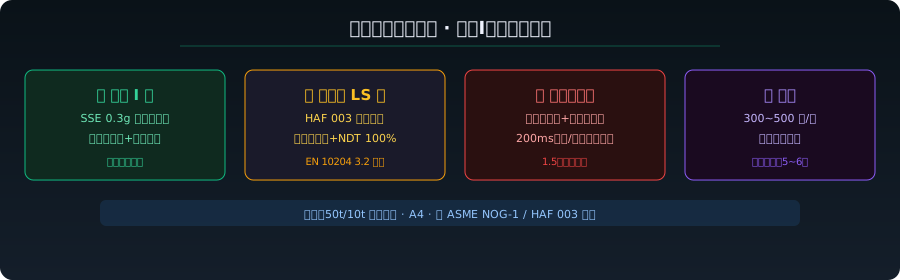

Seismic Nuclear Crane Design: Class I Dual Braking
Project Snapshot
Industry: Nuclear power (auxiliary buildings) | Configuration: Two 50t/10t nuclear-safety-class double-girder bridge cranes | Safety Level: LS (safety-related) | Seismic Resistance: SSE safe shutdown earthquake, 0.3g horizontal acceleration | Cost: Approx. $450,000–$740,000 per crane (including nuclear safety certification)
The design philosophy behind nuclear power plant cranes is fundamentally different from that of any industrial crane. It is not about being "good enough" — it is about ensuring that no single failure can cause the load to drop. Cranes in nuclear auxiliary buildings handle nuclear-safety-related equipment such as reactor coolant pump motors and valve actuators. If they cannot perform maintenance tasks after an SSE safe shutdown earthquake, the reactor's ability to achieve safe shutdown is directly compromised.
Seismic Category I: Designed to Function After an Earthquake
The core requirement for Seismic Category I is that the crane must still perform its safety functions after an SSE event. Key design considerations: ① Finite element modal analysis avoids the building's dominant frequency range (2–10 Hz), with time-history analysis verifying that stress does not exceed 90% of yield. ② Anti-derailment brackets at all four corners of the end carriages (clearance ≤ 5 mm). ③ Seismic mounting for electrical cabinets designed for 0.3g horizontal plus 0.2g vertical acceleration.
Dual Redundant Braking: Two Independent Braking Systems
Service brake (high-speed shaft) — electromagnetic disc type, used for normal start/stop operations. Safety brake (low-speed shaft) — hydraulic disc type, applied directly to the drum shaft. When the PLC detects speed exceeding 115% of rated value, brake application occurs within 200 ms. Factory test: with the service brake disengaged, the safety brake independently brings the crane to a stop with a braking distance of ≤ 50 mm.
Comparison with Standard European-Style Cranes
| Comparison Item | Standard European Standard (EN) | Nuclear Power Plant Crane |
|---|---|---|
| Design Standard | FEM (Fédération Européenne de la Manutention) 1.001 / EN 13001 Crane Safety Standard | AS (Australian Standard)ME NOG-1 / HAF 003 |
| Brake | 1Unit | Dualredundancy |
| seismic resistance | No Requirement | SSE 0.3g + modal analysis |
| NDT | UT 20~50% | UT+MT 100% + RTSampling Inspection |
| Factory Acceptance Test | 1.25Static+1.1Dynamic | 1.5Static+1.25Dynamic+Brakingredundancy Verification |
| Cost | 50~8010k | 300~50010k |
FAQ: Nuclear Power Plant Crane Certification & Safety
Q: How many manufacturers in China are qualified to build nuclear power plant cranes?
A: Fewer than 5–8. They must hold both the Civil Nuclear Safety Equipment Manufacturing License (issued by the National Nuclear Safety Administration) and ASME nuclear component certification. The certification cycle takes 2–3 years and costs approximately $450,000–$740,000.
Q: Can a safety brake seize up if it remains idle during normal operation?
A: No. The PLC automatically triggers a no-load self-test every 72 hours, running one close–release cycle while monitoring actuation time and pressure curve. Any anomaly triggers an immediate alarm.
Q: What does traceability of nuclear-grade materials mean?
A: From the steel mill's heat number to plate cutting, welding, NDT, and final assembly, the heat number of every load-bearing steel plate can be traced back to the mill's original test report. EN 10204 3.2 certificates require third-party inspection body witness.
Reference standards: ASME NOG-1 · RCC-M · HAF 003 · ISO 4301