

Digital Twin Crane Simulation Cuts Development Time by 40%
Kelude and university partners develop crane Digital Twin simulation platform, cutting new product development cycles by 40%. The crane Digital Twin simulation platform co-developed by Kelude Heavy Industry and its university partners has passed its phase acceptance review, reducing average new product development cycles by 40%.
The crane Digital Twin simulation platform co-developed by Kelude Heavy Industry and its university partners has passed its phase acceptance review, reducing average new product development cycles by 40%. The platform integrates 3D digital modeling, real-time data acquisition, and multi-physics simulation technologies, enabling virtual performance evaluation, operating condition simulation, and fault rehearsal for complete cranes. This shifts the traditional R&D workflow — from design to physical prototyping — from physical trial-and-error to virtual verification.
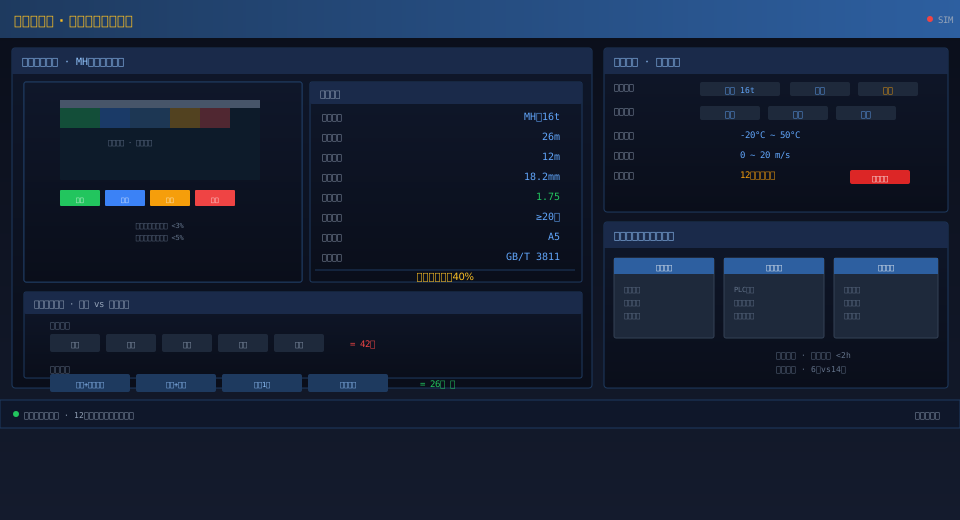
Platform Positioning and Technical Architecture
The Digital Twin simulation platform was jointly developed by Kelude Heavy Industry, Zhengzhou University, and Henan University of Science and Technology, with the V1.0 version completed and deployed over 14 months. The platform adopts a layered architecture with four tiers: device layer, data layer, model layer, and application layer. The device layer uses dual-protocol gateways (OPC UA and MQTT) for real-time data interfacing with the KRUD-IoT platform, supporting data acquisition from mainstream controllers including Siemens S7-1200/1500 PLCs, Mitsubishi FX series, and Delta Electronics PLCs. The data layer is built on the open-source time-series database TDengine, supporting write throughput of over 100,000 data points per second and query responses within 15 seconds, storing six months of operational data. The model layer comprises three sub-modules — 3D geometric models, multi-body dynamics models, and finite element analysis models — enabling coupled multi-physics simulation of structural mechanics, kinematics, and thermodynamics through inter-model data mapping. The application layer provides R&D engineers with four core functions: virtual prototype testing, operating condition simulation, fault rehearsal, and performance evaluation.
3D Modeling and Parametric Design
The platform includes a parametric 3D model library covering all 12 of Kelude's main product series, including QD type overhead cranes, QZ type grab bridge cranes, MG type gantry cranes, and MH type single-girder gantry cranes. When designing a new product, engineers simply select the product model and enter core parameters such as lifting capacity, span, lifting height, and work duty classification. The platform then automatically generates a complete 3D assembly model using parametric templates, including all components such as the main girder, end carriages, trolley frame, hoisting mechanism, and electrical control cabinet. The parametric modeling is implemented through secondary development on the SolidWorks API, reducing model generation time from 2–3 days of manual modeling to under 2 hours. The model library supports User-Defined parametric configuration of individual components, allowing engineers to adjust dimensions and material parameters on the template basis for non-standard custom requirements.
Multi-Physics Simulation
The simulation module integrates finite element analysis solvers, supporting structural static analysis, modal analysis, and fatigue life assessment for cranes. Static analysis calculates stress and deformation distribution of the main girder under full load, eccentric load, and wind load conditions, automatically identifying stress concentration areas and providing structural optimization recommendations. Modal analysis computes the first six natural frequencies and mode shapes of the complete crane, comparing them against the operating frequencies of the hoisting and trolley mechanisms to predict resonance risks. Fatigue life assessment is based on the S-N curve and Miner's linear cumulative damage theory, using load spectrum data from actual operating conditions to predict fatigue life of the main girder and critical weld seams. In a validation case involving a 20-ton MG type gantry crane, finite element calculation results showed a deviation of less than 3% between simulated and measured mid-span deflection of the main girder, and less than 5% deviation for maximum equivalent stress — confirming the accuracy of the simulation models.
Digital Twin Mapping
The Digital Twin mapping function dynamically links real-time operational data of in-service equipment to 3D models. The platform collects 32 operational parameters from the equipment's PLC Controller via the OPC UA protocol, including lifting height, trolley position, crane bridge position, lifting speed, trolley speed, travel speed, motor current, motor temperature, brake status, and limit switch status, with a sampling interval of 100 ms. The 3D model drives the motion of each mechanism based on real-time data, synchronously mapping the equipment's actual operating state in virtual space for 3D visualized monitoring. End-to-end latency for twin mapping is controlled within 500 ms, achieving near-real-time performance. Engineers can replay historical motion trajectories for any time period in the twin environment to analyze equipment state changes before and after abnormal events, assisting fault cause investigation.
Operating Condition Simulation and Fault Rehearsal
The platform supports custom operating condition simulation, allowing engineers to configure different operational parameters in the virtual environment to evaluate equipment performance across various job scenarios. Configurable parameters include load capacity (four levels: no-load, half-load, full load, overload), travel speed (three adjustable levels: low, medium, high), ambient temperature (-20°C to 50°C), and wind speed (0–20 m/s). The fault rehearsal function simulates 12 common fault scenarios, including hoisting brake failure, VFD overcurrent faults, limit switch malfunction, wire rope breakage, and cable drag chain jamming, predicting equipment state changes and cascading effects after fault occurrence. Fault rehearsal results are output in two formats: time-series animations and data analysis reports, helping design teams assess the adequacy of fault response measures during the R&D phase. The platform recently completed fault rehearsal analysis for 3 fault scenarios during the design review of a KPC type electric flat car, identifying and resolving a safety hazard caused by brake response delay before production.
Development Cycle Reduction Results
Since the Digital Twin simulation platform was put into operation, product R&D efficiency has improved significantly. Taking a newly designed MH type single-girder gantry crane as an example, the traditional R&D process requires solution design (5 days), detailed design (8 days), drawing review (3 days), prototype production (18 days), prototype testing (5 days), and design modifications (3 days) — a total cycle of approximately 42 days. With the Digital Twin platform, virtual verification runs in parallel during the solution design and detailed design phases, design issues are identified and corrected directly at the computer stage, prototype iterations are reduced to 1 unit (previously 2–3 iterations were needed), and the total cycle is shortened to 26 days — a saving of approximately 40% in development time. After product finalization, simulation data generated by the Digital Twin is directly used for writing the Operation Manual and preparing Operator Training materials, indirectly reducing the documentation preparation period after product launch.
Collaborative Design Platform
The platform also offers collaborative design capabilities, enabling multi-site R&D teams to conduct joint design reviews in a unified virtual space. Mechanical design, electrical design, and process design disciplines can work simultaneously on the same digital prototype, using model annotations and online markup tools for cross-disciplinary design communication and conflict detection. Modification comments generated during collaborative reviews are automatically linked to the corresponding components and design parameters, creating a traceable design change record. This functionality was validated in a non-standard gantry crane project jointly undertaken by Kelude Heavy Industry and Zhengzhou University, where the two teams completed design collaboration and review work in 6 working days through the platform — work that previously required 14 days of co-located effort.
Development Roadmap
V2.0 of the Digital Twin simulation platform is now in the planning stage, with a target release in the first half of 2027. The V2.0 upgrade focuses on three key areas. First, adding computational fluid dynamics (CFD) simulation capabilities to support wind load distribution calculation and wind stability assessment for cranes under strong wind conditions, filling the current gap in wind engineering analysis. Second, introducing machine learning-based surrogate model technology, training neural networks to replace parts of the time-consuming finite element calculation process, reducing single simulation time for multi-option comparative analysis from hours to minutes. Third, extending the Digital Twin from the R&D domain to the operations and maintenance domain, delivering continuous lifecycle Digital Twin services for delivered equipment at customer sites, providing data-driven equipment health condition assessment and maintenance recommendations based on operational data.
FAQ
Q: How does Kelude's Digital Twin platform differ from general-purpose simulation tools like ANSYS Twin Builder or Siemens Simcenter?
A: General-purpose digital twin software such as ANSYS Twin Builder and Siemens Simcenter offer broad simulation capabilities across industries, but they require users to build models and configure parameters themselves, demanding a high level of simulation expertise. Kelude's Digital Twin platform, by contrast, is a crane-specific simulation tool. It comes with a parametric model library covering 12 core product series, a crane-specific load spectrum database, and a built-in library of industry-standard testing specifications. Engineers simply enter the design parameters, and the platform automatically generates the simulation model and runs standard test procedures—making it far more accessible than general-purpose tools.
Q: How much deviation can be expected between Digital Twin simulation results and actual physical testing?
A: Through multiple rounds of comparative verification, the platform keeps deviation in structural mechanics simulations within 5%. This deviation primarily stems from idealized assumptions about material properties (actual steel's Elastic Modulus varies by ±3% between batches) and simplified boundary conditions (real installation foundations are not perfectly rigid). The platform explicitly labels the confidence interval for each output parameter, allowing engineers to assess the reliability of simulation results. For critical safety indicators such as maximum stress and minimum safety factor, we recommend retaining a safety margin of no less than 1.5 times.
Q: Can the Digital Twin platform also support maintenance and modification of existing crane products?
A: Yes. The platform allows users to import design parameters and operational data from existing products to build their digital twin models. For older cranes, engineers can simulate different retrofit solutions in the twin environment and select the optimal approach before proceeding with on-site implementation. For example, in a retrofit project to upgrade the Lifting Capacity of an existing MH Type Gantry Crane from 10 tons to 16 tons, engineers first validated the Main Girder reinforcement plan and the control system upgrade solution on the Digital Twin platform. Only after confirming that the Main Girder's stress and Deflection remained within the safe range did they schedule the on-site work—avoiding rework risks caused by insufficient evaluation of the retrofit solution.
Q: Can Digital Twin simulation data be used as evidence for product Certification?
A: Digital Twin simulation results currently serve primarily as a reference for internal R&D validation and cannot replace Type Test or supervision inspection of special equipment. Under TSG Q0002—the Rules for Type Test of Lifting Appliances—new products must pass Type Test on a physical Prototype before a manufacturing license can be issued. The value of Digital Twin lies in drastically reducing the number of physical prototypes needed: design issues are exposed and resolved in the virtual environment before a prototype is built, ensuring the physical prototype passes the Type Test at the first attempt. To date, two new products whose designs were optimized on the Digital Twin platform have passed their Type Tests on the first submission, with no need for re-testing.
