

Kelude Heavy Industry Boosts R&D with Postdoctoral Station
Kelude Heavy Industry establishes postdoctoral research station, boosting advanced-degree share of R&D team to 45%. The company has become the first lifting equipment manufacturer in the region to receive approval for a postdoctoral research station.
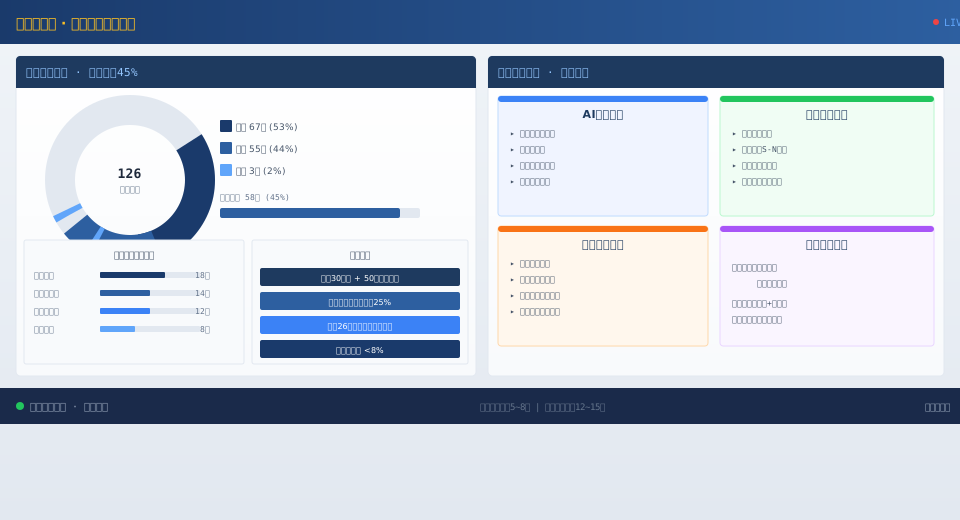
Kelude Heavy Industry has officially received approval to establish a postdoctoral research station, making it the first enterprise in the regional lifting appliances industry to do so. Meanwhile, the share of R&D personnel holding master's or doctoral degrees has risen to 45%, with 58 researchers holding graduate-level qualifications. This ongoing optimization of the talent structure provides a solid foundation for deeper technological innovation across the company.
Postdoctoral Research Station Approval
The postdoctoral research station is established with approval from the National Postdoctoral Management Committee Office and serves as a key platform for joint training of high-level research talent between enterprises and universities. Kelude's station plans to recruit 3–5 postdoctoral researchers in its first cohort, with research focused on three areas: AI vision algorithms for cranes, fatigue life prediction of metal structures, and intelligent control algorithms. The station has established joint training mechanisms with Zhengzhou University and Henan University of Science and Technology, adopting a dual-supervisor model with one corporate mentor and one academic mentor. Postdoctoral researchers receive an annual salary starting at RMB 300,000 plus research startup funding of up to RMB 500,000, with priority placement into core technical leadership roles upon completion. Day-to-day management is handled by a dedicated postdoctoral management office under the corporate technology center, staffed by two full-time administrators, with comprehensive management guidelines and an assessment system in place.
Talent Acquisition Strategy
Kelude Heavy Industry launched its talent-driven growth strategy in 2023, significantly increasing recruitment efforts alongside sustained growth in R&D investment. The company pursues three parallel recruitment tracks: experienced hires, campus recruitment, and flexible expert engagement. The experienced-hire track targets industry engineers with 3+ years of experience in industrial automation, machine vision, or IoT development, attracting mature professionals through competitive compensation and clear career progression paths. Campus recruitment focuses on provincial universities including Zhengzhou University, Henan University of Science and Technology, and Henan Polytechnic University, with dedicated job fairs held each spring and fall. In 2024 and 2025 combined, the company signed 18 master's-level graduates. The flexible engagement track brings in university professors and technical experts as advisors for short-term projects, leveraging external expertise through collaborative research arrangements. Currently, five visiting professors and technical advisors are engaged, three of whom hold senior professional titles.
Talent Development Framework
Bringing talent in is only the first step — retaining it and unlocking its full value is what truly matters. Kelude has built a three-tier talent development framework tailored to the needs of a manufacturing enterprise. The entry tier targets newly hired master's and doctoral graduates with a 6-month program: 3 months of basic training (product orientation, production processes, safety regulations) followed by 3 months of rotational on-the-job training across R&D groups. The mid tier targets researchers with 2–3 years of experience, who take on roles as deputy project leads or technical managers to build independent problem-solving capability, with at least two industry conferences or technical exchange opportunities per year. The leadership tier targets senior engineers and above, supporting participation in international conferences, overseas technical visits, and part-time doctoral study. Since 2024, three researchers have received company sponsorship to attend international conferences, and two have published papers in core journals. The technology center also runs a weekly technical sharing session every Friday afternoon, where one research group presents its work — a practice that encourages cross-team knowledge exchange and technical integration.
Advanced-Degree Talent Profile
The R&D team currently comprises 126 members: 3 PhDs, 55 master's degree holders, 67 bachelor's degree holders, and 1 associate degree holder. The PhDs graduated from Zhengzhou University (mechanical engineering), Huazhong University of Science and Technology (control science and engineering), and Xidian University (computer vision), with research spanning crane structural optimization, servo control, and AI vision algorithms. Master's degree holders cover five disciplines: mechanical design and theory (18), electrical engineering and automation (14), computer science and technology (12), control theory and control engineering (8), and instrumentation science and technology (3). The distribution of advanced-degree personnel across research institutes is as follows: overhead and gantry crane research institute (10), intelligent control research institute (14), AI vision research institute (14), software development group (12), and IoT platform research institute (8). The AI vision research institute has the highest advanced-degree ratio at 78%, reflecting the company's intensive talent investment in this field.
Talent Retention and Incentives
Retention rate is the core metric for measuring talent management effectiveness. Kelude's annual R&D staff turnover rate is held below 8%, lower than the industry average. The incentive system comprises three components: compensation, project-based rewards, and equity participation. In terms of compensation, R&D salaries rank in the top 25% of local manufacturing, with senior engineers earning RMB 180,000–250,000 annually and technical core members participating in a profit-sharing plan. Project incentives target group leaders and key personnel on technical breakthrough projects, with bonuses awarded upon project acceptance based on outcome grade — individual bonuses can reach up to RMB 100,000. Equity incentives are offered to core technical personnel and senior engineers with 5+ years of continuous service; the first 26 employees now hold virtual equity, with a 2025 dividend yield of 12%. The company also provides free dormitory housing, children's education subsidies, and an annual full health check-up, fostering a workplace environment with a strong sense of belonging.
Measurable R&D Outcomes
The impact of talent optimization is directly reflected in innovation output. From 2024 through the first half of 2026, the R&D team filed 62 patent applications — 18 invention patents and 44 utility model patents — with an approval rate exceeding 85%. During the same period, the team registered 12 software copyrights and 3 technical know-how records. In standard development, advanced-degree personnel account for 72% of the team's participation in drafting national and industry standards, making them the backbone of the company's standardization work. The AI vision research institute has an average team age of 29.6 — a young, energetic group that achieved deployable detection models for five defect categories from scratch in under three years. In 2025, three team members received provincial-level science and technology talent honors, and two were selected for the municipal professional and technical talent pool. The corporate technology center had previously passed provincial-level enterprise technology center certification.
Future Talent Roadmap
The next phase of talent development focuses on three priorities. First, fully leverage the postdoctoral research station to recruit 5–8 additional PhDs within three years, bringing the total to approximately 10, and drive breakthroughs in cutting-edge AI vision algorithms and critical control technologies through postdoctoral research projects. Second, expand campus recruitment, increasing the annual master's-level hiring plan to 12–15 across mechanical engineering, electrical automation, and computer science to maintain the team's vitality and continuous renewal. Third, establish a dual career track: the technical track with five grades (assistant engineer, engineer, senior engineer, principal engineer, chief engineer) and the management track with four levels (group leader, deputy research director, research director, deputy director of the technology center) — ensuring technical professionals can achieve equivalent compensation growth without having to move into management.
FAQ
Q: How are research topics determined for the postdoctoral research station at Kelude Heavy Industry?
A: Research topics are proposed by the corporate technology center based on the company's R&D strategy and actual technical needs, then reviewed by the technical committee before being publicly announced. Topic selection balances technical frontier relevance with industrial application potential. Candidate topics include research on few-shot learning algorithms for crane AI vision, digital twin models for fatigue life prediction of crane metal structures, and adaptive anti-sway control algorithms for cranes. Postdoctoral researchers may choose from the designated topics or propose alternative topics aligned with the company's development direction based on their own academic background.
Q: What R&D hardware does the company provide for master's and doctoral researchers?
A: The technical center is equipped with 2 NVIDIA A100 80GB GPU servers, 4 RTX 4090 GPU workstations, 8 Jetson Orin NX/AGX development kits, 12 sets of sensing equipment including industrial cameras and LiDAR, and a 200TB NAS storage array. Each AI algorithm researcher is assigned a dedicated workstation with an RTX 4080 GPU. The software development team has access to a 32-core, 64GB RAM code server and a GitLab version management platform. All R&D staff receive an annual learning allowance of $740 for professional books and online courses.
Q: Do R&D staff get opportunities to join international technical exchanges and standard development?
A: Kelude encourages its R&D personnel to participate in industry technical exchanges and standard development activities. Since 2025, the R&D team has attended 15 domestic industry events, including the China Lifting Appliances Development Forum and the National Industrial Vision Technology Symposium. Two team members have also taken part in ISO/TC 96 crane technical committee international standard workshops. Among the senior engineers at the technical center, 4 serve as observers or registered experts on the National Technical Committee for Standardization of Lifting Appliances, directly contributing to the revision and formulation of national and industry standards and helping turn the company's proprietary technologies into widely adopted specifications.
Q: How is intellectual property handled for postdoctoral researchers co-supervised with universities?
A: IP ownership for jointly supervised postdoctoral researchers follows the collaboration agreement signed by both parties. As a general rule, research outcomes developed during the postdoc term using company-provided equipment, data, and technology platforms belong to the company, while academic research results produced using university laboratory facilities belong to the university. For projects with joint investment from both sides, the resulting IP is co-owned, with specific benefit-sharing terms negotiated and agreed upon at project initiation. The postdoctoral researcher's right to be named as an inventor is protected in all circumstances.
