
Electric Hoist Wire Rope Discard Criteria: Inspect Broken Wires

Wire rope discard criteria are based on actual damage, not service time. GB/T 5972-2016 "Cranes — Wire ropes — Care, maintenance, inspection and discard" is the governing standard for determining when a wire rope must be replaced. Discard is mandatory if any of the following conditions is met: the number of visible wire breaks within one lay length reaches 10% of the total number of wires (regular lay) or 5% (Lang lay); diameter wear or corrosion exceeds 7% of the nominal diameter; or kinking, crushing, birdcaging, or electric arc damage is present. A daily inspection is required for each work shift, and a thorough examination must be performed at least once a month.

The electric hoist wire rope is the most critical load-bearing component of the entire unit, directly affecting lifting safety and personnel safety. Many users mistakenly believe that a wire rope "should be replaced after two years of use" or "can keep working as long as it hasn't snapped." These assumptions are not only wrong—they are dangerous. Wire rope discard criteria are defined by a clear national standard—GB/T 5972-2016 "Cranes — Wire ropes — Care, maintenance, inspection and discard," which is an equivalent adoption of ISO 4309 Wire Rope Inspection Standard. The standard specifies mandatory quantitative discard indicators across five dimensions: wire breaks, wear, corrosion, deformation, and heat damage. The following sections break down each criterion.


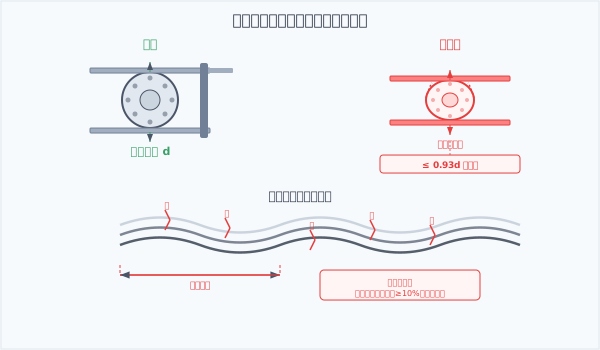
Wire rope diameter measurement and discard criteria diagram — caliper measuring wire breaks

What are the discard criteria for electric hoist wire rope?

A: According to GB/T 5972-2016, the rope must be discarded if any of the following conditions is met: ① the number of visible wire breaks within one lay length reaches 10% of the total number of wires (regular lay) or 5% (Lang lay); ② diameter reduction due to wear or corrosion reaches 7% of the nominal diameter; ③ kinking, crushing, birdcaging, electric arc damage, or other deformation or heat damage is present; ④ an entire strand fractures. Detailed evaluation methods and threshold tables are provided in the sections below.


Wire Break Discard Criteria

Wire breaks are the most common and most dangerous form of wire rope failure. The standard uses "one lay length" (the linear distance along the rope over which one strand makes a complete revolution around the rope axis) as the statistical unit, and specifies different thresholds for regular lay and Lang lay wire ropes.

Lay direction Type Onelay length Withinwire break Proportion Threshold Taking6×37structure As an Example(222Rope Steel wire)
regular lay ≥10% wire break≥23Rope, i.e.scrapping
Lang lay ≥5% wire break≥12Rope, i.e.scrapping

Determining the Lay Length: The lay length varies with the wire rope diameter. For a nominal diameter d ≤ 14 mm, one lay length is approximately 6d (e.g., for an 11 mm diameter CD1-3t wire rope, the lay length is ≈ 66 mm). For 14 mm < d ≤ 30 mm, the lay length is approximately 7d (e.g., for a 15 mm diameter CD1-10t wire rope, the lay length is ≈ 105 mm). For d > 30 mm, the lay length is approximately 8d. To measure, select any strand on the rope's surface, mark a starting point with a marker, and count along the strand's axis until it completes a second full wrap. The distance between these two points is one lay length.

Assessing Clustered Wire Breaks: If more than two wire breaks are concentrated at the same location within a single lay length, the inspection frequency should be increased, or the rope should be scrapped prematurely, even if the total number of broken wires hasn't reached the 10% threshold. Such localized clusters are often a sign of mechanical damage or severe overload and are more dangerous than dispersed wire breaks.

Complete Strand Fracture: If any single strand is completely fractured, the wire rope must be immediately scrapped, regardless of the number of broken wires.


2. Discard Criteria for Diameter Reduction (Wear & Corrosion)

During service, the wire rope's diameter gradually decreases due to external surface wear, internal corrosion, and a dried-out rope core. According to ISO 4309, the rope must be discarded when the actual diameter reduction reaches 7% of the nominal diameter.

Correct Measurement Method: Measurements must be taken with the rope unloaded. Straighten the rope and select a point at least 1.5 m from the rope end (avoiding the deformed zone near the end fitting). Use a vernier caliper to measure the diameter at two perpendicular points on the same cross-section. The average of these two readings is the actual diameter. For a given rope, take measurements at 3 to 5 different cross-sections (e.g., near the end, in the middle, and close to the drum). The minimum measured diameter is the basis for the discard judgment. The table below provides a quick reference for the scrap thresholds of common Electric Hoist wire ropes:

Nominal Diameter (mm) Scrap Threshold (mm)
8 7.44
9 8.37
10 9.30
11 10.23
12 11.16
13 12.09
14 13.02
15 13.95
16 14.88
18 16.74
20 18.60
22 20.46
24 22.32
26 24.18
Wire Ropenominal diameter(mm) Common Matching Electric Hoist scrapping Critical Diameter(mm)
7.4 CD1-1t ≤6.9
8.7 CD1-2t ≤8.1
11.0 CD1-3t ≤10.2
13.0 CD1-5t ≤12.1
15.0 CD1-10t ≤14.0
17.5 CD1-16t ≤16.3

Diameter reduction typically results from three compounding factors: surface wear on the outer steel wires caused by friction against pulleys and drums, internal corrosion that flakes away and reduces the effective cross-section, and a dried-out, shrunken rope core (fiber or steel) that causes the entire wire rope to slim down. Any one of these three factors alone can trigger scrapping criteria.


Corrosion Scrap Standards for Wire Ropes

Corrosion is the "silent killer" of wire ropes because its damage often starts from within—the exterior may only show slight surface rust while the internal wires have already thinned significantly. GB/T 5972-2016 classifies wire rope corrosion into three grades:

Corrosion Grade Appearance Characteristics Handling Method
Mild Corrosion Surface Loose Rust, Removable by Hand Enhanced Lubrication, Serviceable
Moderate Corrosion Corrosion Has Entered Strand Clearance, Visible Rust Spots Combined With Diameter reduction Andwire break Comprehensive Assessment
Severe Corrosion Obvious Rust Pitting, Corrosion Powder, Rust Filled Between Strands Immediatelyscrapping

Severely corroded wire ropes can lose 30% to 50% of their breaking force. For example, a rope with a rated breaking force of 100 kN may only withstand 50–70 kN after heavy corrosion. Given that electric hoist wire ropes typically have a safety factor of 5 to 6, the actual safety margin after corrosion can drop to less than 3, making rope breakage highly likely under overload or impact conditions.

For electric hoists operating in highly humid and corrosive environments—such as steel mills, chemical plants, and ports—it is recommended to shorten the thorough examination interval from once a month to once every two weeks, and to apply a wire-rope-specific grease for anti-corrosion protection.


Deformation and Heat Damage: Discard Criteria

Deformation and heat damage are "one-strike" defects—if any of the following conditions are present, the rope must be scrapped immediately, regardless of wire break or wear levels:

Defect Type Appearance Characteristics Comprehensive Assessment
Kink(Knotting) Strand Twisted and Knotted, Rope Body Forms a Permanent Bend Immediatelyscrapping
Flattening Wire Rope Flattened by Crushing Immediatelyscrapping
Lampion Bulge Rope diameter Localized Enlargement, rope core Extruded Between Strands Immediatelyscrapping
Bending(Rope Body Forms a Permanent Bend) Wire Rope Irrecoverable Sharp Angle Immediatelyscrapping
Arc Burn Weld Splatter Burns or Arc Strike Marks Immediatelyscrapping
Thermal Damage/Overheating Wire Rope Subjected to Fire or High-Temperature Radiation Immediatelyscrapping

Arc burns deserve special attention. When welding near an electric hoist, an improperly connected grounding wire can cause the welding current to return through the wire rope. Even a single tiny arc burn mark will locally anneal the steel wire at that point, drastically reducing its strength. Always verify that the grounding wire is connected directly to the workpiece itself—never routed through the hoist or wire rope—before starting any welding work.


Wear Scrapping Criteria for Wire Ropes

Wire rope wear falls into two categories—external and internal—each with its own acceptance criteria and handling procedures.

External wear: Caused by friction between the rope's outer surface and the pulley groove walls, drum surface, hook block sheave, or I-beam guide rail. The most visible sign is the flattening of outer wires, where the cross-section changes from round to flat. The rope must be discarded when external wear reduces the diameter to 7% below the nominal diameter. Localized severe wear on one side—where one flank is noticeably more worn than the other—also warrants early scrapping, even if the overall diameter reduction has not yet reached 7%.

Internal wear: Caused by friction between individual wires within the strands, this type is invisible to the naked eye. It is typically detected indirectly through diameter reduction measurements, combined with broken wire inspection and lubrication condition assessment. When internal wear leads to simultaneous diameter reduction and wire breakage, the safety margin of the rope is compromised more severely, and the rope should be scrapped without delay.


Common Misconceptions About Wire Rope Care

Four misconceptions are particularly widespread in daily operation, and each one can create a serious safety hazard:

Misconception 1: "It was only replaced six months ago—it can't be worn out." Whether a wire rope needs scrapping depends on the actual extent of damage, not on how long it has been in service. In harsh environments—high heat, high humidity, frequent heavy loads—broken wires and wear can reach the discard criteria within six months. The right approach is a visual inspection before every shift and a full measurement with quantitative assessment at least once a month.

Misconception 2: "A little rust? Just grease it and move on." Grease can only slow down further corrosion; it cannot restore the cross-section of steel already weakened by rust. Once corrosion has penetrated into the strand gaps or visible rust pitting has formed, the effective load-bearing cross-section is already reduced—greasing is purely psychological comfort at that point. Assess the corrosion grade and scrap the rope immediately if corrosion is severe.

Misconception 3: "Only two or three broken wires—no big deal." The number of broken wires is not a simple running total; what matters is whether they are concentrated within a single lay length. If multiple wire breaks cluster within one lay length, even a modest total count indicates localized damage that can progress to sudden, concentrated fracture in a short time. Clustered wire breaks call for immediate scrapping.

Misconception 4: "The diameter hasn't shrunk, so it's safe." A stable diameter does not mean the rope is in good condition. Internal corrosion, a dried-out rope core, and internal wear are all hidden damage that does not show up directly in diameter readings. Furthermore, if the rope develops a birdcage bulge or kink deformation, it must be scrapped even if the diameter measures perfectly normal.


Six Proven Ways to Extend Wire Rope Service Life

Extending the service life of your wire rope not only cuts replacement costs but, more importantly, reduces downtime from rope changes. These six measures have proven most effective in practice:

1. Maintain proper lubrication. Apply a wire-rope-specific grease (such as rope surface dressing or graphite calcium grease) every two weeks, focusing on the strand gaps and the surfaces that contact the pulley. Grease does more than prevent rust—it reduces inter-strand friction, which is the primary source of internal wear. Before lubricating, brush off surface sludge and rust with a wire brush so fresh grease can penetrate into the strand gaps. Never substitute ordinary chassis grease for rope-specific lubricant; it lacks the adhesion needed to penetrate and protect effectively.

2. Avoid angled pulls. Electric hoists are designed for vertical lifting. Pulling at an angle forces the rope into severe friction against the drum or rope guide, causing one-sided wear. For every 10° increase in pull angle, the contact stress between the rope and the drum edge rises by more than 30%. Operators should center the hook over the load's center of gravity before lifting.

3. Prevent loose or tangled spooling. When the hook is fully lowered, at least 3 wraps of rope must remain on the drum (excluding the dead end). Poor spooling—rope jumping or overlapping—creates pinch wear between adjacent wraps and accelerates localized damage. If spooling becomes uneven, adjust the rope guide or replace the spooling mechanism promptly.

4. Avoid impact loads. Sudden lifting or emergency stops generate impact forces far exceeding the rated load, which can overload localized sections of the rope and produce hidden internal wire breaks. Accelerate smoothly when hoisting, and pause about 300mm above the ground before lowering slowly to the floor.

5. Prevent interference with structural components. The rope should never rub against steel structure members such as the main girder, end carriage, or support brackets. If you notice a regular wear pattern on the rope surface—repeated contact at the same spot—check the pulley alignment and rope travel path, and make adjustments as needed.

6. Keep thorough inspection records. Set up a wire rope inspection file for each electric hoist, starting from the installation date: record every diameter measurement, broken wire count, lubrication date, and any anomalies. Tracking data trends lets you predict the rope's deterioration rate, schedule replacements in advance, and avoid sudden rope breakage incidents.


Frequently Asked Questions (FAQ)

Q: How often should the electric hoist wire rope be replaced?

A: There is no fixed replacement interval for wire rope. Discard criteria per ISO 4309 (based on GB/T 5972-2016) apply: replace the rope if any of the following conditions is met—broken wires reach 10% of the total (regular lay) or 5% (Lang lay), rope diameter wear exceeds 7%, kinks, birdcaging, or arc burns are present, or an entire strand has fractured. Under normal operating conditions, replacement typically falls within 12 to 24 months. In corrosive environments such as chemical plants or ports, shorten the inspection interval to once a month.

Q: What wire rope diameter is used on a 5t electric hoist, and what is the scrap threshold?

A: A 5t electric hoist typically uses a wire rope with a diameter of 11–13 mm, most commonly in a 6×37+FC construction. Per ISO 4309, the critical diameter for scrapping is 93% of the nominal diameter (i.e., a 7% reduction): an 11 mm rope must be replaced at ≤10.2 mm, and a 13 mm rope at ≤12.1 mm. Regarding wire breaks, a 6×37 construction has 222 wires in total; scrapping is required when 23 or more wires (regular lay) are broken within one lay length.

Q: How many broken wires require scrapping of a wire rope?

A: It depends on the lay direction and the total number of wires. Taking the most common 6×37+FC regular lay wire rope as an example, the total wire count is 222, and scrapping is required when 23 or more wires (10%) are broken within one lay length. For a 6×19+FC regular lay wire rope with 114 wires in total, 12 or more broken wires require replacement. The scrap threshold for lang lay wire ropes is stricter — scrapping is required when 5% or more wires are broken; for instance, a 6×37 lang lay rope must be replaced when 12 or more wires are broken. Operators can directly count the visible broken wires within one lay length on the rope surface to make the comparison.

Q: Can a corroded electric hoist wire rope still be used?

A: It depends on the severity. Surface rust that can be wiped off by hand is considered light corrosion — the rope can remain in service with increased lubrication. Moderate corrosion, where rust has penetrated into the strand gaps, requires a combined assessment of diameter reduction and wire breaks. Severe corrosion — characterized by visible rust pitting, corrosion dust, or strands completely filled with rust — can result in a 30%–50% loss of breaking force, and the rope must be immediately scrapped and replaced.

Related News

contact

contact us

phone:
+86 13903802779

mail:3915269@qq.com

Working hours: Monday to Friday

Wechat
Wechat
SHARE
TOP