

Kelude Heavy Industry R&D Center Earns Provincial Recognition
Kelude Heavy Industry's Technology Center has been officially certified as a Provincial Enterprise Technology Center, with R&D investment growing at an average annual rate of over 30%. The certification process covered document submission, expert review, on-site inspection, and comprehensive evaluation — a full-scale assessment of the company's R&D capabilities.
Kelude Heavy Industry's Technology Center has officially passed the certification for Provincial Enterprise Technology Center status, a recognition of the company's sustained R&D investment and technological innovation capabilities. The certification was jointly organized by five provincial authorities — the Development and Reform Commission, the Department of Science and Technology, the Department of Finance, the Provincial Tax Service, and Zhengzhou Customs. Following a rigorous process of enterprise application, expert review, on-site inspection, and comprehensive evaluation, the Kelude Technology Center met all provincial standards across four dimensions: R&D infrastructure, talent pool, innovation output, and operational management.
Certification Criteria and Evaluation Process
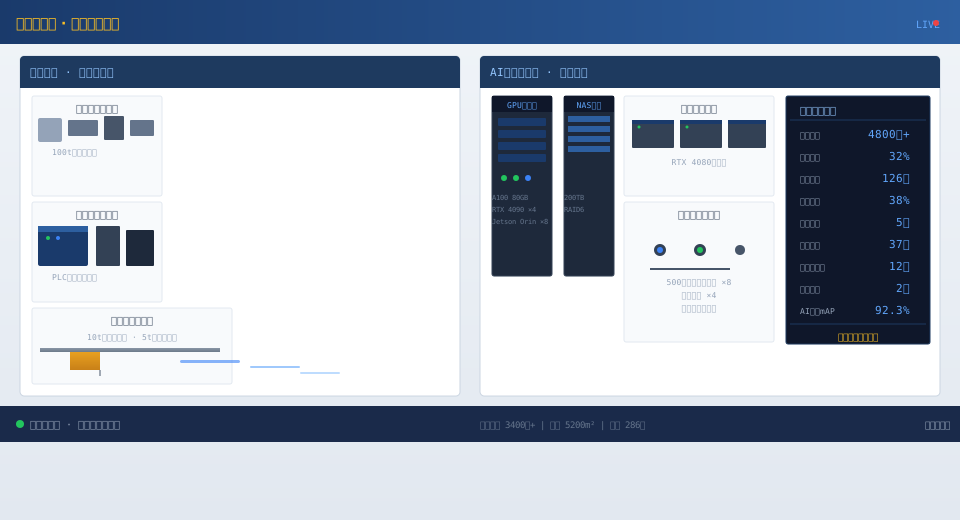
Provincial Enterprise Technology Center certification is a key benchmark for measuring a company's technological innovation capability. The 2026 evaluation cycle focused on six core indicators: R&D investment intensity, original value of R&D instruments and equipment, size and structure of the technology center's personnel, number of intellectual property rights over the past three years, and the share of new product sales in total revenue. Over the past three years, Kelude Heavy Industry has invested more than RMB 48 million in R&D, achieving an average annual growth rate of 32% — approximately 1.5 percentage points above the provincial requirement for R&D investment intensity. The technology center occupies 5,200 m² of floor space and houses 286 sets of R&D and testing equipment with a combined original value exceeding RMB 34 million, spanning four laboratories: electrical testing, structural mechanics analysis, material performance testing, and full-machine integrated commissioning. The R&D team comprises 126 members, 38% of whom hold senior professional titles, forming a multidisciplinary research system centered on mechanical design, electrical automation, and computer vision.
R&D Structure and Core Capabilities
The Kelude Technology Center is organized into four research institutes and one pilot-scale testing base. The Overhead and Gantry Crane Research Institute focuses on structural optimization and work duty classification upgrades for conventional cranes, with particular emphasis on fatigue life assessment of main girders and wind-resistance stability design under long-span, high-hoisting, and heavy-load conditions. To date, the institute has completed finite element analysis and lightweight design for 12 product series. The Intelligent Control Research Institute specializes in electrical control systems including PLC control, variable-frequency speed control, positioning and stopping, and anti-sway control. Its independently developed KRUD-E series intelligent electrical control system has been deployed on more than 150 machines shipped from the factory, achieving a mean time between failures (MTBF) exceeding 8,000 hours. The AI Vision Research Institute, established in 2023, is the technology center's core competitive advantage. It focuses on computer vision applications in crane safety monitoring, load identification, and defect detection, and has produced three invention patent applications and two software copyright registrations. The IoT Platform Research Institute develops and operates the KRUD-IoT remote operation and maintenance platform, which currently connects over 200 machines and collects more than 120,000 data points daily.
R&D Investment and Output
R&D investment figures over the past three years reflect the company's sustained commitment to technological innovation. In 2024, R&D spending reached RMB 15.2 million, accounting for 5.8% of main business revenue; in 2025, it grew to RMB 18.6 million, or 6.2% of revenue; and in the first half of 2026 alone, investment exceeded RMB 11 million, with full-year spending projected to surpass RMB 20 million. This high level of investment has yielded substantial results: over the past three years, the company has been granted 5 invention patents, 37 utility model patents, 8 design patents, and 12 software copyrights. In standardization efforts, Kelude has led or participated in the development and revision of 2 national standards, 4 industry standards, and 3 association standards. Notably, the revised edition of GB/T 28264-2017 Safety Monitoring and Management System for Cranes, to which the company contributed, has incorporated AI visual inspection provisions into its scope. Revenue from new products as a share of total sales rose from 28% in 2023 to 46% in 2025, demonstrating significantly improved technology commercialization efficiency.
Key Research Focus Areas
The technology center's current research efforts are concentrated in four areas. The AI visual safety monitoring system for cranes is the largest investment project. Built on the YOLOv8 deep learning model, it delivers five detection functions: personnel intrusion detection in lifting zones, load attitude recognition, wire rope broken wire detection, main girder weld defect detection, and crane rail anomaly identification. The system achieves a mean average precision (mAP) of 92.3% with single-frame inference latency below 30 ms, and has been validated at 18 customer sites. The intelligent crane control system is another priority, built on Siemens S7-1500 PLCs and G120 frequency inverters to provide full variable-frequency drive (VFD) stepless speed control for the hoisting, trolley, and bridge mechanisms. An in-house developed anti-sway algorithm keeps load swing within ±5 cm, improving operational efficiency by approximately 30% compared to conventional operation. The Digital Twin platform fuses BIM models with real-time operational data to enable fully three-dimensional visual monitoring and predictive fault diagnosis of crane operations. The industrial IoT platform (KRUD-IoT V3.0) features an independently developed data acquisition gateway supporting both OPC UA and MQTT protocols, enabling standardized data interfacing with enterprise management systems such as MES, ERP, and WMS. Integration time has been reduced from an average of 5 working days to under 2 working days.
Industry-University-Research Collaboration
The Kelude Technology Center pursues an open innovation model, maintaining long-term partnerships with multiple universities and research institutions. In 2025, the company established a joint AI Vision Laboratory for overhead cranes with Zhengzhou University, focusing on lightweight object detection algorithms and few-shot learning techniques for industrial scenarios. The first three research projects have completed their initiation and mid-term reviews. In collaboration with Henan University of Science and Technology, four research projects have been conducted on fatigue life assessment of crane metal structures, with results applied to the main girder life prediction model for QZ-type overhead cranes with grab. The company has also participated in the development of two industry standards led by the National Quality Inspection Center for Overhead and Gantry Cranes, incorporating its independently developed AI visual inspection methods into industry-standard technical specifications. Additionally, the technology center has undertaken two Henan Provincial Science and Technology Key Projects and one Xinxiang Municipal Major Science and Technology Special Project, receiving over RMB 2 million in government funding support.
R&D Facilities and Test Capabilities
The technology center is equipped with comprehensive R&D and testing facilities. The Structural Mechanics Laboratory features a 100-ton universal material testing machine, a dynamic signal testing and analysis system, a coordinate measuring machine, and ultrasonic flaw detectors, providing full-spectrum mechanical property testing capabilities including tensile, bending, impact, hardness, and fatigue testing of metallic materials. The Electrical Control Laboratory is equipped with PLC programming and commissioning platforms, frequency inverter test benches, and an EMC electromagnetic compatibility testing platform, supporting program development and simulation commissioning for mainstream PLCs including Siemens S7-1200/1500, Mitsubishi FX series, and Delta Electronics. The AI Vision Laboratory is outfitted with 8 Jetson Orin NX/AGX edge computing development kits, 4 NVIDIA RTX 4090 GPU workstations, 12 sets of industrial cameras and LiDAR sensors, and a self-built industrial defect annotated data management platform with over 300,000 annotated training images. The full-machine integrated commissioning workshop covers 2,800 m² and houses a 10-ton overhead crane test rig and a 5-ton gantry crane test rig, supporting pre-delivery full-machine test runs and coordinated mechanism commissioning for new products. All test procedures are executed in accordance with ISO 4301 (crane design specification) and FEM 1.001 (crane test specification and procedures).
Talent Development and Team Building
The technology center currently employs 126 full-time R&D personnel, including 3 PhD holders and 28 master's degree holders, forming a well-balanced team structure that combines experienced veterans with mid-career professionals and young talent. The core R&D team is organized into six groups: mechanical design (32 members), electrical control (26), AI algorithms (18), software development (24), testing and verification (16), and project management (10). The company invests over RMB 600,000 annually in staff training and organizes participation in no fewer than 15 industry technical exchange conferences and academic forums each year. The technology center operates a project leader responsibility system with performance-based compensation, offering special rewards for teams that achieve major technological breakthroughs or file invention patents. Over the past two years, more than RMB 1.2 million in innovation incentive bonuses have been distributed. Since 2024, four R&D staff members have been promoted to senior engineer, and three have received provincial or municipal science and technology talent honors.
Future Development Roadmap
Following its recognition as a Provincial Enterprise Technology Center, Kelude has set clear technology development goals for the next phase. R&D investment will continue to grow at an annual rate of over 25%, with a target of reaching 8% of core business revenue by 2028. In AI vision, the company plans to complete development of a next-generation visual inspection model based on the Transformer architecture by 2027, targeting a detection accuracy of no less than 96% mAP. In the control domain, Kelude aims to complete development of a crane-specific Servo Drive with fully proprietary intellectual property, reducing reliance on imported brands in core electrical control systems. In the IoT domain, the company plans to complete the KRUD-IoT V4.0 Upgrade, expanding connected equipment to more than 500 units and building a data asset system covering the full lifecycle of equipment. On the talent front, Kelude plans to recruit more than five PhDs within three years and expand the R&D team to 180 members.
FAQ: Enterprise Technology Center Certification
Q: What practical value does the Provincial Enterprise Technology Center certification bring to a company?
A: The certification is jointly organized by the Provincial Development and Reform Commission, the Department of Science and Technology, and other government bodies, serving as an authoritative endorsement of a company's technological innovation capabilities. After receiving the certification, Kelude is eligible for tax incentives including additional deductions for R&D expenses and income tax reductions on technology transfers, as well as priority support in provincial science and technology project applications. More importantly, the certification serves as official recognition of the company's technical strength, providing a direct boost to technical capability scores in bidding evaluations.
Q: How are R&D outcomes from the Technology Center translated into products?
A: The Technology Center operates a pilot testing base where all R&D outcomes must complete small-batch prototyping and field validation before entering mass production. The pilot process consists of three stages: prototype development (1–2 units), internal testing (functional test + environmental testing + reliability testing), and customer field trials (2–3 typical operating conditions). Each stage has defined pass criteria. For example, the AI vision system goes through an average pilot validation cycle of six months from algorithm model prototype to formal product delivery, ensuring stability and reliability under real-world operating conditions.
Q: How do the Enterprise Technology Center and university joint laboratories divide their work?
A: The joint laboratories operate on a model where the company defines the problems and the university provides the solutions. The Enterprise Technology Center is responsible for identifying technical requirements based on real operating conditions, defining application scenarios, and providing field testing environments and validation data. University teams focus on frontier algorithm research and theoretical model development, producing publications and patent applications. A management committee with representatives from both sides meets quarterly to review progress and ensure research directions remain aligned with practical application needs. The few-shot learning algorithm in the overhead crane AI visual safety monitoring system, one of the first incubated projects, is a typical case of this collaboration model.
Q: Does the Enterprise Technology Center meet the requirements for National Enterprise Technology Center certification?
A: The National Enterprise Technology Center certification has higher thresholds: annual core business revenue of no less than RMB 200 million, R&D intensity of no less than 3%, at least 80 Technology Center staff with no less than 30% holding senior professional titles, no fewer than 5 valid invention patents, and participation in the development of no fewer than 2 international or national standards in the past three years. Kelude's Technology Center already meets the hard requirements in terms of R&D personnel (126 staff), invention patents (5), and standard development (2 national standards + 4 industry standards). The remaining gaps are primarily in revenue scale and the original value of R&D equipment, with preparations for the National Enterprise Technology Center application targeted for completion by 2028.
