

Overhead Crane AI Vision with MES Interface
Kelude Releases Enterprise Standard for Overhead Crane AI Vision–MES Data Interfacing, Enabling Plug-and-Play Equipment Management. Inspection data from the overhead crane AI vision system only becomes a true data hub for production scheduling decisions—rather than an isolated alerting tool—when it is efficiently integrated with the manufacturing execution system (MES) and higher-level management platforms.
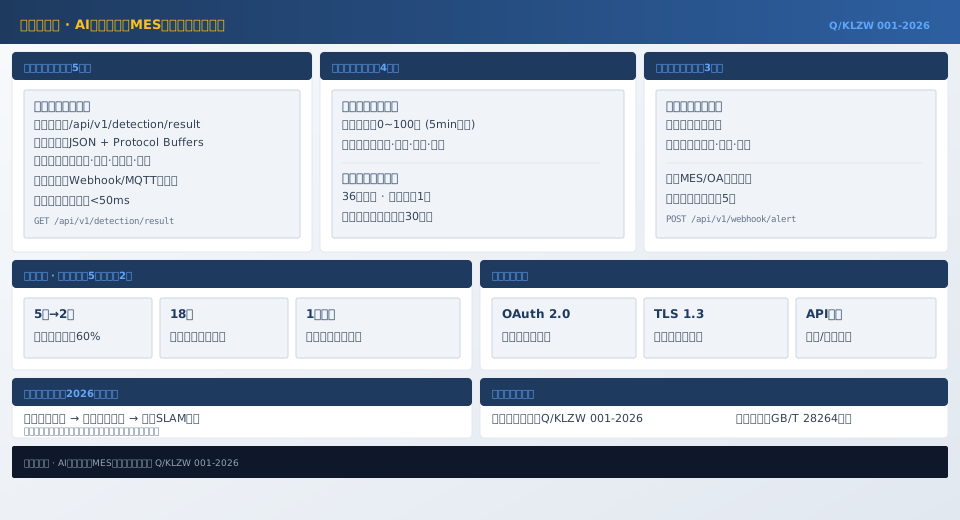
Inspection data generated by the overhead crane AI vision system must be efficiently interfaced with the manufacturing execution system (MES) and upstream management platforms before it can evolve from a standalone alarm tool into a data hub that feeds production scheduling decisions. Kelude Heavy Industry has officially released and implemented its enterprise standard for overhead crane AI vision–MES data interfacing. The standard defines protocol formats, data transmission specifications, and security certification requirements for 12 standardized data interfaces between the AI vision inspection platform and customer MES systems. Since the standard took effect, the average MES integration cycle for new customers has been cut from 5 days to 2 days, delivering a true plug-and-play integration experience.
Why This Standard Was Developed
While opening the overhead crane PHM Predictive Maintenance API and completing data interfacing with 30 MES vendors, we found significant variations in interface specifications across vendors. Every new customer integration required substantial custom development effort. By unifying the interface specification, this standard upgrades AI vision–MES data integration from a one-to-one custom development model to a standard product delivery model.
The 12 Standardized Data Interfaces
The 12 interfaces fall into three categories based on data flow and function. Detection result interfaces include a real-time detection result push interface in JSON format, supporting detection box coordinates, confidence scores, class labels, and timestamps. Equipment status interfaces include an equipment health score interface rated 0–100, computed from multi-dimensional parameter fusion and updated every 5 minutes. Alarm linkage interfaces support real-time alarm event push, allowing the MES to automatically generate maintenance work orders based on alarm grade.
Results and Customer Feedback
Since its implementation, the enterprise standard has been applied to data interfacing for 18 new customers. Before the standard, each new customer integration required approximately 2 working days for pre-sales solution alignment plus about 3 working days for custom development—roughly 5 working days in total. After the standard, customer MES systems are connected and commissioned against the standard interface specification, and in most cases joint commissioning and acceptance can be completed within 1 working day.
FAQ
Q: What is the difference between the enterprise standard and the already-released PHM API?
A: The enterprise standard is the technical specification and implementation guide for the PHM API. The PHM API is the concrete implementation of the standard—it provides RESTful API endpoints that MES systems can call directly, following the interface protocols and data formats defined in the enterprise standard. Think of the enterprise standard as the architectural blueprint and the PHM API as the building constructed from that blueprint. When integrating, MES vendors first consult the enterprise standard to understand the interface specification, then call the PHM API to complete the actual data exchange.
Q: Is the enterprise standard open to other AI vision system vendors in the industry?
A: The enterprise standard is currently an internal standard and is not mandatory for external use. However, we have submitted a recommendation through the National Technical Committee for Standardization of Lifting Appliances to incorporate the interface specification provisions into the GB/T 28264-2017 standard, which is currently under revision. If the interface specification clauses are adopted, it will become an industry-wide standard, driving data interoperability between AI vision systems and MES platforms across the overhead crane industry from fragmented, vendor-specific approaches toward a unified specification.
Q: Do existing customers who have already completed integration need to upgrade to the new standard?
A: Existing customers with completed integrations are not affected by the new standard—their current integration solutions remain fully valid. For customers who wish to migrate, the platform offers a smooth transition path: new and legacy interfaces run in parallel for a 3-month migration window, during which customers can switch over at their convenience without interrupting existing operations. Migration support is provided free of charge by our technical team.
Q: Will the standard be extended to cover data interfaces for more AI vision inspection modules in the future?
A: The current version covers data interfaces for two AI inspection modules already deployed in production: safety monitoring and wire rope inspection. Data interfaces for three additional modules—load positioning, weld inspection, and visual SLAM—are planned for standard extension by the end of 2026. The standard is designed with backward compatibility in mind: new interfaces will not affect the definitions or functionality of existing ones, and MES systems already integrated will not need code changes due to the extension.
