

Kelude Heavy Industry Joins ISO/TC 96 AI Visual Inspection Talks
Kelude joins ISO/TC 96 crane committee discussions on AI visual inspection standards, bringing Chinese technical expertise to the global stage. International standardization of AI visual inspection technology for cranes is currently in the research and discussion phase.
International standardization of AI visual inspection technology for cranes is currently in the research and discussion phase. Kelude Heavy Industry recently participated for the first time as an observer in the ISO/TC 96 crane technical committee's TC 10/SC 2 working group session on AI visual technology applications in crane safety monitoring. At the session, Kelude presented its Technical Solution for an overhead crane AI visual safety monitoring system, along with field application data. The case study—a Chinese overhead crane AI visual safety monitoring system deployed in the steel and metallurgy industry—was cited in the meeting minutes as a representative industrial application example.
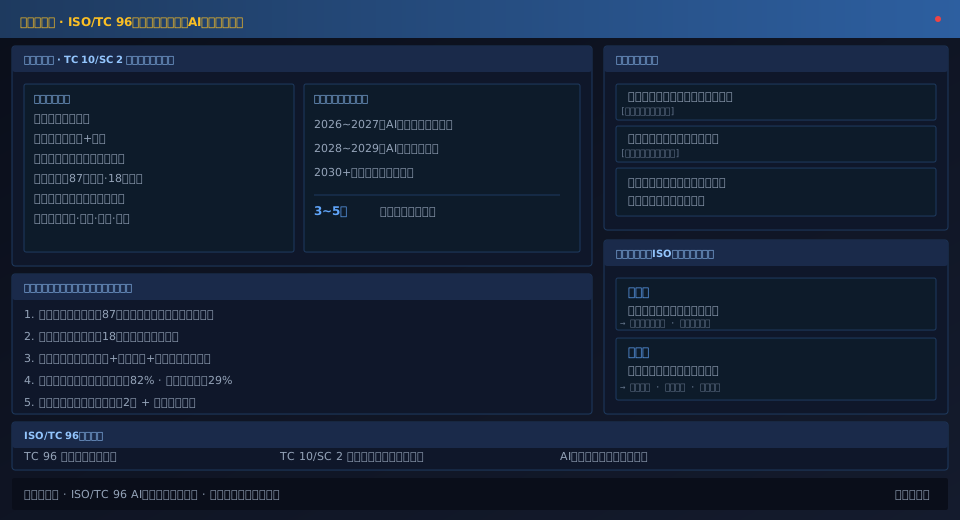
ISO/TC 96 and AI Visual Inspection Standard Development
ISO/TC 96, the technical committee responsible for crane standards within the International Organization for Standardization, oversees ten subcommittees (SC1 through SC10). Standardization work for AI visual technology in the crane sector is currently led by TC 10/SC 2, the subcommittee on crane safety.
Technical Solution Submitted at the Workshop
The Technical Solution submitted at the workshop covers three areas: system architecture overview, key technical indicators, and field application data. The case study presented data from 87 overhead cranes deployed at scale, with continuous operational statistics collected over 18 months—a scale that drew attention from attending experts. International peers' AI visual safety applications for overhead cranes remain at the pilot stage with single or a few units, and no deployment case at the scale of 100 units has been reported.
Roadmap for International Standard Development
At the workshop, delegates from participating countries agreed that AI visual technology for crane safety monitoring has reached the technical maturity required to begin drafting international standards. The plan is to complete a technical report on AI visual technology applications in crane safety monitoring within the next 3 to 5 years, laying the groundwork for a formal international standard.
FAQ
Q: What are the requirements and process for Chinese companies to participate in ISO international standard development?
A: Chinese companies can participate in ISO international standard development through two main channels: being recommended by the National Technical Committee on Standardization of Lifting Appliances to join the Chinese delegation to ISO/TC 96 as technical experts, or applying to attend ISO/TC 96 working group meetings as observers. Observer status allows companies to attend meetings, submit technical files, and voice opinions, but does not include voting rights on standards. The overhead crane AI visual technology team has applied through the National Technical Committee on Standardization of Lifting Appliances to be included on the expert list of the Chinese delegation to ISO/TC 96. If approved before 2027, the team will formally participate in voting.
Q: How do international AI visual inspection standards relate to domestic Chinese standards? Will domestic products need recertification after the standards are adopted?
A: After an international standard is published, it is typically adopted as a domestic standard using either the IDT (identical) or MOD (modified) approach. AI visual inspection systems manufactured by domestic companies that comply with the adopted domestic standard will meet the equivalent requirements of the international standard. Products that have already passed domestic certification or testing generally do not require recertification during the standard transition period.
Q: How competitive is China in the field of crane AI visual technology internationally?
A: China leads internationally in large-scale deployment and engineering applications of crane AI visual technology. However, China still lags behind Europe and the United States in original innovation in core AI visual algorithms, although key technical indicators are close to international advanced levels. Both sides have their strengths, and maintaining exchange and cooperation in standard development is the best path forward for technical standardization.
Q: What specific benefits does participating in international standard workshops bring to a company's export business?
A: Participating in international standard workshops gives companies early insight into the technical direction and requirements trends of international standards, enabling more targeted technical preparation when entering overseas markets. Direct involvement in international standard discussions also helps expand a company's global industry influence, with core target markets primarily in Europe and Southeast Asia. The mechanism for Chinese companies to participate in ISO/TC 96 international standard workshops is coordinated by the Standardization Administration of China, in accordance with the management requirements for international standardization activities outlined in the GB/T 20000 series of standardization guidelines.
