

Overhead Crane AI Visual Inspection Named in MIIT Typical Case List
Overhead Crane AI Visual Inspection Technology Named a Typical Application Case in MIIT's AI–Smart Manufacturing Integration List. The typical application cases selected by China's Ministry of Industry and Information Technology (MIIT) serve as a national-level benchmark for evaluating how deeply AI technology is integrated into smart manufacturing.
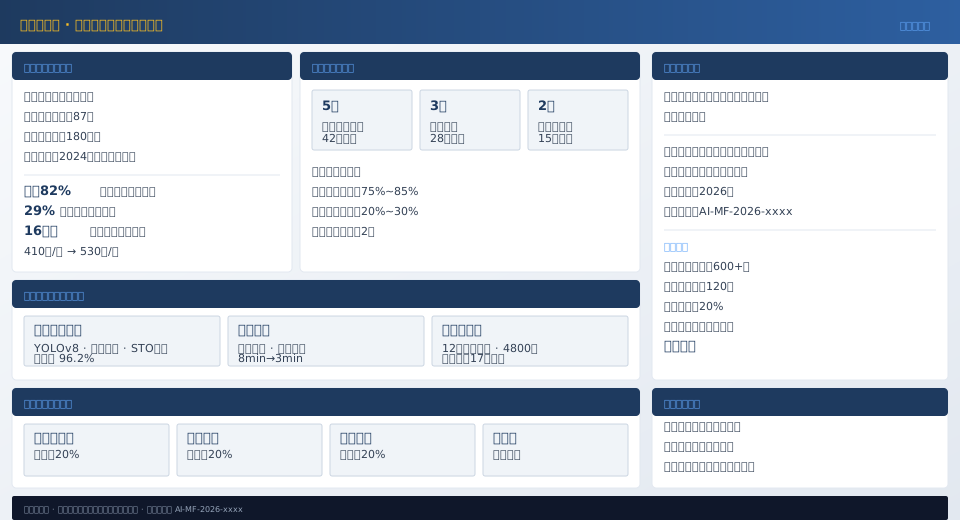
The MIIT's selection of typical application cases for AI-empowered smart manufacturing is a nationally recognized benchmark for assessing the depth of AI integration in the manufacturing sector. The overhead crane AI visual inspection technology has recently been officially included in the MIIT's list of typical application cases for AI-empowered smart manufacturing. Nationwide, more than 600 cases were submitted for this selection, with approximately 120 ultimately chosen — the overhead crane AI visual inspection technology being the only case selected from the lifting appliances industry. This article provides a systematic overview from three perspectives: the case content, the selection process, and the deployment results.
Typical Case: AI Visual Safety Monitoring for Overhead Cranes
The submitted case focuses on the AI visual safety monitoring system for overhead cranes in the steel and metallurgy industry. It covers three core application areas: the personnel intrusion detection system uses the YOLOv8 model to detect ground personnel in the lifting zone in real time, with a three-level alarm linked to the crane's PLC to trigger deceleration or STO stop. At the steel plant where the case was submitted, the detection recall rate for personnel intrusion events reached 96.2%. The load positioning system uses coordinate transformation to achieve precise positioning of steel coils and steel plates, reducing average lifting and positioning time from 8 minutes to 3 minutes. The AI-based online Wire Rope Inspection system was deployed on 12 metallurgical casting cranes at the applicant company, inspecting a cumulative effective length of approximately 4,800 meters and identifying 17 Wire Rope defects in advance.
Selection Process: From Provincial Review to National Recognition
The selection of typical application cases follows a three-stage process: recommendation by provincial industry authorities, expert review, and public announcement. The case passed the initial review and recommendation by the Henan Provincial Department of Industry and Information Technology before advancing to the expert review stage. The expert review panel scored the case quantitatively across four dimensions: technical advancement, application effectiveness, scalability, and innovation.
Deployment Results and Scalability Across Industries
The steel company featured in the selected case is a typical application scenario for the AI visual safety monitoring system. Since 2024, the company has deployed the system in three phases across 87 overhead cranes, with a total investment of approximately $267,000. Post-deployment operational data shows an 82% year-on-year reduction in personnel intrusion-related safety incidents — only 2 cases of personnel entering the danger zone occurred throughout the year, both of which were successfully detected by the AI system and triggered STO stops, resulting in no actual injuries. In terms of lifting efficiency, the average daily number of lifts across the 87 cranes increased from 410 before deployment to 530 after deployment, an improvement of approximately 29%. After the Wire Rope inspection module was deployed on 12 critical cranes, the annual number of Wire Rope replacements dropped from an average of 4.2 to 2.8, directly saving approximately $24,000 in Wire Rope procurement costs.
FAQ
Q: How does being listed in the MIIT typical application cases help with market promotion of overhead crane products?
A: Being included in the MIIT typical application cases list means that the technical advancement and application effectiveness of the overhead crane AI visual inspection technology have been recognized by a national-level authority. In customer-facing marketing, the case list serves as credible third-party validation. Additionally, when companies apply for national or local smart manufacturing-related projects, having a selected case is a significant advantage during project evaluation.
Q: Which indicators in the typical case selection criteria do review experts focus on most?
A: The three indicators experts prioritize most are: the replicability and scalability of the technology, the authenticity of quantified application results, and the reasonableness of the investment-to-return ratio. The AI visual inspection case scored in the top 20% across all three indicators — in terms of scalability, the case has been validated at 19 companies spanning the metallurgy, shipbuilding, and heavy equipment manufacturing industries. Regarding the investment-to-return ratio, the $267,000 investment across 87 overhead cranes generates an estimated annual benefit of approximately $141,000.
Q: Are there any follow-up tracking, evaluation, or supervision requirements after being selected?
A: After selection, companies are required to submit a semi-annual progress report on case application, detailing the replication and promotion status and updated application effectiveness data. The MIIT conducts a dynamic adjustment every two years based on the promotion results. The selection of typical application cases is evaluated in accordance with the assessment dimensions of GB/T 39116-2020, the Smart Manufacturing Capability Maturity Model. Cases demonstrating significant promotion results retain their qualification without re-evaluation.
Q: Has the case been replicated in industries other than steel and metallurgy?
A: Yes, the case has been replicated across three additional industries — in heavy equipment manufacturing, the AI visual safety monitoring system has been deployed at 5 customers on a total of 42 overhead cranes. In shipbuilding, it has been deployed at 3 customers on 28 cranes. In the new energy industry, it has been deployed at 2 customers on 15 cranes. Deployment results across these industries closely match the metallurgy sector's performance, with personnel intrusion incidents down 75%–85% and lifting efficiency up 20%–30%.
