

Kelude Overhead Crane AI Visual Safety Monitoring System
Kelude leads the drafting of a certification technical specification for AI visual safety monitoring systems for overhead cranes, filling a gap in industry certification standards. Before AI visual safety monitoring systems can be brought to market, a unified technical standard is needed to verify that their functionality and performance meet safe use requirements.
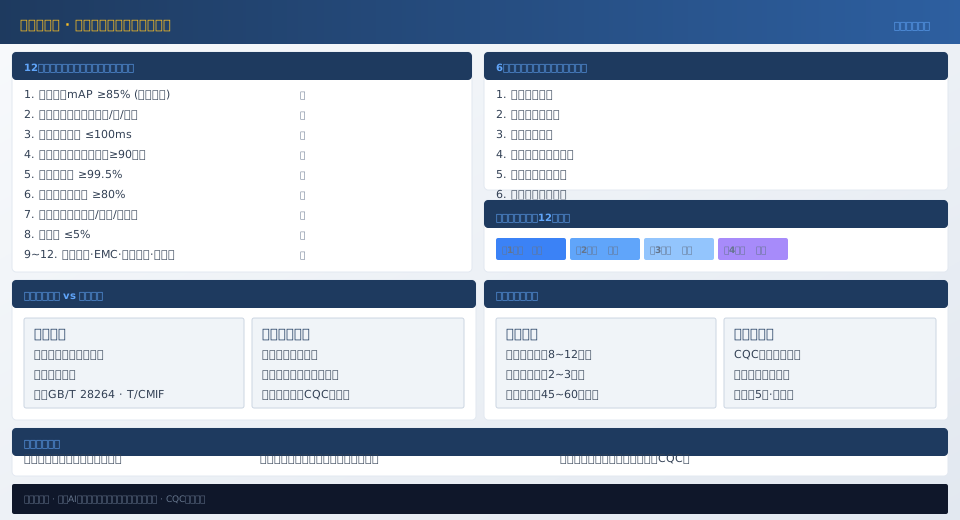
AI visual safety monitoring systems need a unified technical standard to verify that their functionality and performance meet safe use requirements before they can be brought to market. Kelude Heavy Industry recently took the lead in drafting a certification technical specification for AI visual safety monitoring systems for overhead cranes. The specification has passed the project review by the China Quality Certification Center and the standard development work has officially begun. The technical specification will cover five chapters — functional requirements, performance indicators, inspection methods, certification process, and acceptance criteria — comprising 12 mandatory inspection items and 6 optional inspection items.
Background of the Standard Initiative
Existing standards in China, including GB/T 28264-2017 Safety Monitoring and Management System for Lifting Appliances and the T/CMIF 1XX-2025 group standard, already define technical requirements and inspection methods for AI visual safety monitoring systems. However, these standards focus on product design specifications rather than conformity assessment for product certification. The fundamental difference between a certification technical specification and a product technical standard is that the certification specification not only defines "what indicators the product should achieve" but also specifies "how to determine whether the product meets those indicators" and the "acceptance criteria for passing certification."
Core Content of the Technical Specification
The 12 mandatory inspection items include personnel detection mAP, three-level alarm function verification, system response time, data recording integrity, system availability, low-light detection accuracy, anti-interference capability, false alarm rate, hardware Protection Rating (IP), EMC electromagnetic compatibility, communication interface protocol compliance, and completeness of the installation and operating instructions. The 6 optional inspection items include load detection, Wire Rope Inspection, Weld Inspection, multi-crane collaborative detection, remote operation and maintenance platform integration, and Digital Twin data interface functionality.
Standard Development Work Plan
The standard development is planned over a 12-month period and will be carried out in four phases. Once published, the standard will be promoted to the industry through voluntary certification. Manufacturers of AI visual safety monitoring systems for overhead cranes may voluntarily apply for certification. Upon passing certification, they will receive the CQC product certification certificate, and the certification mark may be used on the product itself, in the Operation Manual, and in promotional materials.
FAQ
Q: What is the difference between the certification technical specification and the published group standard T/CMIF 1XX-2025?
A: The two standards serve different purposes — the group standard T/CMIF 1XX-2025 defines the technical requirements the product should meet, while the certification technical specification defines how to determine whether the product meets those requirements. In simple terms, the technical standard answers the question "what should the product be like?" while the certification specification answers "does the product meet the standard's requirements?"
Q: Will the inspection items in the certification specification be frequently updated in response to the rapid iteration of AI vision technology?
A: The certification specification establishes three grades of inspection items. Basic-grade items, such as personnel detection accuracy and system response time, are relatively stable and will not be frequently adjusted due to algorithm iterations. Advanced-grade items, such as false alarm rate and anti-interference capability, are reviewed annually based on industry technology development. Frontier-grade items, such as multi-crane collaborative detection, are optional inspection items only and do not count toward the certification pass determination. This graded design maintains the stability of the certification standard while leaving room for technological advancement.
Q: Will the certification specification affect the factory inspection process for existing overhead crane AI vision products?
A: Implementation of the certification specification will not have a retroactive impact on existing products that have already passed inspection under the T/CMIF 1XX-2025 standard. Products applying for new certification will need to be tested in accordance with the new certification specification. The inspection method clauses in the certification specification can also serve as a reference for optimizing the factory inspection process of existing products.
Q: How much does certification cost and how long does the certification period take?
A: Product certification fees consist of three parts: application fee, product testing fee, and factory inspection fee. The product certification system is implemented in accordance with the Regulations of the People's Republic of China on Certification and Accreditation and GB/T 27065-2018 Conformity Assessment — Requirements for Bodies Certifying Products, Processes and Services. The full testing cost for the 12 mandatory inspection items is approximately $12,000–$18,000, and the factory inspection fee is approximately $3,000–$4,500. The certification period includes four stages — test plan confirmation, sample preparation, test execution, and factory inspection — totaling approximately 45–60 working days.
