

AI Visual Inspection for Overhead Cranes
Kelude and Zhengzhou University launch joint AI visual inspection laboratory for overhead cranes, advancing smart equipment through industry-university-research collaboration. This partnership marks a key step in moving overhead crane intelligence from isolated breakthroughs to a systematic, integrated approach.
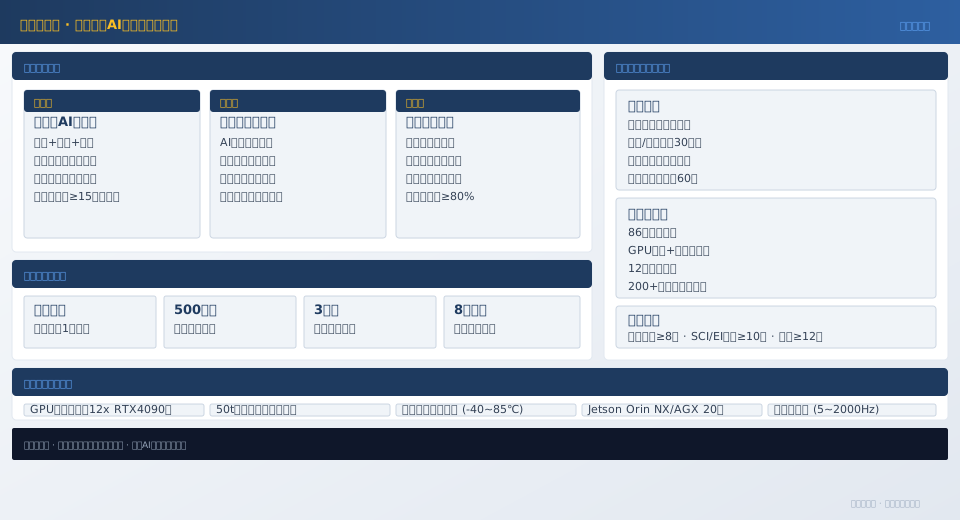
Industry-university-research collaboration is the critical pathway for advancing overhead crane intelligent technology from isolated breakthroughs to systematic progress. Kelude Heavy Industry has recently signed an agreement with the School of Mechanical and Power Engineering at Zhengzhou University to establish a joint laboratory focused on AI visual inspection for overhead cranes. The laboratory will concentrate on three frontier research directions: multimodal AI large models, fully automatic unmanned operation, and Digital Twin-based fatigue life prediction for complete crane systems. Both parties are jointly investing RMB 5 million (approx. $741,500) to equip the laboratory with a GPU computing cluster and structural fatigue Test Benches, among other experimental facilities.
Why This Partnership Matters: Background and Strengths
The School of Mechanical and Power Engineering at Zhengzhou University has a faculty team of over 30 doctoral and master's supervisors specializing in mechanical structural strength analysis, machine vision, and intelligent control. The school enrolls approximately 60 graduate students each year in mechanical engineering and instrumentation science. It also operates two provincial-level research platforms: the Henan Key Laboratory of Intelligent Manufacturing Technology and Equipment, and the Henan Key Discipline of Mechanical Engineering.
Three Core Research Directions
Direction 1: Multimodal AI Large Model for Overhead Cranes. This research focuses on developing a comprehensive crane health assessment model that integrates visual, vibration, and acoustic sensing modalities. The goal is to improve equipment Fault Diagnosis accuracy by leveraging complementary information from multiple data sources. Research scope includes deep learning architectures for multimodal data alignment and fusion, as well as lightweight model deployment solutions tailored for industrial environments.
Direction 2: Fully Automatic Unmanned Operation System for Overhead Cranes. This direction targets full-process unmanned crane control technology, from Lifting and transport command input and Path Planning to precise load positioning. Three sub-projects are planned: AI vision-based environment perception and Positioning, reinforcement learning-based lifting path optimization, and multi-sensor fusion for precise load alignment.
Direction 3: Digital Twin-Based Fatigue Life Prediction for Complete Crane Systems. This research aims to develop online remaining life assessment technology for critical crane structures, based on accumulated operational data and fatigue analysis models. Key work includes establishing baseline fatigue life models for critical structures using the finite element method, and developing data-driven fatigue life prediction models.
Operating Model and Technology Commercialization
The joint laboratory will be co-directed by a professor from Zhengzhou University's School of Mechanical Engineering and the head of Kelude's R&D center. Daily operations will be managed by a committee comprising two researchers from each party, who will jointly make decisions on major matters. The company provides research funding and real-world application scenarios, while the university contributes academic expertise and graduate research talent. Intellectual property from joint research will be shared by both parties. Research outcomes will be prioritized for engineering commercialization within Kelude's AI visual inspection product line for overhead cranes.
FAQ
Q: Will the joint laboratory's research results be made public? Will the company exclusively own all technical outcomes?
A: Research results from the joint laboratory are allocated according to the intellectual property clauses in the cooperation agreement. Academic outcomes such as papers and experimental data may be published in academic journals and conferences with the company's consent. Applied technology results, including algorithm models and system prototypes, are granted exclusive implementation licenses to the company. The agreement includes a pre-publication review period of typically 3 months, allowing the company sufficient time to file patent applications.
Q: Does the joint laboratory accept collaboration applications from other universities or research institutions?
A: Zhengzhou University is currently the primary academic partner of the joint laboratory. However, the laboratory also opens project collaboration channels for universities and research institutes with outstanding strengths in specific technical areas. Project proposals are reviewed twice a year by the management committee, with priority given to topics closely aligned with the laboratory's three core research directions. Collaboration models include commissioned research and joint applications for vertical research funding.
Q: What is the research timeline and what output targets has the joint laboratory set?
A: The initial cooperation period is 3 years. Expected outputs include at least 8 invention patent applications, at least 10 SCI/EI indexed papers, training for at least 12 master's students, and at least one engineering verification prototype for each of the three research directions. The company conducts annual assessments of research progress and output, with results determining the following year's funding allocation. This industry-university-research cooperation model aligns with the standardized approach to collaborative innovation outlined in GB/T 24421-2023, the Chinese national standard for standardization work in service organizations.
Q: What practical value does this industry-university-research collaboration bring to overhead crane customers?
A: The collaboration provides a stable academic research foundation for continuous technology upgrades to our overhead crane products. Basic research outcomes from the joint laboratory can be translated into functional enhancements or new products within Kelude's AI visual inspection system over a 1-2 year engineering commercialization cycle. Additionally, the joint laboratory platform gives customers access to the university's advanced testing equipment—such as scanning electron microscopes and Fatigue test machines—for more in-depth product inspection and analysis services.
