

Kelude Heavy Industry Smart Crane Control System Patented
Kelude Heavy Industry's self-developed crane intelligent control system has been granted a national invention patent, with 100% domestic core algorithm development. The level of autonomy in a crane intelligent control system directly determines equipment safety, controllability, and the ability to pursue future technology upgrades.
The degree of self-reliance in a crane intelligent control system directly determines equipment safety, controllability, and the flexibility to pursue future technology upgrades. Kelude Heavy Industry's self-developed crane intelligent control system has recently been granted a national invention patent titled "A Method and System for Intelligent Path Planning and Anti-sway Control of Bridge Cranes." This system serves as the core control layer for the company's AI-based vision inspection technology, achieving a complete replacement of foreign-brand PLCs with a domestically developed control platform, with 100% of core algorithms developed in-house. This article provides a systematic overview from three perspectives: patented technology, control platform architecture, and the degree of domestic localization.
Core Algorithms Behind the Crane Control Patent
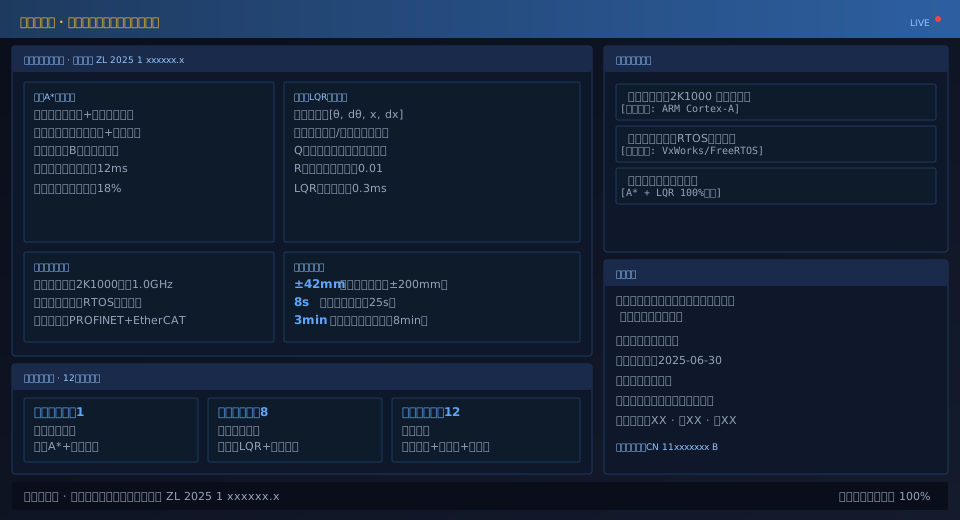
The granted invention patent covers two core algorithms. The optimal path planning algorithm is based on an improved A* search method that operates within the two-degree-of-freedom motion space of the crane bridge (long travel) and trolley (cross travel). The anti-sway control algorithm uses an adaptive Linear Quadratic Regulator (LQR) that dynamically adjusts the weight matrices Q and R in real time based on detected hook swing angle and angular velocity. Working in tandem, the path planning module generates motion commands while the anti-sway module continuously corrects the acceleration/deceleration profiles in real time, keeping load sway within ±50 mm when the crane reaches its target position.
Embedded Control Platform Architecture
The intelligent control algorithms run on a self-developed embedded control platform built around the domestic Loongson 2K1000 dual-core processor running at 1.0 GHz with a 64-bit operating system. The platform comes preloaded with a real-time operating system (RTOS) that guarantees deterministic computation and command output for both path planning and anti-sway algorithms. Communication with frequency inverters (VFDs) and servo drives is handled through dual-protocol industrial Ethernet interfaces supporting PROFINET and EtherCAT, enabling precise motion control of the crane bridge, trolley, and hoisting mechanism.
Domestic Technology Roadmap for Crane Control
The localization of the intelligent control system is implemented across three layers, from hardware to software. At the hardware layer, the core processor uses the domestic Loongson 2K1000, replacing imported ARM Cortex-A series processors. At the operating system layer, a domestic RTOS replaces VxWorks and FreeRTOS. At the algorithm layer, all path planning and anti-sway control algorithms are developed entirely in-house. The system has completed joint commissioning with the crane AI vision inspection system at three customer sites. Operational data shows that in automatic positioning mode, the average hoisting cycle time has been reduced from approximately 8 minutes under manual operation to under 3 minutes.
Frequently Asked Questions
Q: Is the intelligent control system compatible with the existing PLC control system on my overhead crane? Will I need to replace the existing electric control cabinet?
A: The intelligent control system operates as a supervisory control layer that works in parallel with the existing PLC system rather than replacing it. The existing PLC continues to handle safety circuit logic and traditional manual operation modes. The intelligent control system reads status data from the PLC via PROFINET and sends optimized motion commands directly to the frequency inverters. No replacement of the existing electric control cabinet is required — only the addition of the intelligent controller module and corresponding communication wiring. The retrofit typically takes 2–3 working days, including commissioning.
Q: How does the anti-sway performance hold up in real-world crane operation?
A: Field test data from three sites shows that when lifting a 5 t steel coil, the adaptive LQR anti-sway control reduces residual sway after load stop from an average of ±200 mm under manual operation to ±42 mm, while settling time drops from approximately 25 seconds to about 8 seconds. When lifting a 15 t mold, residual sway is ±55 mm with a settling time of roughly 10 seconds. When the AI vision inspection system provides real-time load position feedback, the number of positioning adjustments per cycle drops from 3–5 under manual operation to just 1.
Q: Is the computing power of the domestic Loongson processor sufficient for real-time control requirements?
A: The Loongson 2K1000 dual-core 1.0 GHz processor provides ample computing power for both path planning and anti-sway control algorithms. Measured data shows that the A* path search computation takes 12 ms in a typical scenario with a 30 m crane span. The adaptive LQR state-feedback calculation takes only 0.3 ms per control cycle. Under normal operating conditions, processor load is approximately 35%; under high-load conditions with simultaneous path replanning and control computation, it reaches about 60% — leaving sufficient headroom to meet industrial control stability requirements.
Q: What is the scope of protection and validity period of the invention patent?
A: The scope of protection is defined by the patent claims. This granted patent includes 12 claims: three independent claims covering the path planning method, the anti-sway control method, and the system architecture, plus nine dependent claims. The validity period of an invention patent is 20 years from the filing date. In accordance with GB/T 29490-2013 "Enterprise Intellectual Property Management Specification," which sets requirements for the creation, utilization, and protection of intellectual property, patent filing and maintenance should be integrated into the enterprise's IP management system. Unauthorized use of the patented algorithms and methods constitutes patent infringement.
