
Compressor & Fan Manufacturing Crane Solutions

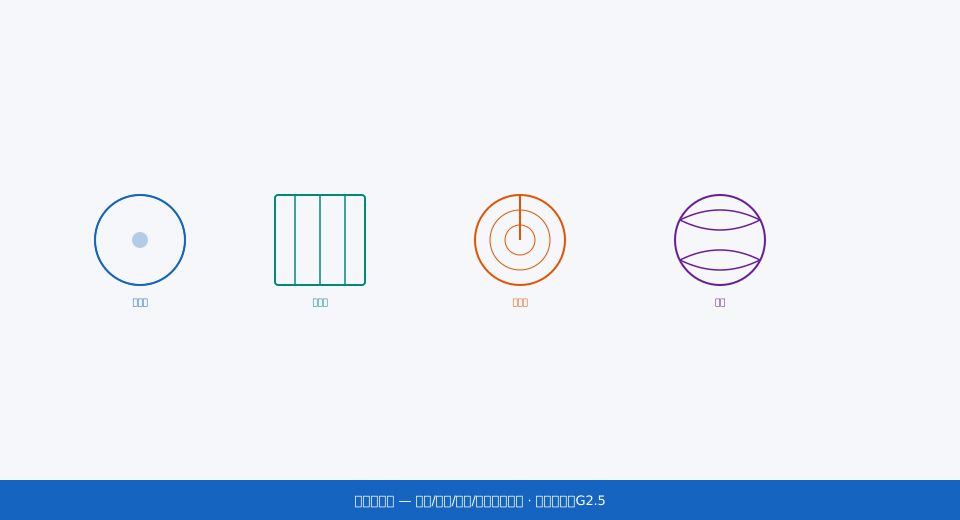
Compressor manufacturing (centrifugal / screw / axial / fan) hinges on precision rotor machining and assembly. Recommended configuration: LD Type overhead crane 5–20t + KBK system 0.5–2t + BZD jib crane 1–3t. Kelude's compressor and fan industry solutions cover the full assembly process for all four product categories.

Industry Solution
Crane Configuration for Compressor & Fan Manufacturing
Assembly solutions for centrifugal, screw, axial compressors and fans
compressorFancraneLive Scene

Centrifugal Compressor Cranes: Precision Assembly of Large Impellers & Casings

Centrifugal compressors (multi-stage centrifugal / gear-driven types) rely on two critical components: the impeller (200–1500 mm diameter, 50–500 kg each) and the casing (horizontally split, comprising the inlet chamber, volute, and diffuser, weighing 1–10 t). The assembly sequence: lower casing is lifted into position → rotor (impeller + shaft + bearings) is installed → upper casing is lowered and bolted down → piping and instrumentation are connected. Rotor installation is the most critical step in the entire process — the rotor, weighing 500–3000 kg, must be lifted from a horizontal orientation and precisely lowered into the bearing housings of the lower casing.

Recommended Model: LD Type overhead crane 10–20t with a dedicated rotor lifting tool (cross-beam design with two adjustable lifting points, each fitted with nylon liners to protect the rotor journals). We recommend variable frequency hoisting (creep speed 0.3–0.5 m/min for rotor seating) plus electronic anti-sway — the rotor must not swing excessively during transport, as any impact against the seal teeth or impeller inside the casing could cause damage.

Price Reference: LD Type overhead crane 16t/20m: approx. $18,000–$33,000 per unit. Kelude's centrifugal compressor assembly solution comes standard with a dedicated rotor lifting tool and anti-sway system.

Screw Compressor Cranes: Precision Rotor Meshing & Alignment

Screw compressors (twin-screw / single-screw) center on a pair of screw rotors (male + female), ranging from 100–600 mm in diameter, 200–1500 mm in length, and 50–1000 kg per set. The rotor surfaces are precision-machined profiles (ground to ≤0.01 mm accuracy) — any impact during lifting will ruin the profile. During assembly, the male and female rotors must be inserted simultaneously from one end of the casing and achieve precise meshing inside (clearance: 0.05–0.2 mm).

Recommended Model: LD Type overhead crane 5–10t + BZD jib crane 1–3t. The LD overhead crane handles cross-station transport of the casing (1–5t) and the complete rotor set (50–1000 kg), while the BZD jib crane covers precise positioning during rotor insertion into the casing. Hoisting must include a creep speed setting (0.2–0.5 m/min).

Price Reference: LD Type overhead crane 5t/15m: approx. $7,500–$15,000 per unit. Kelude's screw compressor solution includes a dedicated rotor protection lifting tool (nylon V-support + anti-impact buffer pads).

Axial Compressor Cranes: Precision Assembly of Long Rotor & Stator Blades

Axial compressors (used in blast furnace blowing, wind tunnels, and aero engine test benches) comprise two critical assemblies: the rotor (drum or disc-type with multiple blade stages, 1–5 m long, 1–15 t) and the stator (casing + vane carrier rings, 2–20 t). The rotor blades can number in the hundreds, each weighing 0.5–20 kg, and must be individually inserted into the blade root slots of the rotor during assembly.

Recommended Model: QD Type double-girder bridge crane 20–50t (for the rotor) / LD Type overhead crane 10–20t (for the stator). Rotor lifting requires a dedicated spreader beam — the rotor is supported at both ends by bearing housings, which connect to the crane hook via the spreader beam, ensuring the rotor stays perfectly horizontal without any inclination during transport.

Price Reference: QD Type double-girder crane 32t/22m: approx. $67,000–$119,000 per unit. Kelude's axial compressor rotor solution comes standard with a rotor spreader beam and precision fine-adjustment mechanism.

Fan Manufacturing Cranes: Handling Thin-Walled Fan Casings Without Deformation

Fans (centrifugal / axial / mixed-flow) feature thin-walled welded casings (3–10 mm plate thickness) that are large in size (1–5 m diameter) but relatively light (200–2000 kg). Fan casings are prone to deformation during manufacturing — if lifting points are poorly chosen, the circular cross-section can distort into an ellipse, creating uneven clearance between the impeller and casing (which compromises fan efficiency).

Recommended Model: LD Type overhead crane 5–10t with a dedicated casing lifting tool (cross-shaped lifting frame — four lifting points evenly spaced around the casing circumference to maintain its circular shape during transport). A KBK system in the fan assembly area handles work-station-level lifting for smaller fans (≤500 kg).

Price Reference: LD Type overhead crane 5t/15m: approx. $7,500–$15,000 per unit. Kelude's fan solution includes a cross-shaped casing anti-deformation lifting frame.

Compressor & Fan Crane Configuration Comparison

← Scroll left / right to view full table →
Equipmentrecommended modeltonnagespecial configurationreference price
CentrifugalLDoverhead type+rotor lifting tool10~20trotor lifting tool/anti-sway control12~2210K
screwLDoverhead type+BZD5~10t+1~3tCreep speed0.2m/min5~1010K
Axial FlowQDDouble Girder+LD20~50t+10~20trotor Spreader Beam45~8010K
FanLDoverhead type+KBK5~10t+0.5~2tcross-shaped lifting frame5~1010K

Key Parameters for Compressor Industry Cranes

Rotor Weight
50–3,000 kg
Compressor rotor range
Impeller Diameter
200–1,500 mm
Centrifugal compressors
Screw Accuracy
≤0.01 mm
Rotor profile tolerance
Mesh Clearance
0.05–0.2 mm
Screw rotor engagement
Lifting Speed
0.2–8 m/min
VFD stepless speed control
Solution Investment
$7,400–$118,600
Depending on equipment type

Kelude Service Advantages for Compressor & Fan Industries

① Dedicated Rotor Lifting Tools: Kelude Heavy Industry offers specialized rotor lifting tools for centrifugal compressors, V-block cradles for screw rotors, axial compressor spreader beams, and cross-shaped lifting frames for fans — every critical compressor/fan component has a purpose-built lifting solution to protect it.

② Precision Creep-Speed Control: The variable-frequency speed control system provides stepless lifting speeds from 0.2 to 8 m/min, with electronic anti-sway keeping residual sway angles at ≤0.5°, meeting the precision assembly requirements of compressor rotors, impellers, and moving blades.

③ Cleanroom Assembly Solutions: Compressor rotor assembly demands high cleanliness levels — Kelude Heavy Industry offers Cleanroom Crane upgrades including stainless steel surfaces, anti-static options, and PFPE lubrication to satisfy the special requirements of oil-free and air separation compressors.

FAQ — Compressor Crane Solutions

Q: Why do compressor rotors require specialized lifting tools?

A: Compressor rotors — especially centrifugal and multi-stage axial rotors — are the most valuable and difficult-to-machine components in a compressor. A rotor consists of a main shaft with multiple stages of impellers or moving blades. The shaft ends are bearing journals (supported on bearing housings during assembly), while the middle section carries the impellers/blades that protrude from the shaft surface and are vulnerable to impact during lifting. Using ordinary wire rope for hoisting poses two risks: ① it can score the shaft surface (bearing journals require a surface roughness of Ra≤0.4 μm — any scratch means rework); ② the rope may slip into the gaps between impellers, damaging the blades. Kelude's rotor lifting tools use a cross-beam, double lifting point configuration, with the lifting points aligned precisely over the bearing journals at both ends of the rotor (never over the impeller zone). The bottom of the lifting tool is fitted with nylon or copper alloy liners — softer than the shaft steel — so no scratches are produced.

Q: How does a spreader beam work for axial compressor rotors?

A: Axial compressor rotors can range from 1 to 5 m in length and weigh between 1 and 15 t. A single-point lift would cause the rotor to tilt because the center of gravity is never perfectly centered — and once tilted, the moving blades at the lower end can strike the floor or nearby equipment. The spreader beam working principle: ① each end of the beam has a support point (V-block or bearing housing) on which the rotor rests horizontally; ② a lifting lug at the beam's center connects to the crane hook; ③ the beam uses counterweights or a screw spindle adjustment mechanism to bring the combined center of gravity of the rotor-plus-beam into vertical alignment with the hook, keeping the rotor level throughout the lift. Kelude's spreader beams feature a manually adjustable screw spindle with ±200 mm of travel, allowing the center of gravity to be repositioned for different rotor lengths in under a minute.

Q: How does a cross-shaped lifting frame prevent fan casing deformation?

A: Fan casings are thin-walled welded structures (3–10 mm plate thickness) that deform easily under radial loads — a two-point lift can pull the circular cross-section into an oval shape, with distortion reaching 5–20 mm. The cross-shaped lifting frame works on this principle: ① four lifting points, one at each end of the cross frame, are spaced evenly around the casing circumference (at 0°/90°/180°/270° positions); ② during lifting, all four points share the load simultaneously, distributing forces uniformly around the circumference so no oval deformation occurs. Kelude's cross-shaped lifting frames feature independently adjustable chain lengths at each lifting point, accommodating casing diameters from 1 to 5 m — eliminating the need for custom frames for each casing size.

Q: What is the return on investment for compressor industry cranes?

A: The return on investment for a compressor-duty crane is realized through multiple channels: reduced rotor rework from eliminated handling damage, faster assembly cycles from precision creep-speed control and anti-sway technology, and lower downtime from reliable, purpose-built components. For compressor manufacturers handling rotors valued at tens of thousands of dollars each, preventing even a single handling incident typically justifies the investment in a specialized lifting system. Additionally, the VFD and electronic anti-sway features reduce operator fatigue and improve positioning accuracy, directly contributing to higher throughput in precision assembly operations.

A: Using a plant with an annual output of 100 centrifugal compressors and 50 screw compressors as an example: ① One LD 16t crane with a rotor lifting tool in the centrifugal compressor assembly area (approx. $26,700); ② One LD 5t crane with two BZD hoists in the screw compressor assembly area (approx. $14,800); ③ One QD 32t crane with a spreader beam in the axial compressor assembly area (approx. $81,600); ④ One LD 5t crane with a cross spreader in the fan assembly area (approx. $11,900). Total investment: approx. $135,000. Benefits: Rotor assembly time reduced by 50% (specialized spreader vs. wire rope slinging); cross spreader cuts casing deformation rework rate by 80%. Payback period: approx. 15–20 months.

Related News

contact

contact us

phone:
+86 13903802779

mail:3915269@qq.com

Working hours: Monday to Friday

Wechat
Wechat
SHARE
TOP