
Overhead Crane Solutions for Boiler & Pressure Vessel Manufacturing
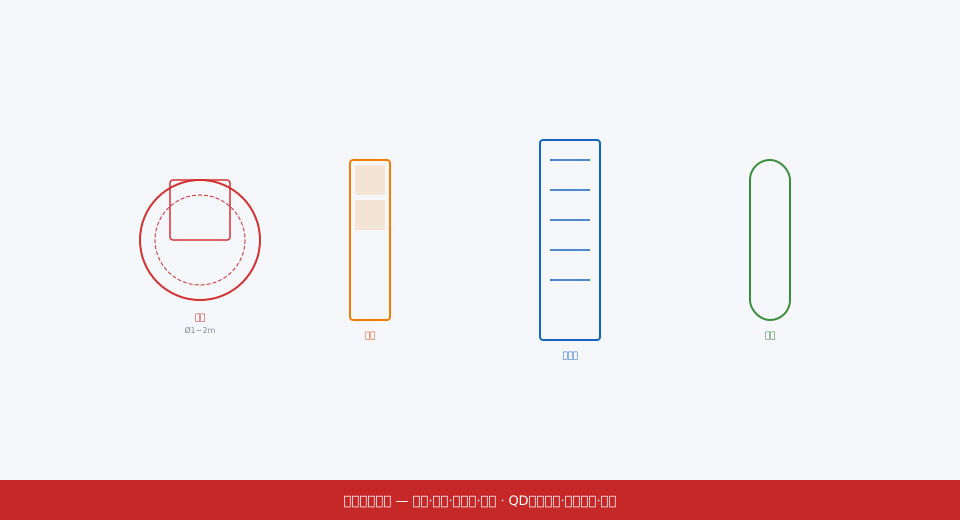
Boiler and pressure vessel manufacturing (drums / headers / water walls / piping) is a hallmark of heavy equipment fabrication. Recommended setup: QD-type double-girder bridge cranes, 20–100 t (for drum plate bending and welding), LD-type overhead cranes, 10–20 t (for headers and piping), and BZD jib cranes, 3–5 t (for station-level auxiliary lifting). Kelude's boiler industry solution covers all four component categories: drums, headers, water walls, and piping.
Drum Manufacturing Cranes: Heavy Plate Bending & Longitudinal/Circumferential Welding
The boiler drum is the core pressure component — typically 1–2 m in diameter, 5–15 m long, with wall thicknesses of 20–100 mm and weights ranging from 10 to 60 t. The manufacturing sequence: steel plate incoming → plate bending (rolling the plate into a cylinder) → longitudinal seam welding → roundness correction → circumferential seam welding (joining multiple shell sections) → nozzle welding → hydrostatic test. For drum plate bending, the heated steel plate (20–100 mm thick) must be lifted into the plate bending machine and then removed after rolling.
Recommended model: QD-type double-girder bridge crane, 32–100 t / span 20–30 m / lifting height 12–18 m. A dual main hook configuration is essential — during plate bending, the two hooks lift both ends of the plate into the bending machine; during tack-up, the two hooks position two shell sections for shaft alignment. The welding area should be equipped with a welding roller stand (motorized turning rolls rotate the drum for welding).
Price reference: QD double-girder 50 t / 24 m span: approx. $66,700–$118,600 per unit. Kelude's boiler industry solution comes standard with dual main hooks, anti-sway control, and variable frequency micro-speed.
Header Manufacturing Cranes: Welding & Handling of Long Tube Banks
Headers (box-type components that distribute or collect the working fluid) typically measure 0.5 m × 0.8 m × 3–8 m, with wall thicknesses of 10–40 mm and weights of 2–15 t. Headers carry a large number of tube stubs (branch connections for the tube banks) — anywhere from dozens to several hundred per header. The critical step in header fabrication is stub welding, which requires moving the header between the welding station and the inspection station.
Recommended model: LD-type overhead crane, 10–20 t / span 18–24 m. For the stub welding area, we recommend a welding positioner (tilting the header through 0–90° so that all stubs remain in the flat welding position).
Price reference: LD overhead crane 16 t / 20 m span: approx. $17,800–$32,600 per unit. Kelude's header manufacturing package (1 LD crane + 2 positioners) totals approximately $29,700–$51,900.
Water Wall Manufacturing Cranes: Assembly Line Handling of Membrane Panels
Water walls (membrane wall panels) are fabricated by welding dozens of steel tubes (Ø30–60 mm) together with flat bar strips. Individual panels range from 1–3 m in width, 5–15 m in length, and weigh 5–20 t. The water wall production line follows an assembly line layout: tube bank tack-up → flat bar welding → tube bending → inspection → packaging. Cranes are required to transfer panels between each station.
Recommended model: LD-type overhead crane, 10–20 t / span 24–36 m (water wall lines are typically long). Equipped with a multi-point lifting beam (4–8 lifting points distributed along the panel length) to prevent bending or deformation during lifting and transport.
Price reference: LD overhead crane 16 t / 28 m span: approx. $23,700–$41,500 per unit. Kelude's water wall package (1 LD crane + multi-point lifting beam) totals approximately $29,700–$51,900.
Piping Manufacturing Cranes: Handling of Raw Steel Pipe & Bent Tubes
Boiler piping systems include main steam lines, reheater tubes, and economizer tubes — typically made of alloy steel (12Cr1MoV/15CrMoG/P91, etc.) in sizes from Ø20–200 mm with wall thicknesses of 3–20 mm. The manufacturing sequence: raw material storage → cutting → bending → welding → inspection. Raw steel pipe comes in 6–12 m lengths (1–5 t per bundle), and after bending the tubes take on irregular shapes (U-bends, W-bends, and complex 3D geometries) that are difficult to handle.
Recommended model: LD-type overhead crane, 5–10 t + KBK flexible suspension, 0.5–2 t. The LD crane handles in-workshop transfer of raw pipe bundles, while the KBK system covers single-tube lifting at the bending stations.
Price reference: LD overhead crane 5 t / 18 m span: approx. $7,400–$14,800 per unit. Kelude's piping manufacturing package totals approximately $11,900–$26,700.
Boiler & Pressure Vessel Crane Configuration Comparison
| Component | recommended model | tonnage/Span | special configuration | reference price |
|---|---|---|---|---|
| Drum | QDDouble Girder Double Hook | 32~100t/20~30m | plate bending machine/welding roller stand | 45~8010,000 |
| Header | LDoverhead type | 10~20t/18~24m | Welding Positioner | 12~2210,000 |
| Water Wall | LDoverhead type+Multi Lifting point | 10~20t/24~36m | Multi Lifting point Cross Beam(4~8Point) | 16~2810,000 |
| pipeline | LDoverhead type+KBK | 5~10t+0.5~2t | Bend Tubespecialized spreader | 8~1810,000 |
Key Parameters for Boiler Industry Cranes
Kelude Service Advantages for Boiler & Pressure Vessel Industry
① Heavy-Duty Crane Line: Kelude manufactures QD double-girder cranes from 32t to 100t (max 250t). Dual main hooks, anti-sway control, and variable frequency micro-speed drive are standard configuration for drum plate bending and drum tack-up operations, with proven performance at multiple boiler manufacturing facilities.
② Heat-Resistant Solutions: Class H insulated motors, heat shields, forced air cooling, and high-temperature grease ensure long-term reliable operation in welding and heating zones (60~80°C ambient temperature).
③ Specialized Lifters: Multi-point lifting beams (for water wall tube panels), welding positioners (for header pipe joints), and C-hooks (for pipe bends) — Kelude provides dedicated lifting spreader solutions for each of the four main boiler component categories.
FAQ — Boiler Industry Crane Applications
Q: Why does drum plate bending require a QD double-girder crane instead of an LD single-girder?
A: Drum plate bending involves lifting steel plates heated to 800~1000°C (20~100mm thick, 2~4m wide, 5~30t) from the heating furnace, feeding them into the plate bending machine, and removing the rolled cylinder. This process demands: ① High load capacity (5~30t) — LD single-girder cranes max out at 20t, so anything heavier requires QD; ② During rolling, one end of the plate is in the bending machine while the other hangs from the hook — the hook must follow the machine's vertical and lateral movement, and the QD's double-girder design provides smoother trolley travel; ③ Limited headroom above the bending machine — the QD's twin-girder configuration allows a more compact electric hoist arrangement. Kelude's recommendation: ≤16t use LD, ≥20t use QD (standard boiler drum solution: 50t QD).
Q: What heat-resistant requirements apply to cranes in boiler manufacturing?
A: Boiler manufacturing involves extensive welding and thermal processing: ① Steel plates heated to 800~1000°C before bending (ambient temperature near furnaces: 60~80°C); ② Preheating to 200~400°C before welding; ③ Post-weld hydrogen removal treatment at 300~400°C. Crane heat-resistance requirements include: ① Class H insulated motors (rated for 180°C) with heat shields; ② Control boxes positioned away from heat sources or equipped with air conditioning/water cooling; ③ High-temperature-resistant wire rope (steel core with graphite lubrication); ④ High-temperature grease for wheel bearings (rated to 200°C). Kelude boiler industry cranes come standard with Class H insulated motors and independent forced air cooling.
Q: Why do water wall tube panels require a multi-point lifting beam?
A: Water wall tube panels (steel tubes welded with flat bars) measure 5~15m long and 1~3m wide — typical thin-wall, long-span components. With two-point lifting (wire rope at both ends), the panel's dead weight causes deflection (sagging in the middle), leading to: ① Additional bending stress at weld seams (potential cracking); ② Deformation that prevents the panel from fitting into the positioning fixture at the next station. A multi-point lifting beam spreader (4~8 lifting points distributed along the length) distributes the load evenly across each point, keeping the panel horizontal and straight during lifting and transport. Kelude's multi-point lifting beam features automatic leveling — each lifting point's chain length is adjusted via a worm gear mechanism to accommodate panels of different lengths.
Q: What is the investment scale for cranes in the boiler and pressure vessel industry?
A: Using a plant producing 200 industrial boilers per year as an example: ① Drum workshop: 1 QD 50t/24m crane (approx. $66,600); ② Header workshop: 1 LD 16t/20m crane + 2 welding positioners (approx. $28,700); ③ Water wall tube workshop: 1 LD 16t/28m crane + multi-lifting-point cross beam (approx. $25,600); ④ Pipeline workshop: 1 LD 5t crane + KBK system (approx. $15,400). Total investment: approx. $136,300. Returns: plate bending efficiency in drum production improved by 40% (QD double hook enables rapid plate change); welding efficiency for header pipe joints improved by 60% (positioners reduce turnover time); rework rate for water wall tube deformation cut from 15% to 2%. Payback period: approximately 18–24 months.